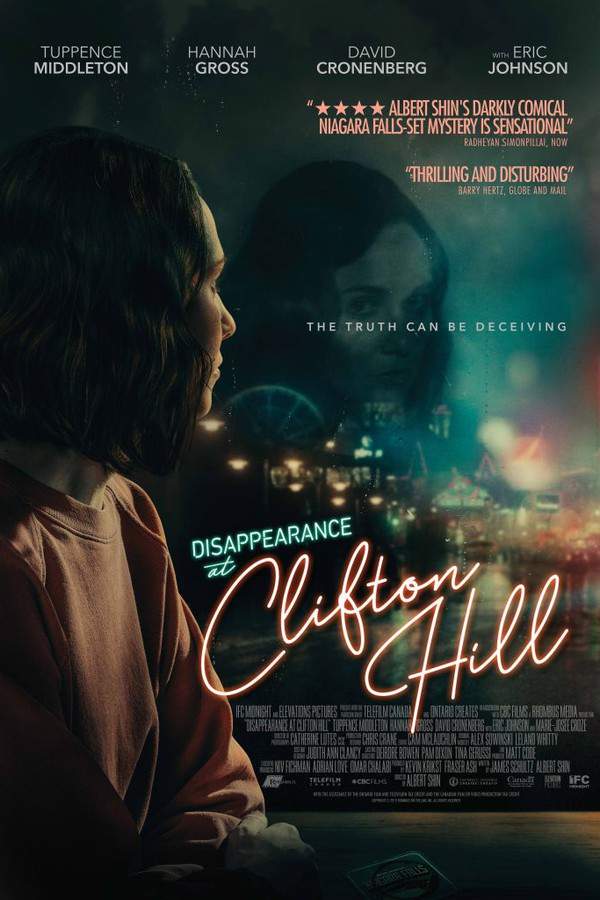
Haunted by her family's past, a young woman returns to Niagara Falls and reopens her family's motel. While investigating a decades-old mystery surrounding a boy's disappearance, she uncovers a dark conspiracy deeply connected to the town’s history. As she digs deeper, she must confront long-buried secrets, unsettling truths, and her own personal demons, all while the majestic falls loom nearby.
Find where to stream, rent, or buy Disappearance at Clifton Hill (2020) in the US with current JustWatch availability, up-to-date pricing, and platform listings for subscription, rental, and digital purchase options.
Warning: spoilers below!
Haven’t seen Disappearance at Clifton Hill yet? This summary contains major spoilers. Bookmark the page, watch the movie, and come back for the full breakdown. If you're ready, scroll on and relive the story!
Read the complete plot breakdown of Disappearance at Clifton Hill (2020), including all key story events, major twists, and the ending explained in detail. Discover what really happened, and what it all means.
As Abby returns to Niagara Falls, her journey becomes a poignant reflection of childhood memories interwoven with the stark realities of her troubled adulthood. Having lived with the burden of being a compulsive liar, she grapples with the deep-rooted pain stemming from a tragic childhood incident where she witnessed the abduction of a young boy, which has forever altered her psyche. This haunting event ignites Abby’s obsession to bring the truth about the “one-eyed boy” to light.
Her homecoming to the Rainbow Motel, a place she inherited from her mother, acts as a pivotal point in her quest for justice. Abby feels a surge of protective instincts as Laure expresses her desire to sell the motel to the affluent Lake family. The thought of letting go of the cozy refuge where her mother once found comfort fills Abby with unease.
Diving deeper into the enigma surrounding Alex Moulin, Abby becomes entangled in a web of conspiracy theories and ambiguous clues. Her pursuit leads her to Walter Bell, a local podcaster who firmly believes that Alex’s death was not a suicide. The Lake family’s sinister history looms over the community, casting shadows of secrecy and suspense.
Driven by her resolve to unveil the truth, Abby manages to sneak into Charlie Lake’s office, where she stumbles upon a photograph of the Magnificent Moulins alongside their animal trainer, Beverly Mole. The menacing threats issued by Charlie spur Abby to retreat to the safety of the Rainbow Motel.
In her next bold move, Abby schemes to ensnare Beverly by appealing to her interests in casinos and providing complimentary lodgings. Gerry, Beverly’s husband, tags along, but as Abby attempts to probe for information, a quarrel at the casino results in Beverly storming off in frustration, leaving Abby disheartened.
Undeterred by her earlier setbacks, Abby daringly travels to America using her sister’s passport, hoping to attend the Magnificent Moulins’ magic show. What she encounters is deeply surreal, propelling her toward a cascade of events leading to her own unravelling. After returning home, a sudden arrest by Canadian authorities forces Abby to confront the repercussions of her relentless pursuit.
Yet, with her spirit unbroken, Abby decides to face the truth directly as she secretly infiltrates Beverly’s home. What she discovers is nothing short of shocking—Gerry, shackled and vulnerable, lies before her. Reluctantly, he reveals the sinister plot orchestrated by him and his wife to kidnap Alex, aiming to blackmail the Moulins for profit. This revelation sparks a swift response from the authorities, who capture Beverly and rescue Gerry, uncovering a trove of damning evidence in the process.
As the narrative unfolds, the case captures media attention, with Gerry’s disclosures sending tremors through the town. Despite being faced with overwhelming evidence, Charlie Lake maintains his innocence regarding Alex’s murder. Meanwhile, the Moulins exploit the media frenzy to portray themselves as innocent victims, while subtly threatening legal actions against potential libel.
Gradually, the town begins to reclaim its normal rhythm, and Abby moves on from her tumultuous experience at the motel. She embarks on a new chapter at a more prestigious venue, but fate brings her face to face with a mysterious guest sporting an eye patch. Though he bears a striking resemblance to Abby, he appears younger, yet his penetrating gaze reveals an unusual depth of insight. When he notices a newspaper featuring Charlie Lake, he cryptically asserts, > “Lake is telling the truth,” before vanishing into his room, leaving Abby to grapple with the implications of his enigmatic words in a stunned silence.
Last updated: November 17, 2024 at 22:13
Explore frequently asked questions about Disappearance at Clifton Hill (2020) with spoiler-rich answers covering the full plot summary, major story beats, character motivations, hidden details, and ending meaning. This movie summary FAQ helps explain confusing scenes, plot twists, and narrative decisions in clear, searchable detail.
Abby's compulsive lying stems from a traumatic childhood incident where she witnessed the abduction of a young boy (the 'one-eyed boy') in Niagara Falls. This traumatic event deeply affected her psyche, causing her to develop lying as a coping mechanism. Her obsession with solving Alex Moulin's death is directly connected to this unresolved trauma, as she desperately seeks to confront and overcome the haunting memories from her past.
Early scenes show Abby's troubled adulthood and hint at her psychological fragility before the full extent of her childhood trauma is revealed.
The one-eyed boy Abby witnessed being abducted as a child remains the central mystery driving her entire investigation. While the film doesn't show the boy's ultimate fate, his disappearance traumatized Abby and fueled her compulsive behavior. Her return to Niagara Falls and her obsessive investigation into Alex Moulin's death are both tied to this unresolved childhood event, which represents the dark secret she has carried since childhood.
Abby's return to Niagara Falls immediately triggers vivid childhood memories, establishing the abduction's importance before her motives become clear.
Alex Moulin's death, originally ruled a suicide, was actually a murder orchestrated by Beverly and Gerry Mole. They kidnapped Alex with the intention of blackmailing the Magnificent Moulins family for money. While the exact circumstances of his death remain somewhat unclear, the film reveals that this wasn't a voluntary suicide but rather a tragic outcome of the kidnapping plot. Charlie Lake maintains his innocence regarding Alex's murder despite the conspiracy surrounding the case.
Walter the podcaster's insistence that Alex's death was not a suicide plants the seeds of doubt early in the investigation.
Beverly and Gerry Mole kidnapped Alex Moulin purely for financial gain. They orchestrated the kidnapping as a scheme to blackmail the wealthy Magnificent Moulins family, who owned the circus where Beverly worked as an animal trainer. The couple hoped to extract money from the Moulins by holding their performer hostage. When Abby infiltrates Beverly's home, she discovers Gerry shackled and learns the full details of this criminal plot.
Abby's discovery of the photograph of the Magnificent Moulins with Beverly in Charlie Lake's office hints at the connection between the performers and the Mole couple.
The mysterious guest with an eye patch who resembles Abby remains deliberately ambiguous. When he notices a newspaper featuring Charlie Lake, he cryptically states 'Lake is telling the truth' before vanishing into his room. This enigmatic figure appears younger than Abby but shares her features, leading to various interpretations. His statement challenges everything Abby (and the audience) believed about the case, suggesting the conspiracy may run deeper than initially revealed or that some truths remain hidden.
The ending deliberately echoes the film's opening trauma, with the one-eyed boy motif returning through the eye-patched stranger.
Abby uses her sister's passport to travel to America because she is determined to attend the Magnificent Moulins' magic show in pursuit of the truth about Alex Moulin. This desperate measure shows how far Abby is willing to go to solve the mystery, even resorting to illegal actions (passport fraud). The journey leads to surreal events that contribute to her psychological unraveling, and upon returning home, she is arrested by Canadian authorities for this transgression.
This desperate act demonstrates Abby's escalating obsession, which has been building since she began her investigation.
The Lake family, particularly Charlie Lake, is connected to the broader conspiracy surrounding Alex Moulin's death. Abby discovers a photograph in Charlie Lake's office showing the Magnificent Moulins with their animal trainer Beverly Mole, suggesting some financial or business relationship between the Lakes and the Moulins. Charlie issues menacing threats to Abby when she gets too close to the truth, and he maintains his innocence regarding Alex's murder even after the Mole plot is exposed. The mysterious guest's final claim that 'Lake is telling the truth' adds another layer of complexity to their involvement.
Charlie Lake's threatening behavior toward Abby signals his deeper involvement in the mystery before the full picture emerges.
Abby is determined to prevent the Rainbow Motel from being sold to the Lake family because it represents her last connection to her mother and her childhood. The motel was gifted to her by her mother and represents a place of comfort and refuge. The thought of losing this cozy sanctuary, especially to the wealthy Lake family who she suspects of sinister dealings, triggers her protective instincts and motivates her to take action. This emotional attachment is intertwined with her larger quest to confront her past.
Abby's strong emotional reaction to Laure's selling plan hints at deeper personal significance attached to the motel beyond just a business concern.
Abby is arrested by Canadian authorities upon returning from America. The arrest is a consequence of her using her sister's passport to travel illegally, a desperate act she committed to attend the Magnificent Moulins' magic show. This legal trouble adds to her mounting troubles and forces her to confront the repercussions of her reckless pursuit of the truth. Despite this setback, Abby's determination remains unbroken, and she continues her investigation through other means.
Abby's use of her sister's passport earlier in the film sets up this inevitable confrontation with the law.
Still wondering what the ending of Disappearance at Clifton Hill (2020) really means? Here’s a spoiler-heavy breakdown of the final scene, major twists, and the deeper themes that shape the film’s conclusion.
The ending of Disappearance at Clifton Hill is intentionally surreal and open to interpretation, but it ultimately reveals a deeper commentary on the nature of truth and sensationalism. Throughout the film, Abby has been portrayed as an unreliable narrator, a woman haunted by her childhood trauma and prone to lying. As she investigates the mysterious disappearance of the boy she saw in her youth, the story seems to unravel into a tangled web of lies, conspiracy, and illusion.
In the climax, Abby uncovers evidence suggesting that the boy, Alex, was murdered because he threatened to expose a corrupt and abusive local family, the Lakes. The key revelation is that Alex did not die by suicide, as previously believed, but was instead murdered by the Moulins and their accomplices, who wanted to hide their involvement. Gerry confesses that he and his wife threw Alex off the cliff, confirming his murder. However, later evidence and a mysterious visitor challenge this story—specifically, a man with an eye patch who arrives at the motel and claims that Charles III, the powerful patriarch, actually saved Alex rather than harmed him.
This revelation raises the possibility that Alex survived the fall and that the whole conspiracy was based on false accusations and manipulated memories. The film suggests that Charles III may have rescued Alex from the Moulins, possibly using his influence and wealth to keep him hidden. The notion that Charles III is innocent, in stark contrast to earlier suspicions, shifts the narrative into ambiguity. The man with the eye patch hints that Alex’s survival is real and that he has returned to clear his name or perhaps to testify.
The final scene is particularly unsettling. As Abby looks at herself in the mirror and smiles, it indicates she might find some dark satisfaction in the chaos she’s created. She could be reveling in the fact that she has helped perpetuate a web of lies and that her story—regardless of its truth—has gained power. The ending suggests that Abby’s obsession with sensational stories and her own unreliability have led her into a dangerous game of deception. Instead of concluding with a clear resolution, the film leaves viewers questioning the truth of what happened, emphasizing how voyeurism and a desire for sensational crime stories can distort reality.
In essence, the ending of Disappearance at Clifton Hill is a commentary on the ways society idolizes sensational crime narratives without understanding their complexities. It underscores how storytelling can be manipulated, how people are often more attracted to shocking twists than to genuine truth, and how this obsession can lead to chaos. The movie hints that Abby, much like the audience, is complicit in this voyeurism—finding enjoyment in chaos even when it hides deeper, unresolved ambiguities about innocence, guilt, and the true nature of the events. The ending leaves us with unsettling questions: Was Alex truly murdered? Did Charles III have anything to do with his fate? Or did survival and rescue play a hidden role? Ultimately, the film reminds us that reality is often much stranger and more ambiguous than the stories we tell ourselves.
Last updated: June 25, 2025 at 09:01
Discover curated groups of movies connected by mood, themes, and story style. Browse collections built around emotion, atmosphere, and narrative focus to easily find films that match what you feel like watching right now.
Compulsive protagonists unraveling mysteries that are deeply personal and dangerous.If you liked the obsessive quest for truth in Disappearance at Clifton Hill, you'll appreciate these movies. This list features similar mystery and thriller stories where a protagonist's fixation on solving a dark secret leads them down a perilous path, blurring the lines between investigation and obsession.
The narrative typically centers on a protagonist, often psychologically fragile or unreliable, who becomes single-mindedly focused on solving a mystery from their past. Their investigation forces them to confront buried secrets and personal demons, escalating the danger and tension as they get closer to an unsettling truth.
These films are grouped by their shared focus on a deeply personal and obsessive investigation, creating a specific type of psychological tension. The viewer experiences the story through the protagonist's increasingly paranoid and unreliable perspective, making the mystery feel intimate and threatening.
Uncovering the dark truths and systemic corruption hidden beneath a town's quiet surface.For viewers who enjoyed the small-town corruption and buried secrets in Disappearance at Clifton Hill, this category highlights similar movies. Discover other mystery and drama films where the idyllic facade of a community cracks open to expose a dark conspiracy that goes back decades.
The narrative pattern involves a protagonist, often someone with a connection to the town, challenging the established order by investigating a past incident. They face resistance from the community, uncovering a web of lies and corruption that suggests the town's identity is built upon a hidden, dark foundation.
These movies share a specific atmosphere where the setting itself becomes a character—a place of hidden malevolence. The collective secret and the protagonist's isolation create a unique blend of mystery, dread, and social commentary, making the discovery process feel claustrophobic and inevitable.
Don't stop at just watching - explore Disappearance at Clifton Hill in full detail. From the complete plot summary and scene-by-scene timeline to character breakdowns, thematic analysis, and a deep dive into the ending - every page helps you truly understand what Disappearance at Clifton Hill is all about. Plus, discover what's next after the movie.
Track the full timeline of Disappearance at Clifton Hill with every major event arranged chronologically. Perfect for decoding non-linear storytelling, flashbacks, or parallel narratives with a clear scene-by-scene breakdown.
Discover the characters, locations, and core themes that shape Disappearance at Clifton Hill. Get insights into symbolic elements, setting significance, and deeper narrative meaning - ideal for thematic analysis and movie breakdowns.
What really happened at the end of Disappearance at Clifton Hill? This detailed ending explained page breaks down final scenes, hidden clues, and alternate interpretations with expert analysis and viewer theories.