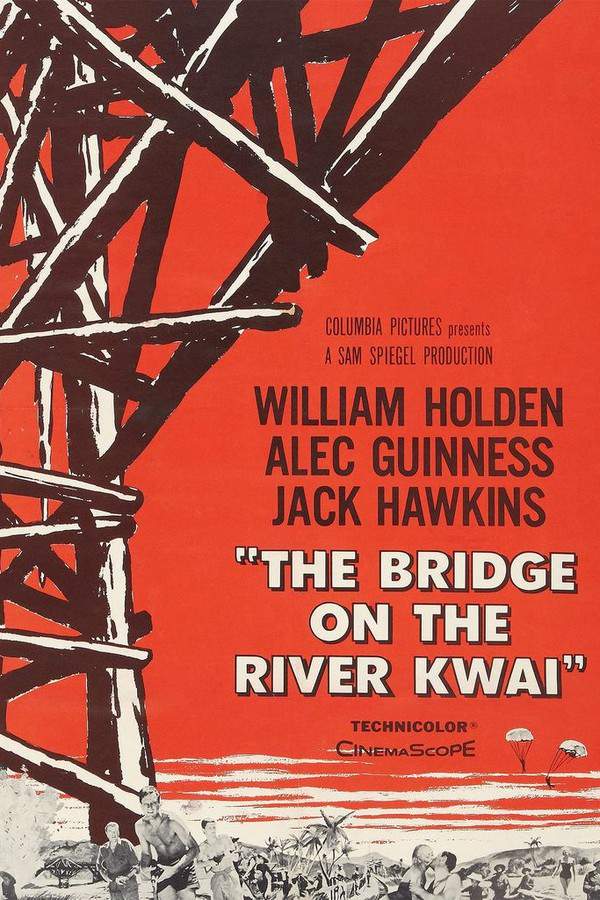
The Bridge on the River Kwai

The Bridge on the River Kwai

JustWatch#814127

Year: 1957

Runtime: 161 min

Language: English

Director: David Lean

Budget: $3M

AdventureDramaWar

During World War II, Allied prisoners of war are forced by their Japanese captors to build a bridge across the River Kwai in Burma. A British colonel, obsessed with maintaining discipline and completing the project as a testament to British engineering, clashes with American officers who plot to sabotage the structure. The conflict escalates into a tense battle of wills with far-reaching consequences for both sides.

Where to Watch The Bridge on the River Kwai?

Find where to stream, rent, or buy The Bridge on the River Kwai (1957) in the US with current JustWatch availability, up-to-date pricing, and platform listings for subscription, rental, and digital purchase options.

Warning: spoilers below!

Haven’t seen The Bridge on the River Kwai yet? This summary contains major spoilers. Bookmark the page, watch the movie, and come back for the full breakdown. If you're ready, scroll on and relive the story!

Timeline – The Bridge on the River Kwai (1957)

Trace every key event in The Bridge on the River Kwai (1957) with our detailed, chronological timeline. Perfect for unpacking nonlinear stories, spotting hidden connections, and understanding how each scene builds toward the film’s climax. Whether you're revisiting or decoding for the first time, this timeline gives you the full picture.

1

Burial of a Prisoner

Two prisoners of war are tasked with burying a corpse in a Japanese prison camp graveyard in southern Burma. This moment sets the tone for the grim circumstances that surround them.

Japanese Prison Camp, Burma
2

Arrival of British Prisoners

A new group of British prisoners arrives, marching to the tune of Colonel Bogey March. Colonel Nicholson emphasizes strict obedience to orders, highlighting the transition of power within the camp.

Japanese Prison Camp, Burma
3

Commander's Demands

Colonel Saito adamantly requires all prisoners, including officers, to work on building a bridge over the Kwai River. This demand leads to rising tensions between Saito and Nicholson, who insists on rank-based exemption.

Japanese Prison Camp, Burma
4

Escalation of Tensions

As Saito threatens officers with execution for disobedience, Nicholson and Major Clipton intervene. Clipton warns Saito of the repercussions of harming officers, which leads to a reluctant compromise.

Japanese Prison Camp, Burma
5

Nicholson's Brutality

Nicholson suffers further abuse at the hands of Saito, culminating in his beating and solitary confinement. This brutal treatment highlights the harsh realities faced by the captives.

Japanese Prison Camp, Burma
6

Saito's Pressure

Under pressure to finish the bridge, Saito faces the threat of dishonor and potential seppuku. He reluctantly offers Nicholson an amnesty, allowing British officers to avoid labor temporarily.

Japanese Prison Camp, Burma
7

Nicholson's Determination

With newfound freedom granted by Saito, Nicholson surveys the chaotic construction site. He motivates his men to improve plans for the bridge, hoping to demonstrate British ingenuity.

Kwai River, Burma
8

Shears' Escape Attempt

Shears and two fellow prisoners attempt a daring escape. Tragically, two are killed, but Shears manages to survive and is rescued by locals after being swept downstream.

Kwai River, Burma
9

Shears is Recruited

In a British hospital, Major Warden approaches Shears, seeking his local knowledge for a mission to sabotage the Kwai bridge. Shears reveals his true identity as a mere enlisted man, complicating his decision.

British Hospital, Colombo, Sri Lanka
10

Plans for a New Bridge

Back at the camp, Nicholson successfully persuades the Japanese to change the bridge's location. He immerses himself in the construction, directing his men vigorously.

Kwai River, Burma
11

Commando Operation

The commandos parachute into the area, but one officer is tragically injured due to a malfunction. They must then evade a Japanese patrol, increasing the stakes of their operation.

Near Kwai River
12

Explosive Ambush

Shears and Joyce wire explosives beneath the newly constructed bridge during the celebratory completion. As the Japanese train prepares to cross, hidden plans begin to unfold ominously.

Kwai River Bridge
13

The Bridge Explodes

As Nicholson proudly inspects the bridge, the explosives detonate, sending the train and its passengers into the river. This act marks a tragic turn in the story, intertwining sacrifice with chaos.

Kwai River
14

Aftermath of the Explosion

In the aftermath, Warden grapples with feelings of guilt over the destruction, while Major Clipton watches in horror. They come to terms with the devastating consequences of war and their decisions.

Kwai River

Last updated: November 07, 2024 at 22:50

Was this helpful?

The Bridge on the River Kwai (1957) Timeline Questions Answered – Chronology FAQ

Find frequently asked questions about the The Bridge on the River Kwai (1957) timeline, including chronological order, nonlinear jumps, cause-and-effect links, and scene sequence clarifications. This timeline FAQ helps explain when key events happen, how moments connect, and why the story unfolds in that specific order.

Q1

Why does Colonel Nicholson agree to help build the bridge?

A.

Colonel Nicholson becomes obsessed with building the bridge as a way to maintain discipline and prove British engineering superiority over their Japanese captors. After being freed from confinement and witnessing the chaotic construction site, he seizes control of the project, believing that completing a高质量 bridge would demonstrate British capability and boost prisoner morale. His obsession stems from a distorted sense of duty, he sees compliance and excellence as ways to assert British identity even in captivity.

Nicholson's earlier insistence that prisoners must obey orders foreshadows his later willingness to lead the bridge construction.

colonel nicholsonbridge constructionprisoners of warbritish superioritydiscipline
Q2

Why does Nicholson change his mind about officers working?

A.

After being beaten and released from solitary confinement, Nicholson undergoes a transformation. When Saito grants him an amnesty to celebrate a Japanese victory, Nicholson surveys the disorganized construction site and realizes he can use this opportunity to prove British ingenuity. He switches from defending officer exemptions to actively directing the bridge construction, even allowing junior officers to work alongside the men, a complete reversal of his earlier stance about rank-based labor exemptions.

His initial rigid adherence to the Geneva Conventions prefigures his later flexible interpretation of duty.

officer laborgeneva conventionsnicholson reversalbridge project
Q3

Why does the bridge need to be destroyed?

A.

The bridge represents a strategic asset for the Japanese military, it would enable troop and supply movements along the railway connecting Burma. Major Warden's British Special Forces mission is to demolish the bridge to disrupt Japanese logistics. The commandos plant explosives beneath the structure to destroy it before the first Japanese train can cross, serving a critical military objective despite the personal cost.

Warden's recruitment of Shears for his local knowledge sets up the sabotage mission.

bridge destructionsabotagemilitary objectivecommando missionexplosives
Q4

What causes Nicholson to say 'What have I done?' during the explosion?

A.

When Nicholson discovers the explosives wired beneath the bridge he helped build, he experiences a devastating moment of clarity. He realizes he has been aiding the enemy by constructing a strategic military asset for the Japanese. His obsessive pursuit of British pride and discipline blinded him to the fact that he was helping the enemy war effort. The explosion of the bridge, triggered by his own actions in guiding its construction, represents the tragic collapse of his misguided sense of duty.

His sudden shift from POW resilience to bridge-builder enthusiasm hints at his disconnection from the larger conflict.

nicholson realizationbridge explosionself-awarenessguiltmilitary betrayal
Q5

Why does Shears lie about being a Navy Commander?

A.

Shears assumes the identity of a deceased officer to secure better treatment in the Japanese POW camp. Enlisted personnel faced the harshest labor conditions, while officers received more favorable treatment. When Major Warden later recruits him for the sabotage mission, Shears confesses to being an enlisted man but agrees to accept a simulated rank to participate in the operation. His deception reflects his survival instinct in the brutal camp environment.

His strategy of bribing guards for sick duty shows his pragmatic approach to survival.

shears deceptionnavy commanderprisoner identitysurvival
Q6

Why does Warden kill the Japanese soldiers who surrendered?

A.

During the confrontation at the bridge, Warden shoots Japanese soldiers who have surrendered or are caught in the crossfire. He justifies his actions by saying, "I had to do it! They might have been taken alive! It was the only thing to do!" This moment highlights the moral ambiguity of war, Warden prioritizes completing the mission and preventing the enemy from potentially capturing the commandos, even though it means executing surrendering soldiers.

The escalating violence throughout the film builds to this morally compromising moment.

wardenkill prisonersjustificationmissionmoral ambiguity
Q7

Why does Colonel Saito give Nicholson amnesty?

A.

Saito faces extreme pressure to complete the bridge on time. If he fails, he will face dishonor and forced seppuku (ritual suicide). Reluctantly, he grants Nicholson an amnesty during what was meant to commemorate a Japanese victory, allowing British officers to avoid manual labor. Saito hopes that by giving Nicholson freedom to organize the construction, the bridge might actually be completed in time, saving Saito from disgrace.

Saito's earlier threats of execution reveal his desperation to maintain control.

colonel saitoamnestybridge deadlineseppukudishonor
Q8

Why does the train explode when crossing the bridge?

A.

Shears and Joyce have planted explosives beneath the bridge in preparation for the sabotage mission. When the Japanese train begins crossing, the explosives detonate, causing the bridge to collapse and sending the train plunging into the river below. The explosion occurs as Nicholson inspects the bridge, transforming his moment of pride into tragic realization. The timing is deliberately set to destroy both the bridge and the enemy transport.

The commandos' nighttime work wiring the explosives sets up this climactic moment.

train explosionbridge collapsesabotagecommando operationjapanese soldiers
Q9

What happens to Shears during the escape attempt?

A.

Shears and two fellow prisoners attempt to escape the camp, but two are killed during the pursuit. Shears is shot and swept away by the Kwai River, where he eventually reaches a Siamese village. Local villagers nurse him back to health. He later ends up in a British hospital in Colombo, Sri Lanka, where he is recruited by Major Warden for the sabotage mission.

His survival and local knowledge become essential for the later commando operation.

shears escapeshotriversiamese villagehospital
Q10

Why is the Colonel Bogey March significant in the movie?

A.

The Colonel Bogey March is a British military tune that the prisoners whistle as they march into the camp. This moment establishes the proud, defiant spirit of the British POWs despite their captivity. The melody recurs throughout the film, symbolizing British resilience and morale. It also contrasts sharply with the Japanese presence, representing cultural resistance even in the most dire circumstances.

The marching theme returns during the bridge construction sequences.

colonel bogey marchbritish prisonersmilitary tunewhistlingcultural resistance
Mobile App Preview

Coming soon on iOS and Android

The Plot Explained Mobile App

From blockbusters to hidden gems - dive into movie stories anytime, anywhere. Save your favorites, discover plots faster, and never miss a twist again.

Sign up to be the first to know when we launch. Your email stays private, always.

Explore Movie Threads

Discover curated groups of movies connected by mood, themes, and story style. Browse collections built around emotion, atmosphere, and narrative focus to easily find films that match what you feel like watching right now.

Movies with Obsessive Heroes Like The Bridge on the River Kwai

Stories where a character's greatest strength becomes their fatal weakness.Explore movies like The Bridge on the River Kwai, featuring protagonists whose rigid principles or obsessive pursuits lead to tragic consequences. If you were captivated by Colonel Nicholson's fatal dedication, you'll find similar stories of pride, duty, and moral collapse in these gripping character-driven dramas.

obsessivetragicsolemnpridefultensemoral conflictcharacter studyfutility

Narrative Summary

The narrative typically follows a brilliant or principled individual whose defining trait—be it pride, genius, or a sense of duty—is pushed to an extreme. As they pursue their goal with unwavering determination, they alienate allies, compromise their morals, and ultimately achieve a pyrrhic victory or face a shattering defeat that highlights the folly of their obsession.

Why These Movies?

These films are grouped by their shared focus on a deeply flawed, yet compelling, central character. They explore the fine line between dedication and madness, often set against high-stakes backdrops, and deliver a heavy emotional impact through the protagonist's tragic arc and the collateral damage of their actions.

Claustrophobic Confrontation Movies Like The Bridge on the River Kwai

Intense battles of will within confined, oppressive settings.Discover movies similar to The Bridge on the River Kwai that explore intense psychological battles in confined spaces. If you enjoyed the tense duel between Nicholson and Saito, you'll appreciate these stories of wills colliding under pressure, set in prisons, submarines, or isolated outposts.

claustrophobictenseoppressivepower strugglepsychological duelconfinedgrimhigh stakes

Narrative Summary

The plot revolves around a central, escalating conflict between two or more strong-willed characters who are forced into close quarters. The confined setting amplifies every interaction, turning dialogues into battles and silence into threats. The story methodically explores the dynamics of power, discipline, and survival, often leading to an explosive resolution that changes everyone involved.

Why These Movies?

These movies share a specific atmospheric and structural similarity: they generate high tension not from large-scale action, but from the intimate, relentless psychological warfare between characters in a contained world. The experience is defined by a feeling of grim inevitability and the high emotional weight of the conflict.

Unlock the Full Story of The Bridge on the River Kwai

Don't stop at just watching - explore The Bridge on the River Kwai in full detail. From the complete plot summary and scene-by-scene timeline to character breakdowns, thematic analysis, and a deep dive into the ending - every page helps you truly understand what The Bridge on the River Kwai is all about. Plus, discover what's next after the movie.

The Bridge on the River Kwai Summary

Read a complete plot summary of The Bridge on the River Kwai, including all key story points, character arcs, and turning points. This in-depth recap is ideal for understanding the narrative structure or reviewing what happened in the movie.

The Bridge on the River Kwai Summary

Characters, Settings & Themes in The Bridge on the River Kwai

Discover the characters, locations, and core themes that shape The Bridge on the River Kwai. Get insights into symbolic elements, setting significance, and deeper narrative meaning - ideal for thematic analysis and movie breakdowns.

Characters, Settings & Themes in The Bridge on the River Kwai

The Bridge on the River Kwai Spoiler-Free Summary

Get a quick, spoiler-free overview of The Bridge on the River Kwai that covers the main plot points and key details without revealing any major twists or spoilers. Perfect for those who want to know what to expect before diving in.

The Bridge on the River Kwai Spoiler-Free Summary

More About The Bridge on the River Kwai

Visit What's After the Movie to explore more about The Bridge on the River Kwai: box office results, cast and crew info, production details, post-credit scenes, and external links - all in one place for movie fans and researchers.

More About The Bridge on the River Kwai

Similar Movies to The Bridge on the River Kwai

Discover movies like The Bridge on the River Kwai that share similar genres, themes, and storytelling elements. Whether you’re drawn to the atmosphere, character arcs, or plot structure, these curated recommendations will help you explore more films you’ll love.