Plot Explained Spoilers guaranteed!
Plot Explained

Browse by genre

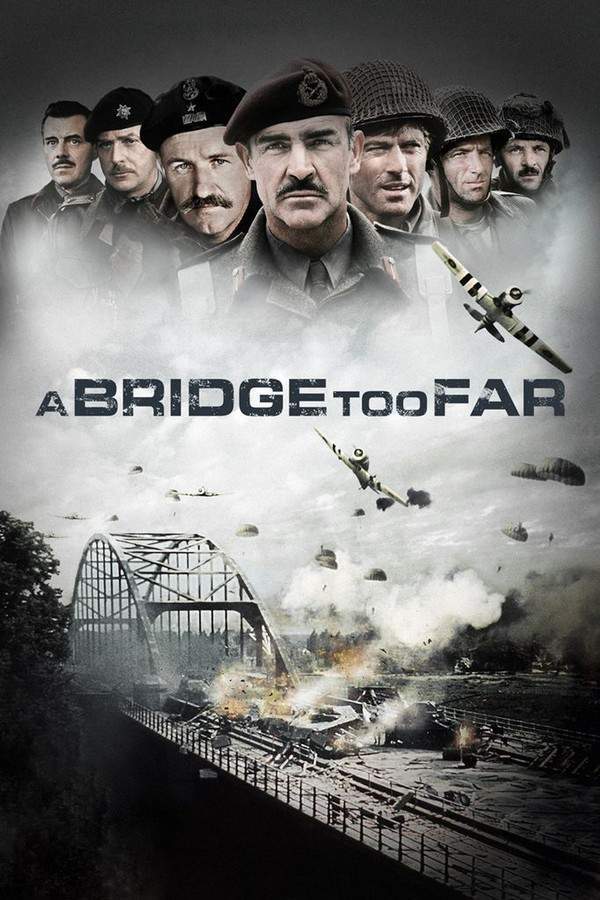
A Bridge Too Far (1977) movie poster

Plot Summary

A Bridge Too Far (1977) Plot Summary Explained

Release, runtime and language
1977 · 175 min · English
Loading streaming availability…
Directed by
Richard Attenborough
Starring
Sean Connery, Erik van 't Wout, Hans von Borsody, Josephine Peeper, Marlies van Alcmaer, Ryan O'Neal
Budget
$27M

During World War II, as Allied forces gained momentum, a complex and ambitious plan was put into action. British and American airborne troops, led by General Gavin and General Urquhart, launched a daring operation to seize key bridges in the Netherlands. The goal was to swiftly penetrate German lines and open a route into Germany. However, the operation faced unexpected challenges and setbacks, testing the resolve of the Allied forces and highlighting the risks inherent in large-scale military endeavors. The mission's ultimate success remained uncertain amidst the escalating dangers.

On this page (6)
  1. 1 Where to watch
  2. 2 What happens: full plot
  3. 3 Plot questions answered
  4. 4 Movie threads
  5. 5 Movies like A Bridge Too Far
  6. 6 Every angle
Loading streaming availability…

Full plot summary · contains spoilers

What Happens in A Bridge Too Far: Full Plot Summary

The whole story of A Bridge Too Far (1977) explained, from the opening scene to the final frame: every key event, every twist and what it all adds up to. Read it as a quick recap before the sequel, to check a scene you missed, or to finally understand what really happened.

Operation Market Garden is a daring military endeavor that sees 35,000 soldiers flown 300 miles (480 km) from English airfields, dropped behind enemy lines in the Netherlands. The planning involves two divisions of US paratroopers, tasked with securing key roads and bridges extending towards Nijmegen. Notably, a British division, commanded by Major-General Roy Urquhart, aims to land close to Arnhem and seize the bridge there, with assistance from a brigade of Polish paratroopers led by General Stanisław Sosabowski to enhance their efforts.

As General Urquhart assembles his officers for a briefing, some express astonishment at the lengthy landing distance from their objectives. The consensus suggests they are up against nothing but inexperienced old men and Hitler Youth, yet reconnaissance photographs reveal the presence of German tanks in Arnhem. Despite this, General Browning dismisses these findings and overlooks crucial intelligence reports from the Dutch underground.

The Arnhem bridge stands as the operation's prime target, representing the last escape route for German forces operating within the Netherlands, also serving as a direct corridor to Germany. However, it’s worth noting that approaching this strategic point involves navigating a narrow, single-lane road connecting essential bridges, where vehicles must often squeeze alongside the verge to pass. The elevated nature of this road further complicates matters, making any movement along it highly conspicuous.

While the airborne drops manage to catch the enemy off guard with minimal immediate resistance, the Son bridge meets a swift demise at the hands of the Germans moments before it can be secured. Compounding the difficulties, numerous jeeps fail to arrive, while others fall prey to an ambush, and several radio sets malfunction.

Meanwhile, the progress of XXX Corps encounters significant obstacles due to German opposition, the road's constricted width, and the necessity of constructing a Bailey bridge to compensate for the destroyed bridge at Son. The advance stalls at Nijmegen, where brave soldiers from the 82nd Airborne Division conduct a daring daylight crossing to secure the vital Nijmegen bridge. This further delays XXX Corps, which must now await infantry support to capture the town.

As the Germans tighten their grip on the isolated British paratroopers around the Arnhem bridge, the arrival of Sosabowski’s delayed troops from England proves too late to bolster Urquhart's men. After enduring several days of relentless combat against SS infantry and armored units, the under-equipped forces find themselves outmanned and ultimately forced to retreat to Oosterbeek. Urquhart receives orders to withdraw, while other Allied commanders attribute their failures to the multitude of challenges they faced.

In a heartbreaking turn, Urquhart escapes with fewer than a fifth of his original contingent of 10,000 soldiers, while the severely wounded remain behind to enable the withdrawal. Back at British headquarters, a tense confrontation occurs when Urquhart challenges Browning about his earlier sentiments regarding the operation, only to find the latter now at odds with his previous optimism.

Meanwhile, in Oosterbeek, Kate ter Horst, whose home has been transformed into a makeshift hospital for the British, prepares to abandon the ruins of her dwelling. Navigating through a yard that now serves as a final resting place for fallen soldiers, she, along with her children and an elderly doctor, gather a few belongings, pulling them along in a cart. All the while, wounded British troops can be heard singing > “Abide with Me” as they await their inevitable capture.
Last updated: November 16, 2024 at 18:33

Was this helpful?

Plot questions answered

A Bridge Too Far Plot Explained: Your Questions Answered

The questions people ask most about A Bridge Too Far (1977): what happens in the confusing scenes, why the characters do what they do, the twists, hidden details and what the ending means. Each answer contains spoilers.

Q1

Why did Allied commanders ignore reconnaissance reports about German tanks at Arnhem?

General Browning dismissed reconnaissance photographs showing German tanks in Arnhem and warnings from the Dutch underground. This critical intelligence error stemmed from overconfidence, the Allied planners believed they would face only inexperienced old men and Hitler Youth troops. The decision to overlook this intelligence proved catastrophic when the British paratroopers landed and encountered formidable SS armored units.

Foreshadowing: Earlier in the briefing, officers expressed astonishment at the long distance from their landing zones to their objectives, hinting at the underestimated challenges ahead.

  • german tanks
  • arnhem
  • intelligence
  • general browning
  • reconnaissance
  • operation market garden
Q2

Why was the Son bridge destroyed before Allied troops could secure it?

The Son bridge was destroyed by German forces just moments before the airborne troops could reach it. Despite catching the enemy largely off guard during the initial drops, the timing was insufficient, German demolition teams managed to detonate the bridge before the Americans could seize it. This forced XXX Corps to construct a Bailey bridge, causing significant delays.

Foreshadowing: The narrow, single-lane approach roads leading to these bridges made rapid movement extremely difficult, giving German forces time to prepare demolitions.

  • son bridge
  • bailey bridge
  • destroyed bridge
  • german demolition
  • xxx corps
  • netherlands
Q3

Why did XXX Corps take so long to advance toward Arnhem?

XXX Corps faced multiple compounding obstacles: German resistance along the single narrow road, the need to construct a Bailey bridge after the Son bridge was destroyed, and waiting for infantry support to capture Nijmegen. The road's constricted width meant vehicles could barely pass, and the 82nd Airborne needed to secure the Nijmegen bridge first through a daring daylight crossing before XXX Corps could proceed.

Foreshadowing: The strategic importance of Nijmegen as a vital crossing point meant the advance could not bypass it.

  • xxx corps
  • nijmegen bridge
  • bailey bridge
  • delay
  • advance
  • allied forces
Q4

Why were the Polish paratroopers delayed and unable to help at Arnhem?

General Sosabowski's Polish brigade was delayed while transport aircraft returned to England after dropping them. By the time they could be reloaded and flown to the Netherlands, the situation at Arnhem had already deteriorated beyond recovery. The delayed reinforcements arrived too late to bolster Urquhart's encircled forces.

Foreshadowing: The operation's complex logistics involving multiple Allied divisions created inherent delays that proved fatal to the mission's timing.

  • polish paratroopers
  • sosabowski
  • delayed reinforcements
  • arnhem
  • british airborne
Q5

Why was capturing the Arnhem bridge so critical to Operation Market Garden?

The Arnhem bridge represented the last escape route for German forces still in the Netherlands and served as a direct corridor into Germany. Securing it would have allowed Allied forces to cross into the German heartland and potentially end the war by Christmas. Its capture was the operation's primary objective.

Foreshadowing: The mission's codename reflected the ambitious goal of crossing multiple bridges to reach this final objective.

  • arnhem bridge
  • strategic objective
  • german escape route
  • germany
  • netherlands
Q6

What caused Operation Market Garden to fail?

The operation failed due to multiple interconnected factors: ignored intelligence about German armor, the destruction of the Son bridge forcing construction delays, the narrow road hampering XXX Corps' advance, and the arrival of reinforcements too late. Combined, these setbacks gave German forces time to surround and overwhelm the isolated British paratroopers at Arnhem.

Foreshadowing: General Urquhart's concerns during the briefing about the long landing distance foreshadowed the logistical nightmares that would plague the mission.

  • operation market garden
  • failure
  • 原因
  • mission failed
  • allied defeat
  • arnhem
Q7

Why was the daylight crossing of the Nijmegen bridge significant?

Soldiers from the 82nd Airborne conducted a daring daylight crossing to secure the Nijmegen bridge, a crucial act that enabled XXX Corps to continue toward Arnhem. This bold action was critical to the operation's limited success but further delayed the advance, as XXX Corps then had to wait for infantry support to capture the town of Nijmegen.

Foreshadowing: The choice to attempt a dangerous daylight operation reflected the desperate need to maintain momentum despite mounting casualties.

  • nijmegen bridge
  • daylight crossing
  • 82nd airborne
  • xxx corps
  • brave crossing
Q8

What happened to Kate ter Horst's home during the battle?

Kate ter Horst's home was transformed into a makeshift hospital for wounded British soldiers. As the battle raged, she gathered her children and an elderly doctor, loading a few belongings into a cart to flee the ruins. The yard became a final resting place for fallen soldiers, while inside, wounded troops sang "Abide with Me" as they awaited capture.

Foreshadowing: The human cost of the operation was personalized through this civilian perspective, foreshadowing the tragic ending.

  • kate terhorst
  • home
  • hospital
  • wounded soldiers
  • abide with me
  • civilians
  • osterbeek
Q9

How many soldiers survived the British retreat from Arnhem?

General Urquhart escaped with fewer than 2,000 soldiers, about one-fifth of the original 10,000 who landed with him. Many severely wounded men were left behind to enable the withdrawal of those still capable of fighting. The majority of the British paratroopers were killed, wounded, or captured.

Foreshadowing: The narrative's steady buildup of setbacks and casualties directly led to this devastating outcome.

  • casualties
  • survivors
  • retreat
  • arnhem
  • 10
  • 000 soldiers
  • killed
  • wounded
  • captured
Q10

Why was the narrow road such a problem for the Allied advance?

The approach to Arnhem required navigating a narrow, single-lane road connecting the bridges at Son and Nijmegen. Vehicles had to squeeze alongside the verge to pass, and the elevated nature of the road made all movement highly conspicuous. This terrain bottleneck severely restricted the flow of XXX Corps' vehicles and made them vulnerable to German attacks.

Foreshadowing: This geographical constraint was visible from the planning stage but its full impact was underestimated.

  • narrow road
  • single lane road
  • terrain
  • bottleneck
  • xxx corps
  • netherlands
  • advance
Q11

Why were there German tanks and elite troops at Arnhem?

Arnhem had become a staging area for German reinforcements and armor retreating from other fronts. The area housed SS infantry and armored units that had been repositioned. This presence, visible in reconnaissance photographs that were ignored, made Arnhem far more heavily defended than Allied planners anticipated.

Foreshadowing: The dismissive attitude toward potential resistance at the briefing set the stage for this catastrophic underestimation.

  • german tanks
  • ss troops
  • arnhem
  • elite forces
  • armored units
  • enemy strength
Q12

What was the Bailey bridge and why was it needed?

The Bailey bridge was a portable, pre-fabricated temporary bridge the Allies used to replace destroyed infrastructure. After the Germans demolished the Son bridge, XXX Corps had to construct a Bailey bridge to cross the gap. This emergency construction work consumed precious time and slowed the entire Allied advance toward Arnhem.

Foreshadowing: The need for field engineering solutions highlighted the improvised nature of the response to German demolitions.

  • bailey bridge
  • temporary bridge
  • son
  • construction
  • engineering
  • xxx corps

Movie threads

More Movies Like A Bridge Too Far, by Mood & Story

Curated lists built around what makes A Bridge Too Far tick: the same mood, the same kind of story or the same emotional payoff. Each list explains why these movies belong together.

Bleak War Epics of Strategic Failure like A Bridge Too Far

Large-scale military operations unravel under the crushing weight of reality. If you appreciated the tragic scale and grim determination of A Bridge Too Far, this section gathers movies that detail monumental military operations facing catastrophic failure. These films share a heavy emotional weight, steady pacing to build inevitable doom, and a deeply somber tone, perfect for viewers seeking similar stories of courage overshadowed by strategic collapse.

  • grim
  • tragic
  • somber
  • tense
  • desperate
  • melancholic
  • Tone: bleak, tragic, grim
  • Pacing: steady, methodical
Why these movies?

The story pattern: The narrative pattern follows a grand plan—often based on historical events—that is executed with initial confidence. However, unforeseen obstacles, hubris, or sheer bad luck cause the operation to falter systematically. The story methodically charts the chain of setbacks, shifting focus from tactical objectives to the sheer struggle for survival and the human cost of failure.

Why they belong together: These movies are grouped by their shared commitment to portraying the bleak side of warfare, where victory is not guaranteed. They resonate through a high-intensity, emotionally heavy atmosphere, a steady pacing that creates a sense of inevitable tragedy, and a narrative structure centered on the collapse of a major undertaking.

Movies with a Methodical Descent into Inevitable Doom like A Bridge Too Far

Stories where a steady, unflinching pace builds towards a tragic and unavoidable conclusion. For viewers who were captivated by the steady, grim progression of A Bridge Too Far, this section finds films that share a similar narrative rhythm. These movies use a methodical pace to build tension and a powerful sense of fate, leading to somber or tragic endings. They are perfect for those who appreciate stories where dread accumulates slowly but surely.

  • tense
  • grim
  • somber
  • melancholic
  • desperate
  • anxious
  • Tone: bleak, tense, somber
  • Pacing: steady, deliberate, slow burn
Why these movies?

The story pattern: The narrative unfolds not with sudden shocks, but with a series of compounding setbacks and logical consequences. The pacing is steady, allowing the audience to fully grasp each new complication and the diminishing chances of success. This creates a powerful emotional journey centered on acceptance of a grim fate rather than a fight against it.

Why they belong together: These films are connected by their unique pacing and tone. The steady rhythm prevents the story from becoming purely action-oriented, instead focusing on the psychological weight of the situation. The shared experience is one of solemn observation as characters march towards a conclusion that feels predetermined by the circumstances.

If you liked this

Movies Like A Bridge Too Far

Similar movies to A Bridge Too Far: the same genre, themes or kind of story. Each one comes with its own plot summary, timeline and ending explained.

Browse all movie summaries

Every angle

A Bridge Too Far (1977) Explained: Plot, Timeline & Characters

Everything about A Bridge Too Far in one place: what happens in the plot summary, the timeline in chronological order, the characters and meaning and a spoiler-free summary. What's After the Movie adds the cast, box office and post-credit scenes.

Coming soon on iOS and Android

The Plot Explained Movie Summary App

Plot summaries, endings explained and timelines on your phone. Catch up on any movie in minutes, save your favorites and never miss a twist again.

Be the first to know when we launch. Your email stays private, always.

Learn more about the app