Plot Explained Spoilers guaranteed!
Plot Explained

Browse by genre

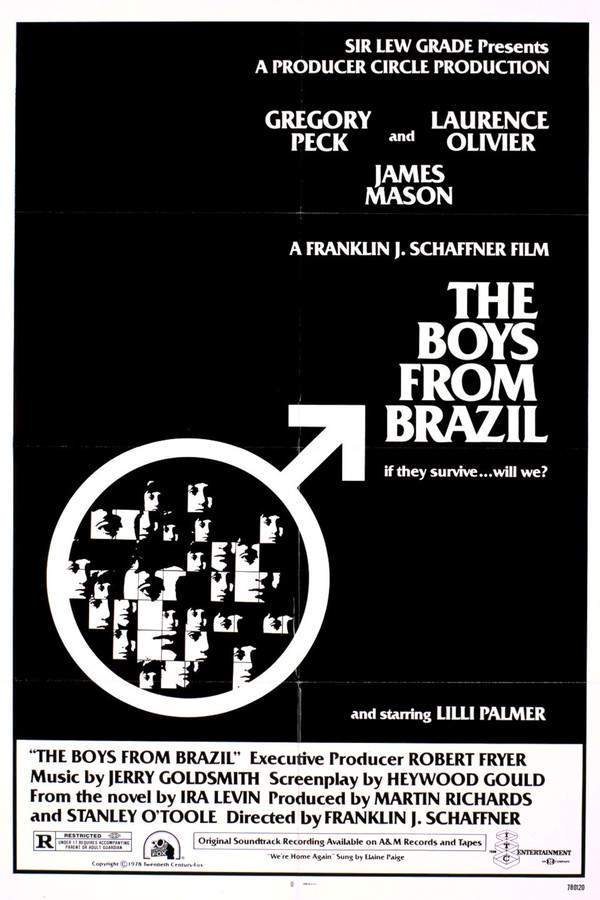
The Boys from Brazil (1978) movie poster

Plot Summary

The Boys from Brazil (1978) Plot Summary Explained

Release, runtime and language
1978 · 125 min · English
Loading streaming availability…
Directed by
Franklin J. Schaffner
Starring
James Mason, Gregory Peck, Laurence Olivier

A Nazi hunter uncovers a disturbing plot by Dr. Josef Mengele, who is secretly creating 95 clones of Adolf Hitler in Brazil. Mengele meticulously recreates their childhoods, intending to mold them into a new generation of Nazi leaders and revive the Third Reich. As the hunter races to stop him, one of the clones grapples with his identity and must ultimately decide between loyalty to his creator and the preservation of humanity.

On this page (7)
  1. 1 Where to watch
  2. 2 What happens: full plot
  3. 3 Plot questions answered
  4. 4 The book behind the movie
  5. 5 Movie threads
  6. 6 Movies like The Boys from Brazil
  7. 7 Every angle
Loading streaming availability…

Full plot summary · contains spoilers

What Happens in The Boys from Brazil: Full Plot Summary

The whole story of The Boys from Brazil (1978) explained, from the opening scene to the final frame: every key event, every twist and what it all adds up to. Read it as a quick recap before the sequel, to check a scene you missed, or to finally understand what really happened.

As Barry Kohler, a resolute young amateur Nazi hunter, secretly listens in on a covert gathering of Kameraden operatives in Paraguay, he unknowingly uncovers the dark plans devised by Josef Mengele, the notorious Auschwitz physician. With chilling precision, Mengele details the assassinations of 94 seemingly ordinary civil servants, all approximately 65 years old, scattered across Northern Europe and North America, all with a tight deadline set to unfold over the next two years. However, Kohler's harrowing discovery is abruptly cut short when he is brutally murdered by the Kameraden operatives while still on the line with Ezra Lieberman, a once-renowned yet jaded Nazi hunter.

Fueled by a combination of resolve and skepticism, Lieberman enlists the help of his savvy sister Esther, British journalist Sidney Beynon, and Jewish-American vigilante leader David Bennett to unravel the mystery surrounding the alarming deaths of civil servants who match Mengele's described profile. As they dig deeper into their investigation, they encounter a disturbing pattern: all the deceased men have sons, around 13 years old, who share strikingly similar features—pale skin, dark hair, and piercing blue eyes. Lieberman's quest reveals a tangled web of illegal adoptions orchestrated by Kameraden member Frieda Maloney, who is now incarcerated, and the shocking truth that these boys were funneled through a Brazilian intermediary.

Maloney’s cryptic hint regarding Henry Wheelock, who traded his newborn puppy for a baby boy, sends Lieberman on a compelling search to uncover the connection behind the boys' uncanny resemblances. Consulting biologist Dr. Bruckner, he learns about cloning, leading to a shocking realization: these boys are clones of Adolf Hitler, all genetically constructed from the very same DNA sample by Mengele. This sinister Nazi plot aims to recreate Hitler’s formative years by placing the boys with parents who resemble Alois (Hitler's abusive father) and Klara (his loving mother). The calculated murders of their fathers serve as a chilling replica of Alois' own demise when young Adolf was just thirteen.

With Maloney's puppy now an unintended linchpin to unraveling the mystery, Lieberman connects the dots of this nefarious scheme. Time becomes a critical factor when he discovers that Henry Wheelock is marked for execution in only four days, precipitating a frantic race to thwart the next phase of Mengele's malevolent design.

As turmoil surges within the Kameraden leadership, they scramble to halt the project amid worries about Lieberman's persistent inquiry and Mengele's increasingly erratic behavior—a man so unhinged that he violently attacks one of his own for a trivial error. However, Mengele cunningly evades those trying to stop his vile plans.

In the picturesque rural landscape of Pennsylvania, Lieberman arrives at the Wheelock home bearing distressing news, only to find that Henry has already fallen prey to Mengele's treachery. Masquerading as Lieberman, the doctor delivers the fatal assault before brutally shooting the investigator himself, leaving him gravely injured. To add insult to injury, Mengele finds himself cornered by a pack of ferocious Doberman Pinschers, their feral anger ignited by a profound fear instilled by the very man they now confront—Mengele, who bears an irrational dread of dogs.

As Lieberman battles to heal from his wounds, he fortuitously retrieves a crucial list from Mengele's pocket, detailing the identities of all 94 clones. However, his recovery is short-lived, as the consequences of blood loss take their toll, rendering him weak. During a subsequent hospital visit, Bennett presents Lieberman with an enticing proposal: deliver the list to allow his vigilante group to eliminate the clones. Unwilling to comply, Lieberman chooses instead to destroy the incriminating evidence, convinced that these innocent children may ultimately grow into harmless individuals.

The film closes on a chilling note as Bobby Wheelock, still grappling with the horrors he's witnessed, stares with unsettling intrigue at images of Mengele's mangled remains—a gruesome token of the monstrous acts committed by this infamous figure.
Last updated: November 19, 2024 at 18:26

Was this helpful?

Plot questions answered

The Boys from Brazil Plot Explained: Your Questions Answered

The questions people ask most about The Boys from Brazil (1978): what happens in the confusing scenes, why the characters do what they do, the twists, hidden details and what the ending means. Each answer contains spoilers.

Q1

Why is Dr. Mengele creating clones of Adolf Hitler?

Mengele is creating 94 clones of Hitler to recreate the Führer's childhood and mold them into a new generation of Nazi leaders. His goal is to revive the Third Reich by placing these boys with parents who replicate Hitler's own childhood environment, ones who resemble his abusive father Alois and loving mother Klara.

Foreshadowing: Early in the film, Mengele's presence at the Kameraden meeting reveals his continued commitment to Nazi ideology.

  • mengele
  • hitler clones
  • nazi plot
  • clone conspiracy
  • third reich
Q2

Why are the 94 civil servants being murdered?

The civil servants are being murdered to replicate the circumstances of Adolf Hitler's childhood. When Hitler was 13, his father Alois died. By killing fathers of 13-year-old boys who share Hitler's genetic traits, Mengele recreates that traumatic loss to shape the clones into future Nazi leaders.

Foreshadowing: Kohler uncovers that Mengele plans assassinations of 94 men matching a specific age profile.

  • hitler childhood
  • father death
  • clone motivation
  • ao13 trauma
  • mimicry
Q3

How were the Hitler clones placed with their families?

The Kameraden organization, led by member Frieda Maloney, orchestrated illegal adoptions to place the clones with families across Northern Europe and North America. These families were carefully selected to mirror Hitler's parents, those with abusive, authoritarian fathers represented Alois Hitler, while those with loving, doting mothers represented Klara Hitler.

Foreshadowing: The investigation reveals a network of illegal adoptions coordinated by Kameraden operatives.

  • adoption
  • clone families
  • hitler childhood
  • kameraden
  • parent selection
Q4

Why does Mengele kill Henry Wheelock?

Henry Wheelock is one of the 94 target fathers marked for assassination as part of Mengele's plan. His murder follows the pattern of replicating Alois Hitler's death when Adolf was 13. Mengele personally travels to Pennsylvania to ensure Wheelock is killed within the two-year timeline.

Foreshadowing: Lieberman learns Wheelock has only four days before his scheduled execution.

  • henry wheelock
  • assassination target
  • clone father
  • mengele murder
Q5

Why does Mengele attack Ezra Lieberman at the Wheelock home?

Mengele attacks Lieberman to silence the investigation and prevent the exposure of his clone operation. When Lieberman arrives at the Wheelock home to warn Henry, Mengele impersonates the investigator, kills Wheelock, and then turns the gun on Lieberman to eliminate the primary threat to his scheme.

Foreshadowing: Lieberman travels to Pennsylvania believing he can save Wheelock in time.

  • lieberman attack
  • mengele confrontation
  • wheelock home
  • pennsylvania
  • impersonation
Q6

Why do the Doberman Pinschers attack Mengele?

The Doberman Pinschers attack Mengele in an ironic twist, these are dogs he trained to be vicious for his operations, but they have developed a deep fear and hostility toward him specifically. Mengele has an irrational fear of dogs, and the pack turns on their former master during the confrontation at the Wheelock property.

Foreshadowing: This moment underscores the theme of the creator being consumed by his own creation.

  • doberman pinschers
  • mengele fear
  • dogs attack
  • wheelock property
  • ironic death
Q7

Why does Ezra Lieberman destroy the list of clones?

Lieberman chooses to destroy the list of 94 clones rather than hand it over to David Bennett's vigilante group, who wanted to kill the children. He believes these innocent boys may grow up to be harmless individuals and cannot condone murdering children for crimes they haven't committed. The list is destroyed with his blood, making it unreadable.

Foreshadowing: The moral dilemma emerges when Bennett proposes using the list to eliminate the clones.

  • clone list
  • moral dilemma
  • innocent children
  • lieberman choice
  • vigilante
Q8

What does the ending imply about Bobby Wheelock?

The film ends with Bobby Wheelock staring at disturbing images of Mengele's mauled remains. The lingering implication is that Bobby, himself a clone of Hitler, may be grappling with his own identity and the horror of his origins. His unsettling fascination with the images suggests he is now aware of what he was created to become, leaving his future uncertain and ambiguous.

Foreshadowing: Throughout the film, Bobby's resemblance to the pale, dark-haired, blue-eyed clones is emphasized.

  • bobby wheelock
  • clone identity
  • ending ambiguity
  • hitler resemblance
  • psychological impact
Q9

What is the significance of the puppy Frieda Maloney traded?

Frieda Maloney mentions she traded her newborn puppy for a baby boy, this becomes the crucial clue that helps Lieberman unravel the clone conspiracy. The puppy, now grown, is used to track down the connection between illegal adoptions and the boys' origins, eventually leading to the revelation that all the boys are clones of Hitler.

Foreshadowing: Maloney's cryptic hint about the puppy trade sends Lieberman on the path to discovery.

  • frieda maloney
  • puppy trade
  • illegal adoption
  • clue
  • investigation breakthrough
Q10

Why does Mengele need exactly 94 clones?

Mengele needs 94 clones to execute his plan across a two-year period. Each clone requires a father matching the profile of Alois Hitler who must die when the boy is approximately 13 years old, the exact age when Hitler lost his father. The large number ensures enough candidates to successfully recreate Hitler's traumatic childhood circumstances for multiple potential candidates.

Foreshadowing: Kohler discovers the two-year timeline during his surveillance of the Kameraden meeting.

  • 94 clones
  • two year plan
  • age 13
  • hitler father death
  • execution timeline
Q11

Why does Mengele attack one of his own assistants?

During the film, Mengele is shown to be increasingly unstable and erratic. He violently attacks one of his own assistants over a trivial error, demonstrating his deteriorating mental state. This instability ultimately contributes to his failure, as the Kameraden leadership grows concerned about his behavior and attempts to halt the project.

Foreshadowing: This violent outburst foreshadows Mengele's complete unraveling and inability to complete his plan.

  • mengele violence
  • assistant attack
  • unstable behavior
  • kameraden concerns
  • psychological deterioration

Movie threads

More Movies Like The Boys from Brazil, by Mood & Story

Curated lists built around what makes The Boys from Brazil tick: the same mood, the same kind of story or the same emotional payoff. Each list explains why these movies belong together.

Conspiracy thrillers with dark plots like The Boys from Brazil

Stories where uncovering a terrifying plot becomes a race against time. If you liked the chilling investigation and high-stakes tension in The Boys from Brazil, you'll find similar movies here. This thread gathers films about uncovering vast, sinister conspiracies, featuring suspenseful pacing, morally complex heroes, and a persistent sense of danger.

  • suspenseful
  • paranoid
  • chilling
  • anxious
  • tense
  • grim
  • Tone: dark, tense, paranoid
  • Pacing: steady, investigative
Why these movies?

The story pattern: These films typically follow a linear investigative structure, where a central mystery or threat is gradually revealed. The protagonist, often an outsider or specialist, works against a powerful, shadowy organization, facing escalating risks as they get closer to the truth. The journey is marked by tension, revelation, and a desperate race to prevent catastrophe.

Why they belong together: Movies are grouped here because they share a core narrative of exposing a dangerous conspiracy, a consistently dark and tense atmosphere, and a pacing that builds suspense methodically toward a climactic confrontation.

Movies about unethical science and moral dilemmas like The Boys from Brazil

Stories where scientific ambition clashes with terrifying moral consequences. Fans of The Boys from Brazil and its exploration of cloning and eugenics will appreciate these films. This thread features stories about dangerous scientific experiments, the ethical dilemmas they create, and the heavy emotional weight of confronting a man-made horror.

  • unsettling
  • grim
  • chilling
  • thought-provoking
  • anxious
  • moral crisis
  • Tone: dark, grim, unsettling
  • Pacing: steady, deliberate
Why these movies?

The story pattern: The narrative pattern involves a scientific breakthrough or experiment that is fundamentally unethical, often reviving past horrors or creating new ones. Characters grapple with the consequences, facing a moral crisis about whether to enable, control, or destroy the creation. The stories are driven by tension between cold scientific logic and human morality, often leading to ambiguous or bleak resolutions.

Why they belong together: These films are linked by their central theme of unethical science, the heavy emotional and moral dilemmas this creates, and a consistently dark tone that forces viewers to confront disturbing questions about humanity and progress.

If you liked this

Movies Like The Boys from Brazil

Similar movies to The Boys from Brazil: the same genre, themes or kind of story. Each one comes with its own plot summary, timeline and ending explained.

Browse all movie summaries

Every angle

The Boys from Brazil (1978) Explained: Plot, Timeline & Characters

Everything about The Boys from Brazil in one place: what happens in the plot summary, the timeline in chronological order, the characters and meaning and a spoiler-free summary. What's After the Movie adds the cast, box office and post-credit scenes.

Coming soon on iOS and Android

The Plot Explained Movie Summary App

Plot summaries, endings explained and timelines on your phone. Catch up on any movie in minutes, save your favorites and never miss a twist again.

Be the first to know when we launch. Your email stays private, always.

Learn more about the app