Plot Explained Spoilers guaranteed!
Plot Explained

Browse by genre

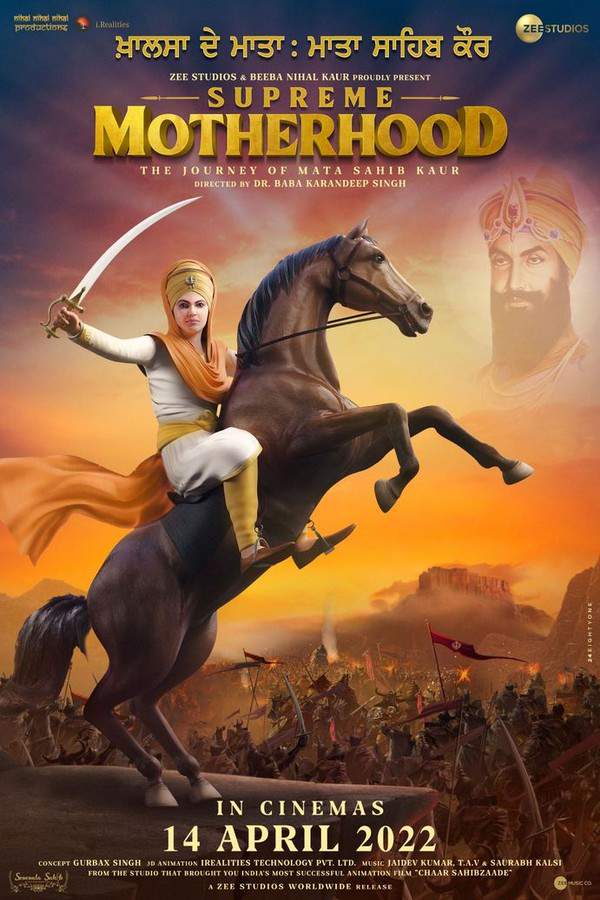
Supreme Motherhood: The Journey of Mata Sahib Kaur (2022) movie poster

Plot Summary

Supreme Motherhood: The Journey of Mata Sahib Kaur (2022) Plot Summary Explained

Release, runtime and language
2022 · 100 min · Punjabi
Echo score 83
Directed by
Karandeep Singh
Budget
$150M

This vibrant 2D animated film celebrates the remarkable life of Mata Sahib Kaur, a courageous warrior and leader who challenged societal norms in 17th-century India. Following the passing of Guru Gobind Singh Ji, she guided the Khalsa nation with unwavering devotion for over four decades, demonstrating exceptional selflessness and strength. The film portrays her as a pioneering female icon who defied convention and left an enduring legacy.

On this page (5)
  1. 1 What happens: full plot
  2. 2 Plot questions answered
  3. 3 Movie threads
  4. 4 Movies like Supreme Motherhood: The Journey of Mata Sahib Kaur
  5. 5 Every angle

Full plot summary · contains spoilers

What Happens in Supreme Motherhood: The Journey of Mata Sahib Kaur: Full Plot Summary

The whole story of Supreme Motherhood: The Journey of Mata Sahib Kaur (2022) explained, from the opening scene to the final frame: every key event, every twist and what it all adds up to. Read it as a quick recap before the sequel, to check a scene you missed, or to finally understand what really happened.

After the remarkable success of India's greatest animation film, Chaar Sahibzaade, IRealties has joined forces with Nihal Nihal Nihal Productions to unveil the inspiring life story of Mata Sahib Kaur, the wife of Guru Gobind Singh. She stands as one of history's most significant yet lesser-known female leaders. This movie, unlike any before, highlights a powerful female figure who represents courage, embodies strength, and exemplifies the essence of motherhood—truly, the Mother of Khalsa.

Set in 1675, the movie opens with the tragic public execution of Guru Tegh Bahadur in Delhi, who sacrifices his life to uphold the rights of the oppressed against Mughal tyranny. In Anandpur, his young son, Guru Gobind Rai, bravely receives his father's head, declaring: the Khalsa will be born soon; this army will always protect the meek and will have the most extraordinary mother. Shortly thereafter, in Rohtas (present-day Pakistan), Sahib Deva is welcomed into the world. Surrounded by a loving family and supportive villagers, she grows up with a charming personality and a courageous heart. As threats from the Mughals escalate, including forceful conversions, her spirit remains unyielded, tackling oppression whenever possible.

During her formative years, she becomes acquainted with the stories of Guru Gobind Rai, the 10th Guru of the Sikhs, and is inspired to become his disciple. Her dedication leads her to develop remarkable skills as a swordswoman, archer, and horse-rider. In 1700, with a profound desire to serve humanity, she boldly asks for the Guru's hand in marriage. The villagers escort Sahib Deva to Anandpur, where her dreams materialize as the Guru entrusts her with the esteemed title of the Mother of the Khalsa. It is here that Guru Gobind Rai is recognized as Guru Gobind Singh, the visionary founder of the courageous Khalsa nation.

Now taking the name Mata Sahib Kaur, she plays a pivotal role in nurturing and expanding the Khalsa community. Before he departs, the Guru assigns her to live in Delhi with Mata Sundar Kaur (his second wife) and gifts her five significant weapons, entrusting her with immense temporal responsibilities. As the Mughal forces, led by Bahadur Shah, Farrukhsiyar, and Zakriyan Khan, launch aggressive assaults against the Khalsa in both Delhi and Punjab, Mata Sahib Kaur stands firm. Alongside her allies, she leads a fierce resistance against the Mughals, bolstering the strength of the Khalsa army.

Tragedy strikes when Mata Sundar Kaur's adopted son betrays them by joining the Mughals, ultimately meeting a grim fate. In 1722, at the age of 42, Mata Sahib Kaur recognizes four-year-old Jassa Singh Ahluwalia as the future leader of the Khalsa. Foreseeing his potential as a valiant warrior, she mentors him in the Khalsa way of life. As Jassa grows into a proficient swordsman, he assumes increasingly critical roles in Punjab’s turbulent politics.

As the tide of history shifts with Nadar Shah's brutal invasion of India, Mata Sahib Kaur's guidance empowers Jassa Singh Ahluwalia to unite the Khalsa army and triumph over Nadar Shah's forces. True to the spirit of Mata Sahib Kaur, he successfully liberates 10,000 captive women and girls while fulfilling her prophetic vision of becoming the 'Sultan-e-Kaum', solidifying his legacy as the next leader of the Khalsa!
Last updated: October 25, 2024 at 09:42

Was this helpful?

Plot questions answered

Supreme Motherhood: The Journey of Mata Sahib Kaur Plot Explained: Your Questions Answered

The questions people ask most about Supreme Motherhood: The Journey of Mata Sahib Kaur (2022): what happens in the confusing scenes, why the characters do what they do, the twists, hidden details and what the ending means. Each answer contains spoilers.

Q1

Why did Guru Tegh Bahadur sacrifice his life in Delhi?

Guru Tegh Bahadur sacrificed his life to uphold the rights of the oppressed against Mughal tyranny. He publicly gave his life to protect Hindu refugees who were being forcefully converted to Islam, standing as a defender of religious freedom and human dignity.

Foreshadowing: Earlier in the film, Guru Tegh Bahadur's sacrifice sets the foundation for the Khalsa movement that his son would later establish.

  • guru tegh bahadur
  • martyrdom
  • delhi
  • mughal tyranny
  • sacrifice
Q2

What did young Guru Gobind Rai mean when he declared the Khalsa would be born?

When young Guru Gobind Rai witnessed his father's execution, he boldly declared that the Khalsa (the army of pure believers) would soon be born. This moment marked his transformation from a grieving son to a future leader who would establish the Khalsa nation to protect the weak and oppressed.

Foreshadowing: This prophetic declaration directly leads to Guru Gobind Rai later founding the Khalsa and taking on the name Guru Gobind Singh.

  • guru gobind rai
  • khalsa
  • prophecy
  • founder
Q3

Why did Sahib Deva propose marriage to Guru Gobind Rai?

In 1700, Sahib Deva proposed marriage to Guru Gobind Rai driven by a profound desire to serve humanity and contribute to his mission. Her boldness was unusual for the time, but her dedication and warrior skills impressed both the villagers and the Guru, leading to her acceptance.

Foreshadowing: This act of bold initiative foreshadows her future role as a leader who would take decisive action for the Khalsa community.

  • sahib deva
  • marriage proposal
  • guru gobind ria
  • 1700
Q4

What does the title Mother of the Khalsa mean?

When Sahib Deva married Guru Gobind Rai, he bestowed upon her the title Mata Sahib Kaur, making her the Mother of the Khalsa. This title represented her role as the spiritual and temporal mother figure for the entire Khalsa community, entrusted with nurturing and protecting the Sikh nation.

Foreshadowing: This title directly explains why she was later given significant responsibilities and weapons to protect the Khalsa.

  • mother of khalsa
  • mata sahib kaur
  • title
  • meaning
Q5

Why did Guru Gobind Singh give Mata Sahib Kaur five weapons?

Before departing on his missions, Guru Gobind Singh gifted Mata Sahib Kaur five significant weapons, entrusting her with immense temporal responsibilities. These weapons symbolized both her authority and her duty to defend and protect the Khalsa community during his absence.

Foreshadowing: These weapons become essential during the Mughal assaults when Mata Sahib Kaur leads resistance against the enemies.

  • five weapons
  • guru gobind singh
  • gift
  • responsibility
Q6

What happened to Mata Sundar Kaur's adopted son?

Mata Sundar Kaur's adopted son betrayed the Khalsa by joining forces with the Mughals. This betrayal resulted in his death, serving as a tragic reminder of the dangers the community faced during this turbulent period of persecution.

Foreshadowing: This betrayal highlights the ongoing threats from within and outside the Khalsa community that Mata Sahib Kaur had to navigate.

  • betrayal
  • mata sundar kaur
  • adopted son
  • mughals
Q7

Why did Mata Sahib Kaur choose a four-year-old as the future Khalsa leader?

In 1722, at age 42, Mata Sahib Kaur recognized four-year-old Jassa Singh Ahluwalia as the future leader of the Khalsa. Despite his young age, she foresaw his potential as a valiant warrior and leader, taking it upon herself to mentor him in the Khalsa way of life.

Foreshadowing: This decision proves prophetic when Jassa Singh grows up to become Sultan-e-Kaum and leads the Khalsa to victory.

  • jassa singh ahluwalia
  • future leader
  • mentor
  • 1722
Q8

Who was Nadar Shah and why was his invasion significant?

Nadar Shah was a Persian ruler who launched a brutal invasion of India, causing widespread destruction and capturing thousands of women. His invasion represented one of the most devastating external threats to the Indian subcontinent during that era.

Foreshadowing: This invasion became the critical moment where Jassa Singh Ahluwalia would prove his leadership abilities as envisioned by Mata Sahib Kaur.

  • nadar shah
  • invasion
  • persia
  • brutal invasion
Q9

How did Jassa Singh Ahluwalia fulfill Mata Sahib Kaur's vision?

Guided by Mata Sahib Kaur's teachings, Jassa Singh Ahluwalia united the Khalsa army and defeated Nadar Shah's forces. True to her vision, he became the 'Sultan-e-Kaum' (King of the People) and liberated 10,000 captive women and girls, fulfilling her prophetic dreams of Khalsa triumph.

Foreshadowing: This victory perfectly aligns with Guru Gobind Rai's childhood declaration that the Khalsa would protect the meek and have an extraordinary mother.

  • jessa singh ahluwalia
  • victory
  • nadar shah
  • liberation
  • sultan-e-kaum
Q10

What was Mata Sahib Kaur's role after Guru Gobind Singh departed?

After Guru Gobind Singh departed on his missions, Mata Sahib Kaur was assigned to live in Delhi with Mata Sundar Kaur (the Guru's second wife). She carried the immense responsibility of nurturing and protecting the Khalsa community during one of the most dangerous periods in Sikh history.

Foreshadowing: This period tested her leadership as she faced Mughal assaults and internal betrayals while maintaining the Khalsa community.

  • mata sundar kaur
  • delhi
  • responsibility
  • guru departed

Movie threads

More Movies Like Supreme Motherhood: The Journey of Mata Sahib Kaur, by Mood & Story

Curated lists built around what makes Supreme Motherhood: The Journey of Mata Sahib Kaur tick: the same mood, the same kind of story or the same emotional payoff. Each list explains why these movies belong together.

Triumphant Historical Biographies like Supreme Motherhood: The Journey of Mata Sahib Kaur

Inspiring life stories of legendary figures who overcame immense adversity. Discover more movies like Supreme Motherhood: The Journey of Mata Sahib Kaur that follow the inspiring true stories of iconic leaders. These films share a focus on overcoming adversity, leaving a powerful legacy, and delivering a hopeful and uplifting conclusion despite a heavy emotional journey.

  • inspiring
  • courageous
  • historical
  • uplifting
  • resilient
  • devotional
  • Tone: hopeful, inspiring
  • Pacing: fast, covering decades
Why these movies?

The story pattern: The narrative follows a straightforward, often chronological arc from great challenge to great triumph. The protagonist faces significant external threats and personal loss, but their unwavering conviction and strength lead to a decisive, positive legacy. The focus is on the heroic journey rather than moral ambiguity or complex subplots.

Why they belong together: Movies in this thread are connected by their shared focus on a true, inspirational life story. They balance heavy themes like persecution and sacrifice with a fundamentally hopeful tone and a happy ending that validates the protagonist's struggles. The pacing is often fast, covering large spans of time to show the full scope of their impact.

Intense Animated Historical Epics like Supreme Motherhood: The Journey of Mata Sahib Kaur

Vibrant animation brings weighty historical drama and spiritual journeys to life. If you liked the animated style and historical depth of Supreme Motherhood: The Journey of Mata Sahib Kaur, explore these similar films. This collection groups animated features that tell serious stories about war, legacy, and spiritual devotion, creating a unique blend of visual appeal and heavy emotional impact.

  • dramatic
  • historical
  • spiritual
  • war
  • courageous
  • visually striking
  • Tone: hopeful, dramatic
  • Pacing: fast, epic scope
Why these movies?

The story pattern: These narratives use the medium of animation not for lighthearted escapism, but to enhance the drama and scale of historical events. They often follow a central figure through pivotal moments, using the visual freedom of animation to depict battles, spiritual visions, and emotional turmoil in a stylized, impactful way. The stories are straightforward and driven by high external stakes.

Why they belong together: These films are grouped by their shared medium and serious tone. They demonstrate that animation can be a powerful vehicle for complex historical and biographical stories. The combination of a fast-paced, high-intensity plot with a hopeful core and a vibrant visual style creates a distinct and memorable cinematic experience.

If you liked this

Movies Like Supreme Motherhood: The Journey of Mata Sahib Kaur

Similar movies to Supreme Motherhood: The Journey of Mata Sahib Kaur: the same genre, themes or kind of story. Each one comes with its own plot summary, timeline and ending explained.

Browse all movie summaries

Every angle

Supreme Motherhood: The Journey of Mata Sahib Kaur (2022) Explained: Plot, Timeline & Characters

Everything about Supreme Motherhood: The Journey of Mata Sahib Kaur in one place: what happens in the plot summary, the timeline in chronological order, the characters and meaning and a spoiler-free summary. What's After the Movie adds the cast, box office and post-credit scenes.

Coming soon on iOS and Android

The Plot Explained Movie Summary App

Plot summaries, endings explained and timelines on your phone. Catch up on any movie in minutes, save your favorites and never miss a twist again.

Be the first to know when we launch. Your email stays private, always.

Learn more about the app