Plot Explained Spoilers guaranteed!
Plot Explained

Browse by genre

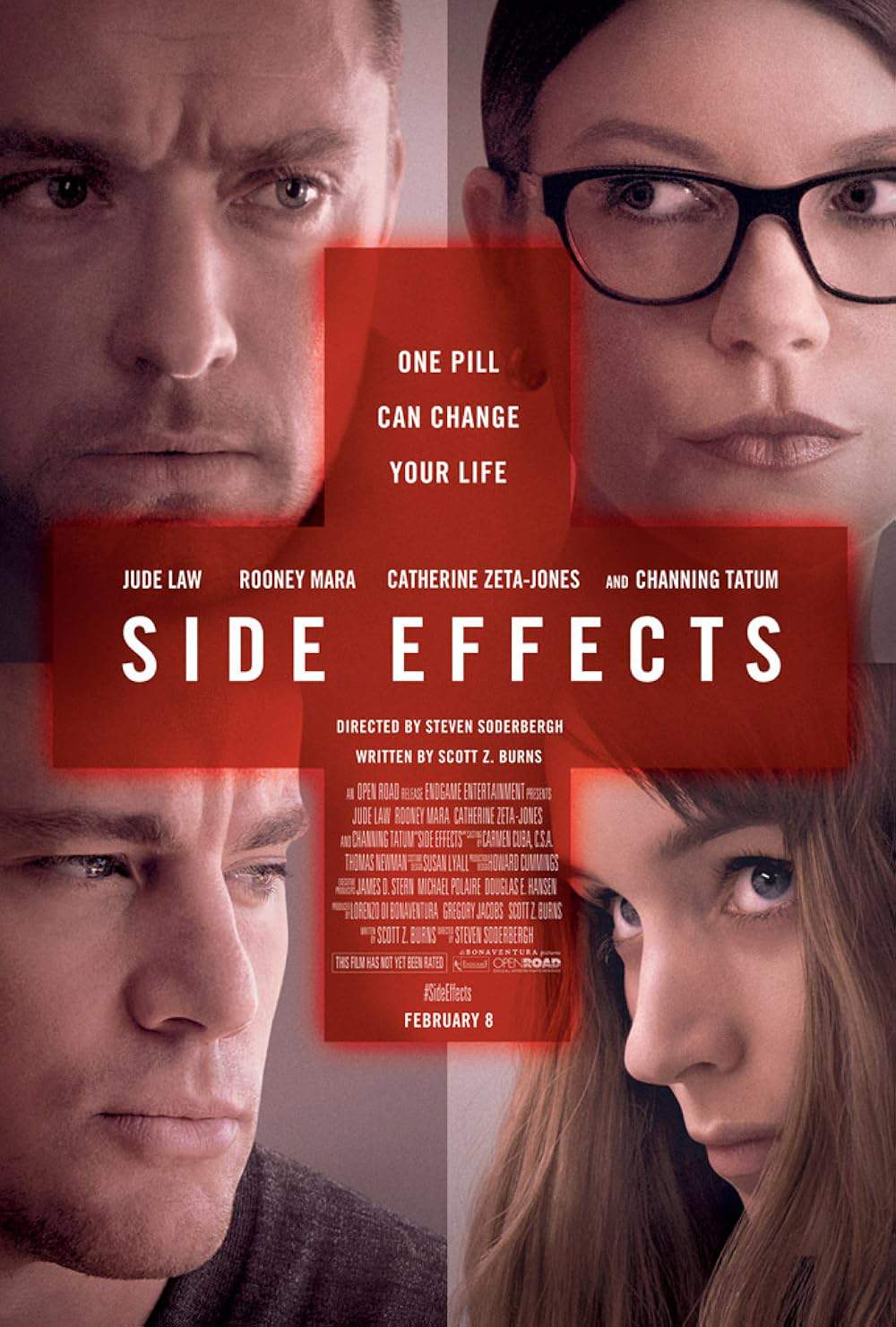
Side Effects (2013) movie poster

Timeline

Side Effects (2013) Timeline Explained – Every Event in Order

Release, runtime and language
2013 · 106 min · German
Loading streaming availability…
Directed by
Steven Soderbergh
Starring
Channing Tatum, Jude Law, Rooney Mara, Catherine Zeta Jones

Facing a life-altering medical diagnosis, a woman begins taking a seemingly harmless drug to help manage her anxiety. However, unexpected and disturbing side effects emerge, leading her down a dangerous path. As her condition spirals out of control, she finds herself entangled in a complex situation with unforeseen consequences and difficult choices.

On this page (6)
  1. 1 Where to watch
  2. 2 Events in order (15)
  3. 3 Timeline questions answered
  4. 4 Movie threads
  5. 5 Movies like Side Effects
  6. 6 Every angle
Loading streaming availability…

15 events in order · contains spoilers

Side Effects Timeline: Events in Chronological Order

Every key event of Side Effects (2013) in order, scene by scene, with when and where it takes place. Use it to untangle flashbacks, time jumps and parallel storylines, to refresh your memory before the sequel or to find the exact scene you are thinking of.

  1. Opening Scene

    The film begins with a haunting image of bloodstains that elicits a sense of dread and curiosity among viewers. This unsettling visual sets the tone for the harrowing narrative that follows, prompting questions about the events leading up to this moment.

  2. Emily's Struggles

    Emily Taylor grapples with the emotional weight of her husband Martin's four-year prison sentence for insider trading. Her duality of joy and disconnection manifests during her visits, suggesting the strain their relationship endures, particularly as Martin mentions his ambitions for the future.

    Where
    Prison
  3. Desperate Suicide Attempt

    In a moment of despair, Emily attempts suicide by crashing her car against a concrete wall. This impulsive act raises alarms about her mental health and serves as a wake-up call for those around her, emphasizing her overwhelming feelings of hopelessness.

    Where
    Parking Lot
  4. Jonathan Takes Charge

    Jonathan Banks, a psychiatrist, is assigned to care for Emily during her recovery. He becomes increasingly concerned for her well-being as he prescribes her medications and discusses the importance of therapy in addressing her mental health issues.

  5. Attempts to Heal

    As Emily recuperates, she tries various antidepressants, but none seem to provide her relief. Flashbacks about her ambitions and previous life reveal the complexities of her mental state, suggesting that her troubles run deeper than what is initially apparent.

  6. Introduction of Ablixa

    In pursuit of a solution, Jonathan consults Emily's previous psychiatrist, Dr. Victoria Siebert, who introduces him to a new medication, Ablixa. This decision sets off a chain of events as they hope it might stabilize Emily's erratic emotional state.

  7. Concert Incident

    During a concert, Emily's emotional instability surfaces as she struggles internally, foreshadowing the turmoil that is to come. This outing highlights her unpredictable mental state and introduces an unsettling tension in the narrative.

    Where
    Concert Hall
  8. Fatal Night

    In a tragic turn of events, Emily fatally stabs Martin during a sleepwalking episode, thrusting her into the center of a murder investigation. This shocking incident acts as a pivotal point in the story, drastically changing the course of her life and Jonathan's.

    Where
    Home
  9. The Trial

    The courtroom drama unfolds as Emily's mental condition is put under scrutiny during her trial. Jonathan, now her defense attorney, faces backlash and pressure to prove her insanity while navigating the complexities of their relationship and his professional reputation.

    Where
    Courtroom
  10. Uncovering the Truth

    As the trial progresses, Jonathan uncovers evidence suggesting a conspiracy involving Dr. Victoria, indicating that Emily may have manipulated her situation. This revelation complicates matters, challenging Jonathan's understanding of the truth behind Emily's actions.

  11. Manipulation Exposed

    Emily discloses the elaborate scheme that she and Victoria devised in pursuit of wealth and influence. The intricate web of deceit highlights the lengths to which they went, showcasing the sinister intertwining of mental illness and ambition.

  12. Law Enforcement Pursuit

    Once Emily's manipulative schemes come to light, she becomes a target for law enforcement. This pursuit encapsulates the chaotic nature of her life as consequences catch up with her, and the hunt for accountability intensifies.

  13. Final Consequences

    Emily is taken back into a mental institution, facing the repercussions of her actions. This moment serves as a stark reminder of the fragile line between sanity and madness, as her world unravels around her.

    Where
    Mental Institution
  14. Jonathan's Reflection

    As Emily's fate unfolds, Jonathan experiences a personal transformation, regaining some stability in his own life. He reflects on the chaotic journey they shared, contemplating the deep implications of mental illness and moral complexities.

  15. Ending Ambiguity

    The film concludes with Emily's unsettling calm within her hospital room, leaving viewers with haunting questions about sanity, manipulation, and the cost of ambition. This final scene encapsulates the movie's themes, provoking thought about the dark sides of human nature.

Last updated: November 02, 2024 at 12:13

Was this helpful?

Timeline questions answered

Side Effects Timeline Explained: Your Questions Answered

When does it happen, and why in that order? The questions people ask about the chronology of Side Effects (2013): time jumps, flashbacks, cause and effect between scenes and the correct order of events, each answered with spoilers.

Q1

Why did Emily Taylor try to kill herself?

Emily's suicide attempt was driven by overwhelming emotional despair from Martin's imprisonment and her feelings of hopelessness. During prison visits, she displayed a mix of joy and emotional disconnection, and her lackluster response to Martin's future plans revealed her deepening internal struggle. The pressure of maintaining appearances while coping with his four-year sentence became too much, leading her to crash her car into a concrete wall.

Foreshadowing: Earlier scenes show Emily's emotional disengagement during intimate moments with Martin, hinting at her deteriorating mental state.

  • emily taylor suicide attempt
  • parking lot crash
  • mental health breakdown
Q2

How did Emily kill Martin while sleepwalking?

Emily stabbed Martin fatally during a sleepwalking episode caused by her prescription medication Ablixa. After Dr. Victoria Siebert introduced the new antidepressant, Emily experienced violent night terrors while asleep. During one of these episodes, she grabbed a knife and attacked Martin in their home, leading to his death and placing Emily at the center of a murder investigation.

Foreshadowing: The concert scene shows Emily struggling internally with mounting tension, foreshadowing her loss of control.

  • emily kills martin
  • sleepwalking murder
  • ablixa side effects
Q3

What was the conspiracy between Emily and Dr. Victoria?

Emily and Victoria devised an elaborate scheme to exploit the pharmaceutical industry and manipulate the mental health system for financial gain. Victoria provided Emily with drugs and medical support while Emily feigned mental illness symptoms to carry out their plan. Their conspiracy was designed to profit from pharmaceutical payouts and insurance fraud by creating a scenario where Emily appeared to suffer from severe mental illness.

Foreshadowing: Jonathan's discovery of inconsistencies in Emily's case and Victoria's quick willingness to prescribe experimental medications hinted at their collusion.

  • emily victoria conspiracy
  • pharmaceutical fraud
  • mental illness scheme
Q4

Why did Jonathan Banks become Emily's defense attorney?

Jonathan took on Emily's defense primarily to protect his own career and reputation from mounting malpractice accusations. As her psychiatrist, he faced significant professional liability for prescribing Ablixa, which was linked to the murder. By defending Emily and arguing she was insane, Jonathan hoped to deflect blame from his own prescribing decisions and avoid legal consequences.

Foreshadowing: Jonathan's concern about his professional reputation was established early when he emphasized the importance of therapy alongside medication.

  • jonathan banks lawyer
  • emily trial
  • malpractice defense
Q5

What was Emily's real motivation in the film?

Emily's true motivation was greed and a desire for wealth and power, not genuine mental illness. Rather than being a victim of depression, she orchestrated events with Victoria to manipulate the system for financial gain. Her suicide attempt and subsequent behaviors were calculated parts of the scheme to exploit insurance payouts and pharmaceutical incentives.

Foreshadowing: Flashbacks revealing Emily's ambitions in graphic design and her romance with Martin showed her as a driven, ambitious person capable of planning.

  • emily taylor motivation
  • greed manipulation
  • financial scheme
Q6

Was Emily actually mentally ill or faking?

Emily was faking her mental illness throughout the film. The conspiracy between her and Victoria involved deliberately feigning symptoms of depression, suicide attempts, and sleepwalking episodes to execute their scheme. Her unsettling calm at the film's conclusion, despite the chaos she caused, further confirms she was manipulating others rather than genuinely suffering from mental illness.

Foreshadowing: The opening bloodstains and Emily's duality of joy and disconnection during prison visits suggested a calculated performance.

  • emily fake mental illness
  • emily sanity
  • manipulation diagnosis
Q7

What happened to Emily at the end of the film?

Emily was taken back into a mental institution to face consequences for her crimes. Despite the exposure of her manipulation scheme, she displayed an eerie sense of calm in her hospital room, showing no remorse for Martin's death or the chaos she caused. The film ends with her confined but unrepentant, leaving viewers to contemplate the blurred line between sanity and madness.

Foreshadowing: The film's opening with bloodstains and Emily's unsettling calm throughout establish her manipulative nature.

  • emily institution ending
  • emily arrested
  • movie conclusion
Q8

What role did the Ablixa drug play in the story?

Ablixa was the experimental antidepressant prescribed to Emily that triggered violent sleepwalking episodes. Introduced by Dr. Victoria Siebert, the drug was central to the conspiracy because it provided the mechanism for Martin's murder. The medication caused Emily to act dangerously while unconscious, making her appear to be a victim of her own treatment rather than a perpetrator.

Foreshadowing: The concert scene where Emily struggles internally foreshadows the drug's destabilizing effects.

  • ablixa drug
  • antidepressant side effects
  • sleepwalking medication
Q9

Why was Martin in prison at the start of the film?

Martin was serving a four-year sentence for insider trading, a financial crime that strained his relationship with Emily. During prison visits, he expressed hopes for a better future using connections to banker Marshall Hellman. His imprisonment created the financial pressure and emotional tension that contributed to Emily's declared mental health crisis.

Foreshadowing: Martin's ambition for wealth and connections is established early, setting up the film's themes about financial greed.

  • martin taylor prison
  • insider trading sentence
Q10

Why did Dr. Victoria Siebert help Emily?

Dr. Victoria Siebert helped Emily because they were co-conspirators in a scheme to exploit the pharmaceutical industry for profit. Victoria introduced Ablixa specifically to create the circumstances for their plan, providing medical support that made Emily's fake illness appear legitimate. Their partnership was driven by shared desires for wealth and influence through manipulating the mental health system.

Foreshadowing: Victoria's quick adoption of an experimental medication and her professional relationship with Emily hinted at deeper involvement.

  • dr victoria siebert
  • emily conspiracy
  • pharmaceutical manipulation

Movie threads

More Movies Like Side Effects, by Mood & Story

Curated lists built around what makes Side Effects tick: the same mood, the same kind of story or the same emotional payoff. Each list explains why these movies belong together.

Medical conspiracy thrillers like Side Effects

Thrillers that expose the dark, manipulative underbelly of the medical and pharmaceutical world. If you were captivated by the manipulative plot and clinical paranoia of Side Effects, explore these movies that delve into the dark side of medicine. Discover similar stories of pharmaceutical deception, corrupt institutions, and characters caught in complex webs of lies, perfect for fans of intelligent, unsettling crime dramas.

  • clinical
  • manipulative
  • suspenseful
  • unsettling
  • investigative
  • cynical
  • Tone: dark, clinical, paranoid
  • Pacing: steady, investigative
Why these movies?

The story pattern: Narratives often begin with a seemingly legitimate medical or psychological issue, which gradually unravels to expose a premeditated scheme. The story structure frequently involves a shift in perspective, where an investigator or a victim must uncover the truth against powerful, seemingly trustworthy adversaries.

Why they belong together: Movies in this thread are grouped by their shared focus on medical settings as a source of crime and suspense. They blend the clinical atmosphere of hospitals with the ethical murkiness of corporate conspiracy, creating a unique form of noir where the villainy is cold, calculated, and intellectually intimidating.

Thrillers with psychological twists like Side Effects

Stories where a character's mental state unravels, blurring the line between victim and perpetrator. For viewers who enjoyed the shocking narrative pivot and complex character deconstruction in Side Effects, this collection features movies with similar mind-bending reveals. These films masterfully build tension around a character's psyche, leading to unforgettable twists that challenge everything you thought you knew about the story.

  • unreliable narrator
  • psychological
  • twist
  • deception
  • unsettling
  • bleak
  • Tone: dark, unsettling, manipulative
  • Pacing: steady, deliberate unraveling
Why these movies?

The story pattern: The emotional journey typically starts with a character in genuine distress, earning the audience's empathy. The plot then introduces elements of doubt, culminating in a pivotal twist that recontextualizes the protagonist's actions, revealing a layer of deception or calculation that was hidden in plain sight.

Why they belong together: These films are united by their complex narrative structure that hinges on re-evaluating a central character. They share a dark, heavy tone and a steady pacing that allows for careful psychological unpacking, delivering a powerful and often bleak payoff that leaves a lasting impact.

If you liked this

Movies Like Side Effects

Similar movies to Side Effects: the same genre, themes or kind of story. Each one comes with its own plot summary, timeline and ending explained.

Browse all movie summaries

Every angle

Side Effects (2013) Explained: Plot, Timeline & Characters

Everything about Side Effects in one place: what happens in the plot summary, the timeline in chronological order, the characters and meaning and a spoiler-free summary. What's After the Movie adds the cast, box office and post-credit scenes.

Coming soon on iOS and Android

The Plot Explained Movie Summary App

Plot summaries, endings explained and timelines on your phone. Catch up on any movie in minutes, save your favorites and never miss a twist again.

Be the first to know when we launch. Your email stays private, always.

Learn more about the app