Plot Explained Spoilers guaranteed!
Plot Explained

Browse by genre

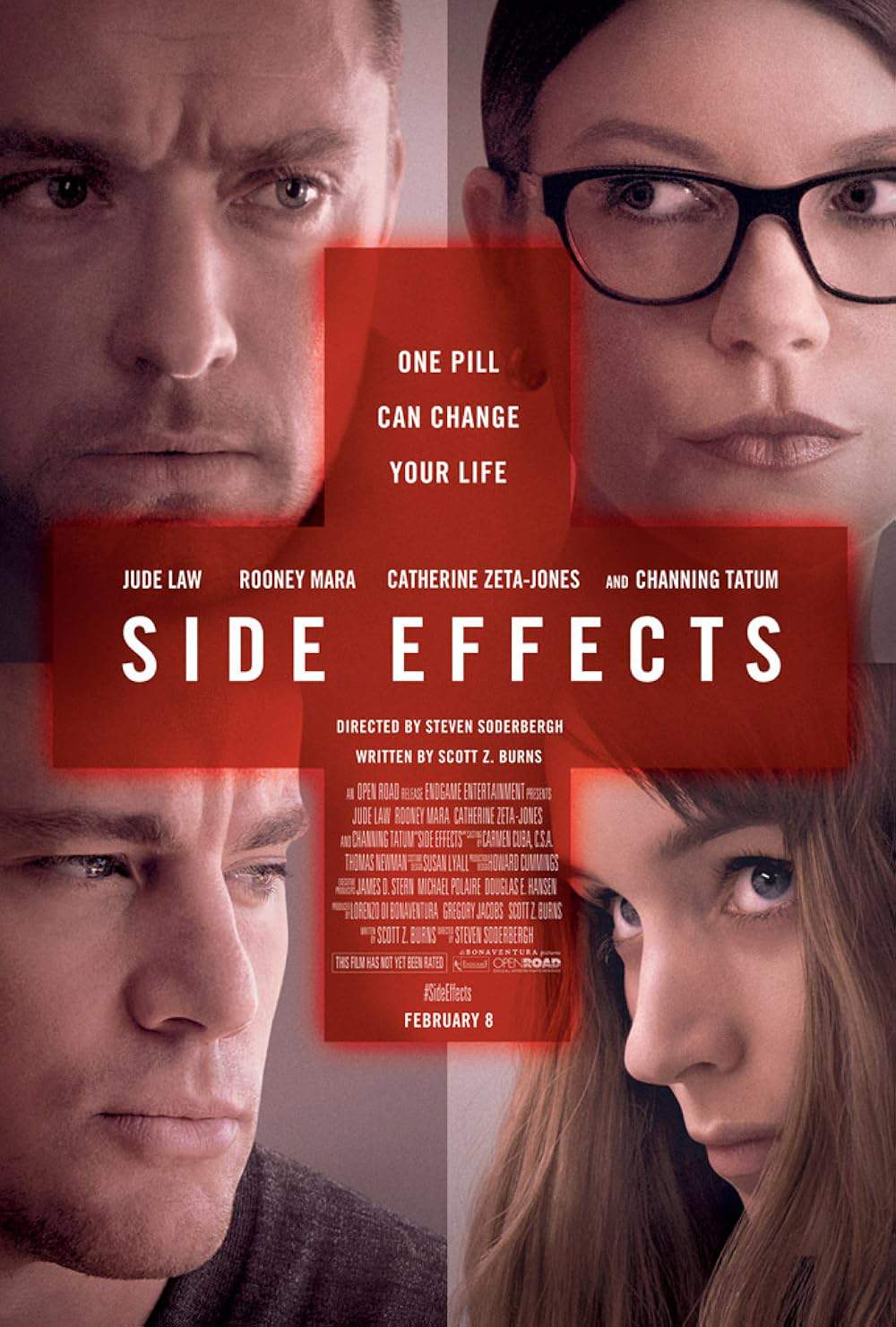
Side Effects (2013) movie poster

Characters & Themes

Side Effects (2013) Characters, Setting & Themes Explained

Release, runtime and language
2013 · 106 min · German
Loading streaming availability…
Directed by
Steven Soderbergh
Starring
Channing Tatum, Jude Law, Rooney Mara, Catherine Zeta Jones

Facing a life-altering medical diagnosis, a woman begins taking a seemingly harmless drug to help manage her anxiety. However, unexpected and disturbing side effects emerge, leading her down a dangerous path. As her condition spirals out of control, she finds herself entangled in a complex situation with unforeseen consequences and difficult choices.

On this page (8)
  1. 1 Where to watch
  2. 2 Characters explained (4)
  3. 3 Where & when it takes place
  4. 4 Themes & meaning (3)
  5. 5 Character & meaning questions
  6. 6 Movie threads
  7. 7 Movies like Side Effects
  8. 8 Every angle
Loading streaming availability…

4 main characters · contains spoilers

Side Effects Characters Explained: Who Is Who

The main characters of Side Effects (2013), heroes and villains: what drives them, how they change over the course of the story and what each of them reveals about the film's bigger ideas.

  • Emily Taylor

    played by Rooney Mara

    Emily is a complex character battling her inner demons and navigating a tumultuous life marked by her husband's imprisonment and her own mental health struggles. Initially appearing desperate and emotionally vacant, her character evolves into a manipulative figure as she plots a concealed scheme. Her actions culminate in tragedy, revealing the fragility of sanity and the lengths to which people will go for wealth.

    • 😔 Mental Health
    • 🕵️‍♀️ Manipulation
    • ⚖️ Betrayal
  • Martin Taylor

    played by Channing Tatum

    Martin is portrayed as a man facing the consequences of his past mistakes, serving a prison sentence for insider trading. His dreams and aspirations clash with Emily's internal struggles, revealing the strain in their relationship. As a pivotal figure in the narrative, his tragic end shifts the focus of the plot towards the repercussions of deceit and betrayal.

    • 💼 Prison
    • 👫 Relationship Strain
    • 💔 Tragedy
  • Jonathan Banks

    played by Jude Law

    Jonathan is a dedicated psychiatrist drawn into Emily's chaotic life, exemplifying the struggles of those in the mental health profession. His journey reflects the challenges of ethical dilemmas and public scrutiny that arise when dealing with complex patients. Ultimately, he embodies the conflict between professional duty and moral integrity as he grapples with the truth behind Emily's actions.

    • 🩺 Psychiatry
    • ⚖️ Ethics
    • 🎭 Conflict
  • Dr. Victoria Siebert

    played by Catherine Zeta Jones

    Dr. Victoria Siebert is depicted as a pivotal figure in Emily's treatment, initially bringing insights but later revealing darker motives. Her manipulative nature and involvement in the conspiracy reflect the ethical ambiguities in the mental health field. Victoria's character serves as a foil to Emily, highlighting themes of trust and betrayal in personal and professional relationships.

    • 👩‍⚕️ Psychiatry
    • ⚠️ Manipulation
    • 📉 Betrayal

Last updated: October 22, 2024 at 20:22

Was this helpful?

Setting

Where and When Does Side Effects Take Place?

The setting of Side Effects (2013): the year and time period, the places and locations, and how they shape the characters, the mood and the tension of the story.

Time period

The timeline of 'Side Effects' is contemporary, mirroring present-day societal issues surrounding mental health, pharmaceuticals, and crime. This modern backdrop accentuates the urgency and relevance of the story, as it reflects on the consequences of manipulation and the morality of mental health treatments in today's world.

Location

Middle-Class Home, Prison, Concert Venue

The film traverses various locations that reflect Emily's turbulent life. The middle-class home symbolizes her strained marriage and emotional disengagement, while the prison serves as a backdrop for Martin’s entrapment due to his crimes. The concert venue highlights moments of emotional highs and lows, encapsulating the complexity of Emily's mental state.

  • 🏠 Home
  • 🏢 Prison
  • 🎶 Concert

Last updated: October 22, 2024 at 20:22

Was this helpful?

3 major themes

Side Effects Meaning: Themes & Message Explained

What is Side Effects (2013) really about? The emotional, social and philosophical themes the film keeps returning to, its symbolism and the message beneath the surface.

  • Mental Health

    The theme of mental health is central to the narrative, exploring the struggles and stigma surrounding psychological disorders. Emily's journey through various treatments and her tragic fate underline the complexities of mental illness, raising questions about authenticity in a society that often misunderstands these issues.

  • Greed and Manipulation

    Greed drives Emily and Victoria to manipulate the situation for financial gain, showcasing the dark side of ambition. Their actions intertwine wealth with deception, illustrating the destructive potential of pursuing success at any moral cost, culminating in a shocking betrayal and a tragic outcome.

  • Justice and Consequences

    The legal ramifications of Emily's actions serve as a potent reminder of the intricate relationship between justice and personal choices. The film delves into the complexities of legal defense against mental health issues, ultimately questioning what justice means when manipulated narratives are at play.

Last updated: October 22, 2024 at 20:22

Was this helpful?

Character & theme questions

Side Effects Characters & Meaning: Your Questions Answered

The questions people ask about Side Effects (2013): who the characters really are, their relationships, what the symbols mean, where it takes place and what the movie is really about. Each answer contains spoilers.

Q1

Where does the story take place?

The film takes place across several key locations that reflect Emily's turbulent life: a middle-class home symbolizing her strained marriage, a prison where her husband Martin is incarcerated, and a concert venue representing moments of emotional highs and lows throughout the story.

  • locations
  • setting
  • home
  • prison
  • concert venue
Q2

When is the movie set?

The film is set in contemporary, present-day times, reflecting current societal issues surrounding mental health, pharmaceuticals, and crime. This modern backdrop makes the story's themes of manipulation and mental health treatment feel urgent and relevant.

  • time period
  • contemporary
  • modern
  • present day
Q3

What does the movie say about mental health?

Mental health is the central theme of the film. The narrative explores the struggles and stigma surrounding psychological disorders through Emily's journey with various treatments. Her tragic fate underlines the complexities of mental illness and raises questions about how society understands and treats these issues.

  • mental health
  • psychological disorders
  • anxiety
  • depression
  • treatment
Q4

How does greed drive the story?

Greed serves as a powerful motivating force, particularly for Emily and Dr. Victoria Siebert, who manipulate circumstances for financial gain. Their actions intertwine wealth with deception, illustrating how the pursuit of success at any moral cost leads to destructive outcomes and shocking betrayals.

  • greed
  • money
  • manipulation
  • deception
  • betrayal
Q5

What does the movie explore about justice and consequences?

The film examines the legal ramifications of characters' actions, exploring the complex relationship between justice and personal choices. It questions what justice means when manipulated narratives are at play, especially regarding mental health defenses.

  • justice
  • legal
  • consequences
  • law
  • accountability
Q6

Who is Emily Taylor?

Emily Taylor is the film's protagonist, a woman battling inner demons and dealing with her husband's imprisonment. She struggles with mental health issues and emotional vacancy. Throughout the story, her character evolves from desperate and vulnerable into a manipulative figure capable of concealed schemes.

  • emily taylor
  • protagonist
  • main character
  • mental illness
Q7

Who is Martin Taylor?

Martin Taylor is Emily's husband, serving a prison sentence for insider trading. His past mistakes and incarceration create significant strain in his relationship with Emily. His dreams and aspirations clash with her internal struggles, and his tragic end becomes a pivotal moment in the narrative.

  • martin taylor
  • husband
  • prison
  • insider trading
Q8

Who is Jonathan Banks?

Jonathan Banks is a dedicated psychiatrist who becomes drawn into Emily's chaotic life. He exemplifies the struggles mental health professionals face when dealing with complex patients. His journey reflects the challenges of ethical dilemmas and public scrutiny, embodying the conflict between professional duty and moral integrity.

  • jonathan banks
  • psychiatrist
  • doctor
  • mental health professional
Q9

Who is Dr. Victoria Siebert?

Dr. Victoria Siebert is a psychiatrist who plays a pivotal role in Emily's treatment. Initially appearing to bring professional insights, she later reveals darker motives and a manipulative nature. Her involvement in a conspiracy highlights themes of trust and betrayal in both personal and professional relationships.

  • victoria siebert
  • psychiatrist
  • doctor
  • antagonist
  • manipulation
Q10

What is the tone and emotional feel of the movie?

The film has a dark, intense tone dominated by themes of deception, mental illness exploitation, and personal downfall. It offers no redeeming hopeful elements. The emotional weight is heavy, dealing with suicide, murder, and the cynical exploitation of the medical system, resulting in a bleak conclusion.

  • tone
  • mood
  • dark
  • heavy
  • intense
Q11

How would you describe the movie's narrative style?

The narrative is complex and hinges on a major plot twist that reframes the entire story. It begins as a slow-burn character study but steadily escalates into a complex web of lies and investigation. The twist transforms the film from what appears to be a medical drama into a calculated crime story.

  • narrative
  • plot twist
  • complex
  • crime
  • deception

Movie threads

More Movies Like Side Effects, by Mood & Story

Curated lists built around what makes Side Effects tick: the same mood, the same kind of story or the same emotional payoff. Each list explains why these movies belong together.

Medical conspiracy thrillers like Side Effects

Thrillers that expose the dark, manipulative underbelly of the medical and pharmaceutical world. If you were captivated by the manipulative plot and clinical paranoia of Side Effects, explore these movies that delve into the dark side of medicine. Discover similar stories of pharmaceutical deception, corrupt institutions, and characters caught in complex webs of lies, perfect for fans of intelligent, unsettling crime dramas.

  • clinical
  • manipulative
  • suspenseful
  • unsettling
  • investigative
  • cynical
  • Tone: dark, clinical, paranoid
  • Pacing: steady, investigative
Why these movies?

The story pattern: Narratives often begin with a seemingly legitimate medical or psychological issue, which gradually unravels to expose a premeditated scheme. The story structure frequently involves a shift in perspective, where an investigator or a victim must uncover the truth against powerful, seemingly trustworthy adversaries.

Why they belong together: Movies in this thread are grouped by their shared focus on medical settings as a source of crime and suspense. They blend the clinical atmosphere of hospitals with the ethical murkiness of corporate conspiracy, creating a unique form of noir where the villainy is cold, calculated, and intellectually intimidating.

Thrillers with psychological twists like Side Effects

Stories where a character's mental state unravels, blurring the line between victim and perpetrator. For viewers who enjoyed the shocking narrative pivot and complex character deconstruction in Side Effects, this collection features movies with similar mind-bending reveals. These films masterfully build tension around a character's psyche, leading to unforgettable twists that challenge everything you thought you knew about the story.

  • unreliable narrator
  • psychological
  • twist
  • deception
  • unsettling
  • bleak
  • Tone: dark, unsettling, manipulative
  • Pacing: steady, deliberate unraveling
Why these movies?

The story pattern: The emotional journey typically starts with a character in genuine distress, earning the audience's empathy. The plot then introduces elements of doubt, culminating in a pivotal twist that recontextualizes the protagonist's actions, revealing a layer of deception or calculation that was hidden in plain sight.

Why they belong together: These films are united by their complex narrative structure that hinges on re-evaluating a central character. They share a dark, heavy tone and a steady pacing that allows for careful psychological unpacking, delivering a powerful and often bleak payoff that leaves a lasting impact.

If you liked this

Movies Like Side Effects

Similar movies to Side Effects: the same genre, themes or kind of story. Each one comes with its own plot summary, timeline and ending explained.

Browse all movie summaries

Every angle

Side Effects (2013) Explained: Plot, Timeline & Characters

Everything about Side Effects in one place: what happens in the plot summary, the timeline in chronological order, the characters and meaning and a spoiler-free summary. What's After the Movie adds the cast, box office and post-credit scenes.

Coming soon on iOS and Android

The Plot Explained Movie Summary App

Plot summaries, endings explained and timelines on your phone. Catch up on any movie in minutes, save your favorites and never miss a twist again.

Be the first to know when we launch. Your email stays private, always.

Learn more about the app