Plot Explained Spoilers guaranteed!
Plot Explained

Browse by genre

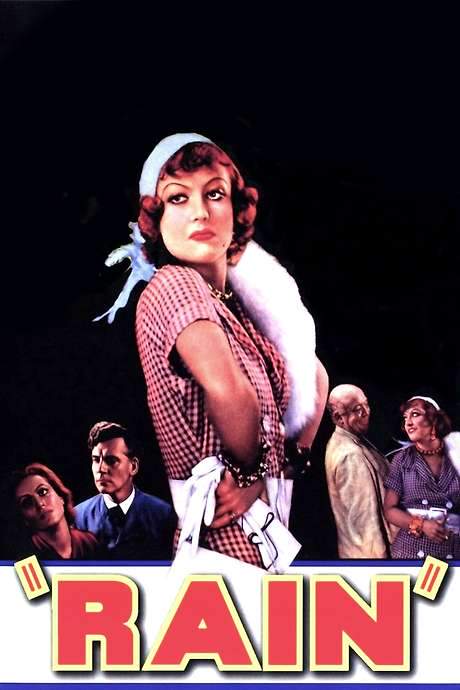
Rain (1932) movie poster

Plot Summary

Rain (1932) Plot Summary Explained

Release, runtime and language
1932 · 94 mins · English
Directed by
Lewis Milestone
Starring
Matt Moore, Walter Catlett, Guy Kibbee, Joan Crawford, Walter Huston, Beulah Bondi

She is a woman without shame or soul. When a suspected cholera outbreak forces a ship’s passengers to abandon the vessel at Pago Pago, a remote Pacific village perpetually drenched by rain, they become stranded. Among them are Sadie Thompson, a prostitute, and Alfred Davidson, a fervent missionary determined to redeem her.

On this page (6)
  1. 1 Where to watch
  2. 2 What happens: full plot
  3. 3 Plot questions answered
  4. 4 Movie threads
  5. 5 Movies like Rain
  6. 6 Every angle

Where to watch

Where to Watch Rain (1932)

Where can you watch Rain? Stream, rent or buy it in the US, including on Artiflix, Brew and Troma NOW: current JustWatch availability with up-to-date prices.

Streaming availability powered by JustWatch

Full plot summary · contains spoilers

What Happens in Rain: Full Plot Summary

The whole story of Rain (1932) explained, from the opening scene to the final frame: every key event, every twist and what it all adds up to. Read it as a quick recap before the sequel, to check a scene you missed, or to finally understand what really happened.

A westbound ship bound for Apia, Samoa, is temporarily stranded at Pago Pago due to concerns about a possible cholera outbreak on board. Among the passengers are Alfred Davidson, a self-righteous missionary, Mrs. Davidson, and Sadie Thompson, a woman whom Davidson condemns as immoral. Thompson spends her time aboard the ship partying and drinking with the American Marines stationed on the island. Sergeant Tim O’Hara, known to Sadie as "Handsome," quickly becomes smitten and pursues her with a quiet persistence. The dynamic on board sets the stage for a clash between judgment and desire, under the constant hum of the tropical environment.

Thompson's carefree behavior provokes tension with the Davidsons, and Alfred Davidson confronts her with the aim to "save her soul." When she dismisses his offer, he uses his authority to have the Governor order her deported to San Francisco, where she is said to be wanted for an unspecified crime (which she insists she was framed for). She pleads to remain on the island for a few more days, hoping to slip away to Sydney, Australia, planning a chance to start anew. The island’s authorities and the governor’s decree underscore the clash between morality as Davidsons’ creed defines it and Thompson's lived reality.

During a heated argument, she experiences a religious conversion and agrees to return to San Francisco to face the jail sentence awaiting her there, a moment that shifts the tone of the tale from condemnation to ambiguous opportunity. The evening before departure, O’Hara steps forward with a tangible offer of marriage and a plan to shelter her until the Sydney-bound boat sails, but Sadie declines, choosing her own path rather than dependence or complicity in a risky future.

Later, while native drums beat at a powerful, uninhibited dance, the repressed Davidson, driven by lust, enters her room and proceeds to rape her offscreen amid the rhythmic pounding. The next morning he is found dead on the beach, his throat slit—a suicide that leaves the ship, the island, and Thompson at a moral crossroads. The assault and Davidson’s death expose the hollowness of his hypocrisy and the rigidity of his worldview, and Thompson’s defenses crumble, allowing her to return to the life she once led. She leaves for Sydney with O’Hara to start a new chapter, signaling a hard-won, if troubling, sense of freedom and reinvention.

Last updated: February 20, 2026 at 12:29

Was this helpful?

Plot questions answered

Rain Plot Explained: Your Questions Answered

The questions people ask most about Rain (1932): what happens in the confusing scenes, why the characters do what they do, the twists, hidden details and what the ending means. Each answer contains spoilers.

Q1

Why does Alfred Davidson want Sadie Thompson deported?

Alfred Davidson, a self-righteous missionary, believes Sadie is immoral and a corrupting influence on the island. He confronts her repeatedly, urging her to repent, and when she refuses, he uses his authority to convince the Governor to order her deportation to San Francisco, where she claims she was framed for an unspecified crime. Davidson sees her removal as necessary to preserve the island's moral integrity.

Foreshadowing: Davidson's moral crusade against Sadie begins the moment he sees her partying with the Marines, establishing his obsessive focus on her from the start.

  • alfred davidson
  • sadie thompson
  • deportation
  • missionary
  • hypocrisy
Q2

Why does Sadie suddenly have a religious conversion?

During a heated argument with Davidson, Sadie experiences what appears to be a genuine religious conversion and agrees to return to San Francisco to face her jail sentence. This sudden shift may stem from exhaustion, a desire for genuine change, or perhaps a strategic move to gain Davidson's trust and buy time. The conversion transforms her perspective, making the jail sentence feel like possible redemption rather than mere punishment.

Foreshadowing: Earlier scenes show Sadie dismissing Davidson's attempts to 'save' her, making this sudden conversion unexpected and potentially calculative.

  • sadie thompson
  • religious conversion
  • redemption
  • davidson
Q3

Why does Alfred Davidson rape Sadie after trying to save her soul?

Davidson's attempted 'rescue' of Sadie was never truly about her salvation, it was about controlling her morality. While native drums beat during an uninhibited dance, his repressed lust overcomes his pious facade. He enters Sadie's room and rapes her, revealing that his moral crusade was driven by desire and power, not genuine spiritual concern. The assault exposes the profound hypocrisy at the core of his character.

Foreshadowing: The constant tension between Davidson's pronouncements and his intense focus on Sadie hints at underlying sexual obsession beneath his religious fervor.

  • alfred davidson
  • rape
  • hypocrisy
  • sexual assault
  • religious zealotry
Q4

Why does Davidson kill himself after assaulting Sadie?

After raping Sadie, Davidson is consumed by guilt and unable to face the consequences of his actions. The next morning, he is found dead on the beach with his throat slit, a suicide that represents the collapse of his carefully constructed moral identity. The act exposes how hollow his righteous worldview truly was, as his internal repression and hypocrisy ultimately lead to his destruction.

Foreshadowing: The rape scene occurs at night while drums pound rhythmically, building toward the psychological breaking point that culminates in Davidson's death.

  • alfred davidson
  • suicide
  • guilt
  • hypocrisy
  • death
Q5

Why does Sadie refuse O'Hara's marriage proposal?

O'Hara offers to marry Sadie and hide her until the Sydney boat sails, providing a way to escape deportation and build a life together. Sadie refuses, choosing autonomy over what she sees as a dependent, possibly doomed arrangement. She prefers to forge her own path, even if it means facing her uncertain future alone rather than relying on a man who might be sheltering her from legal consequences.

Foreshadowing: Sadie's independent spirit is established early through her refusal to be controlled by Davidson's moral judgments.

  • sadie thompson
  • o'hara
  • marriage proposal
  • autonomy
  • independence
Q6

Why does Sadie return to her previous lifestyle after Davidson's death?

After the trauma of Davidson's assault and subsequent suicide, Sadie's defenses crumble. While she and O'Hara do leave together for Sydney, the film suggests she returns to the life she once led, the trauma and scandal have not led to genuine redemption but rather a regression to her old patterns. The ending is bittersweet: she escapes the island's judgment but carries the psychological scars of her ordeal.

Foreshadowing: The religious conversion appears unstable from the start, as it occurs during emotional turmoil rather than genuine spiritual transformation.

  • sadie thompson
  • trauma
  • return to old life
  • scars
  • melancholy ending
Q7

What does the constant rain symbolize in Rain?

The perpetual rain at Pago Pago creates a oppressive, claustrophobic atmosphere that mirrors the moral repression and emotional intensity of the story. The island's endless downpour traps the characters together, intensifying tensions and creating a pressure cooker environment where conflicts escalate. The rain also suggests spiritual desolation and the characters' inability to escape their circumstances, both literal and moral.

Foreshadowing: The film opens with the ship stranded by circumstances beyond control, setting up the theme of being trapped.

  • rain
  • pago pago
  • symbolism
  • atmosphere
  • repression
Q8

How does Davidson's hypocrisy drive the film's central conflict?

Davidson's entire moral crusade against Sadie is revealed as a facade when he rapes her. His righteous condemnation of her 'sin' masks his own repressed lust and moral corruption. The film uses this hypocrisy as its central theme: the danger of rigid, self-righteous moral judgment that masks darker impulses. Davidson's downfall demonstrates that those who judge others most harshly often harbor the very sins they condemn.

Foreshadowing: Davidson repeatedly insists he wants to 'save' Sadie, but his obsessive focus on her suggests personal investment beyond spiritual concern.

  • davidson
  • hypocrisy
  • missionary
  • judgment
  • religious hypocrisy
Q9

What happens to Sadie and O'Hara at the end of the film?

After Davidson's death and the scandal it creates, Sadie and O'Hara decide to leave Pago Pago together for Sydney. They board a boat headed for Sydney, where they plan to start a new life. The ending offers cautious hope, a chance at happiness beyond the island's constraints, but it is tinged with uncertainty, as Sadie carries the psychological scars of her traumatic ordeal.

Foreshadowing: Earlier, Sadie had planned to escape to Sydney to start fresh, but those plans were interrupted by Davidson's interference.

  • sadie thompson
  • o'hara
  • sydney
  • ending
  • new beginning
Q10

Why is the setting of Pago Pago important to the story?

Pago Pago serves as an isolated crucible where the characters' moral conflicts play out. The remote Pacific island, perpetually drenched in rain, creates a closed world where the passengers cannot leave due to the cholera scare. This isolation intensifies the psychological drama, forces prolonged contact between opposing personalities, and removes the characters from civilized society's checks and balances, allowing extreme moral conflicts to emerge.

Foreshadowing: The ship is stranded specifically because of external health concerns, creating forced proximity that drives the narrative.

  • pago pago
  • setting
  • isolation
  • remote island
  • confinement
Q11

Why does Davidson focus specifically on Sadie rather than other passengers?

Davidson singles out Sadie because she represents the opposite of everything he preaches, open sexuality,饮酒, and defiance of conventional morality. His fixation goes beyond spiritual concern; it becomes a personal obsession that reveals his own repressed desires. Sadie's beauty, confidence, and refusal to submit to his authority provoke him because she embodies everything his rigid worldview denies.

Foreshadowing: From the moment Sadie is introduced partying with Marines, Davidson's attention is drawn to her disproportionately.

  • davidson obsession
  • sadie thompson
  • fixation
  • desire
  • power

Movie threads

More Movies Like Rain, by Mood & Story

Curated lists built around what makes Rain tick: the same mood, the same kind of story or the same emotional payoff. Each list explains why these movies belong together.

Dramas about religious hypocrisy and repression like Rain

Stories where rigid morality hides dark desires, leading to explosive conflict. Discover movies like Rain that explore themes of religious hypocrisy, sexual repression, and the dark consequences of moral crusades. If you were captivated by the battle between faith and desire, these films offer a similar intense and thought-provoking experience.

  • moral struggle
  • religious hypocrisy
  • repression
  • lust
  • betrayal
  • psychological torment
  • Tone: dark, intense, morally complex
  • Pacing: steady, building tension
Why these movies?

The story pattern: These films typically feature a charismatic but morally rigid figure who seeks to control or 'save' a worldly, free-spirited individual. The central conflict exposes the zealot's own suppressed desires, culminating in a dramatic and often tragic collapse of their moral authority.

Why they belong together: Movies in this thread share a dark, intense tone and explore the psychological violence of repressed desire. They are grouped by their powerful thematic clash, steady pacing that builds tension, and a focus on moral decay.

Movies with intense moral dramas in isolated settings like Rain

Characters trapped in confined spaces face their deepest moral failings. Find films similar to Rain where characters are stranded or trapped, leading to high-stakes moral and psychological conflicts. If you enjoyed the tense, claustrophobic atmosphere of Pago Pago, these movies capture that same feeling of inescapable pressure.

  • isolation
  • moral dilemma
  • claustrophobic
  • tense
  • character study
  • confinement
  • Tone: tense, dark, claustrophobic
  • Pacing: steady, character-driven
Why these movies?

The story pattern: The narrative pattern involves a group or pair of characters becoming isolated, often in a remote locale. This confinement acts as a pressure cooker, forcing character flaws, secrets, and moral dilemmas to the surface, typically resulting in a bleak or bittersweet resolution.

Why they belong together: These films are grouped by their shared atmosphere of claustrophobia and high tension. They feature a steady pacing that allows character dynamics to simmer and boil over, creating a heavy emotional weight and a dark, often unsettling tone.

If you liked this

Movies Like Rain

Similar movies to Rain: the same genre, themes or kind of story. Each one comes with its own plot summary, timeline and ending explained.

Browse all movie summaries

Every angle

Rain (1932) Explained: Plot, Timeline & Characters

Everything about Rain in one place: what happens in the plot summary, the timeline in chronological order, the characters and meaning and a spoiler-free summary. What's After the Movie adds the cast, box office and post-credit scenes.

Coming soon on iOS and Android

The Plot Explained Movie Summary App

Plot summaries, endings explained and timelines on your phone. Catch up on any movie in minutes, save your favorites and never miss a twist again.

Be the first to know when we launch. Your email stays private, always.

Learn more about the app