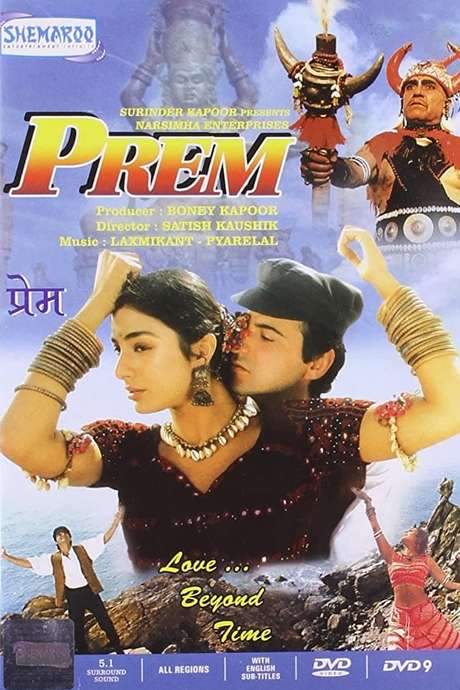
Somen, a lawyer and the son of head priest Swami Dharam Bhushan Maharaj, stands out for his bold sense of justice and readiness to challenge tradition. He embodies equality and freedom, often clashing with his father over social justice and the rigidities of religious authority. He particularly disapproves of Prem Chopra as Kedar Nath, a powerful man who exploits temple funds by leaning on his father’s influence. His uncle Nandlal, a prosperous dairy farmer who keeps religion and social obligations at a distance, represents another side of the family’s complex relationship with tradition. Nandlal, played by Shammi Kapoor, lends a counterpoint to Somen’s crusade by choosing a life away from the ceremonial duties that his nephew challenges.
At the annual festival, Somen meets Kajri, a bright and captivating young woman from a lower caste, and he is drawn to her instantly. Their connection deepens into love, even as social barriers loom large. Kajri, brought to life by Madhuri Dixit, shares in his longing and the dream of a life beyond caste distinctions. The romance faces relentless pressure from the outside world, and before they can openly pursue a future together, circumstances force them apart. Somen’s search for Kajri becomes a quiet, consuming ache, while Kajri’s world begins to fracture under the weight of caste prejudice and a harsh social code.
The romance is shadowed by tragedy when Kajri and her father Baliram, Om Puri, are traveling back to their village, Bansipura. On the road, Kajri is abducted and brutally raped by a mysterious drunkard, leaving her pregnant. This brutal act devastates her, and the aftermath exposes the brutal social ostracism she will face. Kajri’s mother’s sister contemplates arranging a forced marriage to a shoemaker, underscoring the community’s harsh judgments. In a desperate bid to protect her unborn child, Kajri leaves the village and gives birth in secret. She pleads for food so that she can produce milk for the baby, but the child dies. She seeks help from Swami Dharam Bhushan to cremate the infant, only to be refused; Kajri ultimately buries the baby herself. The sorrow of that loss haunts her, shaping the choices she makes in the years to come.
A year passes, and Somen and Kajri cross paths again at Nandlal’s dairy farm, where their shared history rekindles a cautious hope. Kajri is wary and evasive, though she clearly loves him. She writes a letter to explain that she was an unwed mother who faced unjust social condemnation, but Somen does not read the message in time. Around this period, a brutal act by Kedarnath—who burns a woman alive for attempting to press charges against Roop Sahai—crystallizes the peril that powerful men pose to ordinary people and to women who seek justice. The harrowing incident underscores the systemic violence embedded in society and foreshadows the tests Somen and Kajri will face.
As the narrative unfolds at the dairy farm, Dharam Bhushan reveals a painful truth: Kajri had asked him to cremate her dead child, even though the father’s identity was unclear at the time. This revelation complicates Somen’s feelings, and he leaves, while Kajri returns to her village, unsettled and resolute. Nandlal eventually shares a crucial detail that shifts the charge of the story—Kajri’s aunt Natho, Himani Shivpuri, discloses that the rapist is Roop Sahai, a man whom Kajri had reason to fear and who has a troubling history with her.
With the truth finally in the open, Kajri travels to Shreepur to confront the past and to tell Somen the identity of the rapist. United by the shared purpose of confronting injustice, Somen, Kajri, and Baliram confront the abuses of power that have torn their lives apart. In a climactic act of collective justice, they set Roop Sahai and Kedarnath on fire on the festival of Dusshera, a brutal yet decisive break from silence and complicity. Following these events, Somen and Kajri choose to marry, envisioning a future in which courage, truth, and equality might prevail over fear and prejudice.
Throughout this saga, the film delves into weighty themes with a steady, human-centered lens. It probes the resilience required to challenge entrenched hierarchies, the harsh realities faced by unwed mothers, and the perils of wielding power without accountability. The characters Each bring a distinct moral voice: Somen’s unwavering commitment to justice, Kajri’s endurance in the face of social judgment, and the tangible courage of Baliram, Nandlal, and the rest of the supporting figures as they navigate the tension between tradition and reform. The resolution—an act of vigilante retributive justice followed by an intimate union—reflects a complex stance on justice and social transformation, inviting viewers to consider how societies change when individuals stand up against abusive systems, even at great personal risk.
- Baliram, Kajri’s father, is a figure of dignity who endures the toll of violence and social stigma. Om Puri
- Kajri, the central love interest who endures ostracism and tragedy, is a testament to quiet resilience. Madhuri Dixit
- Somen, a principled lawyer who dares to challenge the status quo, embodies the tension between duty to family and duty to truth. Rishi Kapoor
- Swami Dharam Bhushan Maharaj, the head priest whose authority is both influential and contested, represents the institutional side of the conflict. Anupam Kher
- Kedar Nath, who uses his power to exploit temple funds, is a symbol of corruption and brutality. Prem Chopra
- Roop Sahai, the rapist whose actions tie Kajri’s fate to a wider pattern of violence against women. Govind Namdeo
- Parvati, Somen’s mother, and Natho, Kajri’s aunt, offer softer, human foils to the harsher forces at work in the story. Reema Lagoo, Himani Shivpuri
- Nandlal, the prosperous but socially detached uncle who runs a dairy farm and provides an alternate view of life outside the temple’s orbit. Shammi Kapoor
- Laxmi and Guptaji, the broader circle around Kajri and Somen, complete the tapestry of village life and its pressures. Sulabha Arya, Vishwa Mehra
Note: All actor names are linked to their respective pages, using the provided slug format.