Plot Explained Spoilers guaranteed!
Plot Explained

Browse by genre

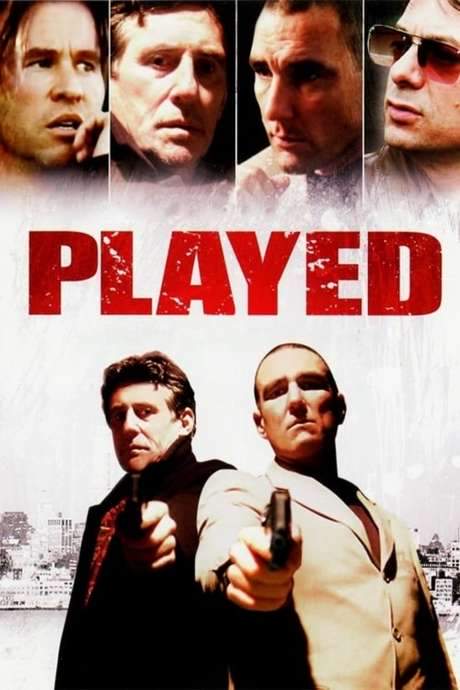
Played (2006) movie poster

Plot Summary

Played (2006) Plot Summary Explained

Release, runtime and language
2006 · 87 mins · English
Loading streaming availability…
Directed by
Sean Stanek
Starring
Val Kilmer, Anthony LaPaglia, Gabriel Byrne, Vinnie Jones, Patrick Bergin, Roy Dotrice

Set against a hostile London underworld, the film follows Ray (Mick Rossi), who has just completed an eight‑year prison term after being framed. Determined to avenge himself, he returns to the streets to confront the ruthless criminals who control the city’s shadowy, despicable underbelly. The story explores the bleak, violent landscape and the moral compromises faced by those who survive within it.

On this page (7)
  1. 1 Where to watch
  2. 2 What happens: full plot
  3. 3 Plot questions answered
  4. 4 Movie threads
  5. 5 Movies like Played
  6. 6 Categories
  7. 7 Every angle
Loading streaming availability…

Full plot summary · contains spoilers

What Happens in Played: Full Plot Summary

The whole story of Played (2006) explained, from the opening scene to the final frame: every key event, every twist and what it all adds up to. Read it as a quick recap before the sequel, to check a scene you missed, or to finally understand what really happened.

Dillon, Val Kilmer works as a cleaner for a ruthless London gangster named Eddie, and the story opens in a rain-soaked Los Angeles where a late-night call from Ray Burns, Mick Rossi, pulls him into a dangerous moment. Ray has just been shot and is fighting to stay alive long enough to tell his would-be rescuer what to do. After a flashy opening title sequence that tracks Dillon’s drive to the scene, he reaches a house where Ray lies on a sofa, fading fast. Dillon does what he’s asked to do—he removes the remaining traces of Ray’s presence, loads him into a car, and torches the house to destroy any evidence. As they speed away, Dillon struggles to keep Ray conscious and, in a rare moment of dark humor, Ray recites a memory about a crooked Mexican auto mechanic, which gives birth to one of the film’s recurring lines: “I’m not gonna taco.”

The narrative then drops back eight years to chart the rise of Riley, Patrick Bergin, a London schemer who fancies himself the mastermind of a major score. Riley is approached by the crooked Detective Brice, Vinnie Jones, who lays out a plan to steal a heroin shipment and haul it back for a substantial payoff. Riley doesn’t hesitate to assemble a crew, tapping Ray Burns—the man he believes can handle the job—and adding Terry Rawlings (the son of mob boss Jack Rawlings) and Terry’s girlfriend Cindy, Patsy Kensit. The setup is simple: Ray and Cindy’s partner, Ray’s colleague Terry, would breach a warehouse and haul away the drugs while Nathan watches from the roof. But the plan unravels in a brutal, fatal instant when Nathan loses his footing and crashes through a skylight, triggering an alarm. Ray and Terry barely escape with the heroin but lose contact with each other in the confusion.

Brice, eager to cover his own tracks, blames Ray for the botched job and pulls Riley into his confidence, insisting that Ray be made the scapegoat. In the meantime, Ray slips into the shadows, trying to reach Terry and understand what happened, only to learn that Riley’s world is more tangled than he thought. Brice’s web widens as a surveillance tape involving London’s criminal circles becomes a dangerous bargaining chip. Ray, who has gone underground, is eventually captured after an anonymous tip points police toward him, and he is tried for the robbery and the manslaughter of Nathan. He serves eight years in prison with little contact with the outside world, even denying a visit from his devoted lover Maggie, Joanne Whalley, who remains a steady presence in his life through the years. While Ray is behind bars, Riley and Brice continue their crooked dealings, and Brice tries to leverage a videotape involving London figures to gain more leverage and cash.

When Ray is released, a fresh thread pulls him toward Los Angeles, where London Charlie has become a pivotal contact. London Charlie recognizes that a clearer path to freedom for himself lies in eliminating Riley—hence he hires Ray to come to Los Angeles, retrieving a $100,000 bag from Jack Rawlings’s club to fund an operation designed to recover a crucial tape. Ray’s return to freedom coincides with Brice’s suspicions and a new directive to keep a close eye on him through a loyal agent, Danny. Danny’s pursuit of Ray on a busy London street quickly escalates, and a tense exchange about Ray’s former girlfriend Maggie underscores how personal the old wounds remain.

On the ground in Los Angeles, Riley meets with his contact and receives orders that pull him deeper into danger. Ray lands in Los Angeles and heads straight for London Charlie’s house, where he is told there is a fat bag with cash to be delivered to Riley so the two can fetch a vital tape later. Ray collects the money, hides his weapon, and attempts to keep a clean getaway as police pressure closes in. A confrontation follows as Riley and Ray confront each other in a tense, heated exchange about what happened eight years earlier, with Riley dismissing Terry’s death in a way that irks Ray. In a moment of deadly resolve, Ray guns Riley down in the apartment, shooting first in the chest and then in the back of the head, a brutal finish to a grueling rivalry.

Ray searches Riley’s apartment for the promised tape but is disappointed to find only a room key to a hotel. As he makes his way to the hotel and then back to retrieve his belongings, the local police tighten their noose. Detective Allen, Bruno Kirby, and Detective Drummond, Anthony LaPaglia, descend on the scene, questioning Samantha Fay, Sile Bermingham, and probing the chain of events that led to Riley’s death. The tension between Ray and the police ebbs and flows as they grind through hours of questioning, and Samantha is eventually released, though not before the detectives reveal that Riley is dead.

Samantha Fay reappears in the plot’s next phase, aided by the pursuit of London Charlie’s powerful circle. She travels to London Charlie’s estate to settle scores, shooting him in his pool and prompting a brutal Mexican stand-off between her and Ray when he arrives to bid farewell. The treasured tape is tossed into the pool and disappears into the water as Samantha retreats, leaving Ray bleeding and reeling. The film then revisits the opening scene as Ray negotiates the grim path ahead with Eddie on the line, while Dillon steps in to clean up the mess once more. The cleanup is not complete, however, as Ray makes it back to Maggie’s care in London for a temporary recovery.

Back in London, the story pivots to a rooftop rendezvous at a car-park in Chinatown where Jack Rawlings’s ally Eddie arranges a meeting that Brice is determined to crash. Eddie’s message to Brice triggers a deadly game of cat and mouse. Brice, watching the action from afar, orders Danny to trail Ray and determine his next move. Danny’s pursuit climaxes with a brutal break-in to Maggie’s flat—the home Ray had once rescued—where he roughed up Maggie, stole Ray’s remaining money, and returns to his own place. Ray, in turn, bursts into Danny’s flat, retrieves the bag of money and the crucial tapes left by Brice, and drags Maggie along as a rescue partner for the final confrontation.

With the money and tapes in hand, Ray and Maggie head toward the Chinatown rooftop rendezvous where Brice himself finally confronts the aftermath of the chaotic web he spun. Brice arrives to face a showdown that has already shifted into a different battlefield, and the tapes that once tied everyone together disappear into a pool of water. The climactic standoff is set, and Samantha reappears with a new adversary in mind, though Ray’s fate hangs in a fragile balance as he contemplates his next move. The rooftop confrontation escalates into violence, and the two sides collide in a brutal exchange that seals the fates of the principal players.

In the end, Dillon reappears as the quiet agent of cleanup, securing a location where Ray can recover, and Ray pays him to return to London, where he spends days recuperating under Maggie’s care. A final call arrives: Jack Rawlings wants a meeting on a Los Angeles rooftop, setting in motion a last round of calculations. Eddie’s discreet tip drives Brice to assign Danny to shadow Ray, hoping to end the threat once and for all. Danny tracks Maggie to her flat, and a brutal confrontation ensues, sealing Danny’s fate and leaving Brice to improvise. The tapes from the answering machine are missing, Brice’s leverage evaporates, and he finally shows up on the rooftop to confront Ray one last time.

> I’m not gonna taco

The movie closes with Dillon’s steady hand guiding the aftermath as Ray, battered but alive, limps back into the frayed orbit of Maggie and a wary London that never truly gives up on its old debts. Ray contemplates his next move as the city’s night noises swirl around him, knowing that old scores—and old loyalties—will always pull him back toward the edge.
Last updated: October 09, 2025 at 15:04

Was this helpful?

Plot questions answered

Played Plot Explained: Your Questions Answered

The questions people ask most about Played (2006): what happens in the confusing scenes, why the characters do what they do, the twists, hidden details and what the ending means. Each answer contains spoilers.

Q1

Why was Ray framed for the botched heist?

Detective Brice and Riley framed Ray to cover their own involvement in the failed heroin theft. After Nathan's death triggered an alarm, Brice needed a scapegoat to protect himself and Riley from police investigation. Ray's absence during the chaos made him an easy target for false accusations.

Foreshadowing: Brice's early collaboration with Riley hints at their corrupt partnership.

  • ray burns
  • detective brice
  • riley
  • framed
  • heist
Q2

How did Nathan die during the warehouse heist?

Nathan fell through a skylight while acting as lookout on the roof, triggering an alarm that alerted guards. His accidental death caused the plan to unravel, forcing Ray and Terry to flee with the heroin but lose contact. This mishap directly led to Ray's eventual capture and imprisonment.

Foreshadowing: The risky rooftop positioning foreshadows Nathan's fatal fall.

  • nathan
  • heist
  • warehouse
  • skylight
  • death
Q3

Why did Riley betray Ray after the heist?

Riley betrayed Ray to shift blame for Nathan's death and the failed robbery onto him. Collaborating with Brice, Riley ensured Ray took the fall while he continued profiting from criminal dealings. This betrayal fueled Ray's eight-year quest for vengeance after prison.

Foreshadowing: Riley's menacing demeanor early on signals his ruthless nature.

  • riley
  • betrayal
  • ray burns
  • heist
  • scapegoat
Q4

What was the incriminating tape used for?

The tape contained evidence linking London Charlie to criminal activities, making it a valuable blackmail tool. Brice and Riley sought it to leverage power over London figures, while Ray aimed to retrieve it for London Charlie. Its destruction in the pool symbolized the collapse of their schemes.

Foreshadowing: Early mentions of surveillance tapes hint at its later importance.

  • incriminating tape
  • london charlie
  • blackmail
  • evidence
Q5

Why did London Charlie hire Ray to go to Los Angeles?

London Charlie hired Ray to eliminate Riley and recover the incriminating tape, tying up loose ends from the heist. Ray's release from prison made him a usable asset for Charlie's cleanup operation. This mission reignited Ray's personal vendetta against Riley.

Foreshadowing: Charlie's early underworld connections foreshadow his manipulation.

  • london charlie
  • ray burns
  • los angeles
  • mission
Q6

What does the line 'I'm not gonna taco' signify?

The phrase originates from Ray's darkly comic story about a crooked Mexican mechanic, symbolizing defiance in dire situations. It recurs as a motif reflecting Ray's resilience amid violence and betrayal. The line underscores the film's gritty tone and Ray's stubborn survival instinct.

Foreshadowing: Ray shares the anecdote while bleeding in the opening scene.

  • i'm not gonna taco
  • motif
  • ray burns
  • dark humor
Q7

Why did Samantha shoot Ray at London Charlie's estate?

Samantha shot Ray to eliminate him as a witness after killing London Charlie, securing her own escape. Her betrayal mirrored the film's theme of trust erosion among criminals. Ray survived but was left wounded, escalating the final confrontation with Brice.

Foreshadowing: Samantha's ambiguous loyalty is hinted during police interrogations.

  • samantha fay
  • betrayal
  • ray burns
  • london charlie
Q8

How did Ray confront Detective Brice in the end?

Ray confronted Brice on a Chinatown rooftop after retrieving the stolen tapes and money from Danny. Brice arrived to reclaim leverage, but Ray's alliance with Maggie shifted the power dynamic. The standoff resolved their feud, though Ray's future remained uncertain.

Foreshadowing: Brice's surveillance of Ray foreshadows their final clash.

  • ray burns
  • detective brice
  • rooftop
  • confrontation
Q9

What happened to Danny in the final act?

Danny was killed by Ray after breaking into Maggie's flat to steal money and tapes. His aggression toward Maggie provoked Ray's lethal response, removing Brice's loyal agent. This act forced Brice to personally intervene in the rooftop showdown.

Foreshadowing: Danny's pursuit of Ray earlier hints at his fatal role.

  • danny
  • death
  • ray burns
  • maggie
Q10

Why did Ray return to Maggie after the violence?

Ray returned to Maggie seeking refuge and emotional stability after years of violence and betrayal. Maggie represented his only genuine connection, offering care during his recovery. Her presence highlighted his desire to escape the criminal cycle, though the ending suggests he remains trapped.

Foreshadowing: Maggie's steadfast loyalty throughout Ray's imprisonment foreshadows this reunion.

  • maggie
  • ray burns
  • refuge
  • emotional stability
Q11

What was Detective Brice's endgame?

Brice aimed to eliminate Ray and recover the tapes to maintain his corrupt power within London's underworld. His manipulation of Riley and Danny served to protect his interests until Ray disrupted his plans. The rooftop confrontation ended his leverage, leaving his fate ambiguous.

  • detective brice
  • endgame
  • corruption
  • tapes
Q12

How did the failed heist affect Ray's life?

The heist led to Ray's wrongful imprisonment for eight years, fracturing his relationship with Maggie and fueling his vengeance quest. Upon release, he became entangled in further violence, unable to escape his criminal past. The event defined his trajectory toward the film's cyclical conclusion.

Foreshadowing: The heist's chaos foreshadows Ray's prolonged suffering.

  • failed heist
  • ray burns
  • imprisonment
  • vengeance
Q13

Why did Riley travel to Los Angeles?

Riley went to Los Angeles to blackmail London Charlie using the incriminating tape, expanding his criminal influence. His presence there drew Ray into the cross-continental conflict, leading to their fatal confrontation. Riley's ambition ultimately sealed his demise.

Foreshadowing: Riley's early scheming foreshadows his risky expansion.

  • riley
  • los angeles
  • blackmail
  • london charlie
Q14

What was Eddie's role in Ray's story?

Eddie acted as a cleaner for London gangsters, disposing of evidence and managing Ray's aftermaths. He facilitated Ray's movements between London and Los Angeles, ensuring loose ends were tied. Eddie's neutrality allowed Ray to survive but kept him within the criminal orbit.

Foreshadowing: Eddie's opening cleanup scene establishes his recurring function.

  • eddie
  • cleaner
  • ray burns
  • evidence
Q15

Why was the ending left ambiguous?

The ambiguous ending reflects Ray's inability to escape the violent cycle of his criminal world. Though he survives, his return to Maggie and London suggests ongoing entrapment in past debts. This uncertainty underscores the film's themes of moral compromise and inescapable fate.

Foreshadowing: Early scenes of Ray's resilience hint at his perpetual struggle.

  • ambiguous ending
  • ray burns
  • cycle
  • fate

Movie threads

More Movies Like Played, by Mood & Story

Curated lists built around what makes Played tick: the same mood, the same kind of story or the same emotional payoff. Each list explains why these movies belong together.

Gritty Underworld Revenge Stories like Played

Protagonists must navigate a corrupt criminal world to settle old scores. If you liked the tense, revenge-driven journey of Played, explore more movies where characters are pulled back into a hostile criminal underworld. These films share a dark tone, high stakes, and a heavy emotional weight centered on betrayal and retribution, perfect for fans of gritty crime thrillers.

  • revenge-driven
  • gritty
  • suspenseful
  • bleak
  • anxious
  • corrupt
  • Tone: dark, cynical, suspenseful
  • Pacing: steady, escalating
Why these movies?

The story pattern: Stories typically begin with a catalyst—a release from prison, a past betrayal coming to light—that forces the protagonist back into a dangerous world. The plot follows their single-minded, often destructive, path of revenge, encountering new threats and uncovering deeper layers of deception. The journey is linear and driven by confrontation, leading to an ambiguous or pyrrhic conclusion.

Why they belong together: Movies in this thread are grouped by their shared focus on a personal vendetta within a corrupt system. They deliver a similar experience through a dark, cynical tone, steady pacing built on escalating threats, and a heavy emotional core defined by loss and the futility of violence.

Movies about Inescapable Crime Cycles like Played

Stories where characters are trapped in an inescapable cycle of violence and retribution. Fans of Played who appreciated its bleak atmosphere and the feeling of being trapped in a violent cycle will find more like it here. These movies explore the psychological toll of a life of crime, featuring steady pacing, a dark tone, and endings that offer little resolution.

  • claustrophobic
  • bleak
  • cynical
  • anxious
  • hopeless
  • futile
  • Tone: bleak, tense, hopeless
  • Pacing: steady, relentless
Why these movies?

The story pattern: The narrative pattern is cyclical rather than linear. The protagonist's attempts to break free or achieve closure only pull them deeper into the same destructive environment. The plot emphasizes the futility of their actions against a larger, corrupt system, resulting in an ending that suggests the cycle is poised to repeat, leaving the character forever changed but not freed.

Why they belong together: These films are connected by their oppressive, claustrophobic mood and the central theme of entrapment. They share a steady, relentless pacing that mimics the inescapable cycle, a dark tone devoid of hope, and a narrative structure that denies catharsis, creating a cohesive experience of futility and moral decay.

If you liked this

Movies Like Played

Similar movies to Played: the same genre, themes or kind of story. Each one comes with its own plot summary, timeline and ending explained.

Browse all movie summaries

Categories

Movie Lists Featuring Played

Played appears in these hand-built movie categories. Each one groups movies by a specific mood, theme or story type, with their plot summaries and endings explained.

View all movie categories

Every angle

Played (2006) Explained: Plot, Timeline & Characters

Everything about Played in one place: what happens in the plot summary, the timeline in chronological order, the characters and meaning and a spoiler-free summary. What's After the Movie adds the cast, box office and post-credit scenes.

Coming soon on iOS and Android

The Plot Explained Movie Summary App

Plot summaries, endings explained and timelines on your phone. Catch up on any movie in minutes, save your favorites and never miss a twist again.

Be the first to know when we launch. Your email stays private, always.

Learn more about the app