













Plot Explained Spoilers guaranteed!
Plot Explained

Browse by genre

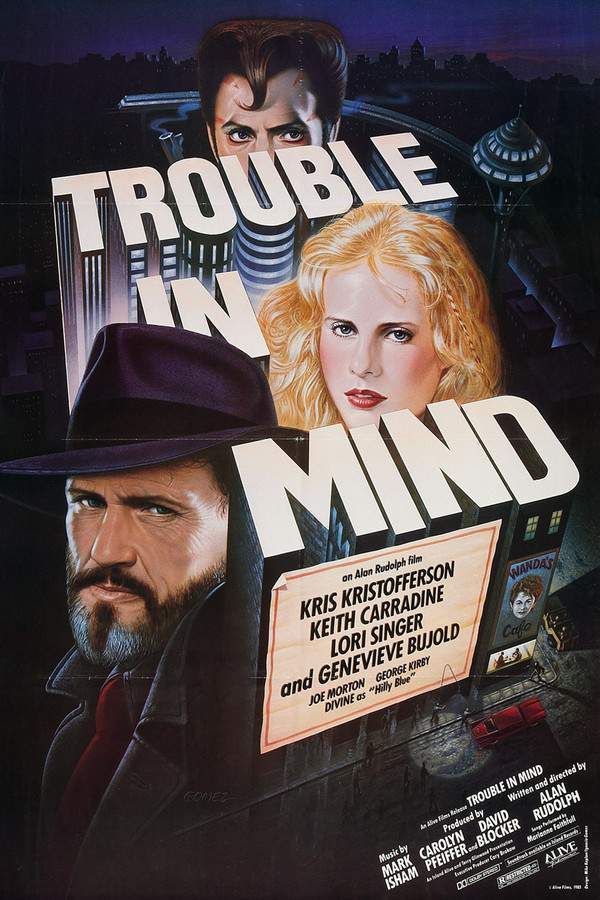
Trouble in Mind (1986) movie poster

Plot Summary

Trouble in Mind (1986) Plot Summary Explained

Release, runtime and language
1986 · 111 min · English
JustWatch #11,248 12
Directed by
Alan Rudolph
Starring
Kris Kristofferson, Keith Carradine, John Considine, Geneviève Bujold, Albert Hall, Dirk Blocker

In the crime-ridden metropolis of Rain City, a former lawman now living as a fugitive, Kris Kristofferson, finds himself caught in a web of danger. He must confront ruthless gangs and navigate the city's dark underbelly to clear his name and seek redemption for past actions. His journey is fraught with peril as he battles to uncover the truth and reclaim his honor.

On this page (7)
  1. 1 Where to watch
  2. 2 What happens: full plot
  3. 3 Plot questions answered
  4. 4 Movie threads
  5. 5 Movies like Trouble in Mind
  6. 6 Categories
  7. 7 Every angle

Where to watch

Where to Watch Trouble in Mind (1986)

Where can you watch Trouble in Mind? Stream, rent or buy it in the US, including on Amazon Prime Video, Night Flight Plus and Kanopy: current JustWatch availability with up-to-date prices.

Streaming availability powered by JustWatch

Full plot summary · contains spoilers

What Happens in Trouble in Mind: Full Plot Summary

The whole story of Trouble in Mind (1986) explained, from the opening scene to the final frame: every key event, every twist and what it all adds up to. Read it as a quick recap before the sequel, to check a scene you missed, or to finally understand what really happened.

The story unfolds in a dystopian future set within the confines of Rain City, a place reminiscent of the 1940s characterized by its strict police state and vintage attitudes. In this environment of cynicism and desperation, we meet a struggling father named Coop and his affectionate wife, Georgia, who live in a humble trailer with their small baby. Driven by the hope of securing a better life, they decide to venture into the city after Coop struggles to find a stable job.

Upon their arrival, they find themselves at Wanda's Diner, where Hawk, an ex-cop recently released from prison for murder, also makes an appearance. Wanda, Hawk's former love who owns the diner, is eager to rekindle their connection. Meanwhile, the couple becomes entangled with Solo, a cunning thug who is notorious for his literary quotes, even as he sips coffee at the diner. With his opportunistic charm, Solo ingratiates himself with Coop, leading him into a dubious scheme involving stolen jewelry intended for a local gangster named Hilly Blue, played by Glen Milstead (aka Divine).

As Hawk observes the troubling dynamics between Coop, Solo, and the vulnerable Georgia, he recognizes the potential harm to the young family and is compelled to step in. Struggling with his own disillusionment, Hawk finds himself drawn to Georgia and her gentle nature. However, as the partnership between Coop and Solo deepens, they become further ensnared in a web of criminal activity that threatens to destroy any semblance of a normal life.

The narrative escalates as Hilly Blue employs manipulation and control over various individuals to maintain his gangster empire in Rain City. The climax surfaces in a tense confrontation among Hawk, Coop, and Hilly Blue, which ultimately leads to a philosophical reflection about the true value of their lives and the paths they have chosen. The film delves into themes of redemption, the search for meaning, and the sometimes painful choices one must make to survive in a morally ambiguous world.

Last updated: May 26, 2025 at 22:02

Was this helpful?

Plot questions answered

Trouble in Mind Plot Explained: Your Questions Answered

The questions people ask most about Trouble in Mind (1986): what happens in the confusing scenes, why the characters do what they do, the twists, hidden details and what the ending means. Each answer contains spoilers.

Q1

Why does Solo target Coop for his scheme?

Solo spots Coop at Wanda's Diner and immediately recognizes him as a desperate father struggling to provide for his family. Solo's opportunistic nature makes him exploit Coop's financial vulnerability, using the promise of quick money to draw him into the stolen jewelry deal. Solo views Coop as an easy mark who can be manipulated into doing risky criminal work while Solo stays in the background.

Foreshadowing: Solo's first appearance at the diner shows him quoting literature while observing potential victims, establishing his cunning nature early.

  • solo
  • coop
  • manipulation
  • stolen jewelry
  • scheme
Q2

Why was Hawk in prison and what happens when he's released?

Hawk is an ex-cop who served time for killing a man, though the exact circumstances of the murder are not detailed in the summary. Upon his release, he returns to Rain City seeking to reconnect with Wanda, his former lover who now owns the diner. Hawk struggles to adjust to life outside prison and seeks purpose, eventually finding it by protecting Coop's family from Solo's criminal schemes.

  • hawk
  • prison
  • ex-cop
  • wanda
  • release
Q3

How does the stolen jewelry deal go wrong?

Coop enters into a crooked deal with Solo to obtain stolen jewelry intended for local gangster Hilly Blue. The plan involves reselling the stolen goods to Hilly Blue, but the scheme puts Coop and his family in grave danger. As the deal progresses, the risks escalate beyond Coop's initial understanding, drawing him deeper into criminal activity he cannot escape.

Foreshadowing: The timeline foreshadows this danger when Coop and Georgia become entangled with Solo at the diner.

  • jewelry
  • deal
  • coop
  • solo
  • hilly blue
  • stolen goods
Q4

Why does Hawk become attracted to Georgia?

Hawk is drawn to Georgia's sensitivity and innocence, qualities that stand out in the dark, cynical world of Rain City. Having spent time in prison and witnessed the city's moral decay, Hawk finds Georgia's gentle nature refreshing. This emotional connection motivates him to intervene in her situation, protecting her and her baby from the dangerous path Coop is heading down with Solo.

Foreshadowing: The narrative shows Hawk observing the troubling dynamics between Coop, Solo, and Georgia before his attraction becomes explicit.

  • hawk
  • georgia
  • attraction
  • innocence
  • protection
Q5

What is Hilly Blue's role in the story?

Hilly Blue is the local gangster who controls the criminal underworld in Rain City. He is the intended buyer of the stolen jewelry in Coop and Solo's scheme. Throughout the story, Hilly Blue manipulates events and people around him to maintain his dominance over the city's criminals. His presence creates the high-stakes environment that threatens Coop's family.

Foreshadowing: The timeline establishes Hilly Blue as someone who strategically positions himself to enforce control over others' actions.

  • hilly blue
  • gangster
  • rain city
  • crime boss
  • control
Q6

Why does Coop decide to leave the criminal path?

Coop comes to grips with the dangers his actions have brought upon his family. As he realizes how Solo has manipulated him and how the criminal lifestyle threatens Georgia and their baby, he chooses to prioritize their safety over the lure of quick money. This realization marks a pivotal turning point where Coop rejects the criminal life in favor of protecting his family.

Foreshadowing: Hawk's intervention and concern for Georgia foreshadows Coop's eventual realization about the dangers he's brought to his family.

  • coop
  • redemption
  • family
  • change
  • criminal path
Q7

What does the film's philosophical ending mean?

The film's ending presents a philosophical reflection where the characters confront the true value of their lives and the paths they've chosen. Rather than providing a clear resolution, the ending leaves their ultimate fates open to interpretation. The characters reflect on their values and the moral cost of survival in Rain City's morally ambiguous world, with the conclusion suggesting that redemption and meaning are still possible despite the darkness.

Foreshadowing: The buildup through the climax confrontation between Hawk, Coop, and Hilly Blue sets up this philosophical reflection on their choices.

  • ending
  • philosophy
  • redemption
  • values
  • choices
  • ambiguity
Q8

Why does Hawk decide to protect Georgia and her baby?

After the confrontation with Hilly Blue, Hawk finds a renewed sense of purpose. Rather than being consumed by his past mistakes as a cop who killed someone, Hawk chooses to embrace the role of protector. His attraction to Georgia and her innocence, combined with his desire for redemption, leads him to commit to safeguarding her and her baby from the dangers of Rain City.

Foreshadowing: Hawk's increasing concern for the young family throughout the story builds toward this protective decision.

  • hawk
  • protection
  • georgia
  • baby
  • redemption
  • purpose
Q9

Why is the dystopian setting of Rain City important to the story?

Rain City operates as a police state with 1940s-style architecture and attitudes, creating an environment of cynicism and desperation. This setting establishes the moral ambiguity where characters must make painful choices to survive. The oppressive atmosphere reflects the characters' struggles and provides the backdrop for themes of redemption and the search for meaning amid crime and corruption.

Foreshadowing: The opening establishes Rain City's dystopian nature, foreshadowing the moral challenges characters will face.

  • rain city
  • dystopia
  • setting
  • police state
  • atmosphere
  • 1940s
Q10

How do the characters pursue redemption in the film?

Redemption manifests differently for each character. Hawk seeks to atone for his past violence by becoming a protector. Coop reevaluates his priorities and chooses family over criminal easy money. Even Solo's manipulation can be seen as a twisted attempt to navigate a brutal system. The film explores how people search for meaning and moral redemption in a morally corrupted world.

Foreshadowing: The meta notes establish redemption as a central theme from the beginning.

  • redemption
  • moral choice
  • character arcs
  • meaning
  • survival

Movie threads

More Movies Like Trouble in Mind, by Mood & Story

Curated lists built around what makes Trouble in Mind tick: the same mood, the same kind of story or the same emotional payoff. Each list explains why these movies belong together.

Gritty Redemption Tales in Dystopian Cities like Trouble in Mind

Characters seek redemption in a cynical, crime-ridden dystopian city. If you liked the desperate search for honor in the bleak Rain City of Trouble in Mind, explore more movies like it. These films feature morally ambiguous protagonists fighting for redemption within gritty, crime-filled dystopian settings, perfect for fans of heavy, dark dramas with a steady, tense pace.

  • gritty
  • cynical
  • morally ambiguous
  • desperate
  • oppressive
  • tense
  • Tone: dark, cynical, melancholic
  • Pacing: steady, methodical
Why these movies?

The story pattern: These narratives follow a protagonist, often an outsider or fallen figure, through a labyrinthine urban underworld. The journey is less about clear victory and more about a personal, philosophical reckoning with past sins and the harsh realities of a broken society, leading to an emotionally heavy and often ambiguous conclusion.

Why they belong together: Movies in this thread share a specific combination of a dystopian or hyper-cynical urban setting, a dark and melancholic tone, and a central character arc focused on redemption amidst moral ambiguity. The pacing is typically steady, building tension towards a climax that weighs the cost of survival against the possibility of personal salvation.
Philosophical Neo-Noir Movies with a Mood like Trouble in Mind

Stylized crime stories where mood and moral questions eclipse the plot. Fans of the oppressive atmosphere and philosophical undertones of Trouble in Mind will appreciate these similar movies. This selection highlights neo-noir films that blend crime drama with heavy emotional weight and ambiguous endings, focusing on tone and theme as much as the central mystery.

  • neo-noir
  • philosophical
  • atmospheric
  • tense
  • morally ambiguous
  • melancholic
  • Tone: dark, tense, morally ambiguous
  • Pacing: steady, atmospheric
Why these movies?

The story pattern: The plot often serves as a catalyst for existential inquiry rather than the main event. Characters are trapped in situations that force them to confront bleak truths about themselves and the world. The story unfolds with a deliberate pace, emphasizing atmosphere and culminating in an ending that is contemplative and open to interpretation rather than neatly resolved.

Why they belong together: These films are grouped by their shared commitment to a specific neo-noir vibe: a dark, tense tone, a steady pacing that builds unease, and a narrative complexity that leans into thematic exploration. The experience is defined by a feeling of existential weight and a visually/stylistically cohesive, often gritty, world.

If you liked this

Movies Like Trouble in Mind

Similar movies to Trouble in Mind: the same genre, themes or kind of story. Each one comes with its own plot summary, timeline and ending explained.

Browse all movie summaries

Categories

Movie Lists Featuring Trouble in Mind

Trouble in Mind appears in these hand-built movie categories. Each one groups movies by a specific mood, theme or story type, with their plot summaries and endings explained.

View all movie categories

Every angle

Trouble in Mind (1986) Explained: Plot, Timeline & Characters

Everything about Trouble in Mind in one place: what happens in the plot summary, the timeline in chronological order, the characters and meaning and a spoiler-free summary. What's After the Movie adds the cast, box office and post-credit scenes.

Coming soon on iOS and Android

The Plot Explained Movie Summary App

Plot summaries, endings explained and timelines on your phone. Catch up on any movie in minutes, save your favorites and never miss a twist again.

Be the first to know when we launch. Your email stays private, always.

Learn more about the app