







Plot Explained Spoilers guaranteed!
Plot Explained

Browse by genre

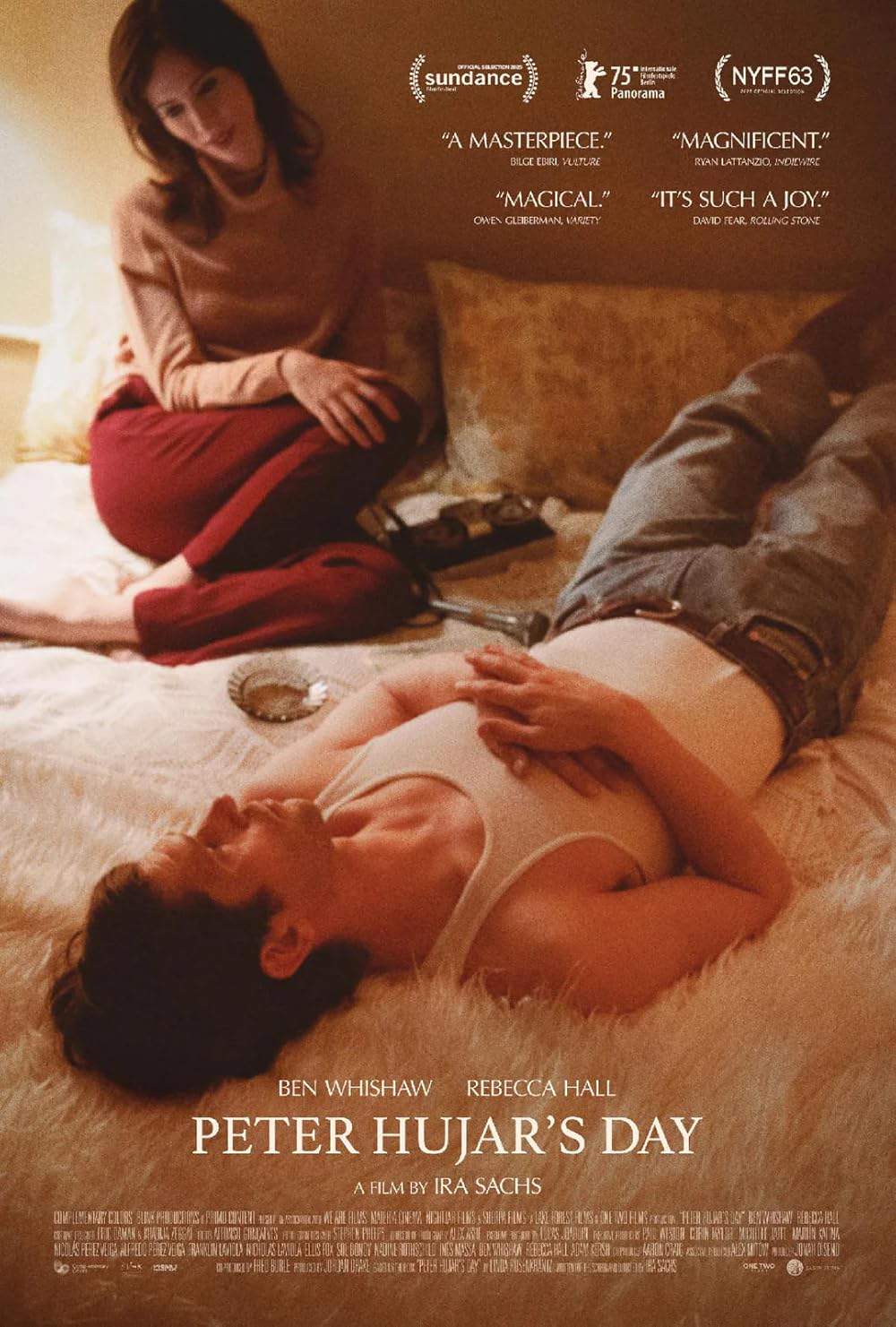
Peter Hujar's Day (2025) movie poster

Timeline

Peter Hujar's Day (2025) Timeline Explained – Every Event in Order

Release, runtime and language
2025 · 1 h 16 m
Echo score 71
JustWatch #2,922 25
Directed by
Ira Sachs
Starring
Ben Whishaw, Rebecca Hall

The newly uncovered 1974 audio dialogue between photographer Peter Hujar and his friend Linda Rosenkrantz provides a rare, candid look at New York’s downtown art world. Their conversation weaves together the cultural pulse of the era with Hujar’s personal struggles, artistic epiphanies, and the intimate dynamics that shape an artist’s life.

On this page (7)
  1. 1 Where to watch
  2. 2 Events in order (14)
  3. 3 Timeline questions answered
  4. 4 Movie threads
  5. 5 Movies like Peter Hujar's Day
  6. 6 Categories
  7. 7 Every angle

Where to watch

Where to Watch Peter Hujar's Day (2025)

Where can you watch Peter Hujar's Day? Stream, rent or buy it in the US, including on Kanopy, Amazon Video and Apple TV Store: current JustWatch availability with up-to-date prices.

Streaming availability powered by JustWatch

14 events in order · contains spoilers

Peter Hujar's Day Timeline: Events in Chronological Order

Every key event of Peter Hujar's Day (2025) in order, scene by scene, with when and where it takes place. Use it to untangle flashbacks, time jumps and parallel storylines, to refresh your memory before the sequel or to find the exact scene you are thinking of.

  1. Interview setup in Linda's SoHo apartment

    Linda begins recording as Peter recounts his previous day, sitting on the couch with a cigarette. He explains that he forgot to write things down until Linda called, and she prompts him to describe even the seemingly trivial moments. The framing sets the film’s structure as a day-in-the-life interview.

    When
    morning
    Where
    SoHo apartment
  2. Alarm and first calls of the day

    Peter wakes up to an alarm he almost misses and learns Jacqueline de Mornay will arrive to collect his Elle photographs. The call signals the start of a busy day of assignments and negotiations. He braces for the morning’s errands.

    When
    8:30 a.m.
    Where
    Peter's apartment
  3. Sontag's call and Paris plans

    Susan Sontag calls to ask for directions to Peter's gallery show, then leaves for Paris. The exchange shows how his day is threaded with literary and artistic figures. Peter juggles these calls as he tries to keep track of his schedule.

    When
    morning
    Where
    Peter's apartment
  4. Jacqueline's arrival and departure with prints

    Jacqueline arrives to collect the prints; she praises the photographs but cannot reveal payment details, which makes Peter suspicious. She departs with the prints, leaving him to tally what he’s owed. Linda interjects with questions that keep the memory of the day vivid.

    When
    late morning
    Where
    Linda's apartment
  5. Calls from neighbors and venting

    Peter handles calls from neighbor Bob Mony and artist Ed Baynard, venting to Linda about Ed's lengthy conversation. He tallies his earnings, tries to stay on top of the day’s small dramas, and bounces between the phone and the notes Linda is taking. The sense of daily tedium and ambition grows.

    When
    late morning
    Where
    Peter's apartment
  6. A nap and a second awakening

    After the flurry, Peter returns to bed for another hour, seeking rest amid the ongoing distractions. The quiet moment contrasts with the demands of the day and previews the afternoon’s portrait work. He stares at the ceiling, thinking about what lies ahead.

    When
    late morning
    Where
    Peter's apartment
  7. Call to arrange Ginsberg portrait; grocery run

    Peter buys cigarettes, then calls poet Allen Ginsberg to arrange a portrait session for The New York Times. He travels to Ginsberg's Lower East Side apartment, where the poet and his visitors linger as phone calls are wrapped up. The day’s mood shifts toward an intimate, artist-to-artist encounter.

    When
    afternoon
    Where
    Lower East Side
  8. Ginsberg session begins and outdoor plan

    Ginsberg is initially resistant, preferring outdoor photos rather than the conventional NYT portrait. He leads Peter through the neighborhood, posing among abandoned buildings and inside the burned-out Peace Eye Book Store while chanting and meditating. The environment becomes part of the portrait’s experimentation.

    When
    afternoon
    Where
    Lower East Side
  9. Indoor session and a decisive shift

    Peter explains to Ginsberg that this is his first assignment for The New York Times and that he isn't representing corporate interests. Ginsberg's attitude softens, and they retreat indoors to finish the session. On the way back, they stop at a vegetable stand to buy persimmons.

    When
    late afternoon
    Where
    Ginsberg's apartment and nearby street
  10. Burroughs talk and lingering connection

    They discuss William S. Burroughs, and they part on friendly terms, though Peter later admits the photographs didn't fully connect with the poet. The exchange leaves him contemplating how to frame his own work beyond his subjects. The afternoon mood shifts toward introspection.

    When
    late afternoon
    Where
    Ginsberg's apartment
  11. Evening routine: dinner and notes

    Back at his apartment, Peter eats a simple meal, lies to a caller to avoid socializing, and Linda reminds him to write down everything he did that day. He starts developing his film in the darkroom and keeps notes as the conversation with Linda continues. The routine blends work with memory and reflection.

    When
    evening
    Where
    Peter's apartment
  12. Visitors arrive: O’Brien, Aletti, and Lebowitz

    Glenn O’Brien, Vince Aletti, and Fran Lebowitz visit, and they discuss the Ginsberg session and Peter's feeling that he spends days working without real progress. The guests bring energy and different perspectives on photography and art. The mood deepens as the night wears on.

    When
    evening
    Where
    Peter's apartment
  13. Vince's hot-water visit and takeout

    Vince stops by because there is no hot water, and they share Chinese takeout while continuing their talk about the day’s events. The conversation touches on Peter’s sense of constant work and occasional frustration with his own ambitions. The casual meal reinforces the day’s intimate, lived-in atmosphere.

    When
    night
    Where
    Peter's apartment
  14. Night work, aging, and the closing to sleep

    Peter spends the rest of the night printing restaurant commissions, retouching his negatives, and reflecting on aging and the death of a fellow photographer. He practices a Bach piece on his harpsichord, brushes his teeth, and goes to bed, exhausted from work and smoking. Outside, sex workers talk near a parked detention-center truck as the film ends with Peter and Linda looking out at the river.

    When
    late night
    Where
    Peter's apartment

Last updated: August 02, 2026 at 13:01

Was this helpful?

Timeline questions answered

Peter Hujar's Day Timeline Explained: Your Questions Answered

When does it happen, and why in that order? The questions people ask about the chronology of Peter Hujar's Day (2025): time jumps, flashbacks, cause and effect between scenes and the correct order of events, each answered with spoilers.

Q1

What is the film Peter Hujar's Day actually based on?

Peter Hujar's Day is built entirely around a real 1974 audio recording between photographer Peter Hujar and writer Linda Rosenkrantz, who sat with him in her SoHo apartment to document a single ordinary day in his life. The film reconstructs that conversation with Ben Whishaw as Hujar and Rebecca Hall as Rosenkrantz, preserving the tape's chronology rather than inventing new scenes.

  • 1974 audio recording
  • linda rosenkrantz
  • ben whishaw
  • documentary
  • soho apartment
Q2

Why does Linda Rosenkrantz interview Peter Hujar?

Linda is working on a book project about ordinary days in the lives of artists, and she chooses Peter as one of her subjects. Her prompts push him to recount even the seemingly trivial moments, phone calls, errands, meals, so that together they form a textured portrait of a working artist's daily rhythm.

  • linda rosenkrantz
  • book project
  • artist interview
  • ordinary days
Q3

Why is Peter suspicious about the payment from Jacqueline de Mornay?

Jacqueline arrives from Elle to collect his Lauren Hutton photographs and openly praises the work, yet she cannot tell him how much he is being paid. Peter is left to puzzle over what he is owed, and Linda's questions amplify his suspicion that the arrangement is less transparent than it should be.

  • jacqueline de mornay
  • elle magazine
  • lauren hutton
  • payment
  • photographs
Q4

Why does Allen Ginsberg resist the indoor portrait session?

Ginsberg prefers outdoor environments where he can wander, chant, and meditate, so he resists the conventional New York Times portrait setup. He leads Peter through the Lower East Side, posing among abandoned buildings and inside the burned-out Peace Eye Book Store, until Peter explains the practical limits of the NYT commission and persuades him to return indoors.

Foreshadowing: Ginsberg's earlier chants during the walk foreshadow the meditative quality Peter later finds in the contact sheets.

  • allen ginsberg
  • portrait session
  • new york times
  • peace eye book store
  • lower east side
Q5

Why does Peter feel the Ginsberg photographs never fully connected?

Although the session is completed on cordial terms, Peter later admits to Linda that the resulting images feel more documentary than a true portrait. The chemistry between photographer and subject never quite clicked, which prompts him to reflect on whether photography can stand on its own, independent of the fame of the person in front of the lens.

  • allen ginsberg
  • portrait
  • documentary photography
  • artistic ambition
  • contact sheets
Q6

Why does Peter lie to callers in the evening?

Peter fabricates reasons to keep people at a distance because he needs to develop film in the darkroom and finish printing for the next day's commissions. The excuses are a form of self-protection, allowing him to guard his working hours from the social pull of New York's downtown art world.

Foreshadowing: Peter's earlier venting about lengthy phone calls foreshadows his growing need to retreat into solitary work.

  • darkroom
  • solitude
  • phone calls
  • print work
  • social avoidance
Q7

Why do friends visit Peter's apartment at night?

Vince Aletti stops by because his own building has no hot water, and the visit quickly turns into a shared meal of Chinese takeout. Glenn O'Brien and Fran Lebowitz drift in as well, and the impromptu gathering becomes a space to decompress, discuss the Ginsberg session, and sit with Peter's sense that his working days rarely add up to recognition.

  • vince aletti
  • glenn obrien
  • fran lebowitz
  • chinese takeout
  • hot water
Q8

What does Peter's reflection on aging and mortality reveal?

As Peter retouches prints in the darkroom, his fading eyesight becomes a practical obstacle, and the conversation turns to the recent death of a fellow photographer and the slow toll of the body. These reflections ground his artistic ambition in a finite life, lending the day a melancholy undercurrent rather than a resolved sense of purpose.

Foreshadowing: Peter's earlier complaint about not writing things down hints at the impermanence he returns to at night.

  • aging
  • mortality
  • eyesight
  • fellow photographer
  • darkroom
Q9

Why does Peter Hujar's Day end with Peter and Linda looking out at the river?

After reconstructing every significant and trivial moment of the day, the two share a quiet, reflective silence at the window. The closing image seals the day's accumulated fragments in stillness, framing the film as a meditation on the worth of small, truthful moments rather than on grand artistic gestures.

Foreshadowing: The view of the river echoes Peter's earlier descriptions of the city outside, tying the day full circle.

  • ending
  • river
  • silence
  • reflection
  • linda rosenkrantz
Q10

Why does Peter feel he works constantly without a sense of achievement?

Peter tells Linda that his days are filled with commissions, errands, darkroom labor, and endless phone calls, yet the accumulation rarely feels like meaningful progress. The gap between constant effort and recognition becomes one of the film's quiet thematic anchors, especially as his visitors echo the same frustration.

Foreshadowing: His tallying of earnings earlier in the day previews the feeling that labor is not translating into reward.

  • artistic ambition
  • recognition
  • labor
  • frustration
  • commissions
Q11

How does the original audio recording shape the film's storytelling?

Because the film is built directly from the 1974 tape, it unfolds in real-time conversation rather than dramatic scenes. Linda's prompts act as the narrative engine, carrying the story from the morning alarm through the Ginsberg shoot and into the late-night darkroom, which gives the film its slow, deliberate pacing and its unusually faithful sense of an actual day.

  • audio recording
  • real-time
  • narrative structure
  • pacing
  • conversation
Q12

Why does Peter practice a Bach piece on the harpsichord before bed?

The harpsichord routine offers a disciplined, solitary ritual that exists outside his commercial photography work. It signals that Peter's identity is not only that of a working artist-for-hire but also of someone pursuing a quieter, more personal craft, and it gives the night a sense of closure before he finally goes to sleep.

Foreshadowing: His earlier return to bed in the late morning foreshadows the way the day is bookended by rest and small private rituals.

  • bach
  • harpsichord
  • ritual
  • solitude
  • night routine

Movie threads

More Movies Like Peter Hujar's Day, by Mood & Story

Curated lists built around what makes Peter Hujar's Day tick: the same mood, the same kind of story or the same emotional payoff. Each list explains why these movies belong together.

Conversational day portraits like Peter Hujar's Day

Films that turn a single unremarkable day into an intimate, unhurried revelation. Looking for movies like Peter Hujar's Day? This thread gathers slow, low intensity films that follow a single uneventful day through conversation, observation, and quiet intimacy. Perfect if you enjoyed the documentary-like rhythm, the unhurried pace, and the feeling of simply listening in on an artist's life.

  • conversational
  • intimate
  • quiet
  • documentary-like
  • observational
  • reflective
  • Tone: melancholic, intimate, conversational
  • Pacing: slow, unhurried, observational
Why these movies?

The story pattern: Stories in this thread follow a compressed timeframe, often a single afternoon, evening, or day, unfolding largely through dialogue and ambient detail rather than plot mechanics. Characters move through ordinary routines, phone calls, walks, and shared silences while inner lives, creative anxieties, and relationships surface through what is said and left unsaid. There is little conventional conflict; the drama lives in attention itself, in the texture of a voice, a pause, or a passing thought. The structure tends to be linear and cyclical, closing where it opened, sealing the day in a reflective mood.

Why they belong together: Films are grouped here because they share a documentary-like intimacy and a willingness to trust the audience with stillness. The pacing is deliberately slow, the intensity low, and the emotional register contemplative. What unites them is the commitment to treating a small slice of time as worthy of close attention, and the sense that revelation can come from the most mundane exchanges when you listen carefully enough.

Melancholic artist portraits like Peter Hujar's Day

Bittersweet portraits of creators reckoning with time, vision, and recognition. If you liked Peter Hujar's Day, these movies like it share its bittersweet, low intensity approach to creative ambition, memory, and mortality. Expect quiet biographies and character studies that linger on the texture of an artist's day, the weight of aging, and the small epiphanies that make a creative life worth documenting.

  • melancholic
  • bittersweet
  • introspective
  • nostalgic
  • artistic
  • contemplative
  • Tone: melancholic, bittersweet, reflective
  • Pacing: slow, steady, meditative
Why these movies?

The story pattern: Stories in this thread center on a single creative figure or a tight circle of makers, tracing the textures of their working day and inner monologue. External plot is minimal, but thematic pressure is constant: time passing, bodies failing, peers disappearing, ambitions unmet or quietly fulfilled. Characters oscillate between self-doubt and stubborn devotion to their craft, and the narrative often drifts through memories, phone calls, and small commissions rather than rising to a conventional climax. Endings are typically bittersweet and contemplative, leaving the artist mid-process rather than triumphant or defeated.

Why they belong together: These films are grouped because they share a melancholic but loving gaze on creative lives lived away from mainstream success. They tend to be slow, low intensity, and emotionally weighted by themes of aging, mortality, and artistic integrity, often set in specific artistic communities or eras. The viewer experience is meditative rather than thrilling, prioritizing atmosphere, conversation, and the dignity of small, sustained work.

If you liked this

Movies Like Peter Hujar's Day

Similar movies to Peter Hujar's Day: the same genre, themes or kind of story. Each one comes with its own plot summary, timeline and ending explained.

Browse all movie summaries

Categories

Movie Lists Featuring Peter Hujar's Day

Peter Hujar's Day appears in these hand-built movie categories. Each one groups movies by a specific mood, theme or story type, with their plot summaries and endings explained.

View all movie categories

Every angle

Peter Hujar's Day (2025) Explained: Plot, Ending, Timeline & Characters

Everything about Peter Hujar's Day in one place: what happens in the plot summary, the timeline in chronological order, the characters and meaning, the ending explained and a spoiler-free summary. What's After the Movie adds the cast, box office and post-credit scenes.

Coming soon on iOS and Android

The Plot Explained Movie Summary App

Plot summaries, endings explained and timelines on your phone. Catch up on any movie in minutes, save your favorites and never miss a twist again.

Be the first to know when we launch. Your email stays private, always.

Learn more about the app