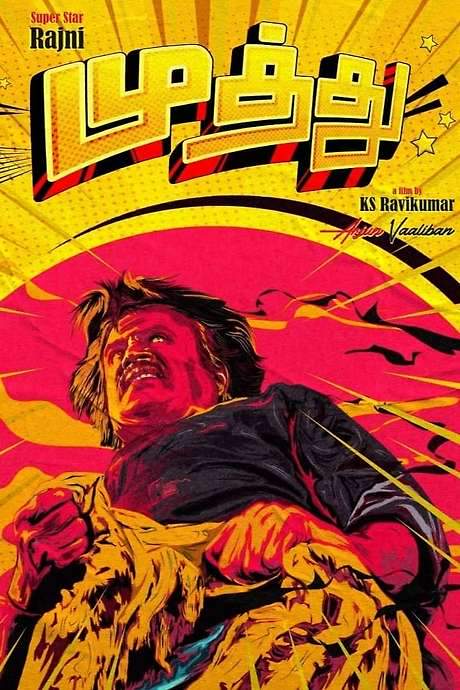
Muthu is a skilled charioteer who works for the stern zamindar, Raja Malayasimman. The tale opens with a chance moment of romance aboard a bustling stage: while watching a play, Ranganayaki catches the eye of Raja when a garland she throws accidentally lands on him, sparking an immediate, undeniable connection. When Raja witnesses another of her performances and sees a local village chief harassing her, he tasks Muthu with protecting her, urging him to act quickly. In a fierce confrontation, Muthu fights off the chief’s goons and rescues Ranganayaki, but more danger looms as reinforcements arrive. To keep her safe, Raja orders Muthu to slip away with her in a sturdy two-horse chariot while he holds off the attackers. Trusting his king’s plan, Muthu carries Ranganayaki to safety, and the pair make a tense exit from the looming threat.
Despite the danger and the abruptness of their flight, Ranganayaki initially resists Muthu’s company, yet circumstances press them together until they reach a calmer path. They wander far enough to land in the lush state of Kerala, where language barriers complicate their journey. Muthu, who does not know Malayalam, gets into a humorous scrape while asking passersby for a kiss—something that Ranganayaki later corrects, teaching him the mistake and guiding him toward comprehension. The moment of clarity comes with a surprised, sincere kiss, and what began as rescue blossoms into something deeper: the two fall in love and eventually return to the royal palace, where the story’s emotional center expands beyond a simple romance.
Back at the palace, Ranganayaki reveals a more complex menace: she is secretly fleeing her abusive brother-in-law, Prathap Rayudu, who has already claimed the life of her sister and now hunts her down. To protect her, she seeks continued sanctuary at the palace, drawing in a circle of allies who will later become pivotal to the unfolding drama. The palace’s power dynamics heat up as the maternal uncle, Ambalathar, plots to seize control of Raja’s wealth by arranging a marriage between Raja and his own daughter, Padmini. The old queen, Sivakamiyammal (a steady voice in the family), urges her son to marry Padmini, while Raja secretly dreams of wedding Ranganayaki. When the truth comes to light, Raja’s desire to marry Ranganayaki clashes with family ambitions, and Ambalathar’s scheming intensifies.
The tension erupts when Ambalathar’s machinations trigger a public conflict: he engineers a situation by whispering to a palace informer, Kaali, that Muthu is persuading Ranganayaki to marry him. Believing Kaali’s misinterpretations, Raja becomes furious and orders Muthu out of the palace, subjecting him to a beating by Kaali. Muthu, shaken and silent, endures the humiliation, while Sivakamiyammal returns from a temple visit to confront the grim reality and defend the truth. She admits to a buried history—the zamindar once raised the child Muthu as a commoner, after discovering that his own nephew, Rajasekharan, had used deceit to seize the estate. The zamindar himself, heartbroken and burdened by betrayal, shifts away with the infant Muthu, while Sivakamiyammal becomes the custodian of the boy’s early life. The tale delves into the backstory: Rajasekharan’s fraudulent actions, the zamindar’s eventual decision to let his son grow up away from the palace, and the subsequent truth that the former ruler lives nearby as a mystic nomad, hidden from the world.
As the secret deepens, Raja resolves to locate the real zamindar, hoping to rectify the land’s rightful ownership. Kaali overhears this plan and reports back to Ambalathar, who sees an opportunity to murder Raja and frame Muthu, clearing the path to a seamless transfer of wealth and power. Kaali ambushes Raja, casts him into a waterfall, and declares that Muthu was the killer. In a dramatic reversal, Muthu fights Kaali and forces him to reveal Ambalathar’s orders. The villagers rally behind Raja as Ambalathar’s treachery is exposed, and the pursuit winds through the countryside until Raja reaches the scene with his betrothed, Padmini. The zamindar’s true identity is finally acknowledged, and he is reconciled with the past; the man who once dictated terms with Ambalathar has the courage to forgive him.
The climactic chapters bring closure to a long-standing conflict: Raja returns to his rightful family, the zamindar who once walked away, and mends the broken ties with Muthu. The zamindar’s rescue of Raja and the wedding to Padmini unfold as a relief after years of scheming. In a pivotal moment, Raja pardons Ambalathar, choosing not to let old grudges derail the family’s future. With the truth revealed, Muthu learns of his true lineage and, though offered the reins of the estate, chooses to live as a worker—embracing a life of dignity grounded in labor rather than titles. The narrative closes on a nuanced note: a man who could have reclaimed power instead selects humility, while the bond between Muthu and Ranganayaki remains steadfast, a testament to their love formed in hardship, danger, and unwavering loyalty.
In this sweeping saga of loyalty, family intrigue, and the tension between power and rightful place, the characters navigate a landscape where love meets duty, and where the past’s shadows illuminate the path to a quieter, more principled future.