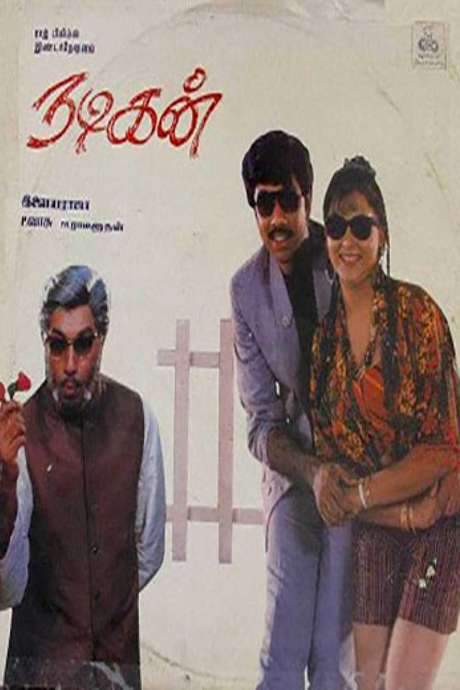
In this twisting tale of ambition, deception, and family loyalties, Vishwanathan—a ruthless financier—finds a deadly way to keep control of massive profits. He coldly murders his partner Raghu, staging the scene as a suicide to avoid scrutiny, and then pretends to grieve at his daughter’s wedding. A hidden videographer, who records a key conversation between Vishwanathan and a henchman about the murder, escapes with the incriminating tape, only to be killed later in a theater by Vishwanathan’s men. The body vanishes before Geetha can report the crime, and the danger intensifies as Vishwanathan’s associates close in on Geetha, who unwittingly holds the damning evidence.
Geetha, her sister Radha, their younger siblings, and their stern aunt, Anandha Karpagavalli, live on a sprawling island estate in the misty hills of Kodaikanal. Karpagavalli is a traditional, exacting guardian who strips away some freedoms and enforces strict rules that stifle the girls’ lives. The estate becomes the center of a delicate power balance between old-world discipline and the yearning for independence that Geetha and Radha secretly crave.
On the streets below, Raja, a resourceful but impoverished performer, tries to keep his mother’s health needs afloat. With a bypass surgery looming and 30 days to raise funds, Raja takes a desperate turn when he and a traveling music teacher named Devaraj cross paths on a train journey toward the island estate. Their lives collide in a sudden mix-up: a swapped suitcase exchange leaves Raja with Devaraj’s job offer and a letter of recommendation. Desperate, he disguises himself as an elderly, bearded Devaraj and lands the role of music teacher and caretaker at the estate, hoping the position will fund his mother’s operation.
Meanwhile, the real Devaraj struggles to find the island estate, hampered by language barriers and a miscommunication that makes “Is-land” sound like a mystery to those he seeks. As the imposter “Devaraj” settles in, he earns Karpagavalli’s trust by lavishing praise on her and positioning himself as a gentle, unmarried elder with a heart of wisdom. The deception buys him entry into the household, where Geetha and Radha begin to experiment with newfound freedoms. They test the boundaries of their aunt’s rules, finding moments of light within the rigid structure and even sparking a romantic tension between Geetha and the enigmatic “Devaraj.”
Yet Geetha’s gaze gradually shifts when she is rescued by the true Raja from Vishwanathan’s henchmen. She comes to see Raja not as an ordinary caretaker, but as a guardian who has stepped into a dangerous world to protect her. As the days unfold, a petty thief named Kannayiram slips into the estate’s orbit, hiding from the law and eventually presenting a new complication: he uses a forged identity as Kandhasamy, Devaraj’s pretend brother, to maneuver within the household. His presence destabilizes the fragile balance and forces Raja to confront the consequences of living a double life.
With Karpagavalli starting to relax her strict regime—allowing Geetha and Radha to dress more freely, and even considering a future for Radha with Inspector Chinni—an unspoken tension grows. She invites “Devaraj,” not realizing the impostor’s true identity, into closer proximity with the family, hoping to weave harmony through the household. Vishwanathan, never far from the thread of evidence, sends two women to retrieve the cassette that could convict him. Geetha, ever practical, feeds the possibility of a life beyond fear, and at one point even nudges Karpagavalli toward a possible union between Raja and “Devaraj,” unaware that the match she is hinting at is in fact a ruse.
The tale thickens when Geetha’s friend Maya sends the vital video cassette to Chinni, the local inspector, as a potential avenue for justice. But Vishwanathan’s henchwomen abduct Geetha at knifepoint and seize the tape, forcing a perilous cliffhanger: will the evidence reach the authorities in time, or will Vishwanathan’s power suppress the truth? Raja springs into action, rescuing Geetha, while Vishwanathan retaliates by kidnapping Geetha’s family and demanding the cassette as the price of their safety.
A high-stakes rescue operation ensues, with Raja joining forces with Kannayiram to slip past the guards and free the family. The confrontation exposes the full extent of Vishwanathan’s criminal reach, and Karpagavalli’s evolving perception of the “Devaraj” persona adds a dramatic layer to the dynamic in the estate. After a tense road chase and a series of decisive moves, Raja’s relentless determination leads to the capture of Vishwanathan’s henchmen and the fall of the corrupt network that had threatened the entire household.
In the aftermath, the truth comes into sharper focus: the real Devaraj, whose suitcase was mistakenly swapped with Raja’s, finally locates the island estate. He arrives just as the family begins to regroup, and a final, quiet moment of recognition emerges between him and Karpagavalli. The story closes with the promise of legitimate opportunity for the music program and a return to stability for the estate, as Devaraj steps forward to accept the position as music teacher, bringing with him a measure of clarity and closure that had been missing since the outset.
Throughout, the film balances high-stakes crime and courtroom intrigue with intimate, character-driven moments. The juxtaposition of Vishwanathan’s cold calculations against the warmth and resilience of the island family creates a narrative that is as much about survival and moral choices as it is about suspense and dramatic reversals. The emotional currents—Geetha’s growth, Raja’s sacrifice, and Karpagavalli’s gradual shift from iron-clad authority to protective ally—give the story a grounded heart while the plot’s twists propel it through a series of escalating confrontations, culminating in a resolution that reaffirms family bonds and the possibility of a hopeful future on the Kodai estate.