












Plot Explained Spoilers guaranteed!
Plot Explained

Browse by genre

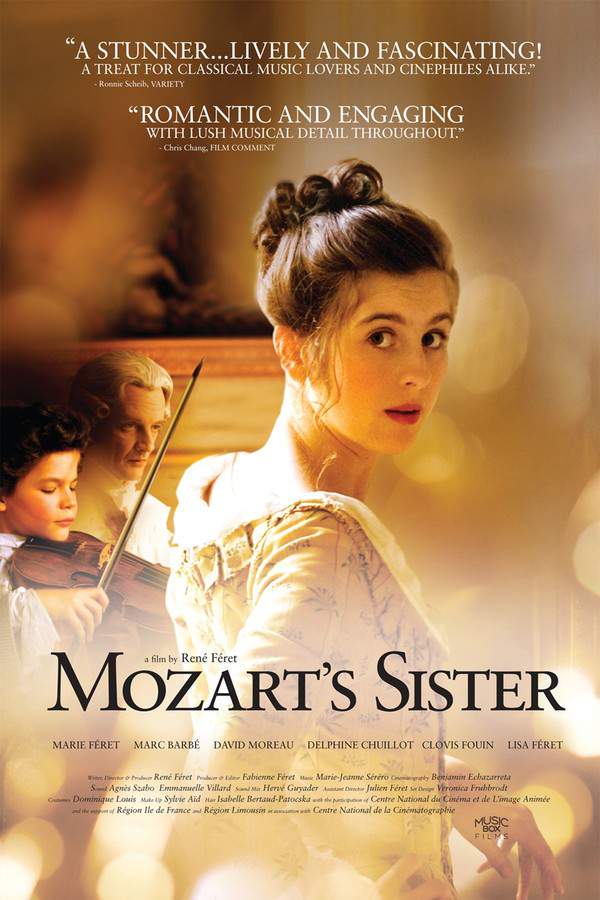
Mozart's Sister (2011) movie poster

Plot Summary

Mozart's Sister (2011) Plot Summary Explained

Release, runtime and language
2011 · 120 min · French
Directed by
René Féret
Budget
$4.5M

Maria Anna "Nannerl" Mozart, a gifted violinist and composer, faces societal pressures as she nears marriageable age. This drama reimagines her story, portraying her struggle against the constraints that limit her musical aspirations. Overshadowed by her brother Wolfgang's rising fame, Nannerl fights to have her own talent recognized and to find her place in a world that seeks to silence her.

On this page (6)
  1. 1 Where to watch
  2. 2 What happens: full plot
  3. 3 Plot questions answered
  4. 4 Movie threads
  5. 5 Movies like Mozart's Sister
  6. 6 Every angle

Where to watch

Where to Watch Mozart's Sister (2011)

Where can you watch Mozart's Sister? Stream, rent or buy it in the US, including on OVID, Fawesome and Hoopla: current JustWatch availability with up-to-date prices.

Streaming availability powered by JustWatch

Full plot summary · contains spoilers

What Happens in Mozart's Sister: Full Plot Summary

The whole story of Mozart's Sister (2011) explained, from the opening scene to the final frame: every key event, every twist and what it all adds up to. Read it as a quick recap before the sequel, to check a scene you missed, or to finally understand what really happened.

During the Mozart family's grand tour, a problematic carriage axle leads Leopold Mozart, his wife Anna, their 14-year-old daughter Nannerl, and the lively 11-year-old Wolfgang to take refuge in the nearby Fontevraud Abbey. Here, Nannerl forms a meaningful friendship with the 13-year-old Princess Louise of France, who resides in the Abbey alongside two of her sisters. This connection paves the way for a significant encounter at Versailles with Louise's brother, Louis, Dauphin of France.

Nannerl, a prodigious harpsichordist and vocalist who contributes to her family's income through a brother-sister performance act, harbors dreams of composing and mastering the violin. However, her ambitions are stifled by her father's insistence that she must not pursue these interests. Intriguingly, the young, recently widowed Dauphin becomes captivated by her talent and passion for music, sparking a romance that eventually fizzles out when he becomes engaged to Maria Josepha of Saxony, the new Dauphine of France.

As Princess Louise enters a convent, she advises Nannerl to distance herself from the Dauphin, who is battling to resist the temptations brought on by his father, King Louis XV. The story culminates in a bizarre final meeting between Nannerl, the Dauphin, and his new wife. In a poignant moment of reflection, Nannerl and Princess Louise ponder how drastically their lives would have changed had they been born male.

Last updated: November 15, 2024 at 20:16

Was this helpful?

Plot questions answered

Mozart's Sister Plot Explained: Your Questions Answered

The questions people ask most about Mozart's Sister (2011): what happens in the confusing scenes, why the characters do what they do, the twists, hidden details and what the ending means. Each answer contains spoilers.

Q1

Why does Leopold Mozart forbid Nannerl from pursuing music?

Leopold Mozart insists that Nannerl must not pursue composing or learning the violin because she is approaching marriageable age. In 18th-century society, a woman's primary role was to marry well and manage a household, not pursue a professional musical career. Despite Nannerl's exceptional talent as a harpsichordist and vocalist, her father views her musical ambitions as incompatible with her future as a wife and mother.

  • leopold mozart
  • nannerl
  • gender roles
  • 18th century
  • musical career
Q2

How does Nannerl meet the Dauphin at Versailles?

During the Mozart family's grand tour, their carriage breaks down at Fontevraud Abbey, where Princess Louise of France is staying with her sisters. Nannerl befriends Louise, and this friendship leads to an invitation to Versailles, where she encounters Louis, the Dauphin of France. The Dauphin becomes captivated by Nannerl's extraordinary musical talent and passion.

Foreshadowing: The friendship with Princess Louise at the Abbey is what opens the door to the royal court at Versailles.

  • versailles
  • dauphin
  • princess louise
  • meeting
  • royal court
Q3

Why does the Dauphin's engagement end his relationship with Nannerl?

The Dauphin becomes engaged to Maria Josepha of Saxony, the new Dauphine of France. This royal engagement forces him to end his romance with Nannerel. As heir to the French throne, he cannot pursue a relationship with a commoner and foreign musician, especially after marrying. His duty to the French monarchy supersedes his personal feelings.

  • dauphin
  • maria josefa of saxony
  • engagement
  • royal duty
  • france
Q4

Why does Princess Louise decide to enter a convent?

Princess Louise chooses to enter a convent as a life path, which was a common option for royal daughters who did not marry. Before leaving, she advises Nannerl to distance herself from the Dauphin, recognizing that his royal duties and the pressures from King Louis XV would ultimately prevent him from being with her.

  • princess louise
  • convent
  • religious life
  • french royalty
Q5

What happens during the final meeting between Nannerl, the Dauphin, and his wife?

The final meeting is described as bizarre because Nannerl encounters both the Dauphin and his new wife Maria Josepha of Saxony together. This awkward encounter brings closure to their complicated relationship, with Nannerl witnessing firsthand the reality of the life the Dauphin chose instead of her.

  • final meeting
  • maria josefa of saxony
  • closure
  • dauphine
Q6

Why can't Nannerl pursue her dream of composing and playing the violin?

Nannerl cannot pursue these ambitions because 18th-century society prohibited women from professional musical careers. While her brother Wolfgang gains fame as a composer, Nannerl's talents are expected to support the family financially through performances until she marries. Composing and violin-playing were considered inappropriate for women, leaving her dreams permanently out of reach.

  • composing
  • violin
  • gender discrimination
  • 18th century
  • suppressed talent
Q7

How does King Louis XV influence the Dauphin's relationship with Nannerl?

King Louis XV exerts pressure on his son to fulfill his royal duties and resist personal temptations. This pressure from the king complicates the Dauphin's feelings for Nannerl, as he struggles between his genuine attraction to her and his obligations to the French monarchy. The king's influence represents the broader constraints of royal life that prevent the relationship.

  • king louis xv
  • royal pressure
  • father son
  • monarchy obligations
Q8

What happens to Nannerl's musical career by the end of the movie?

By the end of the movie, Nannerl does not achieve her dream of becoming a composer or professional musician. The story ends with her reflecting on how different her life would have been if she were born male. She gains perspective through her experiences but remains resigned to the limitations society imposed on women of her era.

  • fate
  • career ending
  • unfulfilled dreams
  • resignation
Q9

Why does the movie focus on Nannerl instead of Wolfgang Mozart?

The movie reimagines the untold story of Maria Anna Mozart, Wolfgang's older sister, who was also a prodigious musician but whose career was cut short by societal expectations. Rather than recount Wolfgang's well-known story, the film explores the historical gap in records about Nannerl and asks what might have been if women had equal opportunities in music.

  • maria anna mozart
  • wolfgang
  • historical fiction
  • untold story
Q10

What historical context explains Nannerl's limited opportunities?

In the 18th century, women were legally and socially prevented from pursuing professional careers, including music. Even aristocratic women had few options beyond marriage or religious life. Nannerl's situation reflects the real historical constraints faced by women artists, who were typically patronized rather than allowed to compose or perform professionally.

  • historical context
  • 18th century women
  • gender inequality
  • music history

Movie threads

More Movies Like Mozart's Sister, by Mood & Story

Curated lists built around what makes Mozart's Sister tick: the same mood, the same kind of story or the same emotional payoff. Each list explains why these movies belong together.

Stories of Suppressed Artistic Ambition like Mozart's Sister

Gifted individuals fighting against societal constraints to express their creativity. For viewers who appreciated the struggle for creative expression in Mozart's Sister, this collection features movies about talented individuals whose artistry is constrained by society, gender, or family. Discover similar historical dramas and character studies exploring unfulfilled potential and the fight for recognition.

  • frustrating
  • reflective
  • oppressive
  • quietly intense
  • melancholic
  • resigned
  • Tone: melancholic, reflective
  • Pacing: slow, character-driven
Why these movies?

The story pattern: These narratives typically follow a gifted but constrained protagonist, often a woman or outsider, whose artistic ambitions clash with the expectations of their society, family, or era. The conflict is internal and societal, leading to a journey of quiet defiance, fleeting triumphs, and often a bittersweet acceptance of their circumstances.

Why they belong together: Movies in this thread share a core theme of artistic suppression, a melancholic tone derived from unfulfilled potential, and a character-driven, slow-paced approach. They resonate through their exploration of talent silenced by circumstance, creating a powerful, reflective viewing experience.
Movies with Quiet Historical Melancholy like Mozart's Sister

Slow-burn period dramas steeped in reflective sadness and restrained emotion. If you liked the slow-paced, reflective, and melancholic atmosphere of Mozart's Sister, this thread highlights similar historical dramas. These films share a quiet intensity, a focus on emotional nuance over action, and a bittersweet feel, perfect for viewers seeking thoughtful period pieces.

  • melancholic
  • dreamlike
  • reflective
  • oppressive
  • atmospheric
  • poignant
  • Tone: melancholic, bittersweet
  • Pacing: slow, atmospheric
Why these movies?

The story pattern: Stories in this thread unfold slowly, prioritizing mood and character reflection over complex plotting. They often depict individuals navigating restrictive historical settings, leading to an emotional journey marked by resignation, subtle defiance, and a profound sense of what might have been.

Why they belong together: These films are grouped by their shared vibe: a specific blend of historical setting, melancholic tone, slow pacing, and medium intensity that creates a uniquely poignant and immersive experience. The similarity lies in the overall felt experience rather than a specific plot.

If you liked this

Movies Like Mozart's Sister

Similar movies to Mozart's Sister: the same genre, themes or kind of story. Each one comes with its own plot summary, timeline and ending explained.

Browse all movie summaries

Every angle

Mozart's Sister (2011) Explained: Plot, Timeline & Characters

Everything about Mozart's Sister in one place: what happens in the plot summary, the timeline in chronological order, the characters and meaning and a spoiler-free summary. What's After the Movie adds the cast, box office and post-credit scenes.

Coming soon on iOS and Android

The Plot Explained Movie Summary App

Plot summaries, endings explained and timelines on your phone. Catch up on any movie in minutes, save your favorites and never miss a twist again.

Be the first to know when we launch. Your email stays private, always.

Learn more about the app