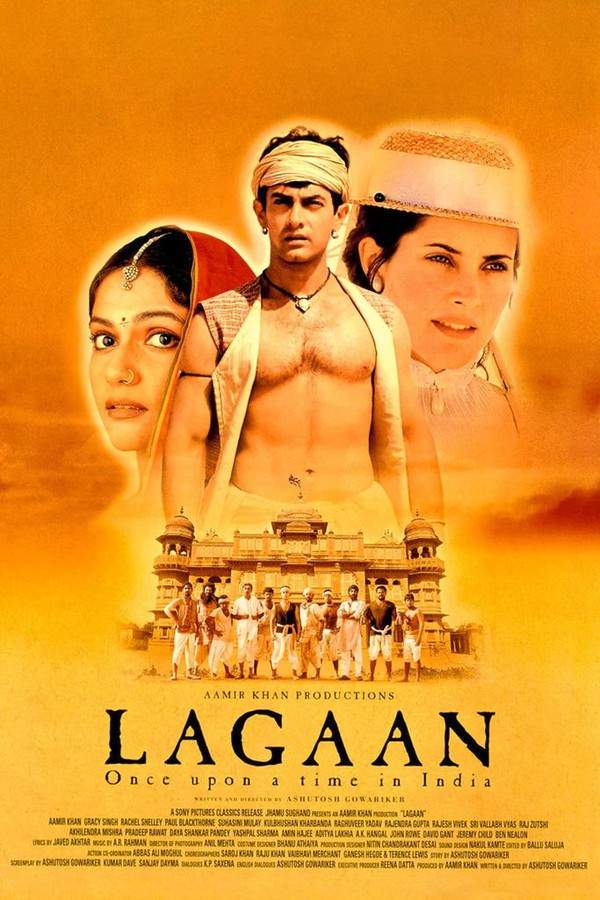
Lagaan: Once Upon a Time in India

Lagaan: Once Upon a Time in India

Year: 2002

Runtime: 224 min

Language: Hindi

Director: Ashutosh Gowariker

DramaSportRomanceMusical

In 1893, a small Indian village struggles under the weight of an oppressive land tax imposed by British authorities. When a defiant farmer named Bhuvan challenges the tax, the ruthless Captain Russell proposes a unique solution: a cricket match. If the villagers can defeat Russell’s team, they will be spared the crippling tax. The stakes are high, and the odds are stacked against them, but the villagers find themselves united in a desperate fight for their freedom and livelihood.

Where to Watch Lagaan: Once Upon a Time in India?

Find where to stream, rent, or buy Lagaan: Once Upon a Time in India (2002) in the US with current JustWatch availability, up-to-date pricing, and platform listings for subscription, rental, and digital purchase options.

Warning: spoilers below!

Haven’t seen Lagaan: Once Upon a Time in India yet? This summary contains major spoilers. Bookmark the page, watch the movie, and come back for the full breakdown. If you're ready, scroll on and relive the story!

Timeline – Lagaan: Once Upon a Time in India (2002)

Trace every key event in Lagaan: Once Upon a Time in India (2002) with our detailed, chronological timeline. Perfect for unpacking nonlinear stories, spotting hidden connections, and understanding how each scene builds toward the film’s climax. Whether you're revisiting or decoding for the first time, this timeline gives you the full picture.

1

High Taxes Imposed

In 1893, during the height of the British Empire in India, Captain Andrew Russell imposes high taxes on the villagers of Champaner due to a prolonged drought. This tax, known as 'lagaan', is unbearable for the villagers who are struggling to survive in severe conditions.

1893 Champaner, Gujarat
2

Villagers Seek Help

Desperate for help, the villagers approach Raja Puran Singh for assistance. Unfortunately, the Raja informs them that he is bound by British law and regrets that he cannot help them in their plight against the oppressive tax.

Raja's Palace
3

Introduction to Cricket

During their struggle, the villagers encounter a game of cricket for the first time. Bhuvan, the leader of the villagers, initially mocks the game, displaying his disdain for the British and their culture.

Champaner
4

The Wager

Captain Russell, taking a disliking to Bhuvan, offers a wager: if the villagers can defeat his cricket team, their taxes will be canceled for three years. However, if they lose, their taxes will triple. Bhuvan accepts the challenge without consulting the villagers.

Captain Russell's Camp
5

Villagers' Anger

Upon learning of the wager, the villagers rage against Bhuvan for accepting such a risky bet. Bhuvan argues the importance of standing against British oppression, gradually rallying support from the villagers to practice for the match.

Villagers' Meeting Place
6

Team Formation

Bhuvan starts to form a cricket team but struggles initially to find teammates. He is joined by a few willing villagers and is eventually aided by Russell's sister, Elizabeth, who helps them understand the game, while also developing feelings for Bhuvan.

Champaner
7

Conflict with Gauri and Lakha

As the team prepares, tension arises between Bhuvan, Gauri (who is in love with him), and Lakha, who also loves Gauri and seeks to undermine Bhuvan by acting as a spy for Russell. This results in personal conflicts amidst the team's preparation.

Villagers' Practice Ground
8

Including Kachra

To complete his team, Bhuvan invites Kachra, an untouchable known for his bowling skills. Despite initial refusals based on prejudice, Bhuvan convinces the villagers to accept Kachra as a member of their team, showing unity in their fight against colonial rule.

Villagers' Meeting Place
9

The Cricket Match Begins

The day of the match arrives, and Captain Russell's team begins by batting first. They score aggressively, leading Bhuvan's team to face a daunting challenge as the British officers dominate the game.

Cricket Field, Champaner
10

Lakha's Betrayal and Redemption

During the match, Lakha's initial betrayal affects the team's performance, as he drops crucial catches. However, after witnessing Elizabeth's concern, he seeks redemption by making a spectacular catch later in the game, aiming to restore his loyalty to the team.

Cricket Field, Champaner
11

Kachra's Hat Trick

With determination, Kachra is brought back to bowl and delivers an unexpected hat trick, leading to a miraculous collapse of the British batting lineup. His performance rejuvenates the villagers' spirit and confidence in fighting for their freedom.

Cricket Field, Champaner
12

Tension in the Final Overs

As the match progresses, the villagers struggle with injuries and the pressure of the game. With limited players and the required runs dwindling, the situation becomes tense as they fight against the odds to secure a victory.

Cricket Field, Champaner
13

The Dramatic Finish

In a nail-biting final over, Kachra's single leads to an unexpected no ball that allows Bhuvan to return to bat. He swings with all his might and, through a twist of fate, secures a six, winning the match for his team and marking a moment of triumph over British rule.

Cricket Field, Champaner
14

Aftermath of the Victory

With their victory, Bhuvan's team witnesses the disbandment of the British cantonment. Captain Russell is forced to pay the taxes of the province and is transferred, while Bhuvan's triumph leads to newfound hope for the villagers.

Champaner
15

The Return to Normalcy

Following the match, the villagers celebrate their victory and Bhuvan's love for Gauri blossoms, culminating in their marriage. Meanwhile, Elizabeth, heartbroken but respectful of their love, returns to London, forever changed by her experiences in India.

Champaner

Last updated: May 21, 2025 at 07:31

Was this helpful?

Lagaan: Once Upon a Time in India (2002) Timeline Questions Answered – Chronology FAQ

Find frequently asked questions about the Lagaan: Once Upon a Time in India (2002) timeline, including chronological order, nonlinear jumps, cause-and-effect links, and scene sequence clarifications. This timeline FAQ helps explain when key events happen, how moments connect, and why the story unfolds in that specific order.

Q1

Why did Bhuvan accept the cricket match wager without consulting the villagers?

A.

Bhuvan accepted the wager because he believed the villagers needed to stand up against British oppression rather than simply accepting their circumstances. Although he did not consult them first, his bold acceptance was meant to spark a sense of resistance and pride among the villagers. He argued that a life of dignity under freedom was worth the risk of tripled taxes, and his passionate speech eventually convinced the villagers to support him and prepare for the match.

Earlier, Bhuvan had mocked the cricket game, showing his initial disdain for British culture before recognizing it as an opportunity for resistance.

bhuvancricket wagervillagersresistanceacceptance
Q2

Why did Captain Russell propose a cricket match against the villagers?

A.

Captain Russell proposed the cricket match because he was confident his team would easily defeat the villagers, who knew nothing about the sport. He wanted to teach Bhuvan a lesson for mocking British culture and demonstrate British superiority. The wager offered him a chance to humiliate the villagers while also potentially Tripling their taxes if they lost, which would further enrich the British coffers.

When Bhuvan mocked the cricket game, Russell took personal offense, setting the stage for his vindictive proposal.

captain russellcricket matchbritish superioritywager proposal
Q3

Why was including Kachra on the cricket team important?

A.

Kachra was an untouchable with exceptional bowling skills that the villagers initially refused to include due to caste prejudice. Bhuvan convinced the team to accept him by arguing that their fight against British oppression was meaningless if they oppressed each other. Kachra proved crucial by taking a hat-trick and bowling out several British batsmen, dramatically turning the match in the villagers' favor.

Bhuvan's speech about unity against oppression directly challenged the villagers' deep-rooted prejudices.

kachracasteuntouchablebowlingteam inclusionvictory
Q4

What happened in the final over of the cricket match?

A.

In the final over, Kachra faced the last ball with the villagers needing six runs to win. Russell's team believed they had won when Kachra was caught, but the umpire ruled the catch was made beyond the boundary line, awarding six runs to the batting side. This gave the villagers a one-run victory. The moment was particularly dramatic because the British team had already started celebrating, making the reversal even more humiliating for Russell.

Earlier in the match, Kachra had already demonstrated his bowling prowess with a hat-trick, establishing his importance to the team's success.

final oversix runsboundarycricketwinning runvictory
Q5

Why did Elizabeth help the villagers prepare for the cricket match?

A.

Elizabeth, Captain Russell's sister, was deeply troubled by her brother's harsh treatment of the villagers. She disagreed with the British oppression and chose to help the villagers learn cricket as a way to oppose her brother's actions. During her time helping Bhuvan's team, she fell in love with him, adding emotional complexity to her decision to assist.

Elizabeth's discomfort with her brother's treatment of locals was established early when she witnessed the oppressive tax collection.

elizabethrussell sistercricket traininghelp villagersromance
Q6

What was Lakha's betrayal and did he redeem himself?

A.

Lakha, who was in love with Gauri and jealous of Bhuvan, agreed to spy for Captain Russell and intentionally dropped catches during the match to help the British win. When Elizabeth discovered his betrayal and informed Bhuvan, he chose to show mercy rather than expel Lakha. This act of forgiveness inspired Lakha to redeem himself by making a crucial catch later in the match, helping secure the villagers' victory.

Lakha's jealousy toward Bhuvan was evident from the beginning, making his betrayal psychologically plausible.

lakhabetrayalspyredemptioncricket catchjealousy
Q7

How did the villagers' victory affect the British presence in Champaner?

A.

The villagers' victory forced Captain Russell to disband the British cantonment in Champaner. Russell was humiliated and reassigned to a remote posting in Central Africa. Additionally, Russell was ordered to pay the taxes of the entire province, significantly weakening British authority in the region and marking a symbolic end to colonial oppression in that area.

The wager had specified that a village victory would halt taxes for three years, but the actual consequences exceeded these terms.

british cantonmentrussell defeatedcolonialismtaxes abolishedreassignment
Q8

Why did Elizabeth return to London at the end of the movie?

A.

Elizabeth returned to London because she realized Bhuvan loved Gauri, not her. Despite the romantic connection that had developed between her and Bhuvan during the cricket training, she respected his true feelings and chose not to interfere. She returned to London and remained unmarried, accepting that her time in India had changed her but that her love for Bhuvan could not be reciprocated.

The romantic tension between Elizabeth and Bhuvan was present throughout, but Gauri's unrequited love for Bhuvan was also established early.

elizabethlondonunrequited lovebhuvangaurireturn
Q9

What was the significance of the rain at the end of the movie?

A.

The rain that fell after the villagers' victory marked the end of the prolonged drought that had plagued Champaner. This timing was symbolically significant, as it suggested that the villagers' triumph over British oppression had also brought spiritual and natural renewal to their land. The rain transformed the despairing, drought-stricken village into a place of hope and new beginnings.

The severe drought was established as the primary reason the villagers could not pay their taxes, making rain essential to their survival.

raindroughtendingsymbolismvictorynature
Q10

What would have happened if the villagers had lost the cricket match?

A.

If the villagers had lost the cricket match, they would have been required to pay triple their original tax amount. This would have been catastrophic for the already drought-stricken village, likely forcing many families off their land and into further poverty or servitude. The British would have used this victory to reinforce their dominance and potentially increase their control over the region.

The stakes were clearly established when Russell proposed the wager, emphasizing the villagers' desperate situation.

triple taxlost betconsequencesfinancial ruincolonial exploitation
Mobile App Preview

Coming soon on iOS and Android

The Plot Explained Mobile App

From blockbusters to hidden gems - dive into movie stories anytime, anywhere. Save your favorites, discover plots faster, and never miss a twist again.

Sign up to be the first to know when we launch. Your email stays private, always.

Explore Movie Threads

Discover curated groups of movies connected by mood, themes, and story style. Browse collections built around emotion, atmosphere, and narrative focus to easily find films that match what you feel like watching right now.

Underdog Sports Triumphs like in Lagaan: Once Upon a Time in India

Stories where a ragtag team must unite and triumph against a superior opponent.If you loved the thrilling cricket match in Lagaan, discover other movies like Lagaan: Once Upon a Time in India that celebrate teamwork and defiance. These films capture the spirit of underdog sports stories, where a group of unlikely heroes must learn a new game and face a formidable opponent, leading to powerful and uplifting victories.

upliftingtensetriumphantunifyingdramatichopefulnail-biting

Narrative Summary

The narrative pattern follows a clear arc: an unfair challenge is issued, a reluctant leader emerges to assemble a mismatched team, internal conflicts and training montages build their skills and unity, leading to a high-stakes final match filled with suspense that culminates in a triumphant victory against all odds.

Why These Movies?

Movies are grouped here for their shared focus on the uplifting power of sports, the nail-biting tension of competition, and the emotional payoff of seeing the underdog succeed through sheer determination and teamwork. They share a hopeful tone and a steady pacing that builds to an intense, joyful climax.

Collective Rebellion Stories like in Lagaan: Once Upon a Time in India

A community must unite to defy an oppressive force for their survival.Explore movies similar to Lagaan: Once Upon a Time in India that focus on communities banding together. If you liked the theme of villagers uniting against colonial rule in Lagaan, you'll enjoy these stories of unified rebellion where ordinary people overcome internal differences to challenge an oppressive authority for their freedom and dignity.

dramaticunifyingpatriotichopefuldefianttenseinspiring

Narrative Summary

The pattern involves an external threat that initially paralyzes a community. A catalyst figure challenges the status quo, rallying people who are divided by class, caste, or internal conflict. The story unfolds as the group learns to trust one another, makes sacrifices, and engages in a direct confrontation with the oppressors, finding strength in their unity.

Why These Movies?

These movies are linked by their core theme of a community's journey from subjugation to empowered defiance. They share a dramatic and hopeful tone, a steady pacing that allows for character development within the group, and a medium-to-high intensity derived from the high stakes of the conflict.

Unlock the Full Story of Lagaan: Once Upon a Time in India

Don't stop at just watching - explore Lagaan: Once Upon a Time in India in full detail. From the complete plot summary and scene-by-scene timeline to character breakdowns, thematic analysis, and a deep dive into the ending - every page helps you truly understand what Lagaan: Once Upon a Time in India is all about. Plus, discover what's next after the movie.

Lagaan: Once Upon a Time in India Summary

Read a complete plot summary of Lagaan: Once Upon a Time in India, including all key story points, character arcs, and turning points. This in-depth recap is ideal for understanding the narrative structure or reviewing what happened in the movie.

Lagaan: Once Upon a Time in India Summary

Characters, Settings & Themes in Lagaan: Once Upon a Time in India

Discover the characters, locations, and core themes that shape Lagaan: Once Upon a Time in India. Get insights into symbolic elements, setting significance, and deeper narrative meaning - ideal for thematic analysis and movie breakdowns.

Characters, Settings & Themes in Lagaan: Once Upon a Time in India

Lagaan: Once Upon a Time in India Spoiler-Free Summary

Get a quick, spoiler-free overview of Lagaan: Once Upon a Time in India that covers the main plot points and key details without revealing any major twists or spoilers. Perfect for those who want to know what to expect before diving in.

Lagaan: Once Upon a Time in India Spoiler-Free Summary

More About Lagaan: Once Upon a Time in India

Visit What's After the Movie to explore more about Lagaan: Once Upon a Time in India: box office results, cast and crew info, production details, post-credit scenes, and external links - all in one place for movie fans and researchers.

More About Lagaan: Once Upon a Time in India

Similar Movies to Lagaan: Once Upon a Time in India

Discover movies like Lagaan: Once Upon a Time in India that share similar genres, themes, and storytelling elements. Whether you’re drawn to the atmosphere, character arcs, or plot structure, these curated recommendations will help you explore more films you’ll love.