Plot Explained Spoilers guaranteed!
Plot Explained

Browse by genre

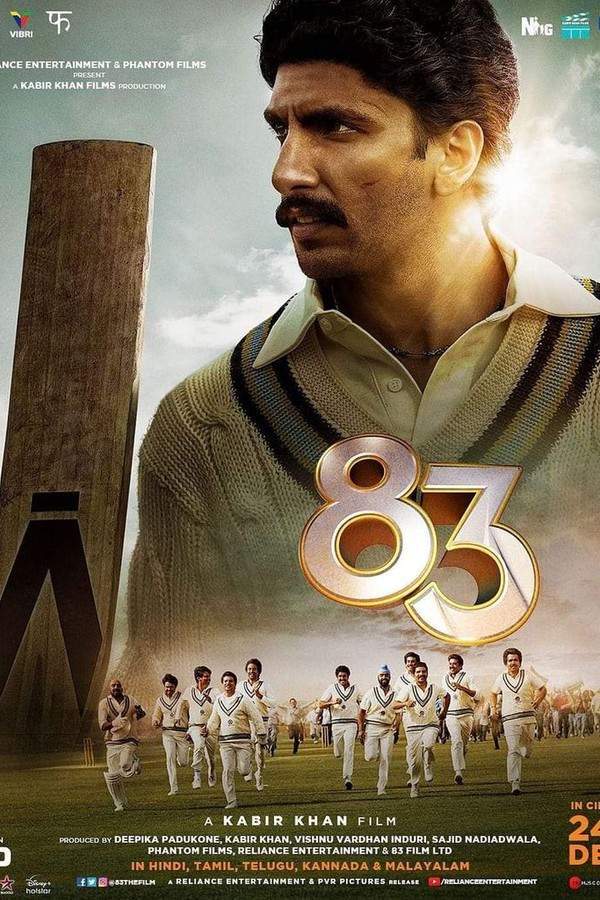
'83 (2021) movie poster

Plot Summary

'83 (2021) Plot Summary & Ending Explained

Release, runtime and language
2021 · 162 min · Hindi
Echo score 76
Directed by
Kabir Khan
Starring
Pankaj Tripathy, Chirag Patil, Deepika Padukone, Dinker Sharma, Harrdy Sandhu, Jatin Sarna

In 1983, the Indian national cricket team faced the seemingly insurmountable challenge of competing against the dominant West Indies, the two-time defending World Champions. This is the story of how a group of determined players, led by a passionate captain, defied all expectations at Lord's Cricket Ground. Through unity and unwavering resolve, they achieved a historic upset, forever changing the landscape of Indian cricket and inspiring a nation. Their improbable victory propelled India onto the world stage as a cricketing force to be reckoned with, creating a lasting legacy.

On this page (6)
  1. 1 What happens: full plot
  2. 2 Plot questions answered
  3. 3 How it ends
  4. 4 Movie threads
  5. 5 Movies like '83
  6. 6 Every angle

Full plot summary · contains spoilers

What Happens in '83: Full Plot Summary

The whole story of '83 (2021) explained, from the opening scene to the final frame: every key event, every twist and what it all adds up to. Read it as a quick recap before the sequel, to check a scene you missed, or to finally understand what really happened.

A young Kapil Dev, played by Ranveer Singh, was unexpectedly appointed as the captain of the Indian cricket team, stepping in for the legendary Sunil Gavaskar. With the all-rounder known as the "Haryana Hurricane" at the helm, a fresh zeal swept through the squad. While the Indian team was composed of remarkable individual players, they still faced the challenge of figuring out how to function cohesively as a unit.

Managing the team during the 1983 World Cup was PR Man Singh (portrayed by Pankaj Tripathi), whose dedication was evident when he paid a hefty Rs 9800 in excess baggage fees just to bring pickles to London—a necessity as the local food left much to be desired.

On the 1st of June, 1983, the team gathered in London, where they encountered organizational issues right from the start, lacking proper transportation on arrival. Meanwhile, Romi Dev, Kapil's wife played by Deepika Padukone, remained in their ancestral home in Haryana, eagerly awaiting a win for their country, a hope echoed by Raj Kumari Nikhanj (Neena Gupta), Kapil's mother. With a meager daily allowance of 15 pounds, the players had to wash their clothes themselves, given the high costs of laundry services.

As the Indian opener, Krishnamachari Shrikant (played by Jiiva) expressed—“one must be a bit mad to believe in defeating the invincible West Indies,” who had secured back-to-back World Cup titles without losing a single match. During this time, the likes of Michael Holding, Colin Croft, Joel Garner, and Andy Roberts formed the terrifying quartet of bowlers that struck fear into their opponents. When Croft retired, he was substituted by Marshall Malcolm, continuing the assault with deliveries that seemed almost inhuman.

The team also included Yashpal Sharma (played by Jatin Sarna), Sandeep Patil (portrayed by Chirag Patil), Kirti Azad (played by Dinker Sharma), Roger Binny (portrayed by Nishant Dahiya), Madan Lal (played by Harrdy Sandhu), among others. Most players followed a vegetarian diet, surviving mainly on bread, butter, and the pickles brought by Man Singh, since their access to quality food was severely limited.

Unfortunately, the team's arrival was marked by setbacks; influenced by their past performance, their passes were dismissed as irrelevant since India was not anticipated to reach the finals—Man Singh had even booked return flights before the semifinals! Critic David Firth cynically remarked he would eat his words if India succeeded; the media echoed their doubts, calling their first win a fluke.

Through a series of unfortunate practice matches leading up to the World Cup, the team lost significantly. However, it was the igniting moment of tension at the Zimbabwe match that became transformative. Facing a precarious situation at 17/5, the team needed to rally and Kapil stepped up to the challenge. He went on to score an astounding 175 runs, turning the game around and catapulting his team towards self-belief: “We must play beyond our potential from now on.”

The momentum shifted afterward—the last group match saw a confident victory against Australia. Yashpal and Kapil's resilience marked a turning point, drawing the nation's attention and even the interest of Indira Gandhi (Avantika Akerkar), who decided to celebrate the team's progress with nationwide broadcasts.

The semi-final against England was a gripping match where, despite trailing early, Mohinder Amarnath’s (played by Saqib Saleem) impressive performance turned the tide, allowing India to secure a win that had never before been achieved on English soil.

The epic final against the West Indies was a daunting prospect, especially since India had never won at Lord's. The pressure mounted as India struggled early in the innings but managed to reach a total of 183—much lower than expected. However, the team's determination strengthened. Despite the pressures, they remained focused, and following a nail-biting performance, they emerged victorious, marking a historic moment in cricket history.

On 25 June 1983, Lord's Cricket Ground became the theatre of an extraordinary upset, where India triumphed over the two-time champions, ultimately solidifying their place in the cricketing world. David Firth ultimately kept his dubious promise, eating his words in front of a celebrating crowd at Lord's.

Last updated: November 04, 2024 at 01:09

Was this helpful?

Plot questions answered

'83 Plot Explained: Your Questions Answered

The questions people ask most about '83 (2021): what happens in the confusing scenes, why the characters do what they do, the twists, hidden details and what the ending means. Each answer contains spoilers.

Q1

Why was Kapil Dev chosen as captain for the 1983 World Cup?

Kapil Dev was unexpectedly appointed as captain of the Indian cricket team, taking over from the legendary Sunil Gavaskar. Despite being young, his reputation as the "Haryana Hurricane" and his all-rounder skills brought fresh energy to the squad. This decision marked a new chapter for the team as they sought to become a cohesive unit under his leadership.

  • kapil dev captain
  • sunil gavaskar
  • team leadership
  • captain selection
Q2

How did Kapil Dev's 175 runs against Zimbabwe change the tournament?

Facing a dire situation at 17/5 against Zimbabwe, Kapil Dev scored an astonishing 175 runs to turn the game around completely. This remarkable performance transformed the team's morale and self-belief, with Kapil urging his teammates to "play beyond their potential from now on." The victory marked the turning point that propelled India toward the final.

Foreshadowing: Earlier doubts expressed by the team about defeating the invincible West Indies made this comeback even more significant.

  • kapil dev 175
  • zimbabwe match
  • world cup 1983
  • turning point
Q3

Why did the team manager bring pickles to London?

PR Man Singh, the team's manager, paid a hefty Rs 9800 in excess baggage fees to bring pickles to London because the local food available to the team was unsatisfactory. Most players followed a vegetarian diet and survived mainly on bread, butter, and these pickles. This detail highlights the various challenges the team faced beyond just the cricket matches.

  • pickles
  • pr man singh
  • team manager
  • food challenges london
Q4

Why was winning the semi-final against England significant?

The semi-final against England was a gripping match where India secured a win that had never been achieved on English soil before. Despite trailing early, Mohinder Amarnath's impressive performance turned the tide in India's favor. This victory advanced India to the final against the West Indies.

  • semi final england
  • mohinder amarnath
  • historic win
  • english soil
Q5

Why was India's total of 183 runs considered difficult to defend?

India managed only 183 runs in the final against the West Indies, a total considered daunting given the dominant bowling attack of the West Indies. The team had never won at Lord's before, and facing the two-time defending champions who had a terrifying quartet of bowlers made the target seem insurmountable. However, the team's determination allowed them to defend this total successfully.

Foreshadowing: The earlier description of West Indies bowlers like Michael Holding, Colin Croft, Joel Garner, and Andy Roberts established how fearsome they were.

  • 183 runs
  • lords final
  • west indies bowling
  • target defend
Q6

How did India manage to win the 1983 World Cup final?

Despite struggling early in the innings against the West Indies' tight bowling, India managed to reach 183 runs. The team's determination strengthened under pressure, and they showed remarkable resilience to defend their total. On June 25, 1983, at Lord's Cricket Ground, India overcame the two-time champions to achieve a historic upset.

  • india victory
  • lords 1983
  • comeback
  • west indies final
Q7

What happened to critic David Firth after India's victory?

David Firth, who had cynically remarked that he would eat his words if India succeeded, ultimately kept his promise. After India's historic victory at Lord's, he humorously ate his words in front of the celebrating crowd. This moment became a memorable part of the tournament's legacy.

  • david firth
  • critic
  • eat words
  • lords celebration
Q8

Why was the West Indies bowling attack so feared?

The West Indies possessed a terrifying quartet of bowlers including Michael Holding, Colin Croft, Joel Garner, and Andy Roberts, who were known for their intimidating deliveries. When Croft retired, Malcolm Marshall continued the assault with seemingly inhuman pace. This bowling attack had helped the West Indies win back-to-back World Cups without losing a single match.

  • west indies bowlers
  • michael holding
  • joel garner
  • world cup champions
Q9

Why did the Indian team have to wash their own clothes?

The Indian cricket team received a meager daily allowance of just 15 pounds during the 1983 World Cup. With laundry services in London being prohibitively expensive, the players had to wash their own clothes. This was just one of many logistical challenges they faced alongside organizational issues and poor transportation.

  • daily allowance
  • wash clothes
  • london 1983
  • team conditions
Q10

Why was the 1983 World Cup victory so important for India?

The victory marked a historic upset, as India defeated the two-time defending champions to win the World Cup. This triumph changed India's identity in the cricketing world, propelling them onto the world stage as a serious cricketing force. The win united the nation and elevated cricket to a prominent status in India, creating a lasting legacy.

  • india cricket history
  • world cup legacy
  • national pride
  • cricketing force
Q11

What was Kapil Dev's wife doing during the World Cup?

Romi Dev, Kapil Dev's wife played by Deepika Padukone, remained in their ancestral home in Haryana during the World Cup. She eagerly awaited a win for their country, sharing the same hope as Kapil's mother Raj Kumari Nikhanj. Their support from home represented the nationwide anticipation and pride surrounding the team's journey.

  • romi dev
  • kapil wife
  • deepika padukone
  • family support
Q12

Why did Indira Gandhi start broadcasting the team's matches?

After India's resilient victory against Australia in the last group match, the team's progress gained national attention and captured the interest of Prime Minister Indira Gandhi. She decided to celebrate the team's progress by arranging nationwide broadcasts of their matches, bringing the excitement to the entire country.

  • indira gandhi
  • prime minister
  • live broadcast
  • australia match

Ending explained

What Happens at the End of '83?

How '83 (2021) ends, in short: the final scene, the last twist and what it means for the characters. The full ending explained, with every spoiler, lives on its own page.

Read the full ending explained

The ending of "83" celebrates the remarkable victory of the Indian cricket team in the 1983 World Cup, a tournament where they were underdogs and underestimated from the start. After a series of unlikely wins, including a stunning and legendary performance by Kapil Dev, who scored 175 runs against Zimbabwe and led the team to a crucial victory, India found itself in the final against the reigning champions, West Indies. Despite being considered unlikely winners, the Indian team rose to the occasion at Lord’s, a place where they had never won a match before.

In the final, India started poorly with a modest score of 183 runs, but their spirited bowling and fielding turned the game around. Kapil Dev's incredible catch of Viv Richards, and the team’s focused effort to dismiss the West Indies’ star batsmen, shifted the momentum in India’s favor. The match became a tense showdown, and with Mohinder Amarnath taking the final wicket, India secured a historic victory. The final moments saw Kapil Dev lifting the World Cup trophy, a symbol of hope, resilience, and national pride for India.

Continue reading the ending (1 more paragraphs)

The story behind this victory gained worldwide attention when David Frith, a cricket journalist, had previously doubted India’s chances. After India’s win, he publicly admitted his mistake by eating his previously published critical article, symbolizing the power of faith and perseverance in the face of doubt. The ending of "83" underscores that even the most unlikely victories are possible when belief, determination, and unity come together, inspiring a nation and rewriting history. It is a triumphant celebration of human spirit, sportsmanship, and the indomitable will to succeed.

'83 ending explained in full

Movie threads

More Movies Like '83, by Mood & Story

Curated lists built around what makes '83 tick: the same mood, the same kind of story or the same emotional payoff. Each list explains why these movies belong together.

Historic Underdog Movies like '83

Stories where the unlikely contender defies overwhelming odds to achieve glory. Discover movies like '83 that capture the electrifying spirit of the underdog. These films feature teams or individuals competing against overwhelming odds, leading to tense, high-stakes contests and ultimately inspiring, history-making victories that resonate far beyond the playing field.

  • underdog
  • triumphant
  • tense
  • uplifting
  • inspiring
  • celebratory
  • Tone: hopeful, tense
  • Pacing: variable, building to climax
Why these movies?

The story pattern: These narratives typically follow a linear path from initial doubt and struggle to growing confidence and a final, high-tension confrontation. The climax is a hard-fought victory that validates the protagonists' belief and hard work, often changing their world or inspiring others in the process. The journey is defined by anticipation and payoff.

Why they belong together: Movies in this thread are united by their core narrative arc: a clear underdog versus a dominant force. They share a high-intensity, hopeful tone that builds anticipation and delivers a satisfying, triumphant conclusion. The emotional focus is on teamwork, determination, and the thrill of an improbable success.

Movies About Unifying National Victories like '83

Cinematic triumphs where a group's success unifies and inspires an entire nation. If you liked '83, explore these films about unifying national victories. These dramas and biopics show how a group's success against the odds can inspire a nation, creating a legacy of pride and hope. They capture the powerful intersection of personal achievement and collective national spirit.

  • national pride
  • uplifting
  • teamwork
  • inspiring
  • celebratory
  • historic
  • Tone: hopeful, celebratory
  • Pacing: variable
Why these movies?

The story pattern: The narrative pattern involves a group facing a monumental external challenge. Their internal dynamics and teamwork are mirrored by the hopes of a watching nation. The victory is not just personal; it becomes a symbolic event that resonates deeply with the public, often marking a turning point in cultural or national consciousness.

Why they belong together: These films are grouped by their shared theme of a collective effort having a profound national impact. They blend high-stakes drama with a hopeful, celebratory tone, emphasizing how teamwork and victory can inspire and unite a people. The emotional core is pride and shared joy.

If you liked this

Movies Like '83

Similar movies to '83: the same genre, themes or kind of story. Each one comes with its own plot summary, timeline and ending explained.

Browse all movie summaries

Every angle

'83 (2021) Explained: Plot, Ending, Timeline & Characters

Everything about '83 in one place: what happens in the plot summary, the timeline in chronological order, the characters and meaning, the ending explained and a spoiler-free summary. What's After the Movie adds the cast, box office and post-credit scenes.

Coming soon on iOS and Android

The Plot Explained Movie Summary App

Plot summaries, endings explained and timelines on your phone. Catch up on any movie in minutes, save your favorites and never miss a twist again.

Be the first to know when we launch. Your email stays private, always.

Learn more about the app