Plot Explained Spoilers guaranteed!
Plot Explained

Browse by genre

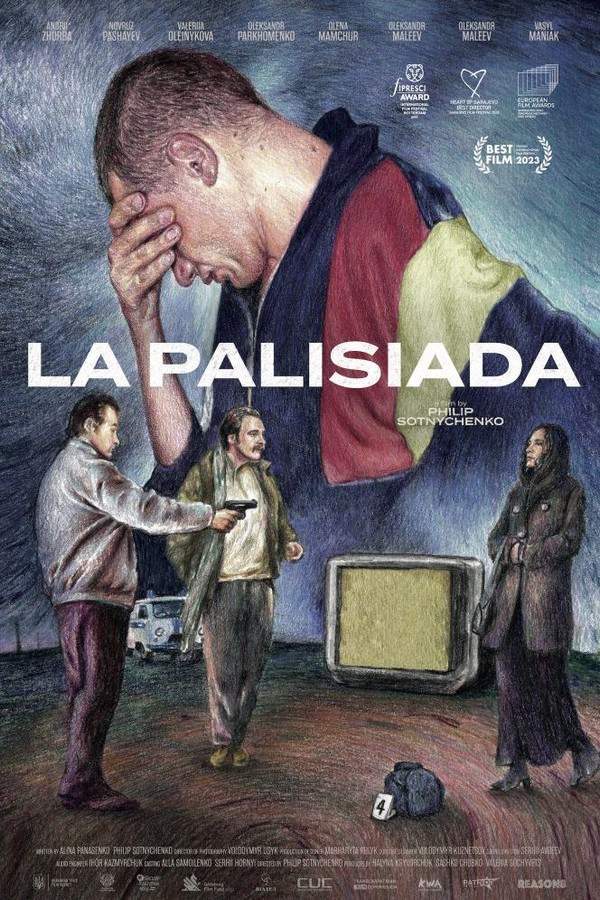
La Palisiada (2024) movie poster

Plot Summary

La Palisiada (2024) Plot Summary Explained

Release, runtime and language
2024 · 1 h 40 m · Ukrainian
Starring
Aleksandr Mavrits, Sergiy Luzanovsky

Set in Ukraine in 1996, just five months before the moratorium on capital punishment, a police detective and a forensic psychiatrist, longtime friends, are drawn into an investigation of their colleague's murder. The case resurfaces old connections and long-buried feelings, particularly concerning the widow of the deceased, with whom both men were once in love. As they delve deeper into the investigation, they confront not only the present mystery but also the weight of their own unrealized ambitions and the legacy they will leave for their children.

On this page (7)
  1. 1 Where to watch
  2. 2 What happens: full plot
  3. 3 Plot questions answered
  4. 4 Movie threads
  5. 5 Movies like La Palisiada
  6. 6 Categories
  7. 7 Every angle

Where to watch

Where to Watch La Palisiada (2024)

Where can you watch La Palisiada? Stream, rent or buy it in the US, including on Film Movement Plus and Klassiki: current JustWatch availability with up-to-date prices.

Streaming availability powered by JustWatch

Full plot summary · contains spoilers

What Happens in La Palisiada: Full Plot Summary

The whole story of La Palisiada (2024) explained, from the opening scene to the final frame: every key event, every twist and what it all adds up to. Read it as a quick recap before the sequel, to check a scene you missed, or to finally understand what really happened.

A forensic psychiatrist finds himself entangled in a complex web of intrigue when he becomes involved in the investigation surrounding the murder of a policeman, just a few months prior to the signing of Protocol No. 6 of the European Convention on Human Rights, which proposed the abolition of the death penalty. This is a groundbreaking Ukrainian film that delves into the controversial topic of capital punishment, a practice that lingered in the country for several years following its independence.

The story is partly inspired by the personal account of Philip Sotnychenko, who, at the tender age of seven, was struck by the harsh reality of executions occurring within his vicinity in Lukyanivka, specifically at the pre-trial detention center. This personal connection highlights deep-rooted societal issues regarding justice and morality in modern Ukraine.

The narrative unfolds through two intertwining timelines: the contemporary (the film's beginning) and the gritty world of the 1990s, which forms the narrative's core. Central to this intricate tale is forensic psychiatrist Oleksandr Mavrits, whose once-tranquil life is thrown into turmoil as he partners with investigator Sergiy Luzanovsky in the pursuit of justice for their slain colleague. Their investigation is not merely a matter of law enforcement; it becomes a matter of honor amongst friends who are also burdened with feelings for the deceased's widow.

The film opens with a seemingly unrelated sequence focusing on contemporary hipsters and their trivial issues—however, this quickly transitions into a gripping investigation set in Uzhhorod in 1996. This initial backdrop can be interpreted from various angles: as a flashback, flashforward, or as a parallel narrative. The structure is intentionally disorienting; viewers may expect a traditional detective story typical of the 1990s, but are instead presented with a layered narrative that challenges traditional storytelling conventions.

As the film progresses, it is revealed that the plot's second act serves not just as a flashback but is so intricately woven that it casts the initial scenes in a new light, forcing the audience to reconsider their perceptions. This isn’t a straightforward investigation, but rather a murky tale where two law enforcement officials wrestle with the integrity of their work as they attempt to fabricate a case against a suspect—pressured by a system eager to deliver swift justice before the death penalty becomes a relic of the past.

Within this ambiguous atmosphere, the essence of what the director refers to as "post-Soviet noir" or "neo-noir" is perfectly encapsulated. The depiction of the 1990s reveals a tumultuous era characterized by chaos and moral decay; it was a time when the nation was finding its footing amidst rampant corruption where various factions indulged in political maneuvering, privatization of public assets, and violent purges of competition. The counter-narratives emerge, leaving the audience questioning the identities of heroes and villains in this morally complex landscape.

Ultimately, the film employs a non-linear narrative that mirrors the intricate and cyclical nature of the stories it tells, much like a Möbius strip—seamlessly blending themes of justice, friendship, and the haunting repercussions of a turbulent past.

Last updated: December 24, 2024 at 10:01

Was this helpful?

Plot questions answered

La Palisiada Plot Explained: Your Questions Answered

The questions people ask most about La Palisiada (2024): what happens in the confusing scenes, why the characters do what they do, the twists, hidden details and what the ending means. Each answer contains spoilers.

Q1

Why were Oleksandr and Ilhar pressured to fabricate evidence?

They were under intense pressure from their superiors to quickly solve the murder before Protocol No. 6 was signed, which would abolish the death penalty. The system wanted a swift conviction while capital punishment was still legally available, forcing the investigators to frame an innocent suspect rather than conduct a proper investigation.

Foreshadowing: The opening scenes already hint at the moral corruption that pervades the investigative process.

  • fabricated evidence
  • death penalty
  • police corruption
  • Protocol No. 6
Q2

What is Protocol No. 6 and why does it matter in the film?

Protocol No. 6 is the European Convention on Human Rights protocol that abolished the death penalty. The film is set just five months before Ukraine signed this protocol, creating urgency for law enforcement to secure convictions before capital punishment ended. This deadline adds suspense and highlights the brutal justice system of 1990s Ukraine.

  • Protocol No. 6
  • death penalty
  • Ukraine
  • European Convention
Q3

What is the relationship between the investigators and the murder victim's widow?

Both Oleksandr and Ilhar had romantic feelings for the widow of the murdered policeman. This love triangle adds emotional complexity to the investigation, creating tension between the two friends as they work together while also competing for the widow's affection.

  • love triangle
  • widow
  • Oleksandr
  • Ilhar
  • romance
Q4

Why does La Palisiada use a non-linear timeline?

The non-linear structure mirrors the 'Möbius strip' metaphor mentioned by the director, blending past and present seamlessly. This approach reflects the cyclical nature of justice, memory, and moral ambiguity in post-Soviet Ukraine, while also creating disorientation that challenges viewers to piece together the truth.

Foreshadowing: The opening hipster sequence appears unrelated but gains meaning through the later 1990s context.

  • non-linear narrative
  • Möbius strip
  • structure
  • storytelling
Q5

What is the meaning of La Palisiada's ambiguous ending?

The ending leaves the identities of heroes and villains unclear, reflecting the film's central theme that justice in post-Soviet Ukraine was morally ambiguous. The resolution questions whether true justice is achievable in a corrupted system, leaving viewers to decide what they believe happened.

  • ambiguous ending
  • resolution
  • justice
  • moral ambiguity
Q6

Why does the film open with hipsters in contemporary settings?

The opening sequence featuring contemporary hipsters creates deliberate disorientation. It can be interpreted as a flashforward, flashback, or parallel narrative that contrasts modern life with the gritty 1990s investigation. This jarring transition sets up the film's intentionally confusing structure.

Foreshadowing: The hipster subplot gains significance when the timeline reveals its connection to the main narrative.

  • hipsters
  • opening scene
  • contemporary
  • narrative structure
Q7

What makes La Palisiada a neo-noir film?

The film is described by its director as 'post-Soviet noir' or neo-noir. This classification comes from its depiction of 1990s Ukraine as a chaotic era of corruption, moral decay, and anti-heroes where the line between right and wrong is deliberately blurred, matching classic noir themes.

  • neo-noir
  • post-Soviet noir
  • genre
  • 1990s Ukraine
Q8

Who actually killed the police officer in La Palisiada?

The investigation reveals that the murder was connected to the corrupt system itself rather than a simple criminal act. The investigators discover the case was fabricated under pressure from superiors eager to secure a death penalty conviction before the moratorium, exposing how the system created victims on all sides.

  • murder
  • police officer
  • investigation
  • killer
  • truth
Q9

Why does the film focus on the death penalty in Ukraine?

The death penalty serves as the film's central tension driver. Set in 1996, just before Ukraine abolished capital punishment, the film uses this historical context to explore how the threat of execution pressured police to frame innocent people. The director was inspired by childhood experiences near executions at Lukyanivka detention center.

  • death penalty
  • capital punishment
  • Ukraine
  • abolition
  • historical context
Q10

What is the significance of the title La Palisiada?

The title references the film's themes of cyclical justice and historical repetition. The 'Möbius strip' narrative structure suggests that the story, like justice in post-Soviet Ukraine, loops back on itself without clear resolution. The title encapsulates the film's exploration of how past traumas continue to shape the present.

  • title
  • La Palisiada
  • meaning
  • symbolism
  • Möbius strip

Movie threads

More Movies Like La Palisiada, by Mood & Story

Curated lists built around what makes La Palisiada tick: the same mood, the same kind of story or the same emotional payoff. Each list explains why these movies belong together.

Gritty Post-Soviet crime stories like La Palisiada

Crime investigations that expose the moral decay of a collapsing system. For viewers who liked the atmospheric and morally complex setting of La Palisiada, this list features movies like it that delve into crime and corruption within post-Soviet societies or similar periods of political decay. These similar dramas and thrillers capture a unique sense of place and time.

  • gritty
  • oppressive
  • atmospheric
  • morally ambiguous
  • melancholic
  • tense
  • Tone: dark, melancholic, gritty
  • Pacing: variable, deliberate
Why these movies?

The story pattern: The narrative typically follows detectives or officials navigating a labyrinth of bureaucratic decay and personal loyalties. The crime at the center often becomes a metaphor for a larger societal sickness, and the investigation forces characters to confront their own complicity within a broken system. The lines between justice and survival are perpetually blurred.

Why they belong together: They are grouped by their specific historical and political setting, which creates a distinct atmosphere of disillusionment and grit. They share a focus on how large-scale political collapse manifests in personal moral crises, often with a melancholic and reflective tone.

Thrillers with heavy moral dilemmas like La Palisiada

Thrillers where the investigation forces a painful confrontation with the past. If you liked La Palisiada for its tense exploration of moral choices and personal history intruding on a criminal case, this list offers similar movies with complex character dynamics. These films feature investigations that are as much about uncovering the truth as they are about confronting the past.

  • tense
  • morally ambiguous
  • reflective
  • suspenseful
  • melancholic
  • psychological
  • Tone: tense, dark, reflective
  • Pacing: variable, psychological
Why these movies?

The story pattern: Stories in this thread often feature a non-linear or complex structure that mirrors the characters' unraveling psyches. The central conflict is not just about solving a crime, but about the ethical cost of the solution and the ghosts it resurrects. Endings are frequently ambiguous, leaving the audience to ponder the price of closure.

Why they belong together: They share a core narrative structure where a professional investigation becomes intensely personal, unlocking a Pandora's box of nostalgia, regret, and unrealized ambitions. The experience is defined by high tension and heavy emotional weight, focusing on character depth over plot mechanics.

If you liked this

Movies Like La Palisiada

Similar movies to La Palisiada: the same genre, themes or kind of story. Each one comes with its own plot summary, timeline and ending explained.

Browse all movie summaries

Categories

Movie Lists Featuring La Palisiada

La Palisiada appears in these hand-built movie categories. Each one groups movies by a specific mood, theme or story type, with their plot summaries and endings explained.

View all movie categories

Every angle

La Palisiada (2024) Explained: Plot, Timeline & Characters

Everything about La Palisiada in one place: what happens in the plot summary, the timeline in chronological order, the characters and meaning and a spoiler-free summary. What's After the Movie adds the cast, box office and post-credit scenes.

Coming soon on iOS and Android

The Plot Explained Movie Summary App

Plot summaries, endings explained and timelines on your phone. Catch up on any movie in minutes, save your favorites and never miss a twist again.

Be the first to know when we launch. Your email stays private, always.

Learn more about the app