














Plot Explained Spoilers guaranteed!
Plot Explained

Browse by genre

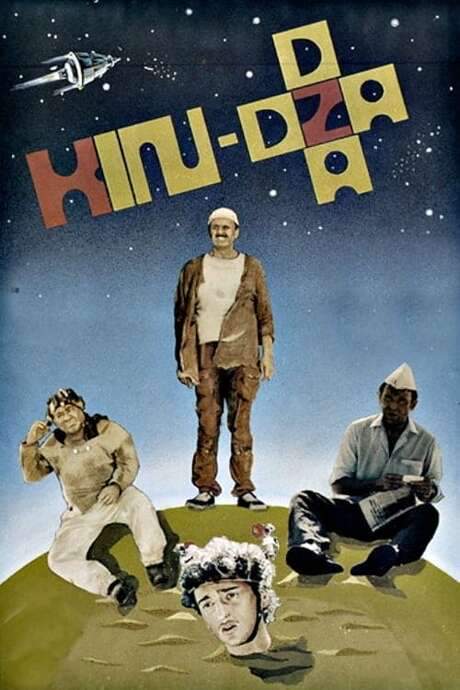
Kin-dza-dza! (1986) movie poster

Timeline

Kin-dza-dza! (1986) Timeline Explained – Every Event in Order

Release, runtime and language
1986 · 135 mins · Russian
JustWatch #4,619 54
Starring
Levan Gabriadze, Vladimir Fyodorov, Georgiy Daneliya, Galina Daneliya-Yurkova, Stanislav Lyubshin, Nina Ter-Osipyan

Two strangers from the Soviet Union are unexpectedly whisked to the desert‑like planet Pluke in the distant Kin‑dza‑da galaxy after stumbling on an alien teleportation device. To survive and find a way home, they must navigate a baffling language, bizarre customs and the planet’s odd laws of space and time.

On this page (6)
  1. 1 Where to watch
  2. 2 Events in order (12)
  3. 3 Timeline questions answered
  4. 4 Movie threads
  5. 5 Movies like Kin-dza-dza!
  6. 6 Every angle

Where to watch

Where to Watch Kin-dza-dza! (1986)

Where can you watch Kin-dza-dza!? Stream, rent or buy it in the US, including on ARROW, Bloodstream and Eternal Family: current JustWatch availability with up-to-date prices.

Streaming availability powered by JustWatch

12 events in order · contains spoilers

Kin-dza-dza! Timeline: Events in Chronological Order

Every key event of Kin-dza-dza! (1986) in order, scene by scene, with when and where it takes place. Use it to untangle flashbacks, time jumps and parallel storylines, to refresh your memory before the sequel or to find the exact scene you are thinking of.

  1. Vova returns home from a stressful day in 1980s Moscow

    Construction foreman Vladimir Mashkov, known as Uncle Vova, arrives at his apartment after work. His wife asks him to buy groceries, setting up a mundane domestic life before the extraordinary events begin. This scene establishes the ordinary world the protagonists inhabit before the strange encounter.

    When
    1980s
    Where
    Moscow, Russia (1980s)
  2. A mysterious barefoot man on Kalinin Prospekt

    On a central street in Moscow, a strange barefoot man in a tattered coat asks passersby about numbers of planets and galaxies. Uncle Vova and the Violinist stop to talk with him, intrigued by the stranger's questions. The encounter hints at a propulsive device and travel beyond Earth.

    When
    Evening, 1980s
    Where
    Kalinin Prospekt, Moscow
  3. The device is tested and they are transported

    The stranger demonstrates a teleportation device and cautions about its dangers. Against his warning, Vova presses a button and triggers a teleport. They are suddenly whisked away to the planet Pluke in the Kin-dza-dza galaxy.

    When
    Moment of the device test
    Where
    From Moscow to Pluke
  4. Arrival on Pluke and first impressions

    Vova and the Violinist arrive on the arid, alien world of Pluke. The Plukanians look human but show a primitive technology and a barbaric culture, while remaining telepathic and quickly adapting to Russian and Georgian. The new environment sets the stage for a satire of human society.

    When
    Immediately after transport
    Where
    Planet Pluke
  5. The visator brands them Patsaks

    A handheld visator identifies them as Patsaks with a green light, placing them within Pluke's social hierarchy. The Patsak-Chatlanian divide drives conflict and comedy as characters navigate status. The device foreshadows the rules they must follow.

    When
    Day of arrival
    Where
    Planet Pluke
  6. Patsaks and Chatlanians: social rules

    Pluke's society is split into Patsaks and Chatlanians, with Patsaks holding privilege. The ecilops police enforce obedience, and respect is shown by counting 'ku' in interactions with others. The color of pants signals social standing, shaping daily life on Pluke.

    When
    Early on
    Where
    Planet Pluke
  7. Water-based fuel and scarcity

    Pluke runs on a fuel called 'luts', made from water, making water itself precious. All natural water has been processed into luts, turning drinking water into a valuable commodity. This scarcity drives the travelers' decisions and conflicts.

    When
    Early on
    Where
    Planet Pluke
  8. Uef and Bi appear as allies and obstacles

    During their stay, the locals Uef and Bi alternate between helping and abandoning Uncle Vova and the Violinist. Their shifting loyalties shape the duo's efforts to get back home. Uef and Bi's involvement adds size to the quest and danger to their escape plan.

    When
    During quest
    Where
    Pluke
  9. Ketse: the matchsticks as treasure

    A recurring plot point is that wooden matchsticks, ketse, are extremely valuable on Pluke. Vova and Violinist must secure them to trade or power devices. The quest for ketse drives interactions with Uef, Bi, and P-Zh's private compound.

    When
    Mid-plot
    Where
    Pluke
  10. A return to the start of the film

    The man from the opening scene returns Uncle Vova and the Violinist to the very beginning of the film. They find themselves in a world that seems familiar but they no longer recognize each other. The reset creates a paradoxical loop that comments on memory and fate.

    When
    Time reset
    Where
    Opening scene / Moscow
  11. The city center scene replays with misrecognition

    As Vova goes outside, the city center seems devoid of the mysterious man. He meets the Violinist again, but they do not recognize one another, illustrating the effects of the reset. A tractor with orange lights triggers a remembered ritual and reshapes their perception.

    When
    Immediately after reset
    Where
    Moscow city center (opening moment)
  12. A final cue: recognition and song

    A passing tractor and the familiar cry of 'ku' remind them of their Pluke identities. Vova looks to the sky and hears a song performed by Uef and Bi, linking the two timelines and leaving a haunting sense that life on Pluke persists beyond the reset.

    When
    End of film

Last updated: October 09, 2025 at 14:15

Was this helpful?

Timeline questions answered

Kin-dza-dza! Timeline Explained: Your Questions Answered

When does it happen, and why in that order? The questions people ask about the chronology of Kin-dza-dza! (1986): time jumps, flashbacks, cause and effect between scenes and the correct order of events, each answered with spoilers.

Q1

Why did Vova press the button on the alien device despite the stranger's warning?

Vova pressed the button out of curiosity and skepticism. The stranger warned him that the device could transport them anywhere in the universe, but Vova, a practical construction foreman, didn't believe the bizarre device would actually work. He pressed a random button to see what would happen, underestimating the consequences of his actions.

Foreshadowing: Earlier, the stranger's cryptic question about planetary numbers hints that he knows about alien worlds.

  • Vova Mashkov
  • teleport
  • device
  • curiosity
  • stranger
Q2

How does the visator determine if someone is a Chatlanian or Patsak?

The visator is a handheld device that instantly reveals a person's social classification with a light: orange for Chatlanians and green for Patsaks. When Vova and the Violinist are tested, they both register as Patsaks. The device appears to scan something inherent to the person, though the exact criteria remain ambiguous, possibly wealth, status, or an intangible quality recognized by Pluke's society.

Foreshadowing: The visator appears early in the story, establishing the rigid social hierarchy that drives much of the conflict.

  • visator
  • Chatlanian
  • Patsak
  • social hierarchy
  • green light
  • orange light
Q3

What is the difference between Chatlanians and Patsaks on Pluke?

Chatlanians and Patsaks are the two main social groups on Pluke. Patsaks hold a strange form of privilege, they must perform ritual worship and obedience, while Chatlanians enjoy tentative freedoms. However, the divide isn't absolute; the narrative suggests status shifts based on location, associations, and possessions. The Patsaks bear the burden of showing deference through repeated utterances of 'ku', while the social hierarchy is reinforced through pants color and other arbitrary markers.

Foreshadowing: Early scenes establish that the classification determines how people interact, with 'ku' serving as a submission marker.

  • Chatlanian
  • Patsak
  • social hierarchy
  • ku
  • Pluke society
Q4

Why are wooden matches (ketse) so valuable on Pluke?

Wooden matches, called ketse, are extremely valuable because they represent a technology Pluke lacks. The planet has primitive fire-making capabilities, making any lit flame a precious resource. Ketse become the primary currency for trade and bribery, especially when dealing with locals like Uef and Bi or accessing Mr. P-Zh's private compound. The matchsticks symbolize how value isrelative, a mundane Earth object becomes a treasured relic in an alien world.

Foreshadowing: The first encounter with locals hints at their fascination with fire and heat-related objects.

  • ketse
  • matches
  • trade
  • currency
  • Pluke valuables
Q5

What is luts and why is water so scarce on Pluke?

Luts is the processed fuel that powers Pluke's civilization, and it's created entirely from water. Because every drop of natural water must be converted into luts, drinking water itself becomes extraordinarily scarce and valuable. This resource scarcity directly shapes Pluke's social order, making water the most precious commodity on the planet and driving many of the conflicts Vova and the Violinist encounter.

Foreshadowing: The explanation of luts early in the story underscores why basic survival is difficult on Pluke.

  • luts
  • fuel
  • water scarcity
  • Pluke resources
  • energy
Q6

What did the stranger mean by asking about the number of the planet in the Tentura?

The stranger was asking Vova to identify Earth's location in a cosmic classification system called the Tentura. His question, asking for Earth's planet number in the Tentura or at least its galaxy number in the spiral, reveals he possesses knowledge of cosmic geography beyond human understanding. This indicates the stranger is either an alien traveler himself or someone who understands the universe's structure in ways ordinary Soviets cannot comprehend.

Foreshadowing: This moment precedes the teleportation, establishing that the stranger operates on a different level of reality.

  • stranger
  • Tentura
  • Earth location
  • galaxy
  • cosmic geography
Q7

Why does the story reset to the beginning at the end?

The mysterious man from the opening returns Vova and the Violinist to Moscow, but not to their original moment, they arrive at the film's beginning, creating a time loop. They no longer recognize each other because the timeline has effectively reset. This surreal ending comments on memory, identity, and fate: even though they return home physically, their experiences on Pluke have permanently altered them, as evidenced by their instinctive reaction to the tractor's orange light.

Foreshadowing: The stranger's initial appearance on Kalinin Prospekt mirrors the ending, suggesting a cyclical narrative.

  • time loop
  • reset
  • ending
  • memory
  • recognition
  • Moscow
Q8

What does the final scene with the 'ku' ritual mean?

When Vova and the Violinist see a tractor with orange lights, they instinctively crouch and say 'ku', the submission word from Pluke. This reveals the reset hasn't truly erased their experiences; the conditioning remains embedded in their psyche. The 'ku' signifies they've been permanently marked by their alien journey, losing their original identities while gaining a bittersweet, melancholic connection to another world.

Foreshadowing: Earlier scenes establish 'ku' as a deeply ingrained response tied to survival and deference on Pluke.

  • ku
  • ritual
  • ending
  • conditioning
  • recognition
  • tractor
Q9

Who is Mr. P-Zh and what power does he hold?

Mr. P-Zh is the ruler of Pluke, seemingly harmless in appearance but exerting power through ritual reverence and fear. He resides in a private compound that Vova and the Violinist attempt to raid. His authority embodies the arbitrary nature of power on Pluke, he rules not through brute force but through established customs and the population's willingness to obey.

Foreshadowing: The ecilops (police) answer to this ruler, reinforcing his status throughout the narrative.

  • Mr. P-Zh
  • ruler
  • Pluke
  • power
  • compound
Q10

Why do Uef and Bi keep switching between helping and betraying Vova and the Violinist?

Uef and Bi represent the opportunistic nature of survival on Pluke. They alternate between aiding the Earth visitors and abandoning or even opposing them, depending on what serves their interests at the moment. Their shifting loyalties reflect the fluid morality and self-preservation instinct of Pluke's inhabitants, adding danger and unpredictability to the protagonists' quest for a way home.

Foreshadowing: Their first appearance shows them willing to help, but later encounters reveal their more self-serving side.

  • Uef
  • Bi
  • loyalty
  • betrayal
  • Pluke locals

Movie threads

More Movies Like Kin-dza-dza!, by Mood & Story

Curated lists built around what makes Kin-dza-dza! tick: the same mood, the same kind of story or the same emotional payoff. Each list explains why these movies belong together.

Absurdist Sci-Fi Satire like in Kin-dza-dza!

Movies that use bizarre alien societies to cleverly critique our own. If you enjoyed the clever social commentary of Kin-dza-dza!, explore more movies that use bizarre alien worlds and sci-fi concepts to satirize human society. These films blend whimsical humor with thought-provoking themes for a uniquely insightful cinematic experience.

  • satirical
  • absurd
  • thought-provoking
  • bizarre
  • ironic
  • whimsical
  • Tone: whimsical, satirical, thought-provoking
  • Pacing: steady, exploratory
Why these movies?

The story pattern: Stories in this thread typically follow characters, often ordinary people, who are thrust into an alien environment governed by illogical or arbitrary rules. Their journey of survival and adaptation becomes a vehicle for exploring and critiquing real-world social issues like class, discrimination, and bureaucracy, often through a lens of sly, observational humor.

Why they belong together: These movies are grouped together because they share a specific tone: using the fantastical elements of science fiction not for epic spectacle, but for sharp, often ironic, social observation. They prioritize intellectual humor and thematic depth over action or high-stakes drama, creating a cohesive vibe of witty absurdism.

Bittersweet Alien Journeys like in Kin-dza-dza!

Stories of characters forever changed by their travels in strange new worlds. For viewers who appreciated the melancholic undertones of Kin-dza-dza!'s adventure, this collection highlights movies about characters navigating alien cultures who return home forever altered. These stories blend wonder with a lasting sense of introspection and bittersweet resolution.

  • melancholic
  • bittersweet
  • thought-provoking
  • dreamlike
  • alienation
  • reflective
  • Tone: melancholic, bittersweet, reflective
  • Pacing: steady, character-driven
Why these movies?

The story pattern: The narrative pattern involves characters being transported to an alien setting, where their primary goal is survival and return. However, the central conflict is often internal—grappling with cultural shock and existential questions. The resolution typically sees them achieving their goal but carrying the emotional and psychological weight of their experience, resulting in a bittersweet or melancholic conclusion.

Why they belong together: These films are united by a specific emotional arc and ending feel. They combine the adventure of exploring a strange world with a reflective, sometimes sad, core. The experience is less about external threats and more about the indelible mark left on the traveler, creating a coherent mood of thoughtful melancholy mixed with discovery.

If you liked this

Movies Like Kin-dza-dza!

Similar movies to Kin-dza-dza!: the same genre, themes or kind of story. Each one comes with its own plot summary, timeline and ending explained.

Browse all movie summaries

Every angle

Kin-dza-dza! (1986) Explained: Plot, Timeline & Characters

Everything about Kin-dza-dza! in one place: what happens in the plot summary, the timeline in chronological order, the characters and meaning and a spoiler-free summary. What's After the Movie adds the cast, box office and post-credit scenes.

Coming soon on iOS and Android

The Plot Explained Movie Summary App

Plot summaries, endings explained and timelines on your phone. Catch up on any movie in minutes, save your favorites and never miss a twist again.

Be the first to know when we launch. Your email stays private, always.

Learn more about the app