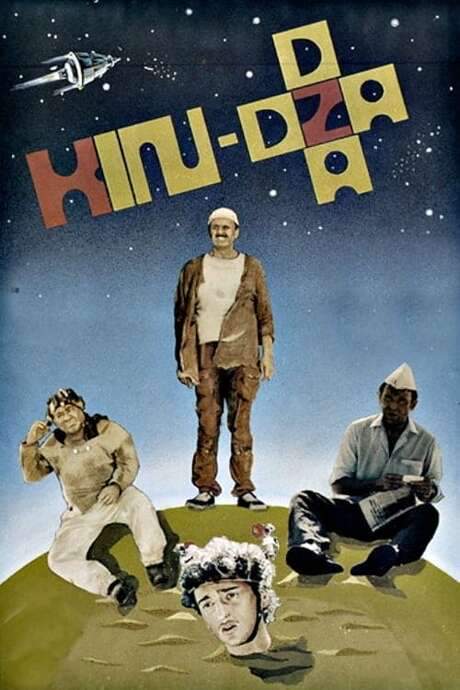
Kin-dza-dza!

Kin-dza-dza!

Year: 1986

Runtime: 135 mins

Language: Russian

Comedy

Two strangers from the Soviet Union are unexpectedly whisked to the desert‑like planet Pluke in the distant Kin‑dza‑da galaxy after stumbling on an alien teleportation device. To survive and find a way home, they must navigate a baffling language, bizarre customs and the planet’s odd laws of space and time.

Warning: spoilers below!

Haven’t seen Kin-dza-dza! yet? This summary contains major spoilers. Bookmark the page, watch the movie, and come back for the full breakdown. If you're ready, scroll on and relive the story!

Kin-dza-dza! (1986) – Full Plot Summary & Ending Explained

Read the complete plot breakdown of Kin-dza-dza! (1986), including all key story events, major twists, and the ending explained in detail. Discover what really happened—and what it all means.

In a vivid, sharply observed portrait of late Soviet life rewritten as a surreal fable, the story starts in 1980s Moscow with Vladimir Nikolaevich Mashkov — known to friends as Uncle Vova Stanislav Lyubshin — trudging home after a grueling day as a construction foreman. His wife asks him to pick up groceries, and the ordinary evening is upended when, parked in the city centre on Kalinin Prospekt, a barefoot man in a tattered coat stops him with an almost biblical question: “Tell me the number of your planet in the Tentura? Or at least the number of your galaxy in the spiral?” The moment is casual yet eerie, a doorway opened to something entirely alien.

Vova and a young Georgian student with a violin, who becomes the film’s memorable Violinist Levan Gabriadze, pause to talk to the stranger. The stranger unveils a device he calls a device for moving in space, a teleportation thing that promises a shortcut beyond time and space. Skeptical but curious, Uncle Vova presses a random button despite the stranger’s warnings, and in a flash they are ripped from their familiar street to a place very far from home: the planet Pluke in the Kin-dza-dza galaxy.

On Pluke, life unfolds with a strange, almost childlike directness that mocks human pretensions. The inhabitants look almost ordinary but live by a tongue-in-cheek, telepathic code, and the two indispensable words of their culture are ku (for goodness) and kyu (for every form of badness). The locals are quick to adapt to Russian and Georgian, which helps the Earth newcomers survive in a world where speech is only a ritual, not a barrier. The society is split into two rigid camps: Chatlanians and Patsaks. A small handheld device called the visator reveals who is who—an orange light marks a Chatlanian, while a green light marks a Patsak—making social status an on-the-spot verdict. The Patsaks, though, carry the burden of ritual worship and obedience, while the Chatlanians enjoy a tentative privilege, a dynamic that hints at a broader, unsettling commentary on power and class. (The narrative makes clear that the two groups are not fixed by fate; Pluke’s tensions shift depending on where you are, who you’re with, and what you own.)

The landscape of power on Pluke is guarded by the ecilopps—the only group allowed to wield weapons, known to locals by their backward-spelled name for “police.” The everyday social currency is bizarre yet revealing: the color of one’s pants becomes a sign of status, dictating how many times one must say ku as a form of submission. The planet’s ruler, a figure named Mr. P-Zh, seems harmless at close range but exerts coercive power through ritual reverence and fear. The fuel that powers Pluke’s world, called luts, is produced from water; water itself is scarce and valuable because every drop must be converted into this processed energy, a detail that underscores how basic resources shape social order.

Amid this strange society, ordinary objects take on extraordinary value. Wooden matches, called ketse, become precious relics, traded and sought after much as much more mundane items would be on Earth. The Earth travelers encounter locals named Uef and Bi, who drift in and out of their efforts to fix a way home. These encounters swing between aid and betrayal, shaping the duo’s attempts to repair a ship or raid the private domain of the enigmatic Mr. P-Zh in hopes of reclaiming their way back to Earth. The plot threads alternate between moments of peril and sly humor, revealing a world where survival often hinges on wit, luck, and a willingness to play by rules that feel absurdly arbitrary to outsiders.

As the journey unfolds, the mission to return home grows ever more urgent. The story eventually threads back to the moment at the film’s start, but with a twist: the man who began their odyssey returns Uncle Vova and the Violinist not to their own city, but to the film’s opening scene. The world seems to reset, and when Uncle Vova steps outside again, he and the Violinist do not recognize each other at first. A passing tractor flashes an orange light, and the two instinctively crouch and utter “ku”—the ritual of fear and deference that has defined their lives on Pluke. It is only then that they re-establish a connection, and the film closes on a note of melancholy irony and muted wonder as Uncle Vova looks up at the sky and hears the distant, hopeful strains of a song performed by the locals Wef Evgeni Leonov and Bi.
Last Updated: October 09, 2025 at 14:15

Mobile App Preview

Coming soon on iOS and Android

The Plot Explained Mobile App

From blockbusters to hidden gems — dive into movie stories anytime, anywhere. Save your favorites, discover plots faster, and never miss a twist again.

Sign up to be the first to know when we launch. Your email stays private — always.

Explore Movie Threads

Discover curated groups of movies connected by mood, themes, and story style. Browse collections built around emotion, atmosphere, and narrative focus to easily find films that match what you feel like watching right now.

Absurdist Sci-Fi Satire like in Kin-dza-dza!

Movies that use bizarre alien societies to cleverly critique our own.If you enjoyed the clever social commentary of Kin-dza-dza!, explore more movies that use bizarre alien worlds and sci-fi concepts to satirize human society. These films blend whimsical humor with thought-provoking themes for a uniquely insightful cinematic experience.

satiricalabsurdthought-provokingbizarreironicwhimsicalsocial commentary

Narrative Summary

Stories in this thread typically follow characters, often ordinary people, who are thrust into an alien environment governed by illogical or arbitrary rules. Their journey of survival and adaptation becomes a vehicle for exploring and critiquing real-world social issues like class, discrimination, and bureaucracy, often through a lens of sly, observational humor.

Why These Movies?

These movies are grouped together because they share a specific tone: using the fantastical elements of science fiction not for epic spectacle, but for sharp, often ironic, social observation. They prioritize intellectual humor and thematic depth over action or high-stakes drama, creating a cohesive vibe of witty absurdism.

Bittersweet Alien Journeys like in Kin-dza-dza!

Stories of characters forever changed by their travels in strange new worlds.For viewers who appreciated the melancholic undertones of Kin-dza-dza!'s adventure, this collection highlights movies about characters navigating alien cultures who return home forever altered. These stories blend wonder with a lasting sense of introspection and bittersweet resolution.

melancholicbittersweetthought-provokingdreamlikealienationreflectivejourney

Narrative Summary

The narrative pattern involves characters being transported to an alien setting, where their primary goal is survival and return. However, the central conflict is often internal—grappling with cultural shock and existential questions. The resolution typically sees them achieving their goal but carrying the emotional and psychological weight of their experience, resulting in a bittersweet or melancholic conclusion.

Why These Movies?

These films are united by a specific emotional arc and ending feel. They combine the adventure of exploring a strange world with a reflective, sometimes sad, core. The experience is less about external threats and more about the indelible mark left on the traveler, creating a coherent mood of thoughtful melancholy mixed with discovery.

Unlock the Full Story of Kin-dza-dza!

Don't stop at just watching — explore Kin-dza-dza! in full detail. From the complete plot summary and scene-by-scene timeline to character breakdowns, thematic analysis, and a deep dive into the ending — every page helps you truly understand what Kin-dza-dza! is all about. Plus, discover what's next after the movie.

Kin-dza-dza! Timeline

Track the full timeline of Kin-dza-dza! with every major event arranged chronologically. Perfect for decoding non-linear storytelling, flashbacks, or parallel narratives with a clear scene-by-scene breakdown.

Kin-dza-dza! Timeline

Characters, Settings & Themes in Kin-dza-dza!

Discover the characters, locations, and core themes that shape Kin-dza-dza!. Get insights into symbolic elements, setting significance, and deeper narrative meaning — ideal for thematic analysis and movie breakdowns.

Characters, Settings & Themes in Kin-dza-dza!

Kin-dza-dza! Spoiler-Free Summary

Get a quick, spoiler-free overview of Kin-dza-dza! that covers the main plot points and key details without revealing any major twists or spoilers. Perfect for those who want to know what to expect before diving in.

Kin-dza-dza! Spoiler-Free Summary

More About Kin-dza-dza!

Visit What's After the Movie to explore more about Kin-dza-dza!: box office results, cast and crew info, production details, post-credit scenes, and external links — all in one place for movie fans and researchers.

More About Kin-dza-dza!

Similar Movies to Kin-dza-dza!

Discover movies like Kin-dza-dza! that share similar genres, themes, and storytelling elements. Whether you’re drawn to the atmosphere, character arcs, or plot structure, these curated recommendations will help you explore more films you’ll love.