














Plot Explained Spoilers guaranteed!
Plot Explained

Browse by genre

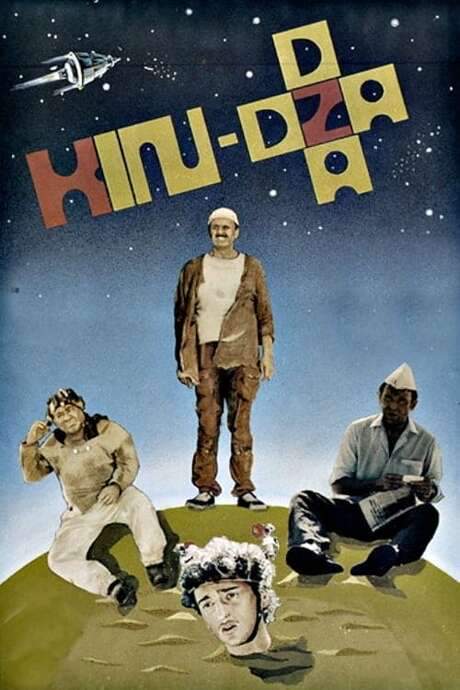
Kin-dza-dza! (1986) movie poster

Characters & Themes

Kin-dza-dza! (1986) Characters, Setting & Themes Explained

Release, runtime and language
1986 · 135 mins · Russian
JustWatch #4,619 54
Starring
Levan Gabriadze, Vladimir Fyodorov, Georgiy Daneliya, Galina Daneliya-Yurkova, Stanislav Lyubshin, Nina Ter-Osipyan

Two strangers from the Soviet Union are unexpectedly whisked to the desert‑like planet Pluke in the distant Kin‑dza‑da galaxy after stumbling on an alien teleportation device. To survive and find a way home, they must navigate a baffling language, bizarre customs and the planet’s odd laws of space and time.

On this page (8)
  1. 1 Where to watch
  2. 2 Characters explained (5)
  3. 3 Where & when it takes place
  4. 4 Themes & meaning (4)
  5. 5 Character & meaning questions
  6. 6 Movie threads
  7. 7 Movies like Kin-dza-dza!
  8. 8 Every angle

Where to watch

Where to Watch Kin-dza-dza! (1986)

Where can you watch Kin-dza-dza!? Stream, rent or buy it in the US, including on ARROW, Bloodstream and Eternal Family: current JustWatch availability with up-to-date prices.

Streaming availability powered by JustWatch

5 main characters · contains spoilers

Kin-dza-dza! Characters Explained: Who Is Who

The main characters of Kin-dza-dza! (1986), heroes and villains: what drives them, how they change over the course of the story and what each of them reveals about the film's bigger ideas.

  • Vladimir Nikolaevich Mashkov (Uncle Vova) - Stanislav Lyubshin

    A stressed construction foreman from 1980s Moscow who tests the teleportation device. Practical and impulsive, he tries to navigate Pluke’s brutal social rules while clinging to the hope of returning home to his wife and ordinary life.

    • 👔 Foreman
    • 🧭 Impulsive
    • 💬 Naive
  • The Violinist (Georgian student)

    A young Georgian student traveling with Uncle Vova. Bright, curious and somewhat wary, he uses his violin and wits to navigate the strange world of Pluke.

    • 🎻 Musician
    • 💡 Resourceful
    • 🤝 Ally
  • Wef (Uef) - The Wandering Chatlanian Singer

    played by Evgeni Leonov

    A wandering Chatlanian singer who interacts with the Earth visitors, offering aid and complicating alliances on Pluke.

    • 🎤 Singer
    • 🧭 Wanderer
    • 💬 Polyglot
  • Bi

    A local of Pluke who alternates between helping and abandoning the Earth visitors, reflecting the unpredictable nature of the planet’s inhabitants.

    • 🤝 Ally
    • 🗺️ Local Guide
  • Mr. P-Zh (P-Zh)

    The nominal leader of Pluke, P-Zh appears harmless and dumb in person, yet his authority underpins the social order and its rituals.

    • 👑 Leader
    • 🗺️ Bureaucracy

Last updated: October 04, 2025 at 14:11

Was this helpful?

Setting

Where and When Does Kin-dza-dza! Take Place?

The setting of Kin-dza-dza! (1986): the year and time period, the places and locations, and how they shape the characters, the mood and the tension of the story.

Time period

1980s

The action begins in late Soviet-era Moscow, a time of shortages and political tension. The transport to Pluke interrupts the ordinary timeline, juxtaposing the familiar urban life with a satirical alien world. The 1980s setting frames the film’s critique of authority, consumerism, and social hierarchies.

Location

Moscow, Pluke (Kin-dza-dza galaxy)

The story opens in 1980s Moscow, a gray, bureaucratic urban setting. A strange visitor urges the protagonists to test a teleportation device, which unexpectedly sends them to the planet Pluke in the Kin-dza-dza galaxy. Pluke features a two-tier society of Chatlanians and Patsaks, governed by ritual and a device called the visator. The planet’s day-to-day life centers on the scarcity of water (luts) and the extreme value placed on mundane objects like ketse matches.

  • 🌆 Moscow
  • 🪐 Kin-dza-dza galaxy
  • 🧭 Teleportation

Last updated: October 04, 2025 at 14:11

Was this helpful?

4 major themes

Kin-dza-dza! Meaning: Themes & Message Explained

What is Kin-dza-dza! (1986) really about? The emotional, social and philosophical themes the film keeps returning to, its symbolism and the message beneath the surface.

  • Class System

    Kin-dza-dza humorously exaggerates social stratification. On Pluke, clothing color, the visator light, and pant shade determine a person’s status, revealing how arbitrary cues govern behavior and power. Patsaks and Chatlanians navigate a system designed to enforce humiliation and obedience. The satire exposes the fragility and performativity of social rank.

  • Language & Communication

    The Plukanian language centers on the two words ku and kyu, underscoring how meaning is reduced to simple terms. The Earth visitors must learn to understand Russian and Georgian, while locals communicate through telepathy and coded signals. Misunderstandings and shortcuts highlight the fragility of cross-cultural communication. The visator provides a pragmatic tool for judging status, shaping interactions.

  • Scarcity

    Water, processed into luts, becomes a scarce and valuable resource. Ketse matches, as ordinary wooden sticks, are improbably precious, illustrating how value is manufactured by social rules. The economy of Pluke hinges on the control and distribution of basic commodities. The seriousness of scarcity is played for absurd humor, revealing human vanity.

  • Absurdity

    Kin-dza-dza parodies bureaucracy, violence, and power through its bizarre rules and rituals. The juxtaposition of a mundane city street with a brutal planetary order creates a continuous sense of satire. Characters bend, switch, and exploit rules to survive, exposing the emptiness of pretensions. The film uses satire and surreal humor to critique human folly.

Last updated: October 04, 2025 at 14:11

Was this helpful?

Character & theme questions

Kin-dza-dza! Characters & Meaning: Your Questions Answered

The questions people ask about Kin-dza-dza! (1986): who the characters really are, their relationships, what the symbols mean, where it takes place and what the movie is really about. Each answer contains spoilers.

Q1

How does the social hierarchy work on Pluke?

Pluke operates on a rigid two-tier society divided between Chatlanians and Patsaks. Status is determined by arbitrary visual markers like clothing color, the light emitted from a device called the visator, and pant shade. These superficial cues govern behavior, power, and interactions, with the system designed to enforce humiliation and obedience. The film satirizes how arbitrary signals control social rank.

  • pluke
  • chatlanians
  • patsaks
  • social hierarchy
  • visator
  • class system
Q2

Why are ketse matches so valuable on Pluke?

On Pluke, ordinary wooden ketse matches are treated as extremely precious commodities, while water processed into 'luts' becomes scarce and valuable. The film uses this absurdity to illustrate how social rules manufacture value out of mundane objects. The seriousness with which Plukanians treat these items reveals human vanity and the arbitrary nature of economic worth.

  • ketse matches
  • scarcity
  • water luts
  • pluke economy
  • value
Q3

What is the language of Pluke and what does 'ku' mean?

The Plukanian language centers on just two words: 'ku' and 'kyu', radically simplifying communication. Meanwhile, locals also communicate through telepathy and coded signals. The Earth visitors must navigate understanding Russian and Georgian while dealing with this minimalist alien tongue. The language serves as a satire of how meaning can be reduced to oversimplified terms.

  • ku
  • kyu
  • plukanian language
  • telepathy
  • communication
Q4

Why does the film start in 1980s Moscow?

The 1980s Moscow setting establishes the familiar, gray, bureaucratic world the protagonists come from, a time of shortages and political tension. This contrast between ordinary Soviet urban life and the satirical alien world of Pluke frames the film's critique of authority, consumerism, and social hierarchies. The transport to Pluke abruptly juxtaposes the familiar with the absurd.

  • moscow
  • 1980s
  • soviet era
  • setting
  • contrast
Q5

Who is P-Zh on Pluke?

P-Zh is the nominal leader of Pluke, appearing harmless and seemingly dim-witted in person. However, his authority underpins the entire social order and its rituals. His seemingly innocuous presence masks the brutal planetary order that governs Chatlanians and Patsaks, representing how power can hide behind performed weakness.

  • p-zh
  • leader
  • pluke
  • authority
  • social order
Q6

What is the visator on Pluke?

The visator is a device that plays a central role in Plukanian society. It emits light that helps determine a person's status, shaping all interactions on the planet. The visator serves as a pragmatic tool for judging social rank, acting as both a status symbol and a mechanism of control within the alien social hierarchy.

  • visator
  • device
  • status
  • pluke social rules
Q7

Who is Uncle Vova in the film?

Uncle Vova (Vladimir Nikolaevich Mashkov) is a stressed construction foreman from 1980s Moscow who becomes testing the teleportation device. He is practical and impulsive, trying to navigate Pluke's brutal social rules while clinging to the hope of returning home to his wife and ordinary life. He represents the average person thrust into an incomprehensible system.

  • uncle vova
  • vladimir mashkov
  • protagonist
  • moscow
Q8

What are the main themes of Kin-dza-dza?

The film explores class stratification through arbitrary social markers, the fragility of cross-cultural communication, how scarcity and manufactured value drive societies, and the absurdity of bureaucracy and power. These themes are conveyed through surreal humor that critiques human folly, discrimination, and the performativity of social rank.

  • themes
  • class system
  • satire
  • absurdity
  • bureaucracy
  • communication
Q9

What is the difference between Chatlanians and Patsaks?

Chatlanians and Patsaks are the two main social groups on Pluke, forming a two-tier hierarchy. The exact distinctions between them aren't fully explained in human terms, but their division drives much of Plukanian social interaction, with both groups navigating a system designed to enforce humiliation and obedience. The separation represents the film's satire of discrimination and social stratification.

  • chatlanians
  • patsaks
  • social groups
  • pluke
  • hierarchy
Q10

Who is the Violinist in Kin-dza-dza?

The Violinist is a young Georgian student traveling with Uncle Vova. He is bright, curious, and somewhat wary. Throughout the story on Pluke, he uses his violin and wits to navigate the strange world, serving as a cultural bridge and demonstrating how music and intelligence help survivors adapt to alien environments.

  • violinist
  • georgian student
  • character
  • adaptation
Q11

Who is Wef the singer on Pluke?

Wef (also called Uef) is a wandering Chatlanian singer who interacts with the Earth visitors. He offers aid while also complicating alliances on Pluke, representing the unpredictable nature of assistance in this alien world. His role highlights how even helpful figures on Pluke have ambiguous motivations.

  • wef
  • uef
  • singer
  • chatlanian
  • helper
Q12

Who is Bi on Pluke?

Bi is a local inhabitant of Pluke who alternates between helping and abandoning the Earth visitors. This reflects the unpredictable nature of Pluke's inhabitants, where assistance is never guaranteed and alliances are fluid. Bi represents how trust is fragile in a society built on arbitrary status markers.

  • bi
  • pluke local
  • unpredictable
  • character

Movie threads

More Movies Like Kin-dza-dza!, by Mood & Story

Curated lists built around what makes Kin-dza-dza! tick: the same mood, the same kind of story or the same emotional payoff. Each list explains why these movies belong together.

Absurdist Sci-Fi Satire like in Kin-dza-dza!

Movies that use bizarre alien societies to cleverly critique our own. If you enjoyed the clever social commentary of Kin-dza-dza!, explore more movies that use bizarre alien worlds and sci-fi concepts to satirize human society. These films blend whimsical humor with thought-provoking themes for a uniquely insightful cinematic experience.

  • satirical
  • absurd
  • thought-provoking
  • bizarre
  • ironic
  • whimsical
  • Tone: whimsical, satirical, thought-provoking
  • Pacing: steady, exploratory
Why these movies?

The story pattern: Stories in this thread typically follow characters, often ordinary people, who are thrust into an alien environment governed by illogical or arbitrary rules. Their journey of survival and adaptation becomes a vehicle for exploring and critiquing real-world social issues like class, discrimination, and bureaucracy, often through a lens of sly, observational humor.

Why they belong together: These movies are grouped together because they share a specific tone: using the fantastical elements of science fiction not for epic spectacle, but for sharp, often ironic, social observation. They prioritize intellectual humor and thematic depth over action or high-stakes drama, creating a cohesive vibe of witty absurdism.

Bittersweet Alien Journeys like in Kin-dza-dza!

Stories of characters forever changed by their travels in strange new worlds. For viewers who appreciated the melancholic undertones of Kin-dza-dza!'s adventure, this collection highlights movies about characters navigating alien cultures who return home forever altered. These stories blend wonder with a lasting sense of introspection and bittersweet resolution.

  • melancholic
  • bittersweet
  • thought-provoking
  • dreamlike
  • alienation
  • reflective
  • Tone: melancholic, bittersweet, reflective
  • Pacing: steady, character-driven
Why these movies?

The story pattern: The narrative pattern involves characters being transported to an alien setting, where their primary goal is survival and return. However, the central conflict is often internal—grappling with cultural shock and existential questions. The resolution typically sees them achieving their goal but carrying the emotional and psychological weight of their experience, resulting in a bittersweet or melancholic conclusion.

Why they belong together: These films are united by a specific emotional arc and ending feel. They combine the adventure of exploring a strange world with a reflective, sometimes sad, core. The experience is less about external threats and more about the indelible mark left on the traveler, creating a coherent mood of thoughtful melancholy mixed with discovery.

If you liked this

Movies Like Kin-dza-dza!

Similar movies to Kin-dza-dza!: the same genre, themes or kind of story. Each one comes with its own plot summary, timeline and ending explained.

Browse all movie summaries

Every angle

Kin-dza-dza! (1986) Explained: Plot, Timeline & Characters

Everything about Kin-dza-dza! in one place: what happens in the plot summary, the timeline in chronological order, the characters and meaning and a spoiler-free summary. What's After the Movie adds the cast, box office and post-credit scenes.

Coming soon on iOS and Android

The Plot Explained Movie Summary App

Plot summaries, endings explained and timelines on your phone. Catch up on any movie in minutes, save your favorites and never miss a twist again.

Be the first to know when we launch. Your email stays private, always.

Learn more about the app