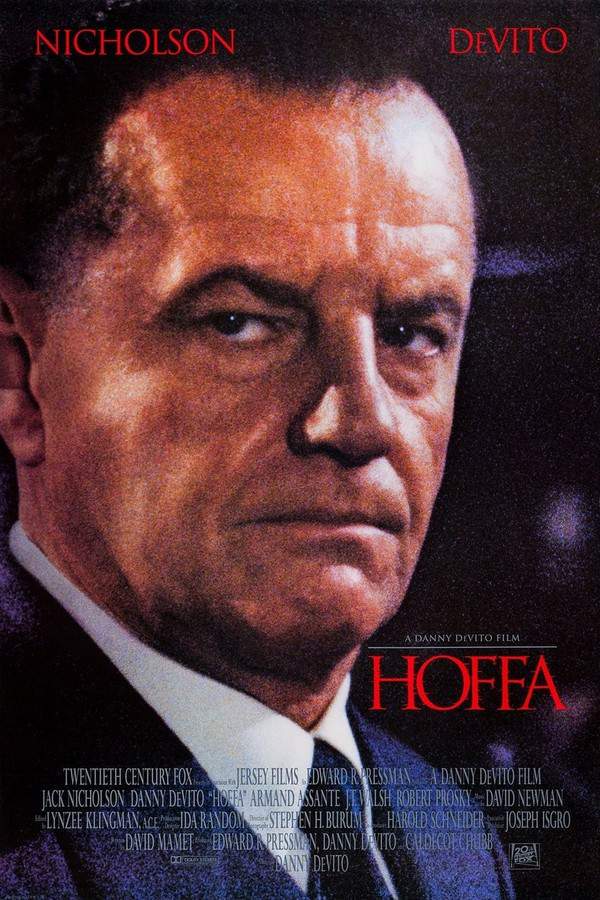
On July 30, 1975, Jimmy Hoffa and his longtime friend Bobby Ciaro linger in the parking lot of a roadhouse diner, a quiet frame that opens a deeper, sprawling portrait of Hoffa’s past. The film unfolds in a series of vignettes that trace four decades of his life, starting with his early days as an International Brotherhood of Teamsters organizer in and around Detroit, and how his drive to unite workers sets him on a collision course with power, loyalty, and crime.
In 1935, Hoffa boards a parked truck where he meets driver Ciaro, pitching the benefits of joining the union and slipping a business card into Ciaro’s hands, inscribing the bold line, > Give this man whatever he needs. A few days later, Ciaro reports to work to find Hoffa already courting his fellow drivers to unionize. Hoffa’s bold, relentless approach backfires when he blurts out that he already spoke to Ciaro, getting Ciaro fired. The tension escalates as Ciaro confronts Hoffa with a knife, but Hoffa’s longtime bodyguard Billy Flynn steps in, forcing the aggressor to drop the weapon at gunpoint. This rough partnership between Hoffa and Ciaro intensifies as they help in the arson of a laundry that refuses to cooperate with the Teamsters. Flynn’s injuries from the fire prove fatal, and Ciaro transitions into Hoffa’s new bodyguard and trusted aide.
The narrative continues with a brutal street-level strike that erupts into a clash between union and non-union workers, drawing Hoffa into a perilous grab for power. He is kidnapped by men working for Detroit Mafia boss Carl D’Allesandro, but Ciaro’s intervention helps negotiate a bargain: D’Allesandro will lend muscle and influence to the Teamsters in exchange for illicit “loans” from the union treasury. Hoffa’s public fate becomes entangled with political scrutiny when he is questioned at a Congressional hearing by Robert F. Kennedy over allegations of organized crime influence over the Teamsters. Hoffa eventually rises to the presidency in 1957, only to see his relationship with Kennedy’s brother, John F. Kennedy, sour into a fierce, public feud as Bobby Kennedy becomes Attorney General.
A hunting trip with D’Allesandro reveals a secret embezzlement scheme involving the Teamsters’ pension fund, sketched haphazardly on the back of a hunting license when there is no paper handy to record the plan. The betrayal by Teamsters official Peter Connelly compounds Hoffa’s troubles: Connelly testifies at Hoffa’s labor racketeering trial and provides the crucial evidence—the very license that bears the scheme’s outline. Hoffa surrenders to federal authorities, and Frank Fitzsimmons, a powerful insider, seizes control of the union while Ciaro is convicted on lesser charges and granted early release.
Political maneuvering continues as D’Allesandro urges a strategic gambit: endorse Richard Nixon in 1968 in exchange for a presidential pardon for Hoffa. The payoff appears when Hoffa is pardoned, but a harsh constraint follows—he is forbidden to contact the Teamsters for ten years due to a deal between the White House and Fitzsimmons. Enraged, Hoffa presses D’Allesandro to eliminate Fitzsimmons, triggering a failed car-bomb attempt and leaving Hoffa isolated from the union’s inner circle. D’Allesandro signals that he won’t help further, suggesting that a direct confrontation may become public.
The tension finally shifts to the diner’s parking lot, where Hoffa enlists Ciaro to deliver a message to D’Allesandro—a warning that if Fitzsimmons is not dealt with, Hoffa will go to the press. When D’Allesandro does not show, the waiting game ends in a brutal confrontation. A driver in the diner’s parking lot, armed with a silenced pistol, ends Hoffa’s life—yet Ciaro’s body is also disposed of in Hoffa’s car as men from a truck pull the vehicle away. The grim sequence underlines a life spent balancing power, loyalty, danger, and the ever-present possibility of being erased by the very forces Hoffa sought to control.
Throughout the film, the narrative moves with a somber, measured tempo, grounding Hoffa’s meteoric rise and catastrophic fall in personal loyalties and the hidden costs of leadership. The blend of intimate scenes and public power plays paints a portrait of a man whose ambition pulled him into a web of crime, politics, and betrayal, and it leaves the viewer with a clear, unflinching view of the costs of influence in American labor history.