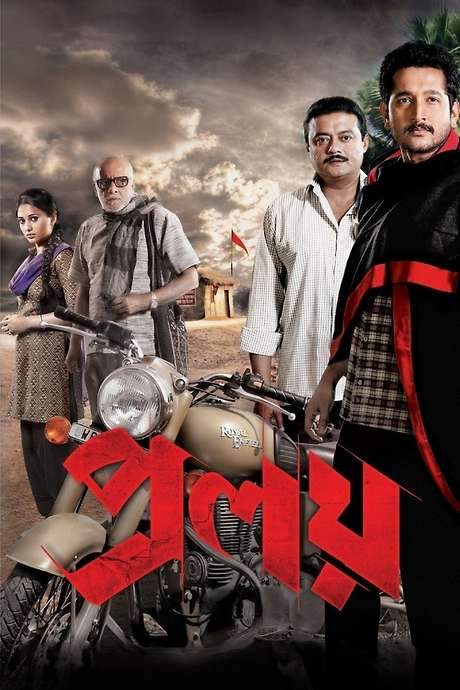
In the rural village of Dukhia, nestled in the fields of Bengal, a brutal pattern of violence grips the community as a gang of criminals uses fear and sexual violence to maintain control. Gang rapes have become a horrifying routine, affecting even the most vulnerable—children and elderly women—while complicit police forces turn a blind eye, protected by the unholy patronage of a powerful local political leader who treats protection as a right rather than a service. In this hostile environment, a beacon of moral resolve emerges: an idealist local teacher, Barun Biswas, who refuses to accept the status quo and dares to challenge the pervasive corruption.
Driven by a sense of social responsibility, Barun forms an activist group named Jagaran Mancha, rallying the frightened villagers to demand accountability and the immediate arrest of the criminals. His courage reshapes the village’s psyche, inspiring many to join the cause, and his actions illuminate a path toward justice that had previously seemed unattainable. Yet the cost of standing up to entrenched power proves immense. One fateful day, Barun is murdered while returning from the school, and his death becomes a crucible that forces the community to confront the depth of the rot that has gripped Dukhia.
Enter Binod Bihari Dutta, a man who met Barun and was deeply moved by his vision of a fairer society. Shocked by Barun’s killing and the revelation of how easily the criminals slipped through the cracks of a corrupt system, Binod rushes to Dukhia to honor Barun’s memory and to understand the full scope of the menace. He learns how the criminals have exploited the hollowed-out machinery of the law, and he resolves to galvanize the villagers to carry Barun’s mission forward, even as he confronts the possibility that justice may be a long, arduous battle.
Arriving in Dukhia is a Special Branch Officer, Animesh Dutta, a no-nonsense cop whose arrival seems almost fated. He learns of Barun’s murder through Binod and brings a different, sharper edge to the struggle. As the narrative unfolds, friction arises between Binod’s idealistic, communal approach and Animesh’s more unconventional, semi-legal tactics. Amid the tension, rumors begin to swirl in the village that Barun has returned from the dead to punish his killers, a suggestion that unsettles the already fragile balance between vigilante action and official justice. Animesh, wary of the disruptive potential of Jagaran Mancha, vows to safeguard what he believes to be the last criminal, interpreting his duty as a public servant to mean protecting the living over the dead reckoning of vengeance.
What emerges in a startling turn is a morally complex truth: Binod Dutta has been carrying out a vigilante campaign of his own, aided by a few members of Jagaran Mancha. He has been killing the criminals in carefully calculated ways, a clandestine effort that sits at odds with the law but speaks to a community fed up with inaction. The climax reveals Binod's final act—killing the last criminal by ripping his stomach open—and, in a wrenching twist, Animesh rescues Binod from the scene and discreetly withdraws him from the village, choosing to bury the case rather than ignite an official confrontation. In the closing moments, Animesh shares a deeply personal admission: he has become a father and plans to name his son Barun, a quiet, somber tribute that underscores the film’s enduring question about the costs of justice, the line between right and wrong, and the price of moral courage in a system bent by power.
Throughout, the story tracks the tension between reformist zeal and the murky ethics of vigilantism, presenting a stark meditation on how a community fights back against brutality when every institutional safeguard seems compromised. It is a narrative that refuses easy answers, instead inviting viewers to weigh loyalty, justice, and the haunting idea that sometimes the person who seeks to protect the living is the one who shadows themselves with questionable means. The result is a deeply examined portrait of a village at a crossroads, where memory, sacrifice, and the memory of a teacher’s idealism linger long after the final act.