Year: 2009
Runtime: 90 min
Language: Japanese
Director: Kirby Dick
This provocative documentary explores the surprising contradiction between the personal lives and public actions of influential figures who identify as LGBTQ+, while simultaneously advocating for policies that harm the community. Featuring candid interviews with key individuals, the film delves into the complex psychological reasons behind this hypocrisy and examines how the media contributes to the ongoing situation. It offers a revealing look at the conflict between identity and political maneuvering.
Warning: spoilers below!
Haven’t seen Outrage yet? This summary contains major spoilers. Bookmark the page, watch the movie, and come back for the full breakdown. If you're ready, scroll on and relive the story!
Read the complete plot breakdown of Outrage (2009), including all key story events, major twists, and the ending explained in detail. Discover what really happened—and what it all means.
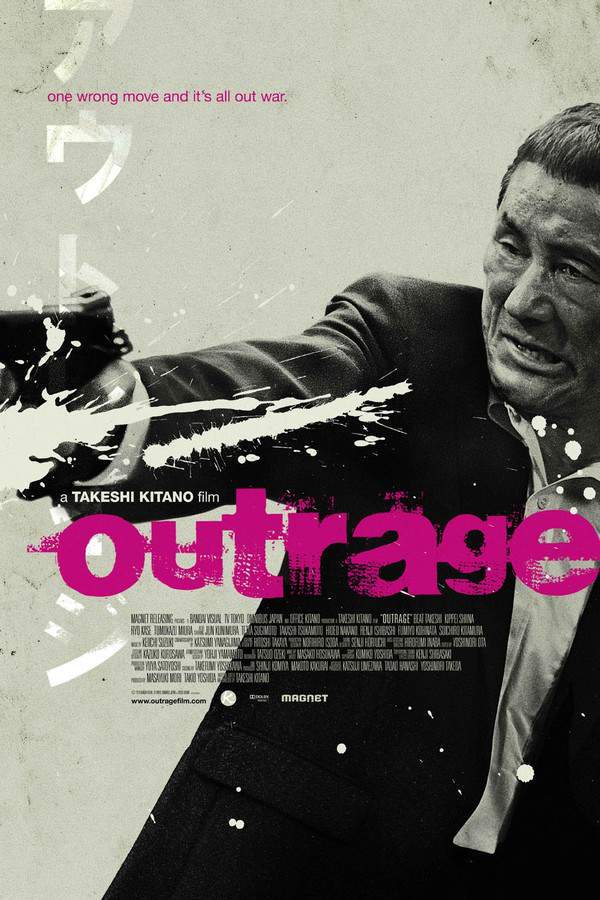
The film opens with a lavish banquet at the opulent estate of the Grand Yakuza leader Sekiuchi, the man at the helm of the Sanno-kai, a sprawling crime syndicate that holds sway over the Kanto region. The gathering brings together the many Yakuza leaders who bend the knee to his authority, setting the stage for a web of loyalties and grudges that will soon fracture.
After the toast and formalities, Kato—the underboss of the Sanno-kai—pulls aside a fellow leader who has just fallen out of favor. He makes it clear that he is displeased with the uneasy friendship that has blossomed between Ikemoto and a rival faction, Murase, during a time when the two were unexpectedly imprisoned together. The message is blunt: Ikemoto must bring the Murase-gumi in line. The weight of this order is then transferred to a trusted subordinate, Otomo, who runs his own crew and is expected to execute the plan.
Soon enough, a pivotal incident unfolds at Murase’s nightclub. A man posing as a customer is driven by a calculated scheme and shaken down for about one million yen. The shocking twist is that this supposed patron is actually a member of the Otomo family, planted into the venue to spark the spark that could ignite an all-out war against Murase’s faction. Murase remains largely ignorant of his falling out with Sekiuchi and believes he can repair the rift by leaning on a former prison friend, Ikemoto. He trusts this alliance without suspecting the treachery lurking behind Ikemoto’s advice, and each time he heeds that counsel, his position and resources weaken further, eroding the strength and stability of his crime family. The violence intensifies when Otomo leaves a cruel scar on the face of Murase’s chief lieutenant, Kimura, deepening the sense that the conflict is spiraling beyond repair.
As the days pass and the dust settles, the scheme reaches a brutal culmination: Ikemoto and Murase are killed, while Otomo finds himself confined in a maximum-security prison—unexpectedly sharing the same fate as Kimura in a brutal prison ambush, where Kimura drives a makeshift knife into Otomo’s belly. The inner workings of the gang world come into sharper focus as the betrayals, loyalties, and power moves collide and collide again, each move tightening the noose around those who believed they could navigate the maze of kinship and treachery.
In the final act, the power players circle back to where they began. Kato takes decisive action, pulling off a covert strike against Sekiuchi himself. The leader falls, and Kato steps into the void, seizing control as the new Grand Yakuza of the Sanno-kai. The film closes on a stark, unsettling note: the cycle of ambition and betrayal that defined the lives within this world continues, even as the old guard is toppled and a new order takes shape.
Across these twists and reversals, the story remains a careful study of how trust can be weaponized, how prison bonds can fracture under pressure, and how a single calculated move can redraw the map of power within a ruthless criminal empire. The tension is sustained through each calculated maneuver, each violence-laden confrontation, and every quiet moment where a character weighs a choice that could alter the course of an entire syndicate. The result is a dense, morally complex portrait of loyalty, control, and the high stakes of a world where survival hinges on who blinks first.
Last Updated: October 09, 2025 at 15:43
Discover curated groups of movies connected by mood, themes, and story style. Browse collections built around emotion, atmosphere, and narrative focus to easily find films that match what you feel like watching right now.
Stories of intricate power webs where every alliance is a potential trap.Explore movies like Outrage that dissect the brutal logic of power struggles within rigid organizations. If you enjoyed the intricate schemes and constant tension of Outrage, you'll find similar complex narratives of loyalty tested and alliances shattered in these selections.
Narratives in this thread follow a steady, often unforgiving, escalation of conflict within a closed society. Characters navigate a web of obligations and rivalries, where a single miscalculation can trigger a chain reaction of violence. The journey is typically one of moral erosion, culminating in a conclusion that reinforces the ruthless nature of the world.
Movies are grouped here based on their shared focus on complex power dynamics, a pervasive atmosphere of mistrust, and a narrative structure that emphasizes strategic gameplay over impulsive action. They deliver a specific kind of tension born from psychological manipulation and the cold calculation of survival.
Unflinching portraits of systems that consume their own, leaving little hope.Find more movies like Outrage that explore the crushing weight of criminal institutions and their bleak, cyclical nature. These films share a heavy emotional weight, a dark tone, and endings that offer little redemption, perfect for viewers who appreciated the unforgiving worldview of Outrage.
The narrative pattern is often tragic and circular. Characters are bound by codes that demand violence, leading to a series of escalating retaliations. The plot moves toward an ending that is fundamentally bleak, affirming that the cycle of ambition and violence is endless and that the institution will always demand more than any individual can give.
These films are united by their oppressive atmosphere, heavy emotional weight, and a conclusive, bleak ending feel. They share a high intensity derived from graphic violence and disturbing themes, creating a coherent viewing experience for those seeking stark, uncompromising narratives about the cost of power.
Don't stop at just watching — explore Outrage in full detail. From the complete plot summary and scene-by-scene timeline to character breakdowns, thematic analysis, and a deep dive into the ending — every page helps you truly understand what Outrage is all about. Plus, discover what's next after the movie.
Track the full timeline of Outrage with every major event arranged chronologically. Perfect for decoding non-linear storytelling, flashbacks, or parallel narratives with a clear scene-by-scene breakdown.
Discover the characters, locations, and core themes that shape Outrage. Get insights into symbolic elements, setting significance, and deeper narrative meaning — ideal for thematic analysis and movie breakdowns.
Get a quick, spoiler-free overview of Outrage that covers the main plot points and key details without revealing any major twists or spoilers. Perfect for those who want to know what to expect before diving in.
Visit What's After the Movie to explore more about Outrage: box office results, cast and crew info, production details, post-credit scenes, and external links — all in one place for movie fans and researchers.
Discover movies like Outrage that share similar genres, themes, and storytelling elements. Whether you’re drawn to the atmosphere, character arcs, or plot structure, these curated recommendations will help you explore more films you’ll love.
Outrage (2009) Scene-by-Scene Movie Timeline
Outrage (2009) Movie Characters, Themes & Settings
Outrage (2009) Spoiler-Free Summary & Key Flow
Movies Like Outrage – Similar Titles You’ll Enjoy
Outlaw (2007) Ending Explained & Film Insights
Pornography (2010) Complete Plot Breakdown
Exposed (2014) Plot Summary & Ending Explained
Outrage Coda (2017) Full Movie Breakdown
Out (2018) Full Movie Breakdown
Outlawed (2018) Detailed Story Recap
Queer Japan (2019) Movie Recap & Themes
Acting Out (1978) Detailed Story Recap
Outrage (1950) Spoiler-Packed Plot Recap
The Forbidden (1966) Complete Plot Breakdown
Outrageous! (1977) Plot Summary & Ending Explained
An Outlaw (1964) Story Summary & Characters
Outrage (1993) Plot Summary & Ending Explained
Sexual Outlaws (1994) Film Overview & Timeline
The Outrage (1964) Film Overview & Timeline