Plot Explained Spoilers guaranteed!
Plot Explained

Browse by genre

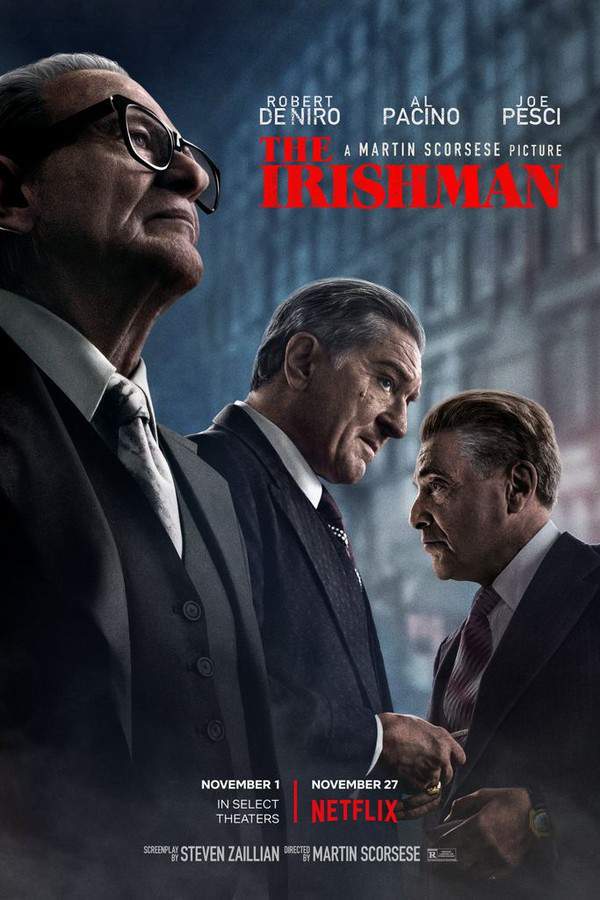
The Irishman (2019) movie poster

Plot Summary

The Irishman (2019) Plot Summary & Ending Explained

Release, runtime and language
2019 · 209 min · English
Echo score 89
JustWatch #23,149 6
Directed by
Martin Scorsese
Starring
Robert De Niro, Sebastian Maniscalco, Stephanie Kurtzuba, Ray Romano, Bobby Cannavale, Anna Paquin
Budget
$159M

Frank Sheeran, a World War II veteran, recounts his life as a hustler and eventually a hitman in post-war America. His path crosses with notorious figures of the 20th century, leading him into a world of organized crime and political intrigue. The film explores Sheeran's involvement in the disappearance of union boss Jimmy Hoffa, revealing a complex web of rivalries and the dark undercurrents of American history across several decades.

On this page (8)
  1. 1 Where to watch
  2. 2 What happens: full plot
  3. 3 Plot questions answered
  4. 4 How it ends
  5. 5 The book behind the movie
  6. 6 Movie threads
  7. 7 Movies like The Irishman
  8. 8 Every angle

Where to watch

Where to Watch The Irishman (2019)

Where can you watch The Irishman? Stream, rent or buy it in the US, including on Netflix and Netflix Standard: current JustWatch availability with up-to-date prices.

Streaming availability powered by JustWatch

Full plot summary · contains spoilers

What Happens in The Irishman: Full Plot Summary

The whole story of The Irishman (2019) explained, from the opening scene to the final frame: every key event, every twist and what it all adds up to. Read it as a quick recap before the sequel, to check a scene you missed, or to finally understand what really happened.

The story unfolds in the early 2000s within the confines of a retirement home, where Frank Sheeran (Robert De Niro) sits in solitude, contemplating the journey of his life that has brought him to this moment. His reflections delve into his past, beginning with his involvement as a "house painter," a euphemism for his role as a hit-man.

In the 1950s, Frank, a proud World War II veteran, resides in Philadelphia, Pennsylvania, earning a living as a truck driver for a meat-packing company. He shares his life with his wife, Mary (Aleksa Palladino), and their daughter, Peggy (portrayed by Lucy Gallina). His fate intertwines with that of Russell Bufalino (Joe Pesci), a local mobster who advises him on fixing his truck. The conversation steers away from personal introductions but sets a future connection in motion.

As Frank delves deeper into the underworld, he forges connections with the notorious gangster Felix "Skinny Razor" DiTullio (Bobby Cannavale). A turning point occurs when Frank is accused of theft by his employers after a delivery goes wrong. Seeking legal assistance, he turns to Bill Bufalino (Ray Romano), who advises him to protect the names of his associates. This leads to a formal introduction to Russell, marking Frank’s entry into the world of organized crime.

Things take a dramatic turn when Frank is approached by a gangster known as Whispers (Paul Herman), who tasks him with eliminating Russell and Angelo Bruno (Harvey Keitel). However, Frank chooses loyalty and informs them instead, showing his complex moral compass. One disturbing incident involving Peggy prompts Frank to confront a store owner violently, leaving his daughter terrified of him—a foreshadowing of their strained relationship.

Russell introduces Frank into the fold of crime, where he becomes an adept hit-man, intertwining his life with various gangsters, each meeting their grim fate as noted throughout the film. Frank’s personal life illustrates his departure from Mary as he embarks on a relationship with Irene (Stephanie Kurtzuba), later growing his family with two more daughters. The narrative weaves in Jimmy Hoffa (Al Pacino), the powerful leader of the International Brotherhood of Teamsters, who seeks Frank's expertise.

In a compelling moment, Frank learns of tensions between Hoffa and Teamsters Vice President Anthony "Tony Pro" Provenzano (Stephen Graham), hinting at the brewing conflicts ahead. Frank begins working alongside Hoffa, becoming a protector and confidant, while Peggy grows particularly fond of him, illustrating the blurred lines between familial ties and criminal allegiance.

As the 1960s unfold, tensions rise within the Teamsters, especially with the election of JFK, which troubles Hoffa. An ill-timed statement leads to Hoffa's arrest and subsequent fallout from his decisions while imprisoned. The landscape becomes perilous as violence escalates, notably orchestrated by the impulsive mobster Crazy Joe Gallo (Sebastian Maniscalco), requiring Frank’s direct intervention to eliminate the threat.

The years progress, and Jimmy's release from prison shatters any sense of security as he attempts to reclaim his power among the Teamsters, embroiling himself in chaos that endangers him even further. The narrative pivots to 1975, where Frank's loyalty is put to the ultimate test when he's tasked with carrying out a shocking order against Hoffa.

In a heartbreaking climax, Frank executes the very man who had once elevated him in the ranks of organized crime. The aftermath of Hoffa's disappearance sends shockwaves through the nation, forever altering Frank's family dynamics—most notably, Peggy, who begins to understand her father’s involvement in the tragedy.

The film then navigates through the web of consequences that ensue, including arrests of Frank and others, leading up to the eventual death of Russell, leaving Frank isolated and resigned to his fate. The present-day strips him of his dignity, as he confronts the alienation from his family, particularly Peggy, who cannot bear to face him.

In his final days, Frank reflects on his choices surrounded by the ghosts of his past, hoping for family connections that seem irrevocably severed as he prepares for death. His story serves as a haunting reminder of the high costs associated with a life woven deeply into crime and betrayal.

As a poignant closing note, Frank clings to a fragile hope, asking the orderly to leave the door open in quiet desperation, yearning for a visit from a family member, a glimmer of connection in his twilight.
Last updated: November 15, 2024 at 16:45

Was this helpful?

Plot questions answered

The Irishman Plot Explained: Your Questions Answered

The questions people ask most about The Irishman (2019): what happens in the confusing scenes, why the characters do what they do, the twists, hidden details and what the ending means. Each answer contains spoilers.

Q1

Why does Frank Sheeran kill Jimmy Hoffa?

Frank kills Jimmy Hoffa because he is ordered to do so by the mob, specifically through Russell Bufalino's crime family. By 1975, Hoffa's reckless attempts to regain power after his prison release have made him a liability to the Teamsters and organized crime. Frank carries out the hit because of his deep loyalty to the Bufalino crime family that gave him his livelihood and identity for decades.

Foreshadowing: The film establishes early on that Frank's primary loyalty is to Russell and the mob, even above his own family.

  • frank sheeran
  • jimmy hoffa
  • murder
  • hitman
  • russell bufalino
  • 1975
Q2

How does Frank Sheeran become involved with the mob?

Frank's descent into organized crime begins when he meets Russell Bufalino, who helps him resolve a truck problem. After being accused of theft by his employer, Frank seeks help from lawyer Bill Bufalino, who advises him to protect his associates' names. This formal introduction to Russell marks Frank's entry into the criminal underworld, where he eventually becomes a trusted hit-man known as a 'house painter.'

Foreshadowing: Russell's early advice to Frank about protecting his associates hints at the deep criminal entanglement to come.

  • frank sheeran
  • russell bufalino
  • organized crime
  • hitman
  • truck driver
Q3

Why does Peggy stop speaking to her father Frank?

Peggy's estrangement from Frank stems from two key moments: first, she witnesses Frank violently attacking a store owner, which terrifies her as a child. Second, and most devastating, she eventually learns that her father was responsible for murdering Jimmy Hoffa, the man she loved and admired. This revelation shatters whatever remained of their relationship, and Peggy cannot forgive him for betraying the man who treated Frank like family.

Foreshadowing: The store incident with Peggy watching serves as an early foreshadowing of the family destruction to come.

  • peggy sheeran
  • frank sheeran
  • jimmy hoffa
  • family estrangement
  • daughter
Q4

Why does Frank choose loyalty to Russell over killing him?

When approached by a gangster called Whispers to kill Russell Bufalino and Angelo Bruno, Frank instead warns Russell about the plot. This decision establishes Frank's core character trait: absolute loyalty to his crime family. This choice defines his entire criminal career and eventually leads him to carry out the ultimate betrayal against his friend Jimmy Hoffa when ordered by the same family.

Foreshadowing: Frank's choice to warn Russell establishes that his loyalty to the mob supersedes all other considerations.

  • frank sheeran
  • russell bufalino
  • loyalty
  • whispers
  • organized crime
Q5

What happens to Jimmy Hoffa in the film?

In 1975, Jimmy Hoffa disappears after being murdered by Frank Sheeran on orders from the mob. Frank drives Hoffa to a house where he shoots him. Hoffa's body is never found, and his disappearance becomes one of America's most famous unsolved mysteries. The murder destroys Frank's family, particularly his relationship with his daughter Peggy.

Foreshadowing: The film hints at Hoffa's fate through the escalating tensions between Hoffa and Tony Pro, as well as the mob's growing anger at Hoffa's attempts to reclaim power.

  • jimmy hoffa
  • disappearance
  • 1975
  • murder
  • mystery
Q6

Why do Jimmy Hoffa and Tony Pro become enemies?

Tony Pro Provenzano and Jimmy Hoffa become rivals due to competing interests within the Teamsters union. Tony Pro serves as a Teamsters Vice President who opposes Hoffa's attempts to regain power after his prison release. Their conflict represents a broader power struggle within the union that ultimately contributes to Hoffa's downfall, as the mob sides with Tony Pro against the increasingly uncontrollable Hoffa.

Foreshadowing: The film establishes these tensions early, showing that Hoffa's enemies within the Teamsters were planning against him.

  • jimmy hoffa
  • tony pro
  • teamsters
  • rivalry
  • union
Q7

Why is Frank Sheeran alone at the end of the movie?

Frank ends up alone because his lifelong choices in organized crime have destroyed his family relationships. His daughter Peggy refuses to see him, having learned he murdered Jimmy Hoffa. His other family members have also distanced themselves over the years due to his absence and criminal lifestyle. In the present day, Frank lives in a retirement home, isolated and awaiting death, still hoping for a visit from Peggy that never comes.

Foreshadowing: The pattern of Frank choosing crime over family is established from the moment he begins his life in the mob.

  • frank sheeran
  • retirement home
  • isolation
  • family
  • ending
Q8

Why does Jimmy Hoffa get arrested?

Hoffa gets arrested due to an ill-timed statement he makes, which leads to legal trouble. The film shows how Hoffa's legal troubles escalate during the 1960s, particularly with the election of JFK, which threatens his influence. These events set in motion the chain of events that eventually lead to his downfall and murder.

Foreshadowing: The film establishes that Hoffa's legal issues and subsequent prison time create the instability that leads to his eventual murder.

  • jimmy hoffa
  • arrest
  • jfk
  • teamsters
  • prison
Q9

What does 'house painter' mean in The Irishman?

'House painter' is the euphemism Frank uses throughout the film to describe his real profession as a hit-man for the mob. It's a darkly ironic term that downplays the violent nature of his actual work. The film opens with Frank in a retirement home reflecting on his life as a 'house painter,' setting up the confession of his criminal past.

Foreshadowing: The term is introduced early as Frank begins his criminal career, recurring throughout the film as he carries out various hits.

  • house painter
  • hitman
  • euphemism
  • frank sheeran
  • murder
Q10

Why does Frank Sheeran leave his wife Mary?

Frank leaves his wife Mary when he becomes increasingly involved in organized crime. As he rises in the criminal underworld, he begins a relationship with Irene and eventually builds a new life with her, having two more daughters. This abandonment reflects Frank's pattern of prioritizing his criminal life and the mob family over his actual family.

Foreshadowing: Frank's choice to prioritize the mob over his family is established early through his growing distance from Mary and Peggy.

  • frank sheeran
  • mary
  • irene
  • wife
  • family
  • divorce
Q11

How does Frank Sheeran first meet Russell Bufalino?

Frank first meets Russell Bufalino in the 1950s when he encounters the mobster while working as a truck driver in Philadelphia. The meeting happens under the pretense of Russell helping Frank fix his truck, which is actually a setup to recruit Frank into the criminal organization. This encounter sets Frank on the path to becoming a mob hit-man.

Foreshadowing: The truck incident is deliberately arranged by the mob to identify potential recruits.

  • frank sheeran
  • russell bufalino
  • philadelphia
  • truck driver
  • meeting
Q12

Why does Frank kill Crazy Joe Gallo?

Frank kills Crazy Joe Gallo because the reckless mobster has become a threat to the organization. Gallo is described as impulsive and violent, and his actions are creating problems for the crime family. Frank is tasked with eliminating this threat, demonstrating his role as the mob's primary enforcer and showing the escalating violence in Frank's criminal career.

Foreshadowing: The film builds toward this killing as evidence of how deep Frank has fallen into the violent world of organized crime.

  • crazy joe gallo
  • murder
  • frank sheeran
  • mob
  • violence

Ending explained

What Happens at the End of The Irishman?

How The Irishman (2019) ends, in short: the final scene, the last twist and what it means for the characters. The full ending explained, with every spoiler, lives on its own page.

Read the full ending explained

At the end of The Irishman, Frank Sheeran, now an old man, sits alone in a nursing home, reflecting on his life of violence, crime, and regret. Despite his long and loyal service to the Bufalino family and his secretive role in the disappearance of Jimmy Hoffa, he has lived a life filled with remorse and loneliness. The film emphasizes that Sheeran’s claims of killing Hoffa may be true or may be part of his own distorted memory, but ultimately, it doesn't matter—what matters is how this life led him to neglect his family and become isolated and haunted by his choices. As he recalls his past, the audience sees that he is burdened by his own guilt, which is symbolized by the fading, CGI-enhanced faces that track his aging.

The haunting realization is that Sheeran's loyalty and obedience have left him with nothing tangible or meaningful in his later years—his relationships are fractured, especially with his daughter Peggy, who despises him for his silence and his role in Hoffa’s death. She refuses to forgive her father, rejecting him completely when she learns the truth about his involvement. The film’s final scenes underscore the futility of Sheeran’s life—an existence driven by violence, manipulation, and a desperate quest for belonging that ultimately leaves him completely alone. The door to his past remains open, but neither he nor the world looks back; it’s a bleak comment on how a life of crime and betrayal leads to emptiness and regret, and how the ghosts of the past continue to haunt long after the violence has ceased. The movie’s ending leaves viewers contemplating the cost of loyalty, the fleeting nature of power, and the inescapable passage of time that ultimately claims everyone, including the man who claimed to have painted houses for a living.

The Irishman ending explained in full

Movie threads

More Movies Like The Irishman, by Mood & Story

Curated lists built around what makes The Irishman tick: the same mood, the same kind of story or the same emotional payoff. Each list explains why these movies belong together.

Bleak crime epics with heavy regret like The Irishman

Slow-paced crime epics that dwell on the moral cost and lonely consequences. If you liked the reflective, somber tone of The Irishman, explore more movies like it. This collection features sprawling crime dramas and biographies that prioritize the emotional fallout of a life of violence over action, leaving characters with profound loneliness and bleak endings.

  • somber
  • regretful
  • lonely
  • grim
  • epic
  • reflective
  • Tone: melancholic, bleak, reflective
  • Pacing: slow, deliberate, epic
Why these movies?

The story pattern: Stories in this thread typically span decades, tracing a character's rise within a criminal organization or violent lifestyle. The narrative momentum comes not from heists or chases, but from the gradual accumulation of moral compromises, culminating in a final act of isolation where the character is left to confront the emptiness of their choices.

Why they belong together: These movies are grouped by their shared commitment to exploring crime as a source of tragedy rather than glamour. They share a slow, deliberate pacing, a melancholic tone, and a heavy emotional weight centered on themes of aging, regret, and the irreversible decay of personal bonds.

Movies with tragic father-daughter relationships like The Irishman

Stories where a father's moral failings sever his most important bond. For viewers moved by the heartbreaking estrangement between Frank and Peggy in The Irishman, this list features similar movies where a father's life of crime or moral compromise leads to the irreversible loss of his daughter's love and respect.

  • tragic
  • somber
  • heartbreaking
  • regretful
  • emotional
  • family drama
  • Tone: somber, tragic, heavy
  • Pacing: steady, character-driven
Why these movies?

The story pattern: The narrative pattern involves a father figure whose profession or personal code is at odds with being a good parent. The daughter, often observant and morally clear, becomes increasingly distant as she witnesses his true nature. The story's emotional climax is not an action sequence, but the quiet, devastating moment of permanent estrangement.

Why they belong together: These films are united by their focus on a specific type of emotional tragedy: the cost of a man's actions measured by the loss of his child's love. They share a heavy emotional weight, a somber mood, and often a bleak ending feel, as this particular loss is portrayed as unforgivable and final.

If you liked this

Movies Like The Irishman

Similar movies to The Irishman: the same genre, themes or kind of story. Each one comes with its own plot summary, timeline and ending explained.

Browse all movie summaries

Every angle

The Irishman (2019) Explained: Plot, Ending, Timeline & Characters

Everything about The Irishman in one place: what happens in the plot summary, the timeline in chronological order, the characters and meaning, the ending explained and a spoiler-free summary. What's After the Movie adds the cast, box office and post-credit scenes.

Coming soon on iOS and Android

The Plot Explained Movie Summary App

Plot summaries, endings explained and timelines on your phone. Catch up on any movie in minutes, save your favorites and never miss a twist again.

Be the first to know when we launch. Your email stays private, always.

Learn more about the app