Plot Explained Spoilers guaranteed!
Plot Explained

Browse by genre

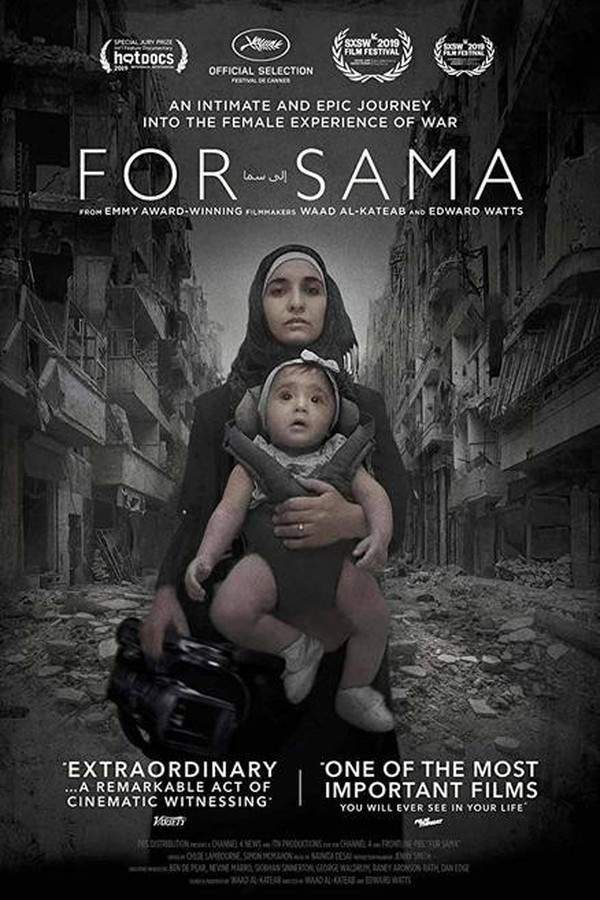
For Sama (2019) movie poster

Plot Summary

For Sama (2019) Plot Summary Explained

Release, runtime and language
2019 · 100 min · Arabic
Echo score 82
Loading streaming availability…
Directed by
Edward Watts, Waad Al-Khateab
Starring
Hamza Al-Khateab, Sama Al-Khateab, Waad Al-Khateab

Amidst the devastation of Aleppo, Syria, a young mother, Waad al-Kateab, documents five years of civil war in a deeply personal love letter to her daughter. Her intimate chronicle captures moments of joy and profound sacrifice, offering a harrowing look at the resilience of women in wartime. Faced with impossible choices, she films the struggle to protect her child and maintain her convictions, revealing the heart-wrenching realities of a nation torn apart.

On this page (6)
  1. 1 Where to watch
  2. 2 What happens: full plot
  3. 3 Plot questions answered
  4. 4 Movie threads
  5. 5 Movies like For Sama
  6. 6 Every angle
Loading streaming availability…

Full plot summary · contains spoilers

What Happens in For Sama: Full Plot Summary

The whole story of For Sama (2019) explained, from the opening scene to the final frame: every key event, every twist and what it all adds up to. Read it as a quick recap before the sequel, to check a scene you missed, or to finally understand what really happened.

FOR SAMA is a deeply moving documentary presented as a heartfelt letter from Waad Al-Khateab, a 26-year-old mother from Syria, to her daughter, Sama. This poignant message is recorded during the harrowing final days of the battle for Aleppo. Living alongside Sama's father, Hamza Al-Khateab, who works as a doctor in the last operational hospital within the beleaguered city, Waad faces the constant threat of death as their neighborhood is relentlessly bombarded by both the Syrian regime and the Russian air force. Fearing for their lives, Waad creates this filmed narrative, a crucial account for her one-year-old daughter to understand her parents’ journey and the reasons behind their relentless fight for freedom.

Waad's narrative begins back in 2012, during her time as a marketing student at Aleppo University. Amid protests against the tyrannical rule of Bashar al-Assad, she becomes one of the early advocates for change. Armed with her camera, she documents the initial waves of hope that swept through the demonstrators. It is during this chaos that she meets Hamza Al-Khateab, a young medic. Together with their close friends, they persist in their pursuit of freedom, undeterred even as violence escalates and envelops their city.

The couple faces unthinkable dangers, navigating around snipers, airstrikes, and the horrific impact of barrel bombs, all of which they courageously capture on film. In a moment of love during adversity, Hamza proposes, and soon after they marry and move into their first home. Not long after, the couple is expecting a child—an experience that, although universally recognized, unfolds against the backdrop of a grim war.

The situation intensifies with the Russian intervention in September 2015, which exacerbates the conflict. Despite the pervasive fear, Waad and Hamza choose to remain resolute, fighting for their future and for that of their newborn daughter, Sama, who arrives on January 1, 2016, bringing with her a glimmer of hope amidst overwhelming darkness.

Sama's early life consists of witnessing the turmoil as the battle for Aleppo reaches its zenith, filled with nightmarish atrocities from the regime aimed at annihilating the rebels. The couple’s world is shrouded in violence; Hamza's hospital is repeatedly bombed, and they endure sieges and chemical attacks. Despite these horrors, the first year of Sama's life is interspersed with moments of joy and laughter, as Waad and Hamza embrace the blessings of parenthood, drawing strength from their little girl.

Eventually, systemic violence forces them into exile. In a heartrending farewell, the family packs their belongings, shedding tears for the city that held their dreams of freedom, now shattered. Yet, they carry Sama with them—an enduring beacon of love and hope, a testament that the brutality of tyrants cannot extinguish the spirit of resilience.

FOR SAMA is an important film produced by Channel 4 News and ITN Productions for Channel 4 and FRONTLINE PBS. The filmmakers express a strong stance against labeling the conflict in Syria as a "civil war," emphasizing the significant influence and intervention of external forces, particularly Russia, Iran, and Hezbollah, in suppressing the popular uprising.

Last updated: November 16, 2024 at 14:27

Was this helpful?

Plot questions answered

For Sama Plot Explained: Your Questions Answered

The questions people ask most about For Sama (2019): what happens in the confusing scenes, why the characters do what they do, the twists, hidden details and what the ending means. Each answer contains spoilers.

Q1

Why did Waad decide to stay in Aleppo despite the constant danger?

Waad stayed in Aleppo because she believed in the protest movement against Bashar al-Assad's regime and wanted to document the truth. She felt leaving would mean abandoning her convictions and the cause for freedom she had fought for since 2012. Her commitment to bearing witness to the war and documenting it for her daughter Sama drove her to remain in the dangerous city.

Foreshadowing: Waad's decision to document the protests from the very beginning in 2012 established her commitment to staying and recording the events.

  • waad al-kateab
  • aleppo
  • staying
  • protests
  • documentation
Q2

Why did Hamza continue working at the hospital even after it was bombed?

Hamza continued working at the hospital because it was the last operational medical facility in Aleppo, and people desperately needed care. As a doctor, he felt a profound responsibility to save lives despite the constant threat of targeted bombings. His dedication to his patients and his belief that leaving would mean abandoning those who relied on him kept him at the hospital.

Foreshadowing: From the moment Hamza was introduced as a medic helping the injured during protests, his commitment to medical work was established.

  • hamza al-kateab
  • hospital
  • doctor
  • bombing
  • medical work
Q3

Why did Waad and Hamza decide to have a child during such dangerous times?

Waad and Hamza decided to have Sama because they wanted to preserve hope and life in the midst of destruction. Despite the war, they believed creating a family was an act of resistance against the regime's violence. Sama represented their future and their refusal to let the war take everything from them.

Foreshadowing: The couple's proposal and marriage in 2014 showed their commitment to building a life together despite the chaos around them.

  • sama
  • baby
  • child
  • pregnancy
  • hope
  • birth
Q4

Why did Waad and Hamza finally decide to leave Aleppo in 2016?

They decided to leave when systemic violence became unbearable and the bombardment intensified to the point where survival was nearly impossible. The constant barrel bombs, chemical attacks, and destruction of their hospital made staying unsustainable. They chose exile to protect their daughter Sama and give her a chance at life.

Foreshadowing: The escalating Russian intervention in September 2015 marked a turning point that made the situation increasingly untenable.

  • exile
  • leaving
  • evacuation
  • aleppo
  • 2016
  • safety
Q5

How did the Russian intervention in 2015 affect the situation in Aleppo?

The Russian intervention in September 2015 significantly escalated the conflict by providing air support to the Syrian regime. This led to intensified bombardment of rebel-held areas including Aleppo. The added military power made the city even more dangerous and accelerated the siege that eventually forced civilians to flee.

Foreshadowing: The timeline notes that Russian intervention escalated violence, directly impacting the family's decision-making.

  • russia
  • intervention
  • 2015
  • air strikes
  • bombing escalation
Q6

Why is the film presented as a letter from Waad to her daughter Sama?

Waad framed the documentary as a letter to explain to Sama why her parents made the choices they did. It allows Sama to understand the reasons behind staying, fighting, and eventually leaving. The letter format creates an intimate explanation of the family's journey and the historical events they lived through.

Foreshadowing: The entire narrative is structured around this maternal explanation, making it the foundational conceit of the film.

  • letter
  • sama
  • explanation
  • daughter
  • documentary format
Q7

What happened to the hospital where Hamza worked?

Hamza's hospital, the last operational medical facility in Aleppo, was repeatedly targeted and bombed. These attacks destroyed much of the infrastructure but the staff continued operating despite the danger. The bombings were part of the regime's strategy to eliminate care in rebel-held areas.

  • hospital
  • bombing
  • hamza
  • medical facility
  • destruction
Q8

Why does the film reject calling the conflict a civil war?

The filmmakers reject the term civil war because it obscures the role of external forces. They emphasize that Russia, Iran, and Hezbollah actively intervened to suppress the uprising. Using civil war implies an internal conflict rather than one involving significant foreign military intervention.

Foreshadowing: Throughout the film, Waad documents the impact of external forces rather than purely internal Syrian dynamics.

  • civil war
  • syria
  • russia
  • iran
  • hezbollah
  • external intervention
Q9

Why did Waad start documenting the protests in 2012?

Waad started documenting the protests because she wanted to capture the historical moment and bear witness to the popular uprising against Assad. As someone who believed in the protest movement, she used her camera to record the hope and demands of demonstrators, creating a personal archive of the early days of resistance.

Foreshadowing: Her background as a marketing student with access to a camera positioned her uniquely to document events.

  • protests
  • documentation
  • 2012
  • aleppo
  • filming
  • evidence
Q10

What does Sama symbolize in the film?

Sama represents hope, resilience, and the future that Waad and Hamza were fighting for. Born on January 1, 2016, she embodies life continuing despite destruction. When the family is forced into exile, Sama becomes the symbol they carry with them, proof that love and hope cannot be destroyed by tyrants.

Foreshadowing: The title of the film itself centers on Sama, making her the emotional anchor of the entire narrative.

  • sama
  • hope
  • symbol
  • daughter
  • future
  • resilience
Q11

What makes For Sama historically significant?

For Sama is significant because it provides intimate, firsthand documentation of the siege of Aleppo from within the city. It captures rare footage of civilian life, protests, and hospital conditions that were otherwise inaccessible to international media. The film serves as both a personal family record and a historical document of the Syrian conflict.

Foreshadowing: The producers include Channel 4 News and ITN Productions, lending the documentary credibility and historical weight.

  • historical significance
  • documentation
  • aleppo
  • syria
  • firsthand account
Q12

What was the central moral dilemma Waad and Hamza faced throughout the film?

The central dilemma was whether to stay and fight for their homeland or leave to protect their daughter. Staying meant preserving their cause and documenting the truth but risking death. Leaving meant survival but abandoning their city and dreams of freedom. This impossible choice defined their journey throughout the five years of filming.

Foreshadowing: This tension between personal survival and political commitment runs from the early protest days through their final departure.

  • moral dilemma
  • stay
  • leave
  • survival
  • choice
  • freedom

Movie threads

More Movies Like For Sama, by Mood & Story

Curated lists built around what makes For Sama tick: the same mood, the same kind of story or the same emotional payoff. Each list explains why these movies belong together.

Intimate Survival Documentaries like For Sama

Personal stories of resilience and hope filmed from within harrowing conflicts. For viewers seeking movies like For Sama, this section features powerful documentaries and dramas that offer a personal, ground-level view of survival. These films share a similar intense, emotional weight, focusing on individual stories of resilience within larger crises, blending harrowing reality with intimate human connection.

  • harrowing
  • intimate
  • urgent
  • resilient
  • oppressive
  • hopeful
  • Tone: dark, hopeful, resilient
  • Pacing: variable, urgent
Why these movies?

The story pattern: The narrative pattern follows a personal, often chronological, account of enduring a major crisis. The journey is defined by daily struggles, impossible choices, and the fight to preserve one's humanity and relationships in the face of overwhelming adversity, often ending with a bittersweet mix of survival and profound loss.

Why they belong together: Movies are grouped here for their shared approach of using an intimate, personal lens to explore large-scale tragedies. They connect through a high-intensity, emotionally heavy vibe, a dark yet hopeful tone, and a focus on the raw, unfiltered reality of human endurance.

Movies with Bittersweet Endings and Heavy Choices like For Sama

Stories where survival comes at a profound personal cost, leaving hope scarred but alive. If the emotional complexity of For Sama's ending resonated with you, this collection features films where characters make heavy sacrifices. These stories conclude on a bittersweet note, balancing survival or a sliver of hope against the profound costs of enduring extreme hardship.

  • somber
  • heart-wrenching
  • resilient
  • hopeful
  • moral dilemma
  • sacrifice
  • Tone: dark, bittersweet
  • Pacing: variable, character-driven
Why these movies?

The story pattern: The narrative journey involves protagonists facing escalating challenges that force them into ethically difficult decisions, often involving personal sacrifice for a greater good or survival. The climax is not a clean victory but a resolution that acknowledges the pain endured, ending with a poignant mix of loss and a tenuous, hard-won hope for the future.

Why they belong together: These films are united by their exploration of the gray areas of morality under duress and their emotionally complex, bittersweet conclusions. They share a heavy emotional weight, a dark tone punctuated by humanity, and a focus on the lasting psychological impact of difficult choices.

If you liked this

Movies Like For Sama

Similar movies to For Sama: the same genre, themes or kind of story. Each one comes with its own plot summary, timeline and ending explained.

Browse all movie summaries

Every angle

For Sama (2019) Explained: Plot, Timeline & Characters

Everything about For Sama in one place: what happens in the plot summary, the timeline in chronological order, the characters and meaning and a spoiler-free summary. What's After the Movie adds the cast, box office and post-credit scenes.

Coming soon on iOS and Android

The Plot Explained Movie Summary App

Plot summaries, endings explained and timelines on your phone. Catch up on any movie in minutes, save your favorites and never miss a twist again.

Be the first to know when we launch. Your email stays private, always.

Learn more about the app