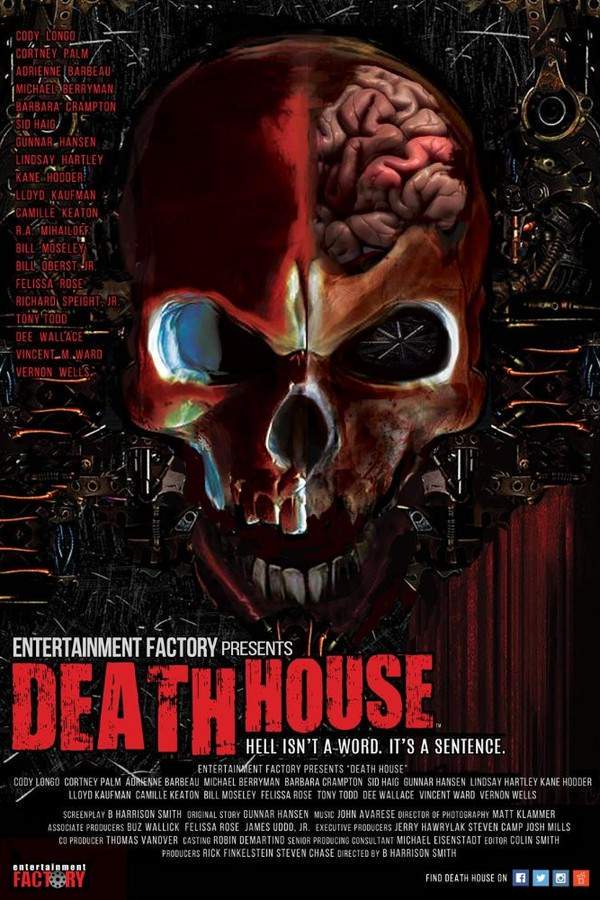
Death House

Death House

JustWatch#22,3091

Year: 2018

Runtime: 95 min

Language: English

Director: B. Harrison Smith

Echo Score: 33
Horror

Two agents are sent on a dangerous mission to inspect the infamous Death House, a maximum-security prison. When a sudden power outage throws the facility into turmoil, they find themselves battling a horde of dangerous inmates. Navigating the complex and sprawling prison, they uncover a sinister secret: a group of malevolent entities resides within, and survival depends on confronting them.

Where to Watch Death House?

Find where to stream, rent, or buy Death House (2018) in the US with current JustWatch availability, up-to-date pricing, and platform listings for subscription, rental, and digital purchase options.

Warning: spoilers below!

Haven’t seen Death House yet? This summary contains major spoilers. Bookmark the page, watch the movie, and come back for the full breakdown. If you're ready, scroll on and relive the story!

Death House (2018) – Full Plot Summary & Ending Explained

Read the complete plot breakdown of Death House (2018), including all key story events, major twists, and the ending explained in detail. Discover what really happened, and what it all means.

As FBI agent Toria Boon (Cortney Palm) steps into the ominous halls of Death House, a federal prison disguised as a research facility, she is immediately confronted by the cold, taunting stare of neo-Nazi criminal Alois Sieg (Kane Hodder). His sinister presence forces her to face the shadows of her past, especially after he uncovers her undercover mission to capture him. As she navigates the intricate maze of this unsettling institution, Toria must confront the demons she has carried with her, driven by the weight of her choices.

Under the guidance of Captain Victor Galan (Captain Victor Galan), Toria meets Dr. Eileen Fletcher (Dee Wallace) and fellow agent Jae Novak. The three share a haunting connection forged through trauma, leaving them scarred yet resilient. Galan leads her to a technology-driven holographic cell, where she must face the very killer who claimed her mother—a confrontation that promises a measure of vengeance but with the heavy burden of guilt.

Settling into her unnerving new environment, Toria embarks on an unsettling tour of Death House's nine grotesque levels, each a disturbing reflection of human depravity. Here, she uncovers the grim reality behind the prison's façade, revealing how the vulnerable, particularly the homeless, are exploited as pawns in chilling games enacted by the facility's occupants.

Outside, the world spirals into disorder. A foreboding young boy, cloaked in mystery, infiltrates the facility, planting a device that sets off a domino effect of catastrophic events. When a surgical team discovers the device, chaos erupts, leading to a devastating power failure that strands Boon and Novak in an elevator with Dr. Fletcher.

With the lights extinguished, Sieg seizes this pivotal moment, igniting a revolt among the inmates against the guards who once controlled them. As Death House plunges into chaos, Boon and her allies find themselves embroiled in a struggle for survival. They cling to the remnants of fallen guards as they navigate through the treacherous landscape of this hellish setting. Yet, in the depths of despair, a glimmer of hope emerges as Toria seeks redemption amid the turmoil.

Venturing further into the bowels of the facility, Boon and Novak calculate that using the Five Evils may present their best chance at liberation. Their descent leads them to the grim depths of the lowest level, where they meet Hirace Giger (Bill Moseley), a prisoner harboring unsettling secrets. His revelations dismantle their perceptions, revealing that their memories are mere constructs fashioned by Death House's nefarious experiments on former inmates.

The harrowing truth emerges: numerous Death Houses are crafting a new breed of entity, one that venerates technology and is unshackled from the concepts of good and evil. As Giger unfolds this dark narrative, Boon and Novak realize that capturing the Five Evils is not merely a mission; it’s a crucial effort to uphold the precarious balance of morality in a world descending into chaos.

Just as the agents grapple with these unsettling truths, Sieg reappears, having tracked the Five Evils in his pursuit of leeching their immortality. However, Giger shatters Sieg's dreams, exposing him as a mere pawn in the Five Evils' escape strategy. As toxic gas floods Death House, chaos consumes the inmates while Sieg vanishes, leaving only echoes of his ambition.

In a daring bid for freedom, Boon and Novak seize their chance to escape as the facility's systems trigger into action once more. Step by step, they emerge into a world predetermined by forces they have yet to comprehend, grappling with the hidden truths of their identities. With the always elusive Five Evils still at large, their journey has only just begun, signaling that peril and mystery lie ahead.
Last updated: November 17, 2024 at 20:06

Was this helpful?

Death House (2018) Plot Questions Answered – Summary FAQ

Explore frequently asked questions about Death House (2018) with spoiler-rich answers covering the full plot summary, major story beats, character motivations, hidden details, and ending meaning. This movie summary FAQ helps explain confusing scenes, plot twists, and narrative decisions in clear, searchable detail.

Q1

Why does Alois Sieg start the inmate revolt after the power outage?

A.

Sieg seizes the opportunity created by the power failure to incite a revolt against the guards. With the facility's security systems disabled, he capitalizes on the chaos to turn the inmates against their captors. This was his moment to break free from the control the guards had over Death House and shift the power dynamic in his favor.

Sieg's menacing presence and awareness of Toria's undercover mission early in the film established him as a cunning manipulator waiting for his chance.

alois sieginmate revoltpower outageprison breakkane hodder
Q2

What are the Five Evils in Death House?

A.

The Five Evils are entities created through Death House's dark experiments on former inmates. They represent a new breed of being that venerates technology and is completely unshackled from concepts of good and evil. According to Giger, multiple Death Houses are working to create these amoral entities, which threatens the balance of morality in the world.

The eerie, technology-driven holographic cell hints at the facility's advanced capabilities before the full scope of their experiments is revealed.

five evilsentitiesexperimentsmemory manipulationhorror entities
Q3

How does the power outage happen at Death House?

A.

A mysterious young boy infiltrates Death House and plants a device that triggers a catastrophic chain of events. When a surgical team discovers the device, chaos erupts and causes the severe power failure that strands Toria and Jae in an elevator with Dr. Fletcher, ultimately enabling Sieg's revolt.

The foreboding description of the boy hints at his role as an agent of chaos from the outside.

power failuredevicemystery boysurgical teamchaos
Q4

What does Hirace Giger reveal about Death House experiments?

A.

Giger reveals that Death House has been conducting sinister experiments on former inmates, including memory manipulation. He exposes that Toria and Jae's memories are mere constructs fashioned by these experiments, challenging everything they believed about their identities and mission. His revelations also uncover the larger conspiracy involving multiple Death Houses creating the Five Evils.

The earlier reference to Toria confronting her mother's killer in a holographic cell hints at memory-related technology before Giger's full reveal.

hirace gigermemory experimentsinmate experimentsbill moseleyreality twist
Q5

Why is FBI agent Toria Boon sent to Death House?

A.

Toria is sent on an undercover mission to capture Alois Sieg, a neo-Nazi criminal. Her personal stake runs deeper, she is driven by the memory of her mother, who was murdered by the same killer she confronts in the holographic cell. This mission combines her professional duty with her need for vengeance and closure.

Sieg's immediate recognition and taunting of Toria upon her arrival foreshadow her personal connection to the facility's darkness.

toria boonfbi agentmissionalois siegrevenge
Q6

What happens to Alois Sieg at the end of Death House?

A.

Sieg pursues the Five Evils hoping to leach their immortality for himself. However, Giger shatters his ambitions by exposing him as merely a pawn in the Five Evils' escape strategy. As toxic gas floods Death House, Sieg vanishes into the chaos, leaving his fate ambiguous while the entities escape.

Giger's earlier revelation about the Five Evils using people as pawns foreshadows Sieg's ultimate role in their plan.

alois sieg fatetoxic gasimmortalitykane hoddervillain
Q7

What is the holographic cell and why does Toria use it?

A.

The holographic cell is a technology-driven environment where Toria must confront the killer who murdered her mother. Captain Galan guides her to this confrontation as a means of facing her past and finding a measure of vengeance, though it carries the heavy burden of guilt. This experience sets the stage for her internal struggle throughout the story.

The high-tech nature of the cell foreshadows the facility's experimental capabilities that are later fully revealed.

holographic celltoria motherconfrontationvengeanceguilt
Q8

Why do Toria and Jae need to capture the Five Evils?

A.

Toria and Jae realize that capturing the Five Evils is not just their original mission, it is crucial to upholding the precarious balance of morality in a world descending into chaos. These amoral entities represent a existential threat if left free, making their capture essential to preventing further corruption.

The escalating chaos throughout the facility reflects the growing danger posed by the Five Evils.

capture missionbalance moralityworld threatfive evils
Q9

Why are homeless people exploited in Death House?

A.

During her tour of the nine grotesque levels, Toria uncovers how the vulnerable, particularly the homeless, are used as pawns in chilling games enacted by the facility's inmates. This reveals the depths of human depravity and exploitation within Death House, showing how the system preys on those society has already discarded.

The overall grim atmosphere of the nine levels establishes the facility as a place where the most vulnerable become tools for others' twisted entertainment.

homeless exploitationvulnerable prisonersnine levelsdepravity
Q10

What does the ending of Death House mean?

A.

After escaping the hellish facility, Toria and Jae step into a world that feels preordained by hidden forces they have yet to comprehend. With the Five Evils still at large and their identities revealed as potentially manipulated constructs, their journey has only just begun, signaling that the larger conflict remains unresolved and peril awaits.

Giger's revelations about memory manipulation and the larger conspiracy of multiple Death Houses foreshadow that escaping the facility is only the beginning.

ambiguous endingfive evils escapenew beginningunresolved plot
Mobile App Preview

Coming soon on iOS and Android

The Plot Explained Mobile App

From blockbusters to hidden gems - dive into movie stories anytime, anywhere. Save your favorites, discover plots faster, and never miss a twist again.

Sign up to be the first to know when we launch. Your email stays private, always.

Explore Movie Threads

Discover curated groups of movies connected by mood, themes, and story style. Browse collections built around emotion, atmosphere, and narrative focus to easily find films that match what you feel like watching right now.

Movies like Death House: Chaotic Survival in a Collapsing System

Stories where characters must endure the violent breakdown of a contained, oppressive environment.If you liked the high-stakes chaos of Death House, explore more movies where characters fight to survive the violent breakdown of a contained, oppressive environment. These films share a fast pace, high intensity, and a claustrophobic setting that turns into a deadly labyrinth.

chaoticclaustrophobicsurvivalistoppressivegrittyunsettlingdesperatenightmarish

Narrative Summary

Narratives in this thread typically begin with characters entering or being trapped within a highly controlled, complex system. A sudden, catastrophic event—like a power failure or containment breach—triggers a rapid descent into anarchy. The plot is driven by non-stop action, strategic navigation through a dangerous environment, and confrontations with unleashed horrors, often while uncovering dark secrets about the facility itself.

Why These Movies?

Movies are grouped here because they share a core experience: the visceral thrill and terror of surviving an immediate, large-scale collapse. They feature a similar mix of fast pacing, high intensity, oppressive atmospheres, and a focus on physical survival within a confined, chaotic world.

Supernatural Horror Movies like Death House That Explore Personal Trauma

Horror stories where external monstrous forces force a confrontation with internal trauma.For viewers who liked how Death House intertwines a siege against evil entities with the characters' personal demons. These similar movies blend intense survival horror with deep psychological themes, where confronting the monster means confronting one's own past.

unsettlingpsychologicalnightmarishheavyoppressivesinisterintrospectivemoral ambiguity

Narrative Summary

The narrative pattern involves characters being thrust into a situation dominated by a sinister, often intelligent evil. As they fight for survival, the nature of the threat acts as a mirror, reflecting and exaggerating their deepest fears, regrets, or fractured identities. The plot progression is as much about uncovering a mystical conspiracy or the entity's origin as it is about the protagonist's journey of self-discovery under extreme duress, leading to an emotionally heavy and often ambiguous resolution.

Why These Movies?

These films are grouped because they share a dual-layered horror experience. They combine the immediate terror of a supernatural threat with the slow-burn dread of psychological unraveling. The connection between the external evil and the internal struggle creates a uniquely heavy and complex horror vibe.

Unlock the Full Story of Death House

Don't stop at just watching - explore Death House in full detail. From the complete plot summary and scene-by-scene timeline to character breakdowns, thematic analysis, and a deep dive into the ending - every page helps you truly understand what Death House is all about. Plus, discover what's next after the movie.

Death House Timeline

Track the full timeline of Death House with every major event arranged chronologically. Perfect for decoding non-linear storytelling, flashbacks, or parallel narratives with a clear scene-by-scene breakdown.

Death House Timeline

Characters, Settings & Themes in Death House

Discover the characters, locations, and core themes that shape Death House. Get insights into symbolic elements, setting significance, and deeper narrative meaning - ideal for thematic analysis and movie breakdowns.

Characters, Settings & Themes in Death House

Death House Spoiler-Free Summary

Get a quick, spoiler-free overview of Death House that covers the main plot points and key details without revealing any major twists or spoilers. Perfect for those who want to know what to expect before diving in.

Death House Spoiler-Free Summary

More About Death House

Visit What's After the Movie to explore more about Death House: box office results, cast and crew info, production details, post-credit scenes, and external links - all in one place for movie fans and researchers.

More About Death House