Plot Explained Spoilers guaranteed!
Plot Explained

Browse by genre

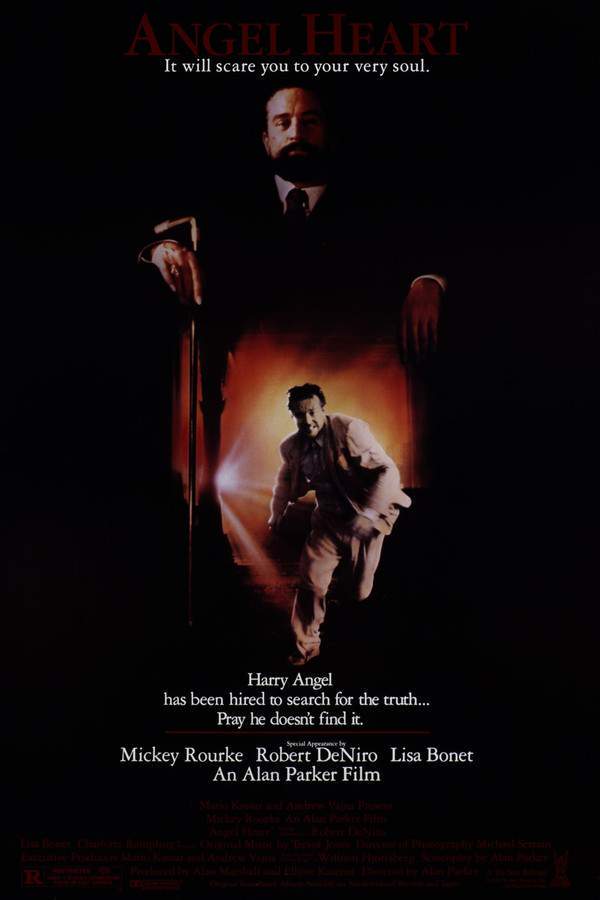
Angel Heart (1987) movie poster

Plot Summary

Angel Heart (1987) Plot Summary Explained

Release, runtime and language
1987 · 113 min · English
Directed by
Alan Parker
Starring
Robert De Niro, Mickey Rourke, Charlotte Rampling, Brownie McGhee, Charles Gordone, Eliott Keener
Budget
$17M

A private investigator named Harry Angel is hired to locate a singer named Johnny Favorite, setting off a disturbing and dangerous search. As he delves deeper into the case, he encounters a series of gruesome murders and unsettling connections to voodoo and dark rituals. The investigation reveals that his mysterious employer, Louis Cyphre, is intricately involved in Favorite's disappearance and holds secrets that threaten to consume Harry. The truth he uncovers is far more sinister than he could have imagined.

On this page (7)
  1. 1 Where to watch
  2. 2 What happens: full plot
  3. 3 Plot questions answered
  4. 4 The book behind the movie
  5. 5 Movie threads
  6. 6 Movies like Angel Heart
  7. 7 Every angle

Where to watch

Where to Watch Angel Heart (1987)

Where can you watch Angel Heart? Stream, rent or buy it in the US, including on Hoopla, Kanopy and YouTube Free: current JustWatch availability with up-to-date prices.

Streaming availability powered by JustWatch

Full plot summary · contains spoilers

What Happens in Angel Heart: Full Plot Summary

The whole story of Angel Heart (1987) explained, from the opening scene to the final frame: every key event, every twist and what it all adds up to. Read it as a quick recap before the sequel, to check a scene you missed, or to finally understand what really happened.

An ominous, slushy street greets us at midnight during winter, as a dark figure meanders down an alley filled with the sounds of anguish and moaning. An alley cat gazes down from a fire escape, while a street dog wanders, desperately searching for scraps. The dog's eyes find the cat, and it begins to chase, only to pause momentarily to lap up the fresh blood oozing from the chest of a homeless man.

In New York City on January 3, 1955, we meet Harold Angel (Mickey Rourke), a disheveled private investigator dressed in a trench coat, making his way through Brooklyn. As he smokes, he nods to various neighbors amidst the persistent sound of a ringing telephone. Harold enters his shabby office to take a call from an attorney, Mr. Winesap, who wishes to arrange a meeting with a mysterious man named Louis Cyphre (Robert De Niro) in Harlem.

Upon arrival, Harold traverses an African-American neighborhood, passing mourners, before stepping inside a building where a peculiar Pentecostal service is underway. Intrigued, he observes from the gallery as the preacher passionately encourages his congregation to give generously for what appears to be his personal gain. Joined by Winesap, Harold is led to meet Cyphre. This man carries an unsettling aura; with a beard, long hair neatly tied, and an odd calmness, he remains seated, scrutinizing Angel’s identification without haste.

Cyphre's interest lies in finding Johnny Favorite, a crooner whose real name was Johnny Liebling. According to Winesap, the singer sustained amnesia from an accident during the war, and Cyphre believes he may still be alive, urging Angel to investigate. As their conversation unfolds, Cyphre's disconcerting demeanor leaves Harold increasingly uneasy, yet he is oddly drawn to the case, intrigued by the mystery shrouding Johnny Favorite.

Driving away, Angel reflects on the meeting, whistling a melancholic tune. He arrives at the hospital tied to Johnny's case, presenting a fake ID to charm the receptionist into revealing that Johnny was transferred on December 31, 1943. Unsettlingly, he notices the signature on the records is in ballpoint—a technology not in use at that time. Determined to dig deeper, Angel heads to the doctor's apartment to confront Dr. Fowler, where a chaotic confrontation reveals dark secrets involving a man named Edward Kelly and a woman who once held Johnny dear.

As the tale spirals into the supernatural, Angel finds himself entwined in a web of ritualistic mysteries. From chilling encounters with hooded figures to blood-soaked visions, he navigates the haunting remnants of Johnny's past intertwined with his own reality. The search for Johnny Favorite leads him to a jazz bar, where he encounters musicians who harbor secrets and shadows of the past: Toots Sweet (Brownie McGhee) refuses to share much; instead, he curls up in a ball of denial whenever Angel presses for answers.

The narrative deepens as secrets of love, betrayal, and dark magic unfold before Angel. His interactions with enigmatic women—such as Margaret Krusemark (Charlotte Rampling) and Epiphany Proudfoot (Lisa Bonet)—bring both desire and dread, as threads of occult practices dance in the periphery. Each encounter unfurls a tapestry of gruesome realizations—the sacrifices made to fulfill ambitions and the truth behind Johnny's last moments before his vanishing act.

In a chilling revelation, Angel discovers the reality of his identity; he is bound to the tragic fate of Johnny Favorite. In his desperate struggle against the dark forces at play—longing for redemption yet confronted by monstrous memories—he positions himself in a dramatic climax. Louis Cyphre reveals himself to be Lucifer, deepening the labyrinth of deception that encircles it all.

The undercurrents of horror and revelation culminate in a harrowing conclusion, where the veil of sanity is lifted, exposing unimaginable truths. As fate intertwines with choices, and bloodlines twist in unnatural ways, Angel's final recognition of self leads him to a devastating acceptance: the devil's bargain was made long before his consciousness awoke. The echoes of his past whisper insidiously, overshadowing any chance of escape from the horrors of his existence.

> "I know who I am!"

In a haunting denouement, we witness the ties that bind him—the blood that unites them all in chaos. As the screen darkens, an elevator calls him down into the depths, leaving behind the ripples of a life marred by fate. The saga of Angel Heart leaves an indelible mark, a reminder that some deals made in darkness may never see the light again.

Last updated: November 03, 2024 at 11:34

Was this helpful?

Plot questions answered

Angel Heart Plot Explained: Your Questions Answered

The questions people ask most about Angel Heart (1987): what happens in the confusing scenes, why the characters do what they do, the twists, hidden details and what the ending means. Each answer contains spoilers.

Q1

Why does Louis Cyphre hire Harry Angel to find Johnny Favorite?

Louis Cyphre is actually Lucifer in disguise. He hires Harry Angel because Johnny Favorite (whose real name was Johnny Liebling) made a bargain with the devil years earlier, selling his soul for success. Cyphre has come to collect, but since Harry is the reincarnation/embodiment of Johnny Favorite, he's drawn into the case to ultimately be claimed. The entire investigation is a setup to bring Harry to his final confrontation with the devil.

Foreshadowing: From their first meeting, Cyphre shows an unsettling interest in Harry's identity documents and seems to already know more about him than he should.

  • louis cyphre
  • luciffer
  • johnny favorite
  • soul bargain
  • contract
Q2

Why does the hospital have a ballpoint pen signature in 1943?

The ballpoint pen signature on Johnny Favorite's hospital records is an intentional clue. Ballpoint pens weren't invented for general use until after World War II, making the 1943 date impossible. This signals to Harry (and the viewer) that something is wrong with the records, hinting at the supernatural nature of his investigation and foreshadowing the identity twist that the case itself may not be what it appears.

Foreshadowing: This anachronism is the first concrete hint that Harry's investigation will lead him into supernatural territory.

  • ballpoint pen
  • hospital records
  • anachronism
  • 1943
  • evidence
Q3

Who is Louis Cyphre really?

Louis Cyphre is revealed to be Lucifer, the devil himself. His name is a phonetic anagram of 'Lucifer.' He operates as a shady businessman and collector of souls, having made deals with aspiring musicians like Johnny Favorite. Throughout the film, he maintains an unnervingly calm demeanor while systematically manipulating Harry toward his fate.

Foreshadowing: Cyphre's unusual calm, his strange interest in Harry's identity, and his ability to appear wherever the investigation leads all hint at his supernatural nature.

  • louis cyphre
  • devil
  • lucifer
  • satan
  • identity reveal
Q4

Is Harry Angel really Johnny Favorite?

Yes. The central twist of the film reveals that Harry Angel is the reincarnation of Johnny Favorite. Harry sold his soul to Lucifer for musical success, then suffered amnesia from a wartime injury. He created a new identity as Harold Angel and forgot his past life entirely. The entire investigation is a ploy by Lucifer to lead Harry back to his original bargain.

Foreshadowing: Harry's unexplained pull toward the case, his familiarity with Johnny's song, and his instinctual reactions throughout the investigation all hint at his hidden connection to Favorite.

  • harry angel
  • johnny favorite
  • reincarnation
  • identity
  • twist
Q5

What is Margaret Krusemark's relationship to Harry?

Margaret Krusemark is Johnny Favorite's former lover and the mother of his child. In the film's shocking revelation, she is also Harry Angel's mother. When Harry investigates her, she doesn't recognize him because she knew him as Johnny Favorite, not as Harry Angel. Their encounter involves both desire and darkness, revealing the incestuous nature of Harry's bloodline.

Foreshadowing: Margaret's intense gaze and mysterious behavior toward Harry, along with her connection to Johnny's past, foreshadow their true relationship.

  • margaret krusemark
  • mother
  • incest
  • relationship
  • johnny favorite
Q6

Who is Epiphany Proudfoot and what is her connection to Harry?

Epiphany Proudfoot is the daughter of Johnny Favorite and a woman connected to the voodoo culture explored in the film. This makes her Harry Angel's daughter in his previous life as Johnny Favorite. Her scenes with Harry carry sexual tension, which makes the revelation of their biological connection deeply disturbing and part of the film's themes of damnation.

Foreshadowing: The voodoo elements and occult themes surrounding Epiphany hint at the dark supernatural forces tying Harry to his past.

  • epiphany proudfoot
  • daughter
  • voodoo
  • bloodline
  • incest
Q7

Why does Harry accept the case despite feeling uneasy about Louis Cyphre?

Harry is drawn to the case because it's fundamentally about himself. As the reincarnation of Johnny Favorite, he has an unconscious pull toward resolving the unfinished business from his past life. Additionally, Lucifer's influence subtly manipulates Harry into accepting, ensuring he walks willingly into the final confrontation.

Foreshadowing: Harry's unexplained intrigue with Johnny Favorite's case and his odd attraction to the mystery suggest a deeper, fate-driven connection.

  • motivation
  • fate
  • lucifer
  • manipulation
  • choice
Q8

What happened to Johnny Favorite after the war?

After serving in World War II, Johnny Favorite returned injured and developed amnesia. He was institutionalized at a hospital where Dr. Fowler performed experiments on him. Before his amnesia fully took hold, Johnny made a deal with Lucifer (then going by Louis Cyphre) to become a successful singer. When the devil came to collect, Johnny had forgotten the bargain entirely, leading to the events of the film.

Foreshadowing: Dr. Fowler's connection to Johnny and the mention of experimental treatments foreshadow the dark medical history surrounding the singer's past.

  • world war 2
  • amnesia
  • hospital
  • dr fowler
  • past life
Q9

What does the ending of Angel Heart mean?

The ending confirms Harry's damnation. After learning the full truth about his identity as Johnny Favorite, his soul bargain with Lucifer, and the incestuous relationships in his bloodline, Harry descends into an elevator that leads to hell. The film ends with no redemption possible, Harry's fate was sealed the moment he made his deal with the devil, and no amount of investigation could save him.

Foreshadowing: The constant descent motifs throughout the film, the bleak tone, and Harry's inability to escape despite his efforts all build toward this inevitable conclusion.

  • ending
  • damnation
  • hell
  • elevator
  • fate
  • conclusion
Q10

Why are there voodoo rituals in Angel Heart?

The voodoo elements connect to Johnny Favorite's past and the dark supernatural forces at work. Epiphany Proudfoot is involved with voodoo practitioners, and the rituals represent the occult practices that surround the soul-bargain theme. The voodoo serves to create atmosphere and reinforce the film's exploration of dark magic, sacrifice, and the crossing of spiritual boundaries.

Foreshadowing: The Pentecostal service Harry observes early on, with its intense atmosphere and preacher's exploitation, sets the tone for the religious and supernatural themes.

  • voodoo
  • rituals
  • occult
  • supernatural
  • sacrifice
Q11

Who is responsible for the murders in Angel Heart?

The murders are committed as part of the supernatural ritual connected to Johnny Favorite's soul bargain. As Harry gets closer to the truth, those connected to his past are killed, likely by Lucifer himself or through his influence, to prevent the truth from interfering with the final collection. The violence is brutal and ritualistic, serving the devil's purpose of tying up loose ends before claiming Harry's soul.

Foreshadowing: The opening scene with the homeless man dying in the alley establishes the film's tone of sacrificial violence and blood.

  • murders
  • victims
  • killings
  • ritual
  • supernatural

Movie threads

More Movies Like Angel Heart, by Mood & Story

Curated lists built around what makes Angel Heart tick: the same mood, the same kind of story or the same emotional payoff. Each list explains why these movies belong together.

Occult Noir movies like Angel Heart

A detective's rational search for answers uncovers supernatural, inescapable truths. If you liked the unsettling blend of detective mystery and supernatural horror in Angel Heart, this list features movies with a similar vibe. Discover other stories where investigators are drawn into a web of occult secrets, leading to dark and fatalistic conclusions.

  • ominous
  • fatalistic
  • sinister
  • unsettling
  • noir
  • occult
  • Tone: dark, unsettling, fatalistic
  • Pacing: steady, methodical
Why these movies?

The story pattern: The narrative follows a protagonist, typically an investigator or outsider, as they methodically pursue a case. Their rational worldview is systematically dismantled as they encounter evidence of the occult. The investigation becomes a personal descent, where the ultimate revelation is not just about the case, but about their own damned connection to it.

Why they belong together: These movies are grouped by their core premise: blending the procedural structure of a noir or thriller with supernatural horror elements. They share a dark, ominous tone, a steady pacing that builds to a shocking climax, and a profound sense of fatalism, where the protagonist is ultimately powerless against the forces they've uncovered.

Psychological horror of self-discovery like Angel Heart

A character's journey to uncover a hidden past leads to psychological disintegration. For viewers who appreciated the chilling identity mystery and psychological unraveling in Angel Heart, this collection features similar films. Explore stories about characters confronting a terrifying hidden past, where the search for truth leads to a complete loss of sanity and a bleak realization.

  • disturbing
  • claustrophobic
  • fatalistic
  • psychological horror
  • identity crisis
  • unraveling
  • Tone: dark, melancholic, fatalistic
  • Pacing: steady, slow burn
Why these movies?

The story pattern: The story hinges on a major twist related to the protagonist's identity, often involving amnesia, doppelgangers, or a cursed bloodline. Clues are revealed slowly, creating a mounting sense of dread as the character realizes they are not who they thought they were. The narrative arc is one of inescapable psychological collapse.

Why they belong together: These films share a focus on the horror of self-knowledge. They are united by a complex, twist-driven plot, a heavy emotional weight, and a consistently dark, claustrophobic mood. The pacing is steady, allowing the dread to build methodically towards a devastating and bleak conclusion about the protagonist's own soul.

If you liked this

Movies Like Angel Heart

Similar movies to Angel Heart: the same genre, themes or kind of story. Each one comes with its own plot summary, timeline and ending explained.

Browse all movie summaries

Every angle

Angel Heart (1987) Explained: Plot, Timeline & Characters

Everything about Angel Heart in one place: what happens in the plot summary, the timeline in chronological order, the characters and meaning and a spoiler-free summary. What's After the Movie adds the cast, box office and post-credit scenes.

Coming soon on iOS and Android

The Plot Explained Movie Summary App

Plot summaries, endings explained and timelines on your phone. Catch up on any movie in minutes, save your favorites and never miss a twist again.

Be the first to know when we launch. Your email stays private, always.

Learn more about the app