Year: 2015
Runtime: 116 min
Language: Marathi
Director: Chaitanya Tamhane
A celebrated folk singer and activist, known as the "people's poet," finds himself facing seemingly ridiculous charges following the death of a sewage worker. His trial becomes a chaotic and unsettling display of bureaucratic inefficiency, marked by questionable witnesses, frustrating legal delays, and a complex legal system that favors outdated colonial laws over human understanding and fairness. The proceedings highlight the struggles of navigating a rigid system seemingly indifferent to justice.
Warning: spoilers below!
Haven’t seen Court yet? This summary contains major spoilers. Bookmark the page, watch the movie, and come back for the full breakdown. If you're ready, scroll on and relive the story!
Read the complete plot breakdown of Court (2015), including all key story events, major twists, and the ending explained in detail. Discover what really happened—and what it all means.
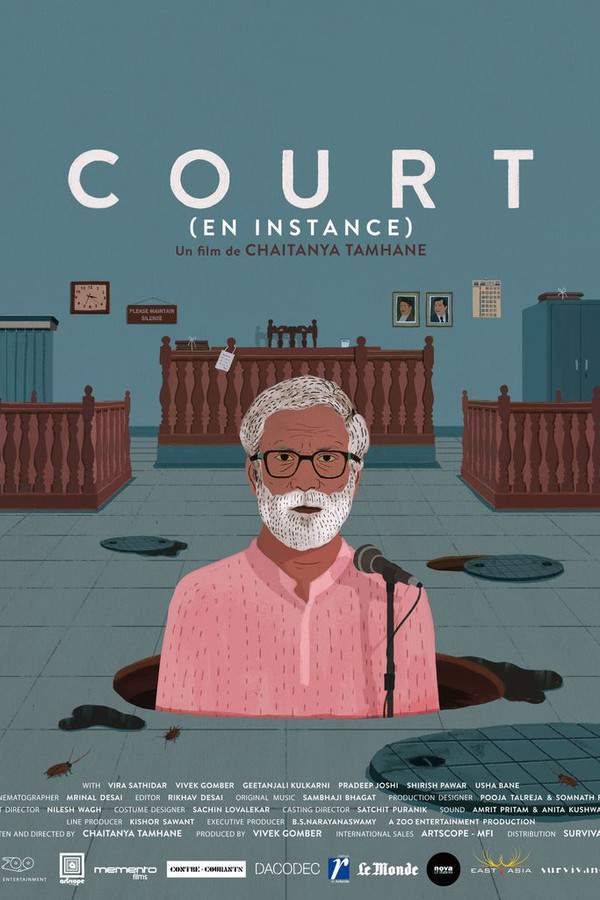
Narayan Kamble, a teacher, social activist and protest singer, finds himself swept up in a legal battle after being arrested on the charge of prompting Vasudev Pawar, a manhole worker, to commit suicide. The prosecution asserts that Pawar, who allegedly heard one of Kamble’s protest songs, was driven to end his life. In court, Kamble maintains that while he has sung many songs about suicide, he cannot recall whether any were performed on the day of Pawar’s death, and he denies any intention to provoke self-harm in others. A witness steps forward claiming to have seen the manhole worker singing Kamble’s song, adding to the tension surrounding the case.
In the following hearing, the investigating officer introduces a new angle, linking Kamble to an incarcerated man, Ashwin Bhagat, through a letter that accuses them of plotting illegal activity in the city. Kamble’s lawyer, Vinay Vora, explains that Bhagat had asked Kamble to look after his ailing mother while Bhagat was behind bars. The public prosecutor, Nutan, reveals that Kamble possessed two banned books—the first on Yoga and the second a critique of certain rituals of the Goyamari sect. The tension between defense and state authorities grows when Vora is beaten by members of the Goyamaris. Meanwhile, Pawar’s widow testifies that her husband worked without safety gear, lost an eye from exposure to poisonous sewer gases, and was also an alcoholic, though she denies any discussion of suicide or any prior mention of Kamble. The autopsy report is read aloud, indicating Pawar died from respiratory failure due to inhalation of hydrogen sulfide, with no signs of self-harm, and the testimony of the initial witness is criticized as that of a stock witness who has appeared in multiple other cases.
Despite Kamble’s deteriorating health and the lack of decisive evidence, the court grants bail set at ₹100,000 (about US$1,200), which Vora pays on Kamble’s behalf. However, Kamble is soon arrested again, this time on charges of conducting seditious camps under the cover of folk-artist workshops, and he is remanded to police custody. Kamble maintains that the charges and the accompanying evidence are fabricated, and Vora pleads for a reconsideration due to the severity of Kamble’s health condition; the judge instructs Kamble to appeal to the High Court. The film closes with a striking domestic vignette: the judge is shown enjoying a holiday with his family, but a playful disruption by children awakens him, and he reacts with a sharp slap, leaving the audience to ponder the fragile line between authority, responsibility, and human frailty.
Last Updated: October 09, 2025 at 16:24
Discover curated groups of movies connected by mood, themes, and story style. Browse collections built around emotion, atmosphere, and narrative focus to easily find films that match what you feel like watching right now.
Stories where characters are crushed by the impersonal, illogical machinery of a system.If you were captivated by the absurd legal battle in Court, explore these other films where characters face the frustrating and illogical machinery of a system. These movies like Court delve into themes of social injustice and the draining experience of navigating a rigid and oppressive bureaucracy.
Narratives in this thread typically follow a protagonist, often an ordinary person or an activist, as they confront a complex and indifferent system. The conflict arises from the disconnection between human need and bureaucratic rule, leading to a journey marked by procedural delays, nonsensical evidence, and a growing sense of powerlessness.
These films are grouped together because they share a central theme of systemic failure and a specific tone of bleak absurdity. They create a similar viewing experience of mounting frustration and a palpable sense of injustice, often with a methodical pace that mirrors the grinding nature of bureaucracy.
Films where tension builds methodically from the weight of an oppressive environment.Fans of the slow-building tension and oppressive atmosphere in Court will appreciate these similarly paced films. Discover more movies like Court that use a deliberate, methodical pace to create a heavy sense of dread and explore themes of systemic failure and moral collapse.
These stories unfold at a deliberate pace, focusing on the accumulation of small details and frustrations that collectively build an overwhelming sense of dread. The narrative structure often mirrors the inescapable nature of the central conflict, leading characters—and viewers—through a seemingly inevitable descent with a bleak or ambiguous resolution.
This thread connects films based on a shared cinematic experience defined by their slow pacing, tense tone, and heavy emotional weight. The similarities lie in the mood they cultivate: one of pervasive unease, psychological pressure, and a grim realism that leaves a lasting impact.
Don't stop at just watching — explore Court in full detail. From the complete plot summary and scene-by-scene timeline to character breakdowns, thematic analysis, and a deep dive into the ending — every page helps you truly understand what Court is all about. Plus, discover what's next after the movie.
Track the full timeline of Court with every major event arranged chronologically. Perfect for decoding non-linear storytelling, flashbacks, or parallel narratives with a clear scene-by-scene breakdown.
Discover the characters, locations, and core themes that shape Court. Get insights into symbolic elements, setting significance, and deeper narrative meaning — ideal for thematic analysis and movie breakdowns.
Get a quick, spoiler-free overview of Court that covers the main plot points and key details without revealing any major twists or spoilers. Perfect for those who want to know what to expect before diving in.
Visit What's After the Movie to explore more about Court: box office results, cast and crew info, production details, post-credit scenes, and external links — all in one place for movie fans and researchers.
Discover movies like Court that share similar genres, themes, and storytelling elements. Whether you’re drawn to the atmosphere, character arcs, or plot structure, these curated recommendations will help you explore more films you’ll love.
Court (2015) Scene-by-Scene Movie Timeline
Court (2015) Movie Characters, Themes & Settings
Court (2015) Spoiler-Free Summary & Key Flow
Movies Like Court – Similar Titles You’ll Enjoy
The Verdict (1982) Detailed Story Recap
...and justice for all. (1979) Story Summary & Characters
Citizen (2001) Full Summary & Key Details
Judge vs. Judge (1000) Full Summary & Key Details
Aakrosh (1980) Film Overview & Timeline
Justice Chowdhary (1982) Film Overview & Timeline
Kosa (2020) Plot Summary & Ending Explained
The Devil Judge (1000) Ending Explained & Film Insights
The Courtroom (2022) Full Movie Breakdown
The Judge (1949) Movie Recap & Themes
Criminal Court (1946) Full Summary & Key Details
The Trial (1962) Spoiler-Packed Plot Recap
The Trial (1993) Full Summary & Key Details
Juvenile Court (1938) Spoiler-Packed Plot Recap
Damini (1993) Detailed Story Recap