Plot Explained Spoilers guaranteed!
Plot Explained

Browse by genre

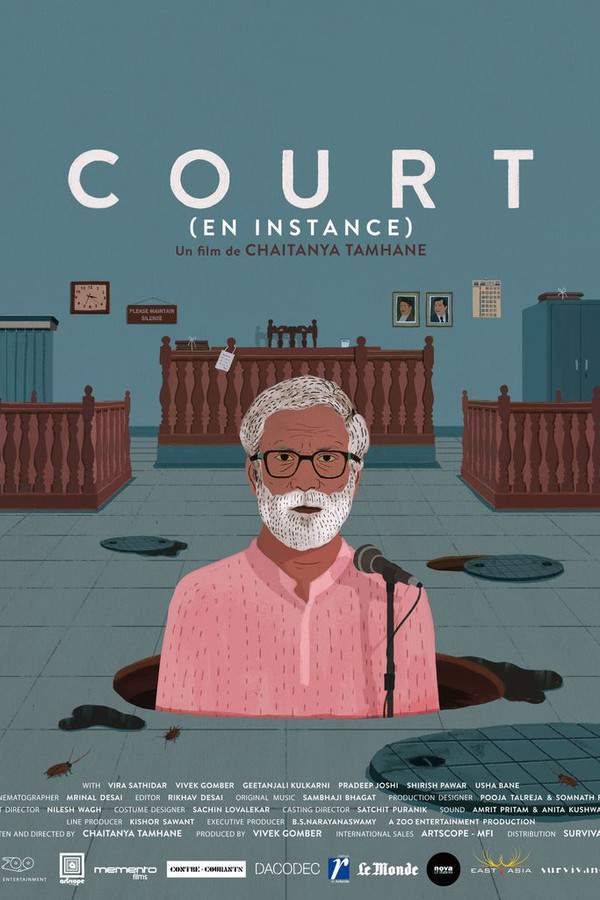
Court (2015) movie poster

Timeline

Court (2015) Timeline Explained – Every Event in Order

Release, runtime and language
2015 · 116 min · Marathi
Loading streaming availability…
Directed by
Chaitanya Tamhane

A celebrated folk singer and activist, known as the "people's poet," finds himself facing seemingly ridiculous charges following the death of a sewage worker. His trial becomes a chaotic and unsettling display of bureaucratic inefficiency, marked by questionable witnesses, frustrating legal delays, and a complex legal system that favors outdated colonial laws over human understanding and fairness. The proceedings highlight the struggles of navigating a rigid system seemingly indifferent to justice.

On this page (6)
  1. 1 Where to watch
  2. 2 Events in order (14)
  3. 3 Timeline questions answered
  4. 4 Movie threads
  5. 5 Movies like Court
  6. 6 Every angle
Loading streaming availability…

14 events in order · contains spoilers

Court Timeline: Events in Chronological Order

Every key event of Court (2015) in order, scene by scene, with when and where it takes place. Use it to untangle flashbacks, time jumps and parallel storylines, to refresh your memory before the sequel or to find the exact scene you are thinking of.

  1. Arrest of Narayan Kamble

    Narayan Kamble, a teacher, activist and protest singer, is arrested on charges that he prompted Vasudev Pawar to commit suicide through his songs. The prosecution argues that his music influenced the worker to take his own life. The arrest marks the initial spark of a courtroom drama revolving around motive, influence, and accountability.

  2. Trial leads to bail

    Kamble is brought before a court and granted bail after a hearing. The defense argues for his release while the investigation continues. The decision highlights the tension between civil liberty and ongoing criminal inquiry.

    Where
    Court
  3. Kamble admits singing about suicide but questions intent

    During testimony Kamble concedes he sang several songs about suicide but cannot confirm he sang that specific day or intended to provoke self-harm. He asserts he does not act with the intent to incite others and says his memory of the day is unclear. The exchange underscores the central question of whether art can influence real-world actions.

    Where
    Court
  4. Witness testifies to seeing Kamble's song

    A witness testifies that he saw Pawar singing Kamble's song, attempting to connect the artist to the alleged influence. The testimony raises questions about what the witness observed and whether it establishes Kamble's responsibility. The defense challenges the credibility and weight of this account.

    Where
    Court
  5. Link to Ashwin Bhagat emerges via letter

    In the next hearing, the investigating officer reveals a link between Kamble and incarcerated Ashwin Bhagat through a letter accusing them of planning illegal activity in the city. The discovery broadens the case beyond the original suicide charge and suggests a wider alleged conspiracy. The development intensifies pressure on Kamble and his defense.

    Where
    Court
  6. Bhagat's request to care for his mother explained

    Vora explains that Bhagat was requesting Kamble to take care of his ailing mother while Bhagat was in jail, providing context to the letter. The defense argues this demonstrates Kamble's non-violent intent and personal connection rather than criminal collaboration. The exchange aims to reframe Kamble's relationship with Bhagat.

    Where
    Court
  7. Banned books found in Kamble's possession

    Nutan, the public prosecutor, states that Kamble possessed two banned books, raising concerns about illicit influences. Vora counters that one book is about Yoga and the other critiques certain rituals, arguing that possession does not prove criminal intent. The exchange reveals the tension between censorship, scholarly interest, and the case's political overtones.

    Where
    Court
  8. Defense lawyer attacked by Goyamaris

    Vora is beaten by members of the Goyamaris, illustrating the volatile atmosphere surrounding the trial and the risks faced by Kamble's defense. The assault reinforces the sense that outside groups are exerting pressure on the legal process. The incident prompts concerns about security and fairness in proceedings.

    Where
    Outside the court
  9. Pawar's widow testifies about the death

    Pawar's widow testifies that her husband worked without safety gear and died from exposure to poisonous sewer gases, having lost an eye in the process. She describes him as an alcoholic who never spoke of suicide or Kamble's influence. Her testimony challenges the narrative that Kamble pushed Pawar toward death.

    Where
    Court
  10. Autopsy contradicts suicide theory

    The autopsy report indicates Pawar died from respiratory failure due to inhalation of hydrogen sulphide, with no signs of self-harm. The medical findings undermine the prosecution's suicide theory and provide a counterpoint to earlier testimony. The defense uses the report to cast doubt on the charge of provoking suicide.

    Where
    Court
  11. Stock witness credibility questioned

    The court notes that the witness who testified against Kamble is a stock witness with a history of testifying in multiple cases, casting doubt on his reliability. The defense argues this undermines the prosecution's case against Kamble. The atmosphere in the courtroom grows tenser as credibility becomes a focal point.

    Where
    Court
  12. Bail granted again; health concerns cited

    Considering Kamble's deteriorating health, the court grants bail of ₹100,000 (US$1,200) with Vora posting the money. He is later arrested again on charges of conducting seditious camps under the cover of folk-artist workshops and is remanded to police custody. The sequence underscores the volatility of the case and the fragility of Kamble's situation.

    Where
    Court and Police custody
  13. Judge advises appeal to High Court

    The judge tells Kamble to appeal to the High Court for relief, outlining the procedural path forward. Kamble's legal team weighs this option, hoping for a more favorable review given health concerns and what has transpired in court. The guidance signals a potential strategic pivot in the case.

    Where
    Court
  14. Judge's holiday scene and incident with children

    The film cuts to a scene showing the judge enjoying a family holiday, creating a stark contrast with the courtroom drama. Some mischievous children wake him, and he slaps one of them before the others flee. The moment adds a human, unsettling dimension to the judge's character.

    Where
    Holiday with family

Last updated: October 09, 2025 at 16:24

Was this helpful?

Timeline questions answered

Court Timeline Explained: Your Questions Answered

When does it happen, and why in that order? The questions people ask about the chronology of Court (2015): time jumps, flashbacks, cause and effect between scenes and the correct order of events, each answered with spoilers.

Q1

Why was Narayan Kamble arrested?

Narayan Kamble, a teacher, social activist and protest singer, was arrested on charges that he prompted Vasudev Pawar, a manhole worker, to commit suicide through his protest songs. The prosecution claimed that Pawar heard one of Kamble's songs about suicide and was driven to end his life.

Foreshadowing: The arrest occurs at the very beginning of the film, setting the foundation for the entire legal battle.

  • narayan kamble arrest
  • vasudev pawar
  • suicide charges
  • protest singer arrested
Q2

How did Vasudev Pawar actually die?

The autopsy report revealed that Pawar died from respiratory failure due to inhalation of hydrogen sulfide, a poisonous gas found in sewers. There were no signs of self-harm, contradicting the prosecution's suicide theory.

Foreshadowing: Early testimony about Pawar working in dangerous conditions without safety equipment hints at the true cause of death.

  • vasudev pawar death
  • autopsy
  • hydrogen sulfide
  • sewer gas death
Q3

Who was the witness and why was his testimony questioned?

A witness testified that he saw Pawar singing Kamble's song, attempting to connect the artist to the alleged influence. However, the court noted this witness was a "stock witness" who had appeared in multiple other cases, severely undermining his credibility.

  • stock witness
  • credibility
  • kamble trial witness
Q4

What additional charges did Kamble face?

After being granted bail, Kamble was arrested again on charges of conducting seditious camps under the guise of folk-artist workshops. The prosecution also linked him to an incarcerated man named Ashwin Bhagat through a letter alleging illegal activity.

Foreshadowing: The investigation officer introduces this new angle during a later hearing, expanding the case beyond the original suicide charge.

  • additional charges
  • seditious camps
  • ashwin bhagat
Q5

What was the connection between Kamble and Ashwin Bhagat?

Kamble's lawyer Vinay Vora explained that Bhagat had asked Kamble to look after his ailing mother while Bhagat was in jail. The letter presented by the prosecution was a request for this favor, not evidence of a criminal conspiracy.

  • ashwin bhagat
  • kamble connection
  • jail
  • ailing mother
Q6

What were the banned books found in Kamble's possession?

The public prosecutor revealed Kamble possessed two banned books: one about Yoga and another that critiqued certain rituals of the Goyamari sect. Kamble's lawyer argued that possessing these books did not prove criminal intent.

  • banned books
  • yoga
  • goyamari sect
  • possession charges
Q7

What happened to Kamble's lawyer during the trial?

Vinay Kamble's lawyer Vinay Vora was beaten by members of the Goyamaris, an outside group whose rituals were criticized in one of the banned books found in Kamble's possession. The assault illustrated the volatile atmosphere surrounding the trial.

  • vinay vora attacked
  • goyamaris
  • lawyer beaten
Q8

What did Pawar's widow testify about?

Pawar's widow testified that her husband worked without safety gear, lost an eye from exposure to poisonous sewer gases, and was an alcoholic. She denied that he ever discussed suicide or mentioned Kamble's influence before his death.

Foreshadowing: Her testimony directly contradicts the prosecution's narrative about Kamble's songs driving Pawar to suicide.

  • pawar widow testimony
  • sewer worker
  • safety gear
  • alcoholic
Q9

What does the judge's final scene mean?

The film ends with the judge enjoying a holiday with his family. When mischievous children wake him, he reacts with a sharp slap, leaving them to flee. This unsettling moment underscores the theme of authority and human frailty, suggesting that those who wield power in the legal system are not necessarily more compassionate in their personal lives.

Foreshadowing: The contrast between the judge's courtroom demeanor and his violent domestic reaction hints at the disconnect between public authority and private character.

  • judge ending scene
  • holiday slap
  • authority frailty
Q10

Why was Kamble granted bail and what happened next?

The court granted Kamble bail of ₹100,000 (about US$1,200) citing his deteriorating health. His lawyer Vora paid the amount on his behalf. However, Kamble was soon arrested again on new charges, making the bail temporary.

  • bail amount
  • health concerns
  • kamble rearrested
Q11

Why does the film not resolve the case?

The film ends without a verdict on the charges against Kamble. The judge simply advises him to appeal to the High Court given the severity of his health condition. This reflects the film's themes of bureaucratic inefficiency and systemic indifference rather than delivering justice.

  • case outcome
  • no verdict
  • high court appeal

Movie threads

More Movies Like Court, by Mood & Story

Curated lists built around what makes Court tick: the same mood, the same kind of story or the same emotional payoff. Each list explains why these movies belong together.

Movies about bureaucratic injustice like Court

Stories where characters are crushed by the impersonal, illogical machinery of a system. If you were captivated by the absurd legal battle in Court, explore these other films where characters face the frustrating and illogical machinery of a system. These movies like Court delve into themes of social injustice and the draining experience of navigating a rigid and oppressive bureaucracy.

  • frustrating
  • bureaucratic
  • oppressive
  • absurd
  • grim
  • unsettling
  • Tone: tense, bleak, absurd
  • Pacing: slow, methodical
Why these movies?

The story pattern: Narratives in this thread typically follow a protagonist, often an ordinary person or an activist, as they confront a complex and indifferent system. The conflict arises from the disconnection between human need and bureaucratic rule, leading to a journey marked by procedural delays, nonsensical evidence, and a growing sense of powerlessness.

Why they belong together: These films are grouped together because they share a central theme of systemic failure and a specific tone of bleak absurdity. They create a similar viewing experience of mounting frustration and a palpable sense of injustice, often with a methodical pace that mirrors the grinding nature of bureaucracy.

Slow-burn tense dramas like Court

Films where tension builds methodically from the weight of an oppressive environment. Fans of the slow-building tension and oppressive atmosphere in Court will appreciate these similarly paced films. Discover more movies like Court that use a deliberate, methodical pace to create a heavy sense of dread and explore themes of systemic failure and moral collapse.

  • slow burn
  • unsettling
  • oppressive
  • grim
  • methodical
  • draining
  • Tone: tense, unsettling, grim
  • Pacing: slow, deliberate
Why these movies?

The story pattern: These stories unfold at a deliberate pace, focusing on the accumulation of small details and frustrations that collectively build an overwhelming sense of dread. The narrative structure often mirrors the inescapable nature of the central conflict, leading characters—and viewers—through a seemingly inevitable descent with a bleak or ambiguous resolution.

Why they belong together: This thread connects films based on a shared cinematic experience defined by their slow pacing, tense tone, and heavy emotional weight. The similarities lie in the mood they cultivate: one of pervasive unease, psychological pressure, and a grim realism that leaves a lasting impact.

If you liked this

Movies Like Court

Similar movies to Court: the same genre, themes or kind of story. Each one comes with its own plot summary, timeline and ending explained.

Browse all movie summaries

Every angle

Court (2015) Explained: Plot, Timeline & Characters

Everything about Court in one place: what happens in the plot summary, the timeline in chronological order, the characters and meaning and a spoiler-free summary. What's After the Movie adds the cast, box office and post-credit scenes.

Coming soon on iOS and Android

The Plot Explained Movie Summary App

Plot summaries, endings explained and timelines on your phone. Catch up on any movie in minutes, save your favorites and never miss a twist again.

Be the first to know when we launch. Your email stays private, always.

Learn more about the app