








Plot Explained Spoilers guaranteed!
Plot Explained

Browse by genre

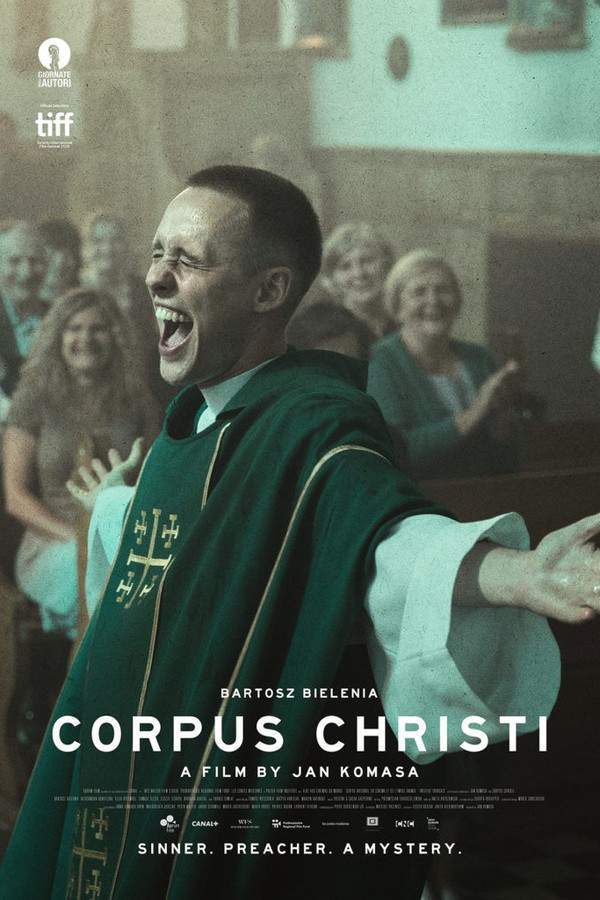
Corpus Christi (2020) movie poster

Timeline

Corpus Christi (2020) Timeline Explained – Every Event in Order

Release, runtime and language
2020 · 115 min · Polish
Echo score 85
JustWatch #6,214 7
Directed by
Jan Komasa
Starring
Tomasz Zietek, Aleksandra Konieczna, Anna Biernacik, Barbara Kurzaj, Bartosz Bielenia, Eliza Rycembel
Budget
$1.3M

Following his release from prison, Daniel impulsively assumes the role of a priest in a small Polish village. He brings a raw and unconventional approach to his new position, seeking redemption and offering comfort to the community. However, his past as a prisoner and the villagers' skepticism create challenges as he tries to reconcile his past actions with his newfound purpose and navigate the complexities of faith and forgiveness.

On this page (6)
  1. 1 Where to watch
  2. 2 Events in order (15)
  3. 3 Timeline questions answered
  4. 4 Movie threads
  5. 5 Movies like Corpus Christi
  6. 6 Every angle

Where to watch

Where to Watch Corpus Christi (2020)

Where can you watch Corpus Christi? Stream, rent or buy it in the US, including on Film Movement Plus, Hoopla and Kanopy: current JustWatch availability with up-to-date prices.

Streaming availability powered by JustWatch

15 events in order · contains spoilers

Corpus Christi Timeline: Events in Chronological Order

Every key event of Corpus Christi (2020) in order, scene by scene, with when and where it takes place. Use it to untangle flashbacks, time jumps and parallel storylines, to refresh your memory before the sequel or to find the exact scene you are thinking of.

  1. Daniel's Sentencing

    Daniel, a devout Catholic, is sentenced to prison for second-degree murder. His past weighs heavily on him as he grapples with the ramifications of his actions and the dream of becoming a priest.

    Where
    Prison
  2. Release from Prison

    After serving his sentence, Daniel is released from prison. He is hopeful about rejoining society, but faces significant challenges due to his criminal background.

    Where
    Prison
  3. Assignment to the Sawmill

    Upon release, Daniel is assigned to work at a sawmill in a small village. This job serves as a fresh start, yet it is a far cry from his aspirations of becoming a priest.

    Where
    Sawmill
  4. Feigning a Priest

    While visiting the local Catholic church, Daniel decides to pretend to be a priest. The local vicar mistakenly believes him and leaves Daniel in charge while he seeks medical treatment.

    Where
    Catholic Church
  5. Embracing the Role

    Daniel takes on the responsibilities of a priest and surprisingly finds joy in serving the parish. His unorthodox methods draw both attention and appreciation from the local community.

    Where
    Village
  6. Confession from the Pulpit

    In a shocking turn of events, Daniel confesses his past crime from the pulpit. This revelation stuns the parishioners but somehow deepens their acceptance of him.

    Where
    Catholic Church
  7. Investigating the Car Accident

    Curiosity leads Daniel to investigate a tragic car accident that killed an adult man and six teenagers. The villagers are conflicted and refuse to accept any blame for the incident.

    Where
    Village
  8. Interview with Marta

    Daniel meets Marta, whose brother was a victim in the accident. She shares a video her brother sent before the crash, which shows the group engaged in reckless behavior, complicating Daniel's investigation.

    Where
    Marta's Home
  9. Conflict with the Mayor

    Under pressure from Mayor Walkiewicz to halt his inquiry, Daniel finds himself in a moral dilemma. He struggles with the implications of the crash and its effect on the community's view of the deceased driver.

    Where
    Village
  10. Burial Service Decision

    Faced with community backlash, Daniel decides to hold a burial service for the driver. This act of defiance against the villagers’ beliefs stirs contentious emotions but is rooted in his sense of justice.

    Where
    Village Cemetery
  11. Marta's Expulsion

    As a consequence of her support for Daniel's burial service, Marta is expelled from her home by her mother. She takes refuge in the rectory with Daniel, bringing them closer together emotionally.

    Where
    Rectory
  12. Burial Service Atmosphere

    During the burial service, tension eases as villagers momentarily set aside their grievances to pay respects. However, underlying conflicts remain palpable among the attendees.

    Where
    Village Cemetery
  13. Confrontation with Youth Detention Priest

    A priest from Daniel's past shows up, exposing his deception and demanding he leave the village immediately. In a desperate move, Daniel escapes and holds a 'farewell Mass' revealing his tattoos.

    Where
    Catholic Church
  14. Return to Prison

    Eventually, Daniel is apprehended and finds himself back in prison. He confronts the brother of the man he killed, leading to a brutal fight that tests his resilience in the face of guilt.

    Where
    Prison
  15. Reflection on Actions

    Having emerged victorious in the fight, Daniel earns the respect of fellow inmates. He reflects on the personal cost of his journey and the choices that have brought him full circle.

    Where
    Prison

Last updated: November 16, 2024 at 15:46

Was this helpful?

Timeline questions answered

Corpus Christi Timeline Explained: Your Questions Answered

When does it happen, and why in that order? The questions people ask about the chronology of Corpus Christi (2020): time jumps, flashbacks, cause and effect between scenes and the correct order of events, each answered with spoilers.

Q1

Why does Daniel pretend to be a priest in the village?

After being released from prison, Daniel is assigned to work at a sawmill in a small village. While visiting the local church, he seizes an opportunity when the vicar mistakes him for a replacement priest. Daniel has always been a devout Catholic and dreamed of becoming a priest, but his criminal record made this impossible. Taking on the role allows him to live out his vocation temporarily and find purpose after prison.

Foreshadowing: Daniel's deep faith is established early in the film, showing his genuine desire to serve God despite his past.

  • impostor priest
  • vocation
  • redemption
  • prison release
Q2

Why does Daniel confess his crime from the pulpit?

Daniel confesses to the congregation that he is serving time for second-degree murder. This shocking act demonstrates his commitment to honesty and his belief that confession should be complete. He wants to serve the community authentically, even if that means revealing his darkest secret. The parishioners respond with deeper acceptance rather than rejection, seeing his honesty as a form of humility.

Foreshadowing: The film establishes early on that Daniel views faith as requiring complete transparency.

  • confession
  • honesty
  • murder
  • community acceptance
Q3

What does the video that Marta shows Daniel reveal?

Marta shows Daniel a video her brother sent hours before the crash. The video shows the group of teenagers drinking heavily and using drugs while the adult driver watched. This evidence suggests the teenagers may have been impaired and potentially caused the accident, contradicting the village's belief that the driver was solely responsible.

Foreshadowing: Marta's reluctance to share the video earlier hints at the weight of this evidence.

  • car accident
  • video evidence
  • teenagers
  • drunk driving
Q4

Why do the villagers refuse to accept that the driver wasn't at fault?

The villagers blindly blame the adult driver, an outcast known for violence, despite evidence suggesting the teenagers were at fault. This refusal stems from grief and community loyalty, they cannot accept that local youth caused the tragedy. Their prejudice against the driver as a social outcast makes it easier to place all blame on him rather than confront uncomfortable truths about the victims.

Foreshadowing: The driver's reputation as a violent outcast is established early, making the villagers' judgment feel predetermined.

  • village prejudice
  • blame
  • grief
  • social outcast
Q5

Why does Daniel insist on holding a burial service for the driver?

Daniel decides to hold a burial service for the driver despite village opposition because he believes everyone deserves dignity in death, regardless of the circumstances. The driver's widow has been ostracized and receiving hateful letters from villagers. Daniel's sense of justice compels him to stand against the town's unfair treatment of the widow, even at the cost of his own standing in the community.

Foreshadowing: Daniel's earlier confession from the pulpit establishes his commitment to uncomfortable truths.

  • burial service
  • dignity
  • justice
  • widow
Q6

Why is Marta expelled from her home?

Marta is expelled from her home by her mother after supporting Daniel's decision to hold the burial service for the driver. Her mother and the rest of the village view Daniel's actions as a betrayal of the community. Marta chooses to stand with Daniel rather than align with the villagers' prejudice, leading her to seek refuge in the rectory.

Foreshadowing: Marta's earlier decision to share the video with Daniel already signals her willingness to go against community norms.

  • family rejection
  • Marta
  • support
  • exile
Q7

Who is the priest that confronts Daniel at the end?

The priest who confronts Daniel is from his youth detention center. He has been alerted to Daniel's impersonation and arrives to expose the fraud. When he orders Daniel to leave, Daniel escapes through a window and conducts his farewell Mass, revealing his tattoos to the shocked villagers before departing.

Foreshadowing: Daniel's tattoos are visible throughout the film but become significant only when he deliberately reveals them.

  • exposure
  • identity
  • priest
  • detention center
Q8

Why does Daniel return to prison at the end of the film?

Daniel is eventually apprehended and returned to prison for impersonating a priest. The film ends with him facing the brother of the man he originally killed. The two fight brutally, but Daniel prevails, earning respect from his fellow inmates who allow him to exit. This return represents the cyclical nature of his consequences, he sought redemption but could not escape his past.

Foreshadowing: The film establishes early that Daniel is serving time for second-degree murder, making his eventual return inevitable.

  • imprisonment
  • consequences
  • return
  • cycle
Q9

What is the significance of Daniel revealing his tattoos during the farewell Mass?

By revealing his tattoos during the farewell Mass, Daniel discards the facade he has maintained throughout his time in the village. The tattoos represent his past life as a prisoner and the person he truly is. This act of public vulnerability completes his journey toward authenticity, he no longer hides behind the role of priest but accepts himself completely before leaving.

Foreshadowing: Daniel's tattoos are visible beneath his clerical clothing throughout the film, symbolizing his hidden past.

  • tattoos
  • identity
  • authenticity
  • revelation
Q10

Why does the brother of the man Daniel killed attack him in prison?

The brother of Daniel's murder victim confronts him in prison seeking revenge for the killing. Their brutal fight represents Daniel finally facing the direct consequence of his crime. When Daniel wins the fight, the other inmates respect his resilience, allowing him to leave the cell, this suggests he has achieved a form of catharsis or closure regarding his original sin.

Foreshadowing: Daniel's original crime of second-degree murder is established early, making this confrontation inevitable.

  • revenge
  • victim brother
  • confrontation
  • prison fight
Q11

How does Daniel convince the vicar to leave him in charge of the church?

The vicar believes Daniel is a replacement priest sent to cover while he receives medical treatment. Daniel exploits this misunderstanding, and the vicar leaves him in charge without verifying his credentials. This convenient belief allows Daniel to step into the role he has always wanted, setting the entire chain of events in motion.

Foreshadowing: The vicar's quick departure suggests he may have health concerns that make him less discerning.

  • deception
  • vicar
  • church
  • misunderstanding
Q12

Why is Daniel so determined to investigate the car accident?

Daniel investigates the accident because his sense of justice compels him to seek the truth. As someone who has committed a serious crime and is grappling with guilt, he feels a responsibility to uncover what really happened. His investigation also reflects his role as a spiritual leader trying to help the community heal through honesty rather than collective denial.

Foreshadowing: Daniel's own confession from the pulpit demonstrates his belief in confronting difficult truths.

  • investigation
  • truth
  • justice
  • car crash
Q13

Why do Daniel and Marta become close?

Daniel and Marta grow close because they both feel alienated from their communities. Marta is ostracized for her brother's involvement in the accident and for sharing the incriminating video. Daniel is an imposter living in the rectory. When Marta is expelled from her home, she moves into the rectory with Daniel, and their shared isolation creates an intimate emotional connection.

Foreshadowing: Both characters are established as outsiders struggling against community judgment.

  • relationship
  • isolation
  • connection
  • Marta

Movie threads

More Movies Like Corpus Christi, by Mood & Story

Curated lists built around what makes Corpus Christi tick: the same mood, the same kind of story or the same emotional payoff. Each list explains why these movies belong together.

Outsider redemption stories like Corpus Christi

Damaged characters seek grace in unforgiving places, hiding their pasts. If you were captivated by the tense, redemptive journey in Corpus Christi, you'll find similar films here. This thread gathers movies about flawed outsiders seeking forgiveness in hostile communities, where secrets and moral dilemmas create gripping, emotionally heavy dramas. Discover other gritty stories about second chances and the heavy weight of the past.

  • gritty
  • tense
  • redemptive
  • raw
  • guilty
  • unforgiving
  • Tone: dark, tense, redemptive
  • Pacing: steady, character-driven
Why these movies?

The story pattern: Stories in this thread typically follow a protagonist with a criminal or shameful past who infiltrates a closed community, often under false pretenses. Their journey involves earning the trust of the community while wrestling with their own guilt, leading to a climax where their secret is threatened or revealed, forcing a confrontation with their true self and the possibility of atonement.

Why they belong together: These movies are grouped together because they share a core narrative of a damaged individual's quest for redemption within an unaccepting environment. They consistently feature high emotional intensity, a dark and gritty tone, and heavy themes of guilt, forgiveness, and social judgment. The pacing is steady, building tension as the character's facade becomes increasingly fragile.

Gritty dramas about secrets and morality like Corpus Christi

Intense dramas where a town's hidden grief and a liar's conscience collide. Fans of the tense, secret-filled village in Corpus Christi will appreciate this selection. These movies explore similar themes of collective guilt, moral ambiguity, and the explosive consequences of unearthing long-buried truths. Find other heavy, steady-paced dramas where a community's facade cracks under pressure.

  • tense
  • gritty
  • melancholic
  • contemplative
  • guilty
  • secretive
  • Tone: dark, melancholic, tense
  • Pacing: steady, slow burn
Why these movies?

The story pattern: The narrative pattern involves a small community grappling with a recent or historical trauma that everyone knows about but no one discusses. A new figure enters this environment, and through their actions or inquiries, the fragile silence is broken. The story unfolds as a slow unveiling of the truth, testing the morality of each character and the bonds that hold the community together, often leading to a bittersweet or bleak resolution.

Why they belong together: These films are connected by their focus on the psychological weight of secrets within a confined social setting. They share a dark, melancholic tone, steady pacing that methodically builds tension, and a high level of emotional intensity derived from moral crises and raw human drama. The endings are typically complex, balancing catharsis with enduring pain.

If you liked this

Movies Like Corpus Christi

Similar movies to Corpus Christi: the same genre, themes or kind of story. Each one comes with its own plot summary, timeline and ending explained.

Browse all movie summaries

Every angle

Corpus Christi (2020) Explained: Plot, Timeline & Characters

Everything about Corpus Christi in one place: what happens in the plot summary, the timeline in chronological order, the characters and meaning and a spoiler-free summary. What's After the Movie adds the cast, box office and post-credit scenes.

Coming soon on iOS and Android

The Plot Explained Movie Summary App

Plot summaries, endings explained and timelines on your phone. Catch up on any movie in minutes, save your favorites and never miss a twist again.

Be the first to know when we launch. Your email stays private, always.

Learn more about the app