Plot Explained Spoilers guaranteed!
Plot Explained

Browse by genre

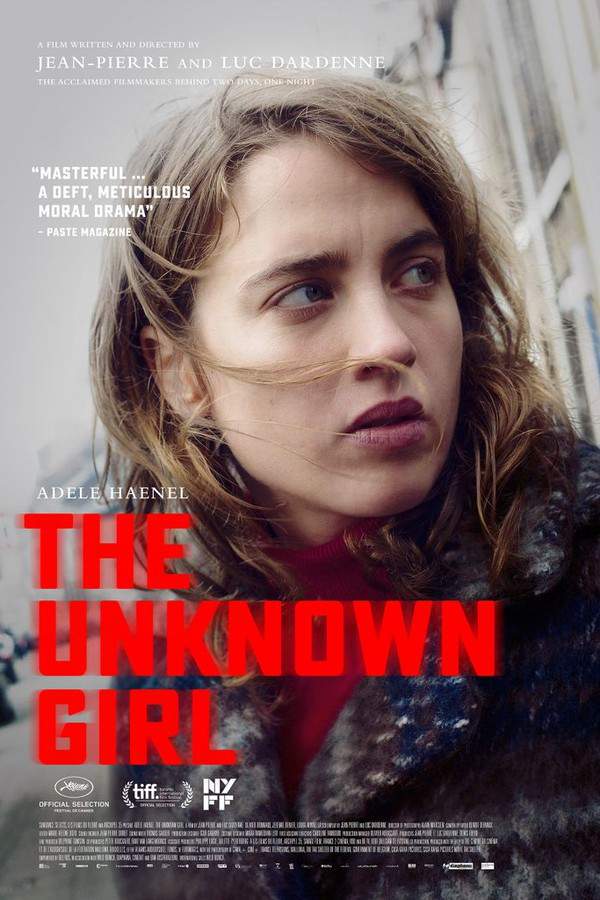
The Unknown Girl (2017) movie poster

Plot Summary

The Unknown Girl (2017) Plot Summary Explained

Release, runtime and language
2017 · 113 min · French
Echo score 66
JustWatch #20,827 9
Directed by
Jean-Pierre Dardenne, Luc Dardenne
Starring
Adele Haenel, Ben Hamidou, Christelle Cornil, Jérémie Renier, Louka Minnelli, Nadège Ouedraogo
Budget
$7M

A young doctor's life takes a dark turn when she inadvertently becomes involved in a mysterious death. After finding an unidentified African woman deceased near her clinic, Jenny’s initial indifference gives way to consuming guilt and a desperate need for answers. Determined to uncover the stranger’s identity and bring closure to the situation, she embarks on a journey to right a wrong and honor the woman’s memory.

On this page (7)
  1. 1 Where to watch
  2. 2 What happens: full plot
  3. 3 Plot questions answered
  4. 4 Movie threads
  5. 5 Movies like The Unknown Girl
  6. 6 Categories
  7. 7 Every angle

Where to watch

Where to Watch The Unknown Girl (2017)

Where can you watch The Unknown Girl? Stream, rent or buy it in the US, including on Philo, Sundance Now and Kanopy: current JustWatch availability with up-to-date prices.

Streaming availability powered by JustWatch

Full plot summary · contains spoilers

What Happens in The Unknown Girl: Full Plot Summary

The whole story of The Unknown Girl (2017) explained, from the opening scene to the final frame: every key event, every twist and what it all adds up to. Read it as a quick recap before the sequel, to check a scene you missed, or to finally understand what really happened.

Dr. Davin, Adele Haenel, a young white Belgian attending physician, steps in for the aging Dr. Habran Yves Larec at a free clinic in Seraing while she prepares to move on to a larger practice. She is supported by Julien, a taciturn intern Olivier Bonnaud, whose presence is quiet but constant in the busy daily grind. On a blistering Thursday, the clinic answers to a seizure case that arrives in a rush; the patient stabilizes, yet Julien’s contribution feels muted, a half-glimpse of competence rather than a clear breakthrough. The day’s pace tests Davin’s resolve, and the two doctors lean on routine to shield themselves from the emotional weight of the patients crowding the waiting room.

That evening, the clinic’s buzzer rings once after hours, a peripheral annoyance that Davin dismisses as fatigue talking louder than duty. She tells Julien that doctors must not let patients drain their energy or cloud their diagnostic judgment. But the moment carries a sting of unease: Julien slips away without a word, leaving Davin to question whether he will return to the room at all. The silence lingers, and with it a creeping sense that something is amiss in the careful balance they try to maintain.

The following morning, Davin is stopped by the police outside the clinic. A woman has been found dead on a construction site along the riverbank, and the authorities want the clinic’s surveillance footage to understand the chain of events. Davin complies, then returns to the routine of the day, only to discover Julien has vanished—he does not answer calls, does not show up for work, and remains an unexplainable absence. By afternoon, the police have questions about a woman who appeared at the clinic; Davin learns she died from an open skull fracture, and she notices a photo she took of the deceased after watching the surveillance footage. The victim appears to be a young African woman, and Davin recognizes that the clinic, in its scattered records, could be implicated in more ways than one. The police suspect she may have visited the clinic as a patient, but Davin cannot place her among the people she knows.

In a bid to keep moving through the day, Davin visits the construction site where the accident took place, only to learn from workers that the block of concrete connected to the fall has already been removed. That night, she goes to Julien’s home and shows him the photo; he does not recognize the woman either, and he confides that he plans to quit medicine and return to his village, offering no further explanation. The exchange hints at a shared wound—one that extends beyond the clinic’s fluorescent halls and into the lives of those who have weaved themselves into medicine’s fabric to heal personal pain.

At the hospital, Davin confronts Habran, who looks at the image but claims no recognition of the woman. Still, he offers to share the names of the dozens of African families he cares for with the police, a gesture that underscores the clinic’s close ties to a broader, more complex network of care. In a sudden turn of conviction, Davin reveals a new resolve: she decides to leave her current practice and take over Habran’s clinic, a choice that signals a different kind of commitment—one that places the care of the community above personal comfort.

On a house call to Bryan, a young patient, Davin shows the dead woman’s photo. Bryan insists he has never seen her, but Davin detects a sharp spike in his heart rate the moment the image is shown, an anxious physiological reaction that raises more questions than it answers. She leaves and calls a detective, learning with a growing sense of urgency that the woman was buried that very afternoon. Davin returns to Bryan’s house and presses him about the dead woman, but he refuses to acknowledge any connection, suggesting he could have no involvement. She tells him he can come to the clinic if he ever wishes to talk.

Davin moves into the clinic and, in a quiet, solemn act, purchases a plot in the cemetery for the woman. The investigation begins to widen as Bryan arrives at the clinic with digestive problems, and under the questioning, he reveals a troubling confession: he and a friend had witnessed the woman engaging in a sexual act with an older man in a truck on that Thursday evening. The truck owner denies knowledge, becoming hostile when pressed, and Davin is forced to leave. At an assisted-living facility, she finds the owner’s father, who offers a fragment of the woman’s story but maintains he does not know her name. The moment drags Davin into a murkier social sphere, with the older man’s world colliding with the younger woman’s desperate choices.

Seeking further answers, Davin enters an Internet café, where she nerves herself to ask the staff and patrons if they recognize the dead woman. She first reaches out to Julien again by voicemail, asking for permission to visit him in his village, then proceeds to question staff and two patrons who bear no knowledge of the woman. The tension grows as the case threads through the city’s networks, with Davin learning that Bryan’s father had driven the situation to a more dangerous edge—he had observed the woman earlier but chose to deal with the aftermath privately rather than involve the police.

When she finally catches up with Julien, he explains how the seizure patient triggered a personal reckoning: the abuse he suffered at the hands of his father and the neglect he felt from physicians made him realize he pursued medicine to heal himself rather than to help others. This confession deepens the film’s meditation on the costs of care and the personal history that shapes every clinician’s decisions. Reinvigorated by the revelation, Davin returns to Seraing and navigates a tense confrontation with the cybercafé crowd, who warn her to stay in her lane regarding the dead woman. Yet the crowd’s exodus leaves room for Davin to pursue the truth.

Bryan and a friend soon ride a motorcycle to another construction site, where Davin hopes to speak with the friend. Before she can engage him, Bryan pushes her into a hole and places a ladder down, giving the friend a chance to escape. This moment marks a turning point: Davin’s pursuit becomes more dangerous as the ever-narrowing path between patient care and the city’s hidden pressures closes in.

Back at home, Julien calls with the news that he intends to resume his medical career, a restoration of the dream he once carried. Bryan’s parents visit Davin to accuse her of harassing Bryan about the dead woman and causing his indigestion to flare up again; they decide to end their use of Davin’s services and warn her to stay away from Bryan. Yet the mother and father’ s decision paradoxically amplifies the need for Davin’s presence and care, as the family’s problem remains unresolved.

Hours later, Bryan’s father calls Davin for help with back pain, and after she administers morphine, she asks whether he knew about the dead woman. His anger intensifies, and he refuses to entertain the possibility of calling the police for fear of repercussions. While he uses Davin’s bathroom, a loud noise interrupts, and Davin discovers that the man has attempted to strangle himself—a moment that crystallizes the danger surrounding the case. With effort, he finally agrees to use Davin’s phone to contact the authorities.

In the ensuing days, Davin receives a crucial update from the Internet café employee, who reveals Félicie Khoumba’s name and shares sobering details: Félicie had a pimp and was given a fake passport because she was a minor. The employee’s own guilt and fear are palpable as she confesses to having once worked closely with Félicie, and she admits that Félicie’s absence would have left her pimp with a dangerous grip on the future. This revelation, though painful, helps Davin piece together the network of people affected by Félicie’s life and death. The employee’s empathy leads her to agree to coordinate Félicie’s burial with Félicie’s family, while offering Davin a quiet, human moment of connection before returning to the day’s patients.

As Davin turns her attention back to the clinic’s current patients, the story leaves a lingering sense of moral responsibility: the dead woman’s life and the city’s hidden networks have complicated the clinical vocation, and Davin’s decision to remain engaged—despite the fatigue, the danger, and the heartbreak—signals a commitment to serve those who are most vulnerable. The film closes on a note of cautious resolve, with Davin standing at the threshold of a new chapter in her career, carrying the weight of Félicie Khoumba’s memory and the knowledge that medicine, at its core, is a generous, sometimes painful act of bearing witness.
Last updated: May 05, 2026 at 10:08

Was this helpful?

Plot questions answered

The Unknown Girl Plot Explained: Your Questions Answered

The questions people ask most about The Unknown Girl (2017): what happens in the confusing scenes, why the characters do what they do, the twists, hidden details and what the ending means. Each answer contains spoilers.
Q1

Why does Davin ignore the late-night buzzer at the clinic?

Davin dismisses the buzzer after hours because she is exhausted from a long day and tells Julien that doctors must not let patients drain their energy or cloud their diagnostic judgment. This moment of professional detachment becomes pivotal because the woman who rang the buzzer was later found dead, and Davin's choice to not answer it haunts her with guilt throughout the film.

Foreshadowing: Earlier in the day, Davin and Julien handle a seizure case that tests their endurance, setting up the fatigue that justifies her decision to ignore the buzzer.

  • davin
  • buzzer
  • after hours
  • guilt
  • clinic
Q2

Why does Julien the intern disappear from the clinic?

Julien vanishes because he decides to quit medicine and return to his village. His disappearance is later explained when he reveals to Davin that the abuse he suffered at the hands of his father and the neglect he felt from physicians made him realize he pursued medicine to heal himself rather than to help others, triggering a personal crisis about his motivations.

Foreshadowing: During the seizure case, Julien's contribution feels muted and inadequate, hinting at his inner turmoil.

  • julien
  • intern
  • quit
  • medicine
  • village
  • abuse
Q3

Who was the dead woman found near the Seraing clinic?

The woman was identified as Félicie Khoumba from Gabon, though she was tentatively identified earlier as Serena Ndong. She was a young African woman who worked as a prostitute and was a minor with fake papers provided by her pimp. She died from an open skull fracture after falling from a construction site.

Foreshadowing: Davin notices the victim appears African but cannot place her among her patients, suggesting she was not a regular clinic patient.

  • félicie khoumba
  • serena ndong
  • dead woman
  • prostitute
  • gabon
Q4

Why does Bryan react strangely when shown the dead woman's photo?

When Davin shows Bryan the photo during a house call, he claims he has never seen the woman, but Davin notices a sharp spike in his heart rate, indicating anxiety or隐藏 knowledge. Bryan and a friend had actually witnessed the woman engaging in a sexual act with an older man in a truck on the evening she died.

Foreshadowing: Bryan's nervous reaction signals he knows more than he admits, setting up his later confession.

  • bryan
  • heart rate
  • photo
  • witness
  • truck
Q5

What was Bryan's father hiding about the dead woman?

Bryan's father had observed the woman earlier with his son but chose to deal with the aftermath privately rather than involve the police. He later attempts to commit suicide when Davin confronts him, revealing the guilt and fear surrounding his involvement in the situation.

Foreshadowing: The hostility from the truck owner and the removed concrete block hint at a cover-up that extends beyond Bryan.

  • bryan father
  • suicide
  • police
  • cover up
  • guilt
Q6

Why does Davin decide to take over Habran's clinic?

After learning the victim may have visited the clinic and discovering Julien's plans to leave, Davin experiences a turning point of conviction. She decides to leave her planned larger practice and take over Habran's clinic to serve the community that the dead woman belonged to, viewing it as a way to honor her memory and address the systemic neglect she represents.

Foreshadowing: Habran's offer to share names of African families he cares for highlights the clinic's connection to marginalized communities.

  • davin
  • habran
  • clinic
  • sereing
  • take over
Q7

What was the significance of the concrete block being removed from the construction site?

When Davin visits the construction site where the woman fell, she learns that the concrete block connected to her fall has already been removed. This detail fuels her suspicion that someone is deliberately covering up the incident, suggesting the death may not have been an accident but rather involves foul play or negligence that parties want hidden.

Foreshadowing: The removal of evidence foreshadows the broader network of protection and silence surrounding the woman's death.

  • concrete block
  • construction site
  • cover up
  • evidence
Q8

How does Davin finally discover the dead woman's name?

Davin discovers the name Félicie Khoumba from an employee at the Internet café where she questions staff and patrons. The employee reveals that Félicie had a pimp and was given a fake passport because she was a minor. The employee later agrees to coordinate Félicie's burial with her family, providing closure.

Foreshadowing: The Internet café warnings for Davin to stay in her lane build tension before this breakthrough moment.

  • félicie khoumba
  • internet café
  • name
  • pimp
  • passport
Q9

What was the connection between the truck owner and the dead woman?

The truck owner, whose father runs an assisted-living facility, brought the woman to his father as a prostitute. When Davin confronts them, the truck owner denies knowledge and becomes hostile. The older man reveals the woman was a prostitute brought by his son but claims he does not know her name, exposing the exploitation network.

Foreshadowing: The father's partial confession at the assisted-living facility links the victim's final moments to a client.

  • truck owner
  • prostitute
  • assisted living facility
  • father
Q10

Why does the Internet café employee help Davin despite the warnings?

The employee helps Davin because she had once worked closely with Félicie and feels guilt and fear about her absence. She admits that Félicie's disappearance would have left her pimp with control over her future, showing the employee's personal connection to the victim and desire for redemption.

Foreshadowing: Earlier warnings from the café crowd create tension before the employee breaks her silence.

  • internet café employee
  • félicie
  • guilt
  • help
  • confession
Q11

What drives Davin's determination to investigate the woman's death?

Davin is driven by consuming guilt after learning the woman died near her clinic after potentially seeking help. Her initial indifference to the late-night buzzer transforms into a desperate need for answers, especially when she realizes the clinic's scattered records could implicate them. This guilt fuels her journey to uncover the truth and honor the woman's memory.

Foreshadowing: The moment Davin dismisses the buzzer establishes the guilt that propels her investigation.

  • davin
  • guilt
  • investigation
  • motivation
  • memory

Movie threads

More Movies Like The Unknown Girl, by Mood & Story

Curated lists built around what makes The Unknown Girl tick: the same mood, the same kind of story or the same emotional payoff. Each list explains why these movies belong together.

Guilt-Driven Investigative Thrillers like The Unknown Girl

When a moral failure compels a relentless search for redemption. Find movies similar to The Unknown Girl where a protagonist's guilt fuels a desperate investigation. If you liked the somber, determined search for answers in this film, you'll appreciate these other heavy dramas and thrillers about moral responsibility and redemption.

  • guilty
  • determined
  • somber
  • reflective
  • tense
  • meditative
  • Tone: dark, somber, guilt-ridden
  • Pacing: slow, methodical, investigative
Why these movies?

The story pattern: The narrative follows a character, often a professional like a doctor or detective, who is initially complicit through indifference or error. A triggering event, usually a death or tragedy, ignites a deep sense of guilt, propelling them into a methodical and personal investigation that becomes their sole focus. The plot unfolds through their dogged pursuit of clues, often against official advice, leading to a resolution that may offer some answers but rarely full absolution.

Why they belong together: These films are grouped by their shared core motivation: a protagonist's consuming guilt. They share a dark, somber tone, a methodical pacing that mirrors the investigative process, and a heavy emotional weight centered on themes of responsibility, atonement, and the psychological toll of seeking justice for a stranger.

Slow-Burn Urban Moral Dilemmas like The Unknown Girl

Quiet stories exploring the ethical cracks in modern city life. Discover movies like The Unknown Girl that explore complex ethical questions within a modern urban setting. These similar slow-burn dramas and thrillers delve into themes of social responsibility, marginalization, and the psychological impact of city life on its inhabitants.

  • somber
  • meditative
  • melancholic
  • tense
  • reflective
  • urban
  • Tone: dark, melancholic, socially conscious
  • Pacing: slow, meditative, deliberate
Why these movies?

The story pattern: The narrative is triggered by a disruptive event that exposes the fragile and often invisible social fabric of a city. A central character, typically someone with a position of slight privilege or responsibility, is drawn into the lives of the marginalized. The story unfolds at a deliberate pace, focusing on their growing awareness of systemic issues, their own complicity, and the difficult, often futile, choices they must make, resulting in a conclusion that acknowledges complex realities rather than offering simple solutions.

Why they belong together: This thread groups films by their shared setting and thematic focus. They possess a slow, meditative pacing that allows for deep reflection on social issues. The tone is consistently dark and somber, exploring heavy themes of alienation, medical or legal ethics, and the psychological trauma that arises from urban isolation and injustice.

If you liked this

Movies Like The Unknown Girl

Similar movies to The Unknown Girl: the same genre, themes or kind of story. Each one comes with its own plot summary, timeline and ending explained.

Browse all movie summaries

Categories

Movie Lists Featuring The Unknown Girl

The Unknown Girl appears in these hand-built movie categories. Each one groups movies by a specific mood, theme or story type, with their plot summaries and endings explained.

View all movie categories

Every angle

The Unknown Girl (2017) Explained: Plot, Timeline & Characters

Everything about The Unknown Girl in one place: what happens in the plot summary, the timeline in chronological order, the characters and meaning and a spoiler-free summary. What's After the Movie adds the cast, box office and post-credit scenes.

Coming soon on iOS and Android

The Plot Explained Movie Summary App

Plot summaries, endings explained and timelines on your phone. Catch up on any movie in minutes, save your favorites and never miss a twist again.

Be the first to know when we launch. Your email stays private, always.

Learn more about the app