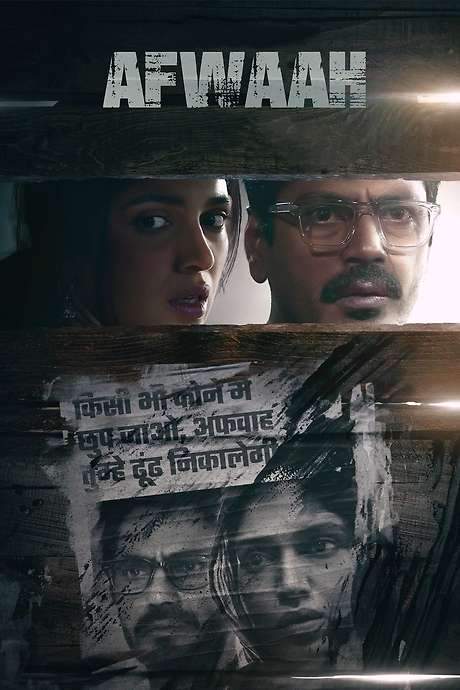
Rahab Ahmed, who is reportedly the NRI CEO of a telecom company, drives along a lonely desert road as a high-speed convoy of motorbikes and cars, led by a local troublemaker named Chandan Singh, roars past in a blur. In the city of Sawalpur, a bustling rally for a regional politician, led by the formidable figure Vikram Singh “Vicky Banna,” threads through the streets until a sudden stone-pelted interruption causes the procession to retreat. The dispute quickly exposes a deep rift between a Muslim neighborhood and the rally’s goons, culminating in the chilling death of a butcher behind a closed shop at the hands of Chandan, Vicky’s trusted henchman. The moment stings with fear and serves as a grim preview of the turmoil ahead.
During a lecture series, Rahab speaks about his decision to return to India, explaining that he wanted to contribute where he felt more connected, signaling a生命line between his past abroad and his present ambitions. The next day, the tension intensifies as Nivedita Singh, known as Nivi, the fiancée of Vicky, confronts him with a harsh accusation: he is a coward and complicit in the violence that has roiled Sawalpur. An angry Vicky pushes her aside just as a call from Nivi’s father, Gyan Singh, emerges—the father is a political leader who urges Vicky to eliminate Chandan. Yet Vicky pushes back, arguing that Chandan has served the family since his father’s time, a claim that only deepens the conflict. Gyan Singh then contacts a local police officer and orders Chandan’s death, only to call Nivi again and attempt to explain the political scheming, a plan she rebuffs by smashing a portrait of her father in a surge of anger. Chandan soon reports to Vicky that he is laying low at the farmhouse, setting the stage for a dangerous game of cat and mouse.
At the same time, Inspector Sandeep Tomar learns from his colleagues that Chandan is a marked man with prior complaints, and he conveys a stark message: he must die, and Vicky should consider his political future. Vicky, faced with a choice, hands over Chandan’s location to Tomar, signaling a reluctant shift in loyalties. Rahab meanwhile heads toward his wife Nandita, who is participating in a literature festival at Nahargarh Fort, while Vicky returns home to find Nivi has fled, leaving behind a note that makes it clear she refuses to be entangled in the family’s political games. The highways are congested, forcing Rahab to alter his route to Sawalpur to help his wife, and as fate would have it, he crosses paths with Nivi while she’s trying to escape the clutches of Vicky’s men.
A tense confrontation unfolds in a public space as Vicky’s goons close in on Nivi. In a twist of fate, Rahab intervenes, and his quick thinking and steady car help them break away, the chase lasting until their vehicle plunges into a ditch. With danger still looming, Rahab and Nivi seek refuge at Saif’s house. Nivi confesses that she does not want to marry Vicky and reveals that she has fled not just from an arranged marriage but from the political machinery itself. Meanwhile, Tomar tries to remove Chandan from the picture with a botched assassination that ends with a farmhouse worker falling into a water ditch; Chandan escapes, and the chase grows more desperate by the hour.
Nivi and Rahab move on, asking Saif to keep their location quiet, even as political scheming intensifies. Saif’s sister, Santosh’s, death becomes a painful focal point that lifts the veil on the hidden brutality surrounding the case. A social media expert hired by Gyan Singh injects a new layer of manipulation into the narrative, spreading a sensational fake story of “love jihad” as a tool to trap Nivi and Rahab. A female police officer is introduced in a tense dynamic—she becomes a quiet counterpoint to Tomar’s forceful approach and eventually tries to shield witnesses. Amid the chaos, a clumsy but revealing moment occurs when Chandan, aided by a truck driver, discusses kidney regeneration and the possibility of organ donation—an odd, almost macabre aside that underscores the strange conversations that weave through the conflict.
Rahab returns to Saif’s place only to discover that Saif himself has left with a plan for Nivi and Rahab to go, insisting that Rahab stay with Nivi or risk being killed. Nivi’s decision to remain steadfast against her family’s ambitions is tested as Vicky, spurred by a manipulator’s fake news, tries to cobble together public support by manipulating perceptions of a supposed "love jihad" connection. The false narrative grows into a viral storm that prompts social unrest: Section 144 is imposed, and Sawalpur becomes a tinderbox of religious tensions and volatile demonstrations. Chandan learns of Saif’s location from a field operative and heads toward it with his own set of fears about Tomar and his relationship to Vicky.
In a dramatic turn, Rahab records a video in which Nivi speaks up about the truth, countering the manufactured story, but the network’s reliability proves unreliable due to poor signal on the Rajasthan roads. The trio—Nivi, Rahab, and Saif—jockey through a series of obstacles as a “beef-smuggling” truck is rumored to be the vehicle that carries danger toward Nahargarh Fort. When they finally reach the fort’s gate, security and event organizers refuse them entry, swayed by the same fake news that has set the city on edge. Rahab pleads outside the gates, while Nandita (the author’s sister-in-law in the festival circuit) also struggles to persuade the organizers of Rahab’s innocence.
As the tension peaks, Chandan is ordered to terminate Rahab in front of the fort, and in a brutal moment, he strikes. Rahab fights back, pushing away Chandan’s blade and pleading with fate as his phone, captured on video, shows the truth to the world. The crowd, misled by the fabricated narrative, mistakes Vicky for Rahab and assaults him, leaving Nivi and Rahab to flee toward the waiting truck. Tomar and the female officer pursue, but not before Chandan is forced to confront his own fate in the middle of the melee.
The climax unfolds at the Lit Fest stage, where Rahab manages to reach the venue, and Nandita hurries to help him; the festival’s momentum carries the moment forward as truth and rhetoric collide on the stage. Authorities later discover that the “beef-smuggling” truck was, in fact, transporting donkeys, a revelation that undermines the false accusation and exposes the manipulation at the heart of the affair. A post-credit scene reveals Rahab recovering from his stab wound, while Nivi looks toward the political future by standing for election, backed by the steadfast support of a determined female police officer and an ally named Jay. In the final beat, Rahab returns to his home only to find it charred, a stark image that lingers as Sawalpur attempts to rebuild after a season defined by fear, rumor, and violence.
In the end, the film leaves a stark impression: power, media manipulation, and communal fault lines collide with personal courage and the desire to choose one’s own path. The story remains true to its core dynamics—ambition, loyalty, and the cost of politics in a city on the edge—while threading together a narrative that is at once urgent, unsettling, and deeply human.