Plot Explained Spoilers guaranteed!
Plot Explained

Browse by genre

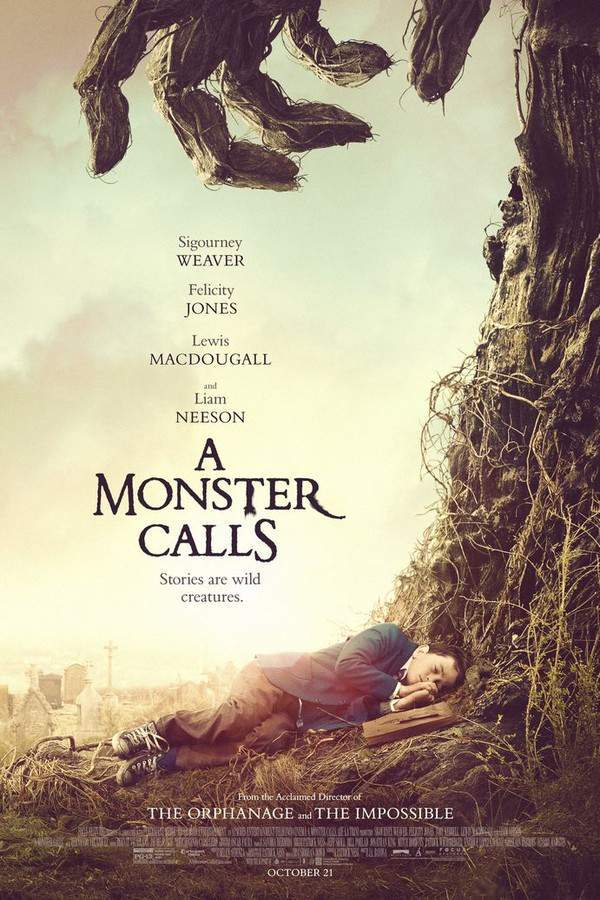
A Monster Calls (2016) movie poster

Plot Summary

A Monster Calls (2016) Plot Summary Explained

Release, runtime and language
2016 · 108 min · English
Directed by
Juan Antonio Bayona
Starring
Liam Neeson, Felicity Jones, Sigourney Weaver, Toby Kebbell, Lewis MacDougall

A young boy struggling with his mother's serious illness finds solace in a fantastical friendship with a towering tree monster. As Conor grapples with family tensions and overwhelming sadness, the Monster guides him on a series of nighttime stories, challenging him to face difficult truths and explore the complexities of grief, courage, and the power of storytelling. Through their interactions, Conor confronts his inner demons and learns valuable lessons about acceptance and healing.

On this page (6)
  1. 1 Where to watch
  2. 2 What happens: full plot
  3. 3 Plot questions answered
  4. 4 Movie threads
  5. 5 Movies like A Monster Calls
  6. 6 Every angle

Where to watch

Where to Watch A Monster Calls (2016)

Where can you watch A Monster Calls? Stream, rent or buy it in the US, including on Amazon Video, Apple TV Store and Fandango At Home: current JustWatch availability with up-to-date prices.

Streaming availability powered by JustWatch

Full plot summary · contains spoilers

What Happens in A Monster Calls: Full Plot Summary

The whole story of A Monster Calls (2016) explained, from the opening scene to the final frame: every key event, every twist and what it all adds up to. Read it as a quick recap before the sequel, to check a scene you missed, or to finally understand what really happened.

The story unfolds with Conor (Lewis MacDougall), a 12-year-old boy trapped in a haunting nightmare where he is clinging to his mother, only to let go as she tips towards an abyss. Waking up, he finds himself in the real world, where his mother, Lizzie (Felicity Jones), is battling cancer, evidenced by her hairless head. Over breakfast, she informs him about her upcoming chemotherapy session and mentions a visit from Conor's grandmother, which Conor dreads. At school, he faces a bully who takes advantage of his vulnerability, further complicating his emotional turmoil.

That night, Conor is jolted awake when a booming voice calls his name. To his surprise, he encounters a towering tree that transforms into a Monster (Liam Neeson). The Monster tells Conor he will share three stories with him, and after that, Conor must tell his own truth, the truth he hides deep within. This exchange marks the beginning of a series of fantastical and educational tales revealing deeper lessons about morality, responsibility, and human complexities.

Conor's grandmother, Gran (Sigourney Weaver), arrives the next morning and immediately begins overseeing Conor's life, much to his displeasure. As tension mounts, Conor struggles with the weight of his feelings—both toward his mother’s condition and his familial relationships. One night, the Monster visitations turn into a cacophony of fantastical tales showcasing moral grey areas. From a prince entangled in his own deceit to an apothecary faced with ethical dilemmas, each story pushes Conor to grapple with his own emotional struggles and grief.

As days pass, Conor finds solace in these tales and begins to act out his frustrations, culminating in an explosive confrontation with his bully at school. Each encounter with the Monster becomes increasingly personal. He faces painful truths about himself, culminating in the revelation that he has called upon the Monster not merely to protect his mother but to heal his own anguish.

In the climax of this journey, Conor is forced back to the edge of his nightmare—the cliff—where he must confront the truth, a painfully human desire for resolution and release. It’s revealed that in order to move forward, he must let go of his mother—not when she dies, but in acceptance of her impending fate. The Monster validates Conor's complexity as a human being, reminding him that it’s natural to wish for an end to suffering.

In the poignant finale, Conor’s emotional journey comes full circle as he and his grandmother find a way to live with their shared pain, cementing their bond through the love for Lizzie. Conor discovers a connection to his mother’s artwork, where he finds a mystical drawing of the Monster, revealing the breadth of their shared experiences and reminding us how stories intertwine our lives in mystical and unexpected ways.

Last updated: November 07, 2024 at 23:46

Was this helpful?

Plot questions answered

A Monster Calls Plot Explained: Your Questions Answered

The questions people ask most about A Monster Calls (2016): what happens in the confusing scenes, why the characters do what they do, the twists, hidden details and what the ending means. Each answer contains spoilers.

Q1

Why does the Monster appear to Conor?

The Monster appears to Conor because he has been silently suffering from the emotional trauma of watching his mother die from cancer. While Conor tries to be strong and supportive, he secretly harbors a desperate wish for the suffering to end. The Monster reveals that Conor himself summoned him, not to save his mother, but to help Conor confront and heal from his own anguish. The Monster functions as a guide to help Conor process his grief rather than escape it.

Foreshadowing: The Monster tells Conor he was summoned, hinting that Conor's deepest psychological needs called forth this fantastical helper.

  • monster
  • conor
  • summoned
  • grief
  • healing
  • psychological
Q2

What is the truth Conor must tell the Monster?

The truth Conor must tell is the painful reality he has been hiding even from himself: he unconsciously wishes for his mother to die so that his own suffering will end. This represents the darkest, most human aspect of grief, the conflicting feelings of love and exhaustion that a child experiences when watching a parent slowly die. The Monster does not punish Conor for this thought but validates that these complex, contradictory feelings are part of being human.

Foreshadowing: Conor's nightmare of letting go of his mother on the cliff foreshadows this truth.

  • truth
  • conor
  • monster
  • wish
  • death
  • acceptance
  • guilt
Q3

What does the nightmare about the cliff represent?

The cliff nightmare represents Conor's deepest fear of losing his mother and the emotional abyss that would follow. In the recurring dream, Conor clings to his mother as she tips toward the abyss, symbolizing his desperate attempt to hold onto her life while simultaneously feeling the weight of his own helplessness. The nightmare appears throughout the film as a visual metaphor for his struggle between wanting his mother to survive and his unconscious desire for the painful uncertainty to end.

Foreshadowing: The nightmare appears in the opening scene and recurs throughout, building toward the climactic confrontation at the cliff.

  • nightmare
  • cliff
  • fear
  • mother
  • loss
  • abyss
  • symbol
Q4

Why is Conor's relationship with his grandmother so tense?

Conor's tension with his grandmother stems from feeling like she is trying to replace his mother and take control of his life during his mother's illness. Gran arrives to help care for Conor and manage the household, but her strict, controlling demeanor feels like an intrusion rather than comfort to Conor. He resents her attempts to impose order on his chaotic emotional world, seeing her as another authority figure failing to understand what he is going through. Their conflict represents the generational gap in processing grief.

Foreshadowing: The timeline notes Conor's dread about his grandmother's arrival, establishing the strained dynamic early.

  • grandmother
  • gran
  • conor
  • tension
  • conflict
  • family
Q5

What does the Monster mean when he says Conor summoned him?

When the Monster says Conor summoned him, he means that Conor's desperate psychological need for help processing his grief manifested in this fantastical visitation. The Monster is not a literal external being but a manifestation of Conor's unconscious mind, a way for his psyche to communicate difficult truths to himself. The Monster explains that stories have power, and Conor's need for someone to help him face reality was so strong that it created this therapeutic figure within his mind.

Foreshadowing: The Monster appears exactly when Conor needs him most, suggesting a psychological connection.

  • summoned
  • monster
  • conor
  • subconscious
  • psychological
  • stories
Q6

What must Conor accept to move forward?

Conor must accept that his mother is dying and that there is nothing he can do to prevent it. More importantly, he must accept the conflicting emotions that come with this reality, the love he feels for her, the exhaustion of watching her suffer, and even the secret wish for it all to end. Acceptance does not mean wanting her to die, but rather acknowledging the full range of his feelings without guilt. Only by accepting this painful truth can Conor begin to heal rather than remain trapped in denial and grief.

Foreshadowing: The Monster's three stories all involve characters facing uncomfortable truths about themselves.

  • acceptance
  • mother
  • death
  • grief
  • healing
  • truth
  • conor
Q7

What is the significance of the Monster in his mother's artwork?

The discovery that Conor's mother drew the Monster in her artwork reveals that she too was processing her own impending death through stories. This connection suggests that the Monster may represent something shared between mother and son, a creative, imaginative way of coping with the unbearable. It also shows that Conor and his mother were always connected through their inner worlds, and that her artistic expression foreshadowed the very coping mechanism Conor would develop. This discovery brings Conor closer to understanding his mother as a full person with her own fears and imaginings.

Foreshadowing: The Monster appears after Conor's mother has already been ill for some time, suggesting a shared psychological inheritance.

  • artwork
  • mother
  • monster
  • drawing
  • connection
  • lizzie
Q8

Why does Conor confront his bully at school?

Conor's confrontation with his bully at school represents a turning point in his character arc where he begins to assert himself rather than remain passive. The Monster's stories challenge Conor to stop hiding from his emotions, and this courage manifests in his physical confrontation with the boy who has been tormenting him. This act of defiance shows Conor that he can face difficult situations directly, which parallels the emotional confrontation he must soon have with the Monster about his hidden truth.

Foreshadowing: The timeline notes this as a pivotal moment where Conor begins to transform.

  • bully
  • school
  • confrontation
  • conor
  • transformation
  • anger
Q9

What lesson does the Monster teach through his three stories?

The Monster's three stories each explore moral complexity and the idea that things are not always what they seem. The first story is about a prince who appears villainous but is actually the victim of manipulation. The second involves an apothecary facing ethical dilemmas. Each story teaches Conor that morality is not black and white, that people are capable of both good and evil, and that understanding requires looking deeper than surface appearances. These lessons prepare Conor to examine his own complex feelings about his mother's illness without judgment.

Foreshadowing: Each story becomes increasingly personal to Conor's situation, building toward his own truth.

  • stories
  • monster
  • lessons
  • morality
  • prince
  • apothecary
  • grey areas
Q10

How does Conor's relationship with his grandmother change by the end?

By the end of the film, Conor and his grandmother move from conflict to mutual understanding and bond over their shared love for Lizzie. After Conor confronts his truth about his mother's impending death, he and Gran are able to grieve together rather than fight. Gransoftens her controlling demeanor and allows Conor to express his emotions, while Conor learns to accept her love and support. Their reconciliation represents healing not just from grief, but from the family conflict that arose during the illness.

Foreshadowing: The timeline shows their bonding as the final stage of Conor's emotional journey.

  • grandmother
  • gran
  • conor
  • reconciliation
  • bond
  • grief
  • family
Q11

Why does the Monster tell Conor three stories?

The Monster tells Conor three stories as a narrative device to teach him about the complexity of truth and morality before revealing his own truth. Each story serves as a lesson about how people and situations are rarely straightforward, and how accepting grey areas in life is part of growing up. The structure of three stories also follows a classic storytelling tradition, building toward the final and most important story, Conor's own truth. The Monster acts as a therapist using narrative to prepare Conor for self-reflection.

Foreshadowing: The Monster explicitly states he will tell three stories and then expects Conor to share his truth in return.

  • stories
  • three
  • monster
  • lessons
  • truth
  • narrative
  • guidance
Q12

Does Conor want his mother to die?

Conor experiences a deeply conflicted emotional state where part of him wishes for his mother's death, not because he doesn't love her, but because watching her suffer from cancer is unbearable. This does not make him a bad person, it makes him human. The Monster validates this feeling as natural, explaining that people often have contradictory wishes when facing terminal illness. The truth Conor must tell is this unspoken wish, which represents the heavy emotional burden he has been carrying and hiding from himself.

Foreshadowing: The recurring nightmare of letting go foreshadows this conflicted desire.

  • mother
  • death
  • wish
  • conor
  • guilt
  • conflicting feelings
  • humanity

Movie threads

More Movies Like A Monster Calls, by Mood & Story

Curated lists built around what makes A Monster Calls tick: the same mood, the same kind of story or the same emotional payoff. Each list explains why these movies belong together.

Movies like A Monster Calls: Using Fantasy to Cope with Grief

Movies where fantasy elements help characters face profound, real-world pain. Discover movies similar to A Monster Calls that blend realistic, heavy drama with fantasy or allegory. If you liked how the Monster helped Conor process his mother's illness, you'll appreciate these stories where magic meets harsh reality, offering a unique path to understanding difficult truths.

  • dreamlike
  • cathartic
  • grieving
  • introspective
  • symbolic
  • therapeutic
  • Tone: melancholic, cathartic
  • Pacing: steady, contemplative
Why these movies?

The story pattern: Stories in this thread often feature a protagonist grappling with a tangible, painful reality—such as terminal illness or loss—who finds their journey interpreted or guided by a fantastical element. This otherworldly presence provides stories, challenges, or perspectives that slowly lead the character toward a crucial emotional breakthrough, making the unbearable somewhat comprehensible.

Why they belong together: Movies are grouped here for their shared narrative device of using fantasy as a direct metaphor for internal emotional processing. They balance a heavy, grounded core theme with a layer of imaginative storytelling, resulting in a cathartic and deeply introspective experience.

Movies like A Monster Calls about a Child's Heavy Emotional Burden

Stories centered on children silently carrying immense emotional weight. Find films similar to A Monster Calls that explore a child's perspective on grief, illness, and family turmoil. These movies capture the unique loneliness and strength of young protagonists who must process overwhelming emotions, often through introspection and imagination.

  • somber
  • grieving
  • introspective
  • lonely
  • cathartic
  • heartbreaking
  • Tone: melancholic, somber
  • Pacing: steady, character-driven
Why these movies?

The story pattern: The narrative pattern follows a young protagonist whose world is defined by a secret or unspoken pain—such as a parent's illness, family breakdown, or bullying. The story charts their internal battle between denial and acceptance, often culminating in a powerful, emotional release where they finally confront the truth they've been avoiding.

Why they belong together: These films are connected by their intense focus on a child's subjective experience of trauma. They share a heavy, melancholic mood, a steady pacing that allows for deep character immersion, and a central theme of navigating sorrow from a perspective of limited power and understanding.

If you liked this

Movies Like A Monster Calls

Similar movies to A Monster Calls: the same genre, themes or kind of story. Each one comes with its own plot summary, timeline and ending explained.

Browse all movie summaries

Every angle

A Monster Calls (2016) Explained: Plot, Timeline & Characters

Everything about A Monster Calls in one place: what happens in the plot summary, the timeline in chronological order, the characters and meaning and a spoiler-free summary. What's After the Movie adds the cast, box office and post-credit scenes.

Coming soon on iOS and Android

The Plot Explained Movie Summary App

Plot summaries, endings explained and timelines on your phone. Catch up on any movie in minutes, save your favorites and never miss a twist again.

Be the first to know when we launch. Your email stays private, always.

Learn more about the app