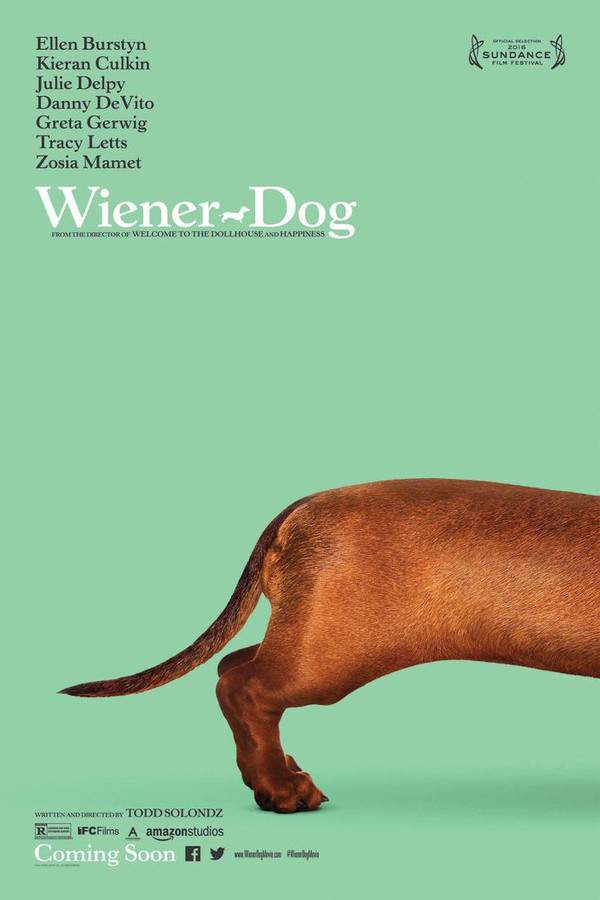
A lean, patient thread runs through a collage of lives in this wry, gently melancholic road-trip of a film: a small Wiener-Dog becomes the quiet catalyst that connects a spectrum of people and moments across the country, each encounter revealing a sliver of love, loss, and resilience. The story begins with a family trying to figure out how to care for a dog who has survived cancer. Danny brings home the little canine survivor to his wife, Dina, and their son Remi. Dina’s instinct is to resist yet another obligation, especially one that feels like a burden, while Danny insists that Remi—who has already faced serious hardship—is old enough to shoulder some responsibility. The household tension unfolds in a loose, almost casual rhythm, until a fateful decision about the dog’s fate bumps against a harsher reality. When Wiener-Dog is taken to the vet to be euthanized after a string of misadventures—spreading feathers around the living room, gnawing on cushions, and even dipping into trouble in a moment of attempted compassion—the emotional stakes rise beyond a pet’s health and into the realms of care, guilt, and the limits of what a family can reasonably bear.
In the moment Wiener-Dog is spared, a new caretaker enters the dog’s orbit: Dawn Wiener, Greta Gerwig. Dawn takes the dog home, nursing her back to health while carrying a sense of estrangement from her own life and family. Her return to a more solitary existence is quietly mirrored by the dog’s own stubborn independence, and the film follows how a simple act of kindness can ripple outward. When Dawn crosses paths with her junior-high ex-boyfriend, Brandon, the narrative expands into a cross-country pilgrimage. The two decide to travel to Ohio to visit Brandon’s brother Tommy and his wife April, a couple navigating the particular joys and challenges of life with Down syndrome. The journey is imperfect, improvisational, and full of small human dramas: they encounter homesick hitchhikers from Mexico, confront Brandon’s unresolved past with drugs, and grapple with the idea of how long one should stay in a place or with a person who might not be ready to settle down. Dawn agrees to leave Wiener-Dog with Tommy and April, who welcome the dog with warmth and ease, creating a brief sense of home for the animal and a sense of possibility for Dawn and Brandon as they discuss their future together. The road-trip sequence is filled with offbeat, intimate moments that feel both tender and observational, painting a portrait of imperfect people trying to do right by a creature they barely understand.
Between these chapters, Wiener-Dog continues to drift across the United States in a way that feels almost documentary in its candor: the dog wanders through strip clubs, motels, and scenes of everyday life, as if the country itself were a wandering backdrop for a quiet meditation on kindness and consequence. The dog’s journey lands in the hands of Dave Schmerz, a screenwriting professor trying to stage his second script. Schmerz is a man worn down by the clash between his artistic integrity and the commercial pressures of his profession. He confesses that he once compromised genuine emotion to fit market expectations, a confession that has left him raw and defensive. When Schmerz faces a renewal of his career—and a confrontation with a former student who has become a famous director—his fragility and sense of failure collide with the realities of the classroom and the industry. In a shocking, almost satirical turn, Schmerz attaches a bomb to Wiener-Dog, triggering alarm and intervention from the authorities, who ultimately stop him and force him to confront the consequences of his bitterness. The sequence is a stark reminder of how art and anger can collide—and how an innocent creature can become an unwilling focal point of broader tensions.
The final leg of Wiener-Dog’s odyssey lands in the life of an elderly woman known as Nana, who lives with a caregiver named Yvette. Nana names the dog “Cancer,” a name that reverberates with memory and a sense of what life can bring in old age. Nana’s world expands when her granddaughter Zoe arrives with her boyfriend Fantasy, a conceptual artist whose ambitions color the visit with a sense of art-world possibility and frayed family ties. Nana chooses to help Zoe by giving her money for Fantasy’s latest project, and a private moment with Zoe reveals the underlying anxieties—whether Fantasy is faithful, whether Zoe’s choices are truly her own. After Zoe leaves, Nana sits with Wiener-Dog in the fading light, and she dreams of a younger, brighter version of herself who might have chosen a more hopeful path. The dream ends abruptly when she wakes to discover Wiener-Dog has run away, and a cruel accident follows: Wiener-Dog is struck by a truck, a stark puncture to the tender chain of lives that the dog has touched.
In a final, almost ceremonial coda, the film skips forward six months to reveal the movie’s coldly whimsical truth: in Fantasy’s art exhibit, a stuffed animatronic Wiener-Dog stands in testament to the path the animal has traversed and the small, stubborn hope it carried. The story leaves the viewer with a quiet afterimage of how a single creature can anchor a mosaic of human moments—moments of care, fear, generosity, and the complex, tender ways we try to do right by those we love.
This kaleidoscopic portrait is crafted with a steady, humane eye, letting humor arise from human foibles while never losing sight of the dog’s simple, unassuming presence. Throughout, the film treats its characters—and the audience—with a gentle patience, inviting us to see the dignity and vulnerability in ordinary choices, even as the world around them remains unpredictable and sometimes unkind. Wiener-Dog’s pilgrimage becomes a meditation on how kindness can travel far across a country and through a multitude of lives, leaving a trace that lingers long after the final scene.