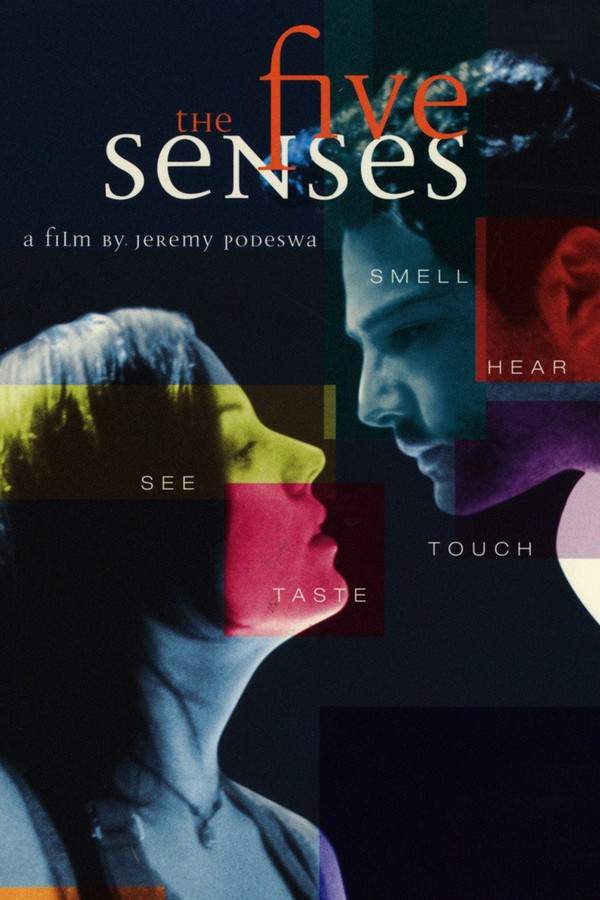
The Five Senses weaves together a network of interconnected stories housed in a single building, where each fragment examines life through a different sense and how perception can shape connection, longing, and healing. At the heart of this mosaic is touch, brought to life by Ruth Seraph, a massage therapist whose craft helps others navigate their private pains. Ruth is portrayed by [Gabrielle Rose],(/actor/gabrielle-rose) and she tends to Anna Miller, Molly Parker whose world is already frayed by the disappearance of her preschool daughter, Amy Lee Miller, Elize Francis Stolk. The troubling moment that sets the film in motion occurs when Ruth’s daughter Rachel Seraph, played by Nadia Litz, loses Amy Lee in the park after being distracted by a couple in the woods. In the immediate aftermath, Rachel encounters a voyeur named Rupert, Brendan Fletcher, and the two outsiders form a cautious friendship as Rupert guides her toward the uneasy joy of watching others. Their uneasy alliance leads them to one of Rachel’s hiding places, where she has Rupert dress like a woman, a moment that underscores the fragility and complexity of what it means to observe—and be observed.
As Ruth grapples with Anna’s pain and the sudden disappearance of Amy Lee, the film broadens to another thread rooted in scent. Robert, a professional housecleaner with an extraordinary sense of smell, seeks out the people he used to see so he can absorb their scents and sense whether there was still some feeling for him, or why that feeling faded. This strand centers on his work with clients such as Raymond, Richard Clarkin, and Rebecca, who together navigate memory, longing, and the elusive traces of emotion that linger in everyday spaces. Another figure in this sense-driven tapestry is Rona, a cake maker who has lost her sense of taste. Rona’s romantic life is unsettled when Roberto, Marco Leonardi, whom she met on vacation in Italy, arrives, bringing both renewed appetite and new complications. The scent and sweetness of these stories intersect with the perfume-making turns shared by Raymond and Rebecca, revealing how smell and taste can carry memory as powerfully as any spoken word.
In the thread devoted to hearing, Dr. Richard Jacob, Philippe Volter, an older optometrist, finds his world slipping as he loses his ability to hear. He had been separated from his wife Sylvie, Amanda Soha and grapples with the fear of losing sound itself, a fear he begins to address with help from Gail, Pascale Bussières, who supports him as he works to cope and reclaim a sense of self. The film gently threads these moments together, showing how sound can anchor memory, connection, and resilience even as other senses falter.
Throughout these interwoven stories—touch, sight, smell, taste, and hearing—the central building stands as a quiet, almost hushed character, a place where private lives spill into shared experience and where strangers become witnesses to one another’s vulnerabilities. The narratives push toward a hopeful resolution: Amy Lee is found, Ruth and Rachel repair their relationship, and the characters learn that understanding can emerge from the senses’ delicate balance rather than from certainty alone.
In the end, The Five Senses invites viewers to consider how perception shapes our lives: how touch can heal, how seeing can reveal longing, how scent can recall what words cannot, how taste can complicate friendships, and how listening can offer a pathway to reconciliation. And it does so with a tender, observational clarity, letting each thread breathe while underscoring the interconnectedness of every human experience under one roof.