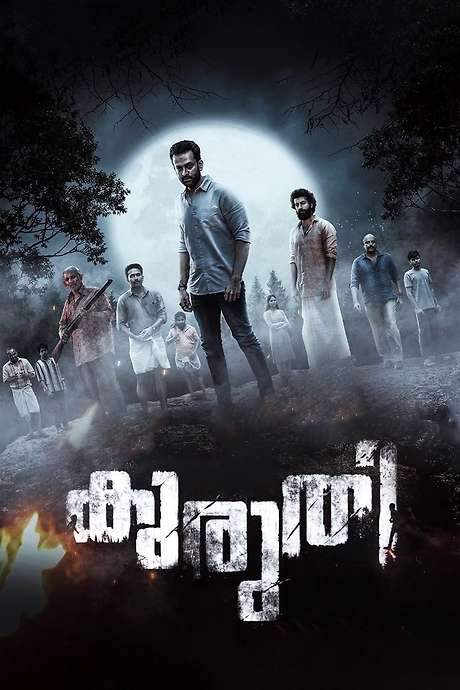
In 1987, a tragic train derailment disrupts a quiet hill village in rural Tamil Nadu, leaving many injured and several lives lost. In the immediate aftermath, officials launch a high-stakes investigation that targets the extremist group Makkal Padai (People's Army), whom they accuse of orchestrating the incident as a protest against a mining project that would alter the village’s hillside landscape. The government declares Operation Ghosthunt to apprehend Makkal Padai’s elusive leader, Perumal, a figure whose identity and whereabouts remain shrouded in mystery, while the hunt unfolds against a backdrop of political pressure, official deceit, and mounting village anxieties.
Kumaresan, a fresh recruit in the police force, joins E-Company as a new driver and quickly learns that life on the front lines is not only about following orders but also navigating precarious loyalties, hidden agendas, and the murky line between safeguarding citizens and enforcing harsh state power. He is a young man of conscientious instinct, torn between his duty and the urge to help those who are suffering, a conflict that grows as he uncovers how deeply entrenched bureaucracy can complicate every decision.
At the heart of Kumaresan’s personal arc is his romance with Tamilarasi, nicknamed "Pappa," the granddaughter of a woman helped by Kumaresan after a bear attack. Their budding relationship adds warmth to a story layered with violence and political pressure, and Tamilarasi’s personal history illuminates how the actions of officials reverberate through ordinary families, often with devastating consequences. Tamilarasi is portrayed by Bhavani Sre, whose character anchors a poignant thread in the larger siege of the hill village.
As the investigation unfolds, Sunil Menon, the officer in charge of the operation, takes a hardline stance against Perumal and his supposed network. Gautham Vasudev Menon appears as DSP Sunil Menon, driving a campaign that includes pressuring residents to turn against Perumal and pursuing a strategy that blurs ethical lines in the name of security. The violence escalates when Ragavendar, the officer-in-charge of the EO unit, orchestrates brutal interrogations that ripple through the community and intensify public fear.
Kumaresan discovers a startling truth: the people he helped during his duty hours may be connected to Perumal’s circle, and he realizes that some officers are complicit in atrocities committed in the name of interrogation. He shares what he learns with Head Constable Chandran, only to discover that Chandran himself is part of Makkal Padai and acts as a hidden mole—a revelation that reframes Kumaresan’s loyalties and the entire operation. S. Chandran makes a chilling impression in this twist, as the web of betrayal tightens around the police force.
The landscape of fear intensifies when the government orders the arrest and brutal interrogation of villagers around the hill, including Pappa’s grandmother, who is killed during torture as the police seek to extract information about Perumal’s whereabouts. The crackdown deepens, and Pappa herself is arrested and subjected to mistreatment along with other villagers, underscoring the human cost of a campaign that seeks to crush insurgent influence by force rather than addressing grievances. The toll on Tamilarasi’s family—and on many families in the village—becomes one of the most painful threads in the story.
Meanwhile, Kumaresan discovers Perumal’s possible hideout and relays details to Sunil, who assigns a team to capture the leader. A massive confrontation ensues, culminating in Perumal’s arrest after a fierce shootout. Pappa’s quick-thinking refusal to abandon the others helps to avert further tragedy, and she is taken away as the rest of the community breathes a sigh of relief that at least some of the danger has passed. Ragavendar asserts his control over the operation, suspending Kumaresan for not submitting a formal act-of-subordination memo, and claims credit for the arrest, highlighting the complex politics of policing even amid moments of apparent victory.
In the mid-credits sequence, a photographer infiltrates the camp and documents brutal acts of violence against women by members of the police department, a stark counterpoint to the supposed order of the operation. Perumal endures interrogation and insults at the hands of Sunil, yet he manages to slip away and reunite with Kumaresan in the forest. The pair shares crucial information about the train attack, and Perumal urges Kumaresan and the police to pursue the truth behind the incident, signaling that the larger battle over justice and accountability is far from over.
This story weaves together themes of power and accountability, the personal costs of coercive policing, and the fragile lines between heroism and complicity. Across the chaotic landscape, characters like Kumaresan, Tamilarasi, Perumal, Sunil Menon, and Ragavendar illuminate how individuals navigate duty, loyalty, love, and moral responsibility when the system itself seems to be breaking down. The film presents a nuanced portrait of a community under pressure and the people who must decide where to stand when every choice carries consequences. The cast—featuring Vijay Sethupathi as Perumal, Gautham Vasudev Menon as Sunil Menon, Chetan as Ragavendar, Ilavarasu as the PWD Minister, Aryan as Aari, Soori as Kumaresan, Saravana Subbiah as the Collector, Bhavani Sre as Tamilarasi, Tamizh as Amudhan, Pavel Navageethan as the Photographer, Surya Sethupathi as A Kid, Bala Hasan as a Constable, Manimegalai as Tamilarsi’s Grandmother, Thendral Raghunathan as a Villager, Asuran Krishna as Asuran Krishna, Rajiv Menon as A. Subramaniyan, Sardar Satya as Velumurugan, S. Chandran as Chandran, Sundareswaran CVC as T.A., and R. Ganesh Gurung as Natarajan—helps ground the film in a recognizably human drama amid political tension and systemic violence.