Plot Explained Spoilers guaranteed!
Plot Explained

Browse by genre

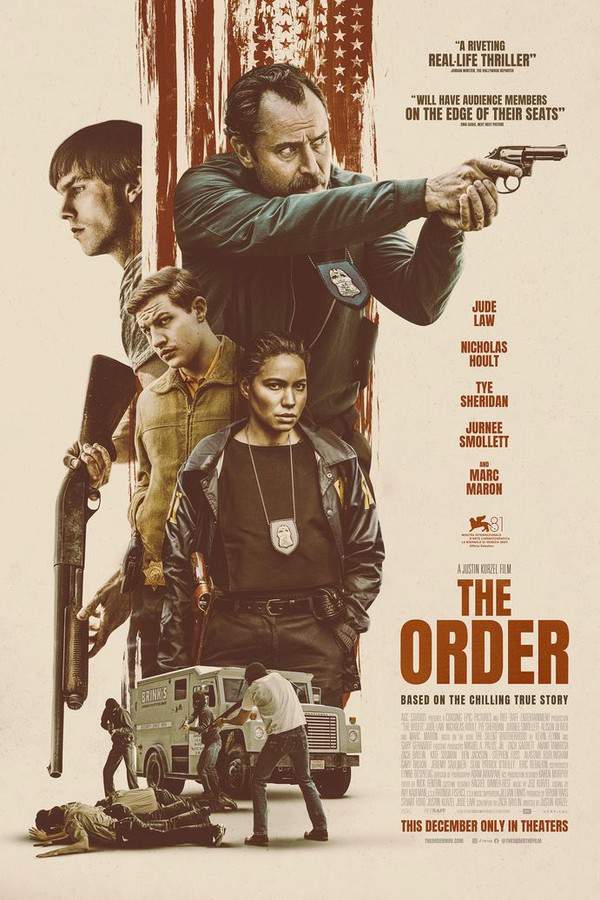
The Order (2024) movie poster

Plot Summary

The Order (2024) Plot Summary & Ending Explained

Release, runtime and language
2024 · 1 h 54 m · English
Echo score 82
Directed by
Justin Kurzel
Starring
Marc Maron, Jude Law, Nicholas Hoult, Daniel Doheny, Sebastian Pigott, Tye Sheridan

In 1983, a string of increasingly violent bank robberies, counterfeiting operations, and armored car heists terrorized communities across the Pacific Northwest. As law enforcement struggled to understand the crimes, a lone FBI agent in the quiet town of Coeur d’Alene, Idaho, began to suspect a connection between the events.

On this page (7)
  1. 1 What happens: full plot
  2. 2 Plot questions answered
  3. 3 How it ends
  4. 4 The book behind the movie
  5. 5 Movie threads
  6. 6 Movies like The Order
  7. 7 Every angle

Full plot summary · contains spoilers

What Happens in The Order: Full Plot Summary

The whole story of The Order (2024) explained, from the opening scene to the final frame: every key event, every twist and what it all adds up to. Read it as a quick recap before the sequel, to check a scene you missed, or to finally understand what really happened.

In 1983, Bruce Pierce and Gary Yarbrough lure Walter West out into the woods at night under the ruse of a hunting trip, and murder him. A veteran FBI agent, Terry Husk, reopens the long-vacant field office in Coeur d'Alene, Idaho, hoping for an easier caseload after years spent working on major investigations into groups like the Ku Klux Klan and Cosa Nostra, and quietly seeking a chance to reconnect with his estranged wife and daughter. The case quickly broadens beyond a single killing as a separate crime spree unfolds in Spokane: on December 18th, a coordinated robbery targets a Washington Mutual branch led by Bob Mathews along with Pierce, Yarbrough, and David Lane.

Bob Mathews is not just a planner of violence; he is entangled in a personal web that tightens the stakes. He carries on an affair with Zillah Craig, who is pregnant with his child, even though he remains married to Debbie. The personal and political grievances feed a broader project: Bob is building a militia and recruiting resources, including Sam Stinson, a veteran who can procure weapons and offer a steady salary to keep men like him loyal. The operation’s violence is not isolated to one act but part of a growing network that appears to blur lines between ideology and criminal enterprise.

Husk’s investigation leads him to the heart of Aryan Nations and its controversial history, including figures tied to its broader spectrum of influence. He introduces himself to the local sheriff's department, led by Sheriff Loftlin, and meets Deputy Jamie Bowen, who offers to guide him to the group’s more clandestine corners. Bowen explains that West—now missing for weeks—is connected to Aryan Nations and has hinted at counterfeiting, while she suspects a string of robberies and a recent synagogue bombing may be linked to the same network. The missing person case takes on a sharper edge as Husk and Bowen uncover West’s last known movements and a path that leads toward a sanctuary for extremist beliefs. West’s wife Bonnie Sue provides crucial clues, directing the investigators toward the woods where they uncover a shallow grave containing West’s body, deepening the sense that this is more than a routine missing person case.

As the investigators trace the group’s steps, Butler, the Aryan Nations figurehead, becomes a focal point. [Butler] is confronted in his Hayden Lake compound, where he states that he expelled Pierce and Yarbrough for misusing the group's printing press to counterfeit money and denies knowledge of their subsequent crimes. Husk presses for accountability, warning that splinter groups threaten to pull the entire movement into chaos if not kept in check. A striking detail appears: a copy of The Turner Diaries sits on display at the compound, a book that later surfaces as a recurring touchstone for the extremists’ worldview and tactics. The discovery links the domestic terror plot to a broader, more dangerous blueprint.

Amid the unfolding tension, a new recruit named Tony Torres is introduced to Mathews—Torres harbors resentments about job loss and immigration that color his perspective, illustrating how personal grievances can feed extremist narratives. The rift between Butler’s strategy—trying to win political influence within the system—and Mathews’ more radical approach—advocating direct, violent action—grows louder as the group’s reach expands. The Turner Diaries becomes a more explicit guide for the group’s rhetoric and plans, fueling a belief in “the time to fight” that pushes individuals toward ever more dangerous acts.

A pivotal moment comes when Yarbrough bombs a porn theater as a distraction for Mathews to lead a bold armored-car heist. Husk rushes to intervene, but he faces an overpowering show of force, while Bowen, overwhelmed by fear or hesitation, falters at a critical moment. The failure to act swiftly under pressure intensifies the FBI’s need to disrupt the cell before it can escalate further. As law enforcement closes in, Mathews begins to see the threat more clearly through the lens of a government crackdown, yet his resolve hardens as the investigation tightens around him. The search intensifies when a gun dropped at the crime scene points investigators toward Tony Torres, who had been trafficking guns for Mathews. Torres cooperates with authorities, providing a key link to Mathews’ operations and leading police to a pivotal confrontation. Husk, eager to act, moves to arrest Mathews without waiting for backup, and a gunfight erupts. Bowen again steps into harm’s way, offering cover fire that allows the team to apprehend Yarbrough, though Mathews escapes in the chaos, shooting and killing Bowen in the process.

Mathews’s wallet surfaces at a meeting point, guiding investigators to Debbie, who reveals the location of Mathews’ hideout. Debbie’s information narrows the hunt to a dangerous stronghold, and Husk learns that Mathews intends to declare war on the federal government from a safe house in Whidbey Island, Washington. Pierce and Lane attempt to flee, but are quickly seized, while Mathews makes a stubborn stand against the FBI’s assault. The tactical team decides to burn the house to force Mathews out, and as the blaze grows, Mathews remains underground until the fiery trap finally explodes. In the end, the operation results in Mathews’ death as the ammunition cache detonates inside the burning house, bringing a violent chapter to a close and leaving a lasting impact on the investigation and the communities affected by these acts.

The threads in this story weave together a portrait of a time when extremist movements intersected with criminal schemes, complicating the pursuit of justice and challenging investigators to confront both ideology and violence with equal resolve. The narrative follows a careful, methodical investigation that exposes how individual loyalties, clandestine networks, and high-stakes criminal operations can intersect in a way that tests even seasoned law enforcement professionals.
Last updated: October 01, 2025 at 13:07

Was this helpful?

Plot questions answered

The Order Plot Explained: Your Questions Answered

The questions people ask most about The Order (2024): what happens in the confusing scenes, why the characters do what they do, the twists, hidden details and what the ending means. Each answer contains spoilers.

Q1

Why was Walter West killed in the woods?

Walter West was murdered because he was connected to Aryan Nations and had been involved in counterfeiting operations. Bruce Pierce and Gary Yarbrough lured him into the woods under the pretense of a hunting trip and killed him, likely to eliminate a potential informant or rival within the extremist network.

  • walter west murder
  • woods killing
  • aryan nations member
Q2

What is The Turner Diaries and why does it matter?

The Turner Diaries is a novel by William Luther Pierce that serves as a blueprint for white supremacist violence and overthrowing the U.S. government. The book is found at Richard Butler's compound and later used by Bob Mathews' group to plan their terrorist operations, including bank robberies and the assassination of Alan Berg.

Foreshadowing: A copy of The Turner Diaries sits on display at Butler's compound earlier in the film.

  • the turner diaries
  • william luther pierce
  • extremist blueprint
  • terrorist manual
Q3

Why did Bob Mathews kill Deputy Bowen?

Bob Mathews shot and killed Deputy Jamie Bowen during a gunfight when the FBI attempted to arrest him. Bowen was providing cover fire to help apprehend the suspects, and Mathews shot him as he escaped. This occurred after Bowen had previously hesitated during another confrontation, showing his willingness to kill law enforcement.

Foreshadowing: Bowen previously hesitated during the armored car heist distraction, failing to act when Husk needed support.

  • jamie bowen death
  • mathews kills deputy
  • deputy killed
Q4

What was the conflict between Richard Butler and Bob Mathews?

Richard Butler, the leader of Aryan Nations, wanted to build political influence through lawful channels, while Bob Mathews advocated for immediate violent action and domestic terrorism. Butler had expelled Pierce and Yarbrough for misusing the group's printing press to counterfeit money, but Mathews' faction continued criminal operations that threatened to draw unwanted attention to the movement.

Foreshadowing: Butler confronts Mathews about the splinter group's aims, with Butler preferring legal methods while Mathews pushes for violence.

  • richard butler
  • bob mathews conflict
  • aryan nations split
  • extremist ideology
Q5

How did Tony Torres become an informant for the FBI?

Tony Torres became an informant after a gun dropped at a crime scene was traced back to him. Torres had been trafficking guns for Mathews' operation. When confronted by authorities, he chose to cooperate, providing key information about Mathews' operations that led to the pivotal confrontation.

Foreshadowing: A gun dropped at the California crime scene points investigators toward Tony Torres.

  • tony torres informant
  • gun trace
  • matthews operation exposed
Q6

Why did the FBI burn the house on Whidbey Island?

The FBI burned the safe house on Whidbey Island to force Bob Mathews out. Mathews had retreated there with plans to declare war on the federal government. When he refused to surrender, the tactical team set the house on fire to flush him out, causing his death when the ammunition cache inside the building detonated.

  • whidbey island
  • fbi burned house
  • mathews death
  • final confrontation
Q7

Was the synagogue bombing connected to the same group?

Yes, Deputy Jamie Bowen explains early in the investigation that a string of robberies and a recent synagogue bombing may be linked to the same white supremacist network connected to Aryan Nations. This connection helps Husk understand the broader pattern of domestic terrorism being planned.

Foreshadowing: Bowen mentions the synagogue bombing as part of the same network before the full investigation unfolds.

  • synagogue bombing
  • domestic terrorism
  • aryan nations crimes
Q8

Why did Agent Husk reopen the Coeur d'Alene field office?

Veteran FBI agent Terry Husk reopened the long-vacant field office in Coeur d'Alene, Idaho, hoping for an easier caseload after years working major investigations into groups like the Ku Klux Klan and Cosa Nostra. The quieter assignment also gave him a chance to reconnect with his estranged wife and daughter who lived in the area.

  • terry husk
  • fbi agent
  • coeur d'alene
  • estranged family
Q9

Why did Bob Mathews order the assassination of Alan Berg?

Bob Mathews ordered Bruce Pierce to travel to Denver and assassinate Alan Berg, a Jewish radio host who frequently sparred with anti-Semitic callers on his show. The killing represented a shift toward high-profile political violence and was motivated by the group's anti-Semitic ideology, following the blueprint of The Turner Diaries.

Foreshadowing: The Turner Diaries provides the ideological motivation for targeting Jewish figures and media personalities.

  • alan berg assassination
  • denver
  • radio host killed
  • political violence
Q10

What was the purpose of the armored car robbery?

The armored car robbery on a remote California highway was one of several large-scale heists designed to fund Mathews' growing militia operation. The group stole millions in cash to finance their extremist activities, including weapons procurement and training. The robbery was part of a coordinated effort that also included using a bomb at a porn theater as a distraction.

Foreshadowing: Yarbrough bombs a porn theater specifically as a distraction for Mathews to lead the armored-car heist.

  • armored car robbery
  • california heist
  • funding terrorism
  • crime spree
Q11

What motivated Bob Mathews beyond ideology?

Bob Mathews was driven by a combination of extremist ideology and personal entanglements. He carried on an affair with Zillah Craig, who was pregnant with his child, while remaining married to Debbie. His personal life created internal tensions, but his radical political beliefs ultimately pushed him toward violent action against the government.

  • bob mathews personal life
  • zillah craig
  • affair
  • family
Q12

How did the FBI find Mathews' hideout on Whidbey Island?

The FBI traced Mathews' location through his wallet, which surfaced at a meeting point. Investigators contacted his wife Debbie, who provided crucial information about his hideout. This tip led authorities to the safe house in Whidbey Island, Washington, where Mathews planned to declare war on the federal government.

Foreshadowing: Mathews' wallet surfaces at a meeting point, guiding investigators to Debbie.

  • whidbey island location
  • debbie mathews
  • hideout discovered
  • fbi tip

Ending explained

What Happens at the End of The Order?

How The Order (2024) ends, in short: the final scene, the last twist and what it means for the characters. The full ending explained, with every spoiler, lives on its own page.

Read the full ending explained

The ending of The Order reveals that Bob Mathews, the leader of the violent white supremacist cult The Order, is ultimately killed in a fiery confrontation with the FBI. After years of criminal activities, including bank robberies, bombings, and the assassination of a political commentator, Bob refuses to surrender when surrounded at his hideout in Washington. Instead, he fights to the death, shooting at the FBI agents as they try to arrest him. The house is set on fire to smoke him out, and in a dramatic final moment, Bob chooses to die rather than face justice, barricading himself inside and refusing to surrender. His death marks the end of the real-life cult he led—the FBI successfully dismantled The Order, arresting or prosecuting its remaining members. The film emphasizes that Bob's actions were inspired by racist propaganda like The Turner Diaries and that he was a real person who committed these heinous crimes. The ending highlights the tragic outcome of extremist ideology, with Bob's death symbolizing the failure of his violent beliefs and the authorities' effort to prevent further violence. After the chaos, Terry Husk, the FBI agent, takes a brief moment to himself, going hunting for deer, reflecting a return to normalcy after the intense events. The film’s conclusion underscores the real historical fight against domestic terrorism rooted in hatred and bigotry.

The Order ending explained in full

Movie threads

More Movies Like The Order, by Mood & Story

Curated lists built around what makes The Order tick: the same mood, the same kind of story or the same emotional payoff. Each list explains why these movies belong together.

Methodical crime procedurals with oppressive dread like in The Order

Stories where a relentless investigation uncovers a terrifying, escalating threat. If you liked the investigative pace and building tension of The Order, explore more movies like it. This collection features crime dramas and thrillers where law enforcement races against time to unravel a complex, violent conspiracy, creating a suspenseful and gritty viewing experience.

  • suspenseful
  • methodical
  • oppressive
  • gritty
  • anxious
  • somber
  • Tone: dark, tense, somber
  • Pacing: steady, methodical
Why these movies?

The story pattern: The narrative follows a linear, procedural structure focused on piecing together a puzzle. The journey is driven by the investigators' growing comprehension of a dangerous and often hidden network, leading to high-stakes confrontations. The emotional core lies in the heavy weight of the crimes and the moral burden on those trying to stop them.

Why they belong together: These films are grouped by their shared focus on a steady, methodical pacing that builds suspense, a dark and gritty tone centered on real-world violence, and a heavy emotional weight derived from the disturbing nature of the crimes and the personal toll on the characters involved.

Bleak chronicles of violent ideological descent like in The Order

Films tracing the grim path of characters consumed by extremist beliefs. For viewers who appreciated the exploration of domestic terrorism and moral conflict in The Order, this list features similar movies about ideological extremism. These stories depict the grim descent into violence, the internal dynamics of radical groups, and the devastating consequences for everyone involved.

  • bleak
  • gritty
  • somber
  • oppressive
  • violent
  • ideological
  • Tone: dark, bleak, somber
  • Pacing: steady, escalating
Why these movies?

The story pattern: The plot follows a downward spiral, often starting with a sense of purpose or grievance that transforms into organized violence. It explores the character arcs of both the extremists, showing their radicalization and personal downfall, and the law enforcement or civilians caught in the crossfire, facing profound moral dilemmas.

Why they belong together: These movies share a dark tone centered on disturbing real-world themes, a high intensity driven by escalating violence, and a mixed or bleak ending that reflects the tragic and unresolved nature of ideological conflict. The emotional journey is heavy, focusing on the human cost of extremism.

If you liked this

Movies Like The Order

Similar movies to The Order: the same genre, themes or kind of story. Each one comes with its own plot summary, timeline and ending explained.

Browse all movie summaries

Every angle

The Order (2024) Explained: Plot, Ending, Timeline & Characters

Everything about The Order in one place: what happens in the plot summary, the timeline in chronological order, the characters and meaning, the ending explained and a spoiler-free summary. What's After the Movie adds the cast, box office and post-credit scenes.

Coming soon on iOS and Android

The Plot Explained Movie Summary App

Plot summaries, endings explained and timelines on your phone. Catch up on any movie in minutes, save your favorites and never miss a twist again.

Be the first to know when we launch. Your email stays private, always.

Learn more about the app