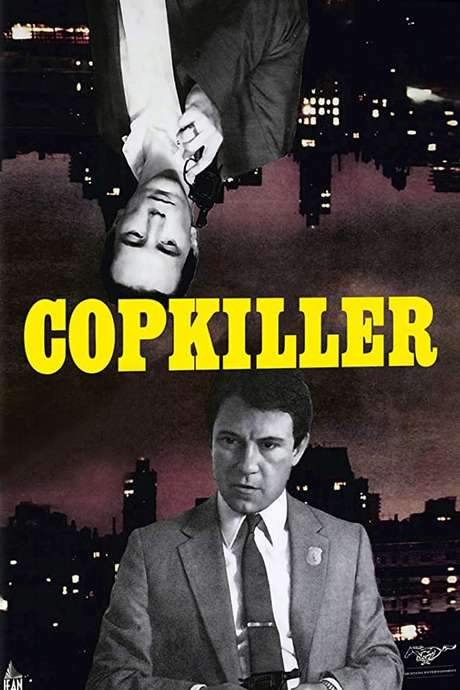
Lloyd Hopkins, [James Woods], is a troubled LAPD detective with a high arrest record and a reputation for bending the rules. When a tip leads him to a murder scene at a provided address, he starts gathering evidence on his own, bypassing the usual chain of command and alerting no one above him. He returns home to a tense moment with his wife, and a growing worry about the impact of his work on their eight-year-old daughter, Jen Hopkins, [Jan McGill], who watches from the doorway. The strain of his job bleeds into his private life, and the drama expands as he drags Dutch Peltz, [Charles Durning], his partner, into a stakeout that will push Hopkins to the edge. The stakeout ends with Hopkins shooting and killing the suspect, after which he flirts with the suspect’s date and imposes control over the scene by asking Dutch to stay and handle the aftermath while he drives the woman home.
Hopkins’ hunt then widens as he tracks down Joanie Pratt, [Randi Brooks], an actress-turned-drug dealer and escort, through classified ads found at the victim’s apartment. They meet in a cafe, where Pratt offers information that could crack the case. Back at the station, Hopkins discovers a poem written in blood on the victim— a chilling clue that suggests a killer who has struck before. When he returns home, he finds a farewell note from his wife, who has left with their daughter, a moment that deepens the sense of loss and isolation surrounding Hopkins.
Pratt calls Hopkins, initiating another dangerous encounter. He goes to her place for a discreet tryst, unaware that someone is watching the exchange. The investigation then broadens to a trove of cold-case murder files, and Hopkins brings Deputy Sheriff Delbert “Whitey” Haines, [Charles Haid], to a diner for a brusque, hard-edged interrogation about two suicides that occurred on the same date on Hopkins’s beat. Hopkins then breaks into Haines’s apartment and uncovers a wiretap that captures evidence of Haines dealing drugs, a revelation that ties into a larger web of crime and complicity.
Seeking more leads, Hopkins visits Kathleen McCarthy, [Lesley Ann Warren], who runs a feminist bookstore. She agrees to accompany him to a party at Dutch’s house, where a long, candid conversation unfolds. McCarthy reveals a painful high school memory: a group of boys hostile to her feminist poetry club sexually assaulted her. She also confides that an anonymous suitor has sent flowers and a poem to her every year. Hopkins, drawn into her past, discovers a photo in her yearbook of Whitey with a male prostitute nicknamed “Birdman,” [Dennis Stewart], a clue that begins to untangle the ties between Whitey and the city’s darker underbelly.
When Birdman turns up dead in a motel room, Hopkins finds a blood-written message at the scene that reinforces McCarthy’s account of a predatory system. He confronts Whitey again at his apartment, where Whitey claims Birdman was his snitch, but Hopkins exposes Whitey’s involvement with drugs and male prostitution via Birdman. A furious confrontation ends with Hopkins threatening Whitey and forcing a confession— a moment that culminates in Whitey’s feigned bathroom trip to retrieve a shotgun, only for Hopkins to be ready and kill him. Hopkins then learns, by way of a message on his home phone, that he has been suspended and is under Internal Affairs scrutiny.
Pratt contacts Hopkins again for another encounter, but when he arrives at her apartment, he finds her murdered and posed in the kitchen— a macabre setup connected to the earlier clues. At the police station, Hopkins and Dutch press Kathleen McCarthy to cross-reference suspects using the yearbook, but they’re interrupted by their captain, who reminds Hopkins of his suspension and orders him to leave. Returning to the interrogation room, Hopkins finds McCarthy has slipped away to a phone booth across the street. She calls Bobby Franco, [Steven Lambert], another member of her high school poetry club, to warn him that Hopkins might target him, and Franco reveals that he is indeed the killer.
The confrontation moves to the high school gym, where Franco lures Hopkins into a deadly shootout. In a tense, brutal turn, Hopkins overpowers Franco and disarms him, but Franco taunts him about the law and his duty as a cop. Hopkins delivers a chilling response that flips the power: "Well, there’s some good news, and there’s some bad news. The good news is, you’re right; I’m a cop, and I gotta take you in." Franco smirks, thinking he’ll be arrested, but Hopkins interrupts with the devastating admission, "The bad news is, I’ve been suspended, and I don’t give a fuck," and fires. The killer falls offscreen as Hopkins cocks his shotgun, and the screen fades to black, leaving the aftermath and justice unresolved in a stark, unresolved finale.
Throughout the unraveling, key figures step in and out of Hopkins’s investigation, each tied to a different thread of the case: Amy Cranfield, [Annie McEnroe], whose role adds texture to Hopkins’s world; Captain Frederick W. Gaffney, [Raymond J. Barry], who oversees the department’s response to Hopkins’s methods; Joanie Pratt, whom Hopkins believes he can guide away from danger even as she remains a volatile link to the case; Birdman, [Dennis Stewart], whose relationship to Whitey and the yearbook becomes a catalyst for the entire investigation; and a cast of others— including Detective, [Scott Sandler], and Detective (uncredited) [Jules Dean]— who populate the city’s darker corners and feed Hopkins’s relentless pursuit of truth, no matter the cost. The film drapes the city in a moral gray, showing a veteran cop’s willingness to bend rules in pursuit of what he believes is justice, all while the personal toll on his family and his own career spirals toward a definitive, if brutal, ending.
> Well, there's some good news, and there's some bad news. The good news is, you're right; I'm a cop, and I gotta take you in. The bad news is, I've been suspended, and I don't give a fuck.