Plot Explained Spoilers guaranteed!
Plot Explained

Browse by genre

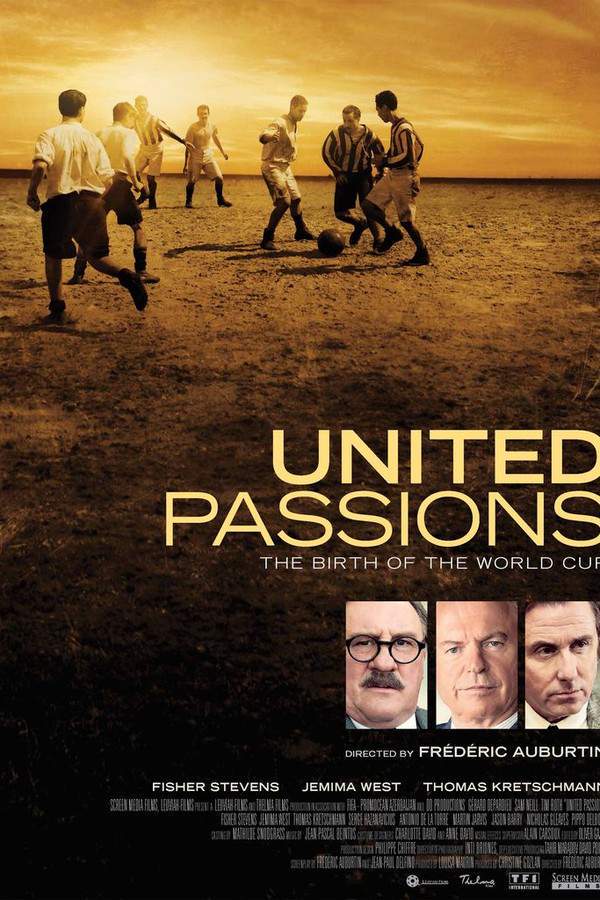
United Passions (2015) movie poster

Plot Summary

United Passions (2015) Plot Summary Explained

Release, runtime and language
2015 · 110 min · English
JustWatch #28,703 3
Directed by
Frédéric Auburtin

Driven by a shared passion, three influential figures – Jules Rimet, João Havelange, and Sepp Blatter – work tirelessly to establish the first FIFA World Cup. Facing internal conflicts and political obstacles, they navigate complex challenges as they strive to unite the world through the beautiful game and realize their ambitious vision for international football.

On this page (6)
  1. 1 Where to watch
  2. 2 What happens: full plot
  3. 3 Plot questions answered
  4. 4 Movie threads
  5. 5 Movies like United Passions
  6. 6 Every angle

Where to watch

Where to Watch United Passions (2015)

Where can you watch United Passions? Stream, rent or buy it in the US, including on fuboTV, Fawesome and The CW: current JustWatch availability with up-to-date prices.

Streaming availability powered by JustWatch

Full plot summary · contains spoilers

What Happens in United Passions: Full Plot Summary

The whole story of United Passions (2015) explained, from the opening scene to the final frame: every key event, every twist and what it all adds up to. Read it as a quick recap before the sequel, to check a scene you missed, or to finally understand what really happened.

As the 20th century dawns, Robert Guérin (the pivotal force behind FIFA, both then and now) boldly confronts the English football federation's refusal to join an international governing body for the sport. With an unwavering spirit, he establishes FIFA and takes on the role of its first president in 1905. Fast-forwarding to the mid-1920s, Jules Rimet (serving as FIFA's second-in-command during this time) faces a significant hurdle: despite Uruguay's triumphant win at the 1924 Summer Olympic football games, his attempts to publicly disparage their success backfire, leaving the media in the dark about FIFA's existence. Undaunted, Rimet realizes the only way to increase the organization's visibility is to create a truly international tournament—an event that would transform the landscape of football forever: the World Cup.

Years of relentless dedication follow, with Rimet steering the ship until an unexpected letter from Enrique Buero arrives, offering a vital source of financial backing. This fortuitous support enables FIFA to finally host its first World Cup in 1930, which Uruguay ultimately claims as their own. As time progresses, Rimet navigates the Great Depression, the ominous specter of war, and internal turmoil within FIFA, successfully organizing the 1938 World Cup before the devastation of World War II derails his plans for tournaments in 1942 and 1946.

In the aftermath of the war, Rimet regains traction, orchestrating two additional World Cups in 1950 and 1954. As FIFA begins to thrive with the addition of new members worldwide, a new chapter unfolds in the organization’s history. Enter João Havelange, who takes the presidency of FIFA, utilizing modern lobbying tactics and a flair for extravagant travel to secure his position. Faced with a daunting financial crisis, Havelange diligently pursues sponsorship opportunities to stabilize operations. Throughout this journey, he is closely supported by Sepp Blatter, who earns recognition as Havelange's reliable right-hand man—a legacy that eventually positions Blatter for the presidency of FIFA.

Yet, the once-mighty organization begins to show signs of decay due to corruption, a problem that has been lingering since Havelange's expansionist reign. With Blatter now leading, he faces the Herculean task of ridding FIFA of this corruption, a challenge that brings him both acclaim and criticism. Known as a staunch defender against corrupt practices, many officials within FIFA conspire against Blatter in an effort to unseat him.

Unmoved by these conspiracies, Blatter executes a brilliant maneuver in 2006, threatening to expose the sordid dealings of those who plot against him. The corrupt factions within FIFA concede, forced to align themselves with Blatter’s presidency if they wish to escape accountability for their past misdeeds.

Ultimately, this resolute leader emerges victorious, with his legacy solidified by the announcement of South Africa as the host for the 2010 World Cup—a symbol of optimism that glimmers brightly amid the shadows of a sport tainted by corruption.
Last updated: November 19, 2024 at 12:31

Was this helpful?

Plot questions answered

United Passions Plot Explained: Your Questions Answered

The questions people ask most about United Passions (2015): what happens in the confusing scenes, why the characters do what they do, the twists, hidden details and what the ending means. Each answer contains spoilers.

Q1

Why did Robert Guérin establish FIFA?

Robert Guérin established FIFA in 1904 because he wanted to create an international governing body for football. He was motivated by his frustration with the English football federation's refusal to join such an organization, and he believed football needed a unified global structure to grow the sport internationally.

Foreshadowing: Guérin's vision for a global football organization would eventually lead to the creation of the World Cup decades later.

  • robert guérin
  • fifa
  • football governing body
  • founder
Q2

Why did Jules Rimet create the World Cup?

Jules Rimet created the World Cup after his attempt to downplay Uruguay's victory at the 1924 Summer Olympics backfired and left FIFA unrecognized by the media. He realized that only a truly international tournament could give FIFA the visibility and prominence it needed within the football world.

Foreshadowing: Rimet's vision for a global tournament was seeded by this early public relations failure.

  • jules rimet
  • world cup
  • fifa
  • tournament creation
  • 1924 olympics
Q3

How did Enrique Buero help make the first World Cup possible?

Enrique Buero provided crucial financial backing to FIFA through a letter offering vital funding. This financial support enabled FIFA to finally host its first World Cup in 1930 in Uruguay, which had otherwise seemed impossible due to funding constraints.

Foreshadowing: Buero's financial contribution directly enabled the first World Cup to take place.

  • enrique buero
  • financial backing
  • world cup 1930
  • funding
Q4

Why were the 1942 and 1946 World Cups cancelled?

The 1942 and 1946 World Cups were cancelled because World War II devastated Europe and global travel became impossible. The war disrupted FIFA's operations and made organizing an international tournament unfeasible, halting the growth the organization had achieved in the 1930s.

Foreshadowing: The war's impact on FIFA demonstrates how global conflicts can interrupt sporting institutions.

  • world war ii
  • 1942 world cup
  • 1946 world cup
  • cancelled tournament
Q5

How did João Havelange become FIFA president?

João Havelange became FIFA president by using modern lobbying tactics and extravagant travel to secure support among FIFA members. He took over when FIFA was thriving with new members worldwide and brought in substantial sponsorships to address a financial crisis the organization faced.

Foreshadowing: Havelange's expansionist approach would later contribute to corruption problems within FIFA.

  • joão havelange
  • fifa president
  • sponsorship
  • lobbying
Q6

Why did Sepp Blatter become FIFA president after Havelange?

Sepp Blatter became FIFA president because he had worked closely alongside Havelange throughout his tenure, serving as his reliable right-hand man. His capability and visibility during Havelange's presidency positioned him favorably for leadership when Havelange's era ended.

Foreshadowing: Blatter's rise set the stage for his controversial but dominant tenure.

  • sepp blatter
  • fifa president
  • joão havelange
  • succession
Q7

What corruption problems did FIFA face?

FIFA developed corruption issues beginning during João Havelange's expansionist reign as president. When Sepp Blatter took over, he faced the challenge of addressing this entrenched corruption, which had spread through various factions within the organization.

Foreshadowing: The corruption that took root under Havelange would become Blatter's biggest challenge.

  • fifa corruption
  • sepp blatter
  • joão havelange
  • scandal
Q8

What happened in 2006 with Sepp Blatter's威胁?

In 2006, Sepp Blatter threatened to expose the corrupt dealings of officials who were conspiring against him to unseat him as president. This bold move forced the corrupt factions to align with his presidency or face accountability for their past misdeeds, allowing him to maintain control of FIFA.

Foreshadowing: Blatter's willingness to use blackmail as a political tool secured his position but did not resolve FIFA's underlying issues.

  • 2006
  • sepp blatter
  • corruption
  • threat
  • conspiracy
Q9

Why was the 2010 World Cup in South Africa significant?

The 2010 World Cup in South Africa was significant because it represented hope and renewal for the sport, taking place in Africa for the first time. The announcement came at the end of Blatter's tenure and symbolized a positive moment amid the shadows of FIFA's corruption scandals.

Foreshadowing: The historic nature of hosting the World Cup in Africa was a major milestone for global football.

  • 2010 world cup
  • south africa
  • fifa
  • historic
  • africa

Movie threads

More Movies Like United Passions, by Mood & Story

Curated lists built around what makes United Passions tick: the same mood, the same kind of story or the same emotional payoff. Each list explains why these movies belong together.

Dramas about building organizations like United Passions

The ambitious and controversial journeys behind powerful global institutions. If you enjoyed United Passions and its story of building FIFA, explore movies like it that chronicle the ambitious and often controversial creation of powerful institutions. These similar historical dramas focus on visionary leaders, political obstacles, and the complex legacy of their world-changing work.

  • inspirational
  • dramatic
  • political
  • persevering
  • controversial
  • nostalgic
  • Tone: hopeful, dramatic, controversial
  • Pacing: variable, episodic
Why these movies?

The story pattern: Stories in this thread typically follow a chronological arc, starting with a bold vision and progressing through significant hurdles like financial crises, political opposition, and internal power struggles. The journey is one of determined perseverance, often culminating in a major success that is tempered by the ethical ambiguities of the path taken.
Why they belong together: These movies are grouped together because they share a specific focus on organizational creation, blending hopeful, inspirational narratives with the gritty realities of political maneuvering. They offer a similar mix of dramatic historical sweep and complex, sometimes controversial, character motivations.

Celebratory historical movies similar to United Passions

Officially sanctioned stories that celebrate achievement while glossing over complexity. Fans of United Passions looking for similar uplifting historical stories will find movies here that share its propagandistic tone. These films portray triumphant events and influential figures with a focus on celebration and legacy, often minimizing more complex or critical perspectives.

  • inspirational
  • nostalgic
  • celebratory
  • triumphant
  • simplistic
  • political
  • Tone: hopeful, celebratory, simplistic
  • Pacing: steady, narrative-driven
Why these movies?

The story pattern: The narrative pattern is one of overcoming adversity to achieve a grand, world-unifying goal. Conflict is presented as a necessary hurdle on the path to a glorious conclusion, with the ending reaffirming the positive impact and righteousness of the central institution or endeavor.

Why they belong together: These films share a unique and specific tone: they are hopeful, officially-sanctioned narratives that prioritize inspirational triumph over nuanced critique. They create a similar viewing experience by blending historical drama with a distinctively optimistic, and sometimes simplistic, perspective on complex events.

If you liked this

Movies Like United Passions

Similar movies to United Passions: the same genre, themes or kind of story. Each one comes with its own plot summary, timeline and ending explained.

Browse all movie summaries

Every angle

United Passions (2015) Explained: Plot, Timeline & Characters

Everything about United Passions in one place: what happens in the plot summary, the timeline in chronological order, the characters and meaning and a spoiler-free summary. What's After the Movie adds the cast, box office and post-credit scenes.

Coming soon on iOS and Android

The Plot Explained Movie Summary App

Plot summaries, endings explained and timelines on your phone. Catch up on any movie in minutes, save your favorites and never miss a twist again.

Be the first to know when we launch. Your email stays private, always.

Learn more about the app