Plot Explained Spoilers guaranteed!
Plot Explained

Browse by genre

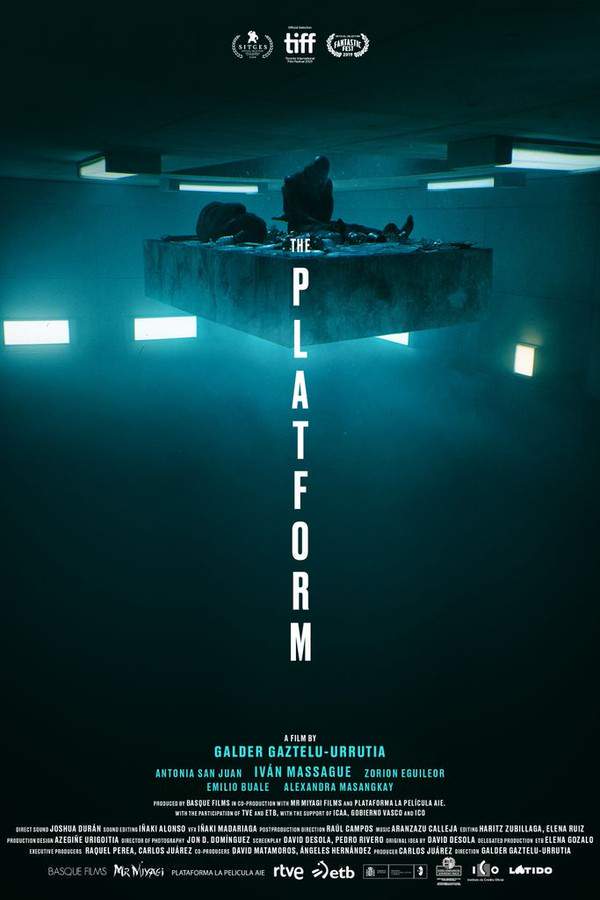
The Platform (2019) movie poster

Plot Summary

The Platform (2019) Plot Summary & Ending Explained

Release, runtime and language
2019 · 95 mins · Spanish
Echo score 70
Loading streaming availability…
Directed by
Galder Gaztelu-Urrutia
Starring
Eric Goode, Alexandra Masangkay, Algis Arlauskas, Antonia San Juan, Emilio Buale, Ivan Massagué
Budget
$1.2M

In a vertical prison, food is distributed from the top level down, representing a stark division between the privileged and the desperate. As the meals descend, those above consume generously, leaving the inmates below to face starvation and dwindling hope. A growing sense of injustice sparks a rebellion among the lower levels, challenging the established order and risking everything for a chance at survival. The system’s inherent inequalities lead to escalating conflict and a fight for basic sustenance.

On this page (7)
  1. 1 Where to watch
  2. 2 What happens: full plot
  3. 3 Plot questions answered
  4. 4 How it ends
  5. 5 Movie threads
  6. 6 Movies like The Platform
  7. 7 Every angle
Loading streaming availability…

Full plot summary · contains spoilers

What Happens in The Platform: Full Plot Summary

The whole story of The Platform (2019) explained, from the opening scene to the final frame: every key event, every twist and what it all adds up to. Read it as a quick recap before the sequel, to check a scene you missed, or to finally understand what really happened.

Perempuán awakens inside a brutal, vertical prison that stretches to 333 floors, with one cell per level and two inmates sharing each space, all centered around a hollow shaft. A platform laden with food descends this shaft daily, pausing at every floor for only two minutes. Those on higher levels get first access to the meals, while inmates on lower floors risk starvation as the platform passes. Before entering, every prisoner is interviewed and selects a daily dish that will be provided each day on their level, and each inmate is allowed to bring one personal item. At the end of each month, prisoners are randomly reassigned to new floors, keeping everyone guessing about who will be their neighbor next.

On level 24, Perempuán shares a cell with a large man named Zamiatin, named after Yevgeny Zamyatin. A Loyalist from the level above, Robespierre, explains the informal system that currently governs the prison. Two factions exist: Loyalists, who follow strict, self-imposed rules about eating only their chosen food (or trading only by consent), and Barbarians, who eat whatever they can grab. Robespierre argues that the Loyalist law ensures a fairer distribution of the food.

Tensions flare quickly when inmates from higher levels eat food meant for others, triggering violence, deaths, and injuries. Perempuán and Robespierre work to defend their level and keep order, while they learn about The Messiah, a mythical figure who is said to have survived a month without food through meditation and who sacrificed his own leg to feed others on the lowest levels. His followers, the Anointed Ones, spread his message of the Loyalist laws.

As days pass, Zamiatin and Perempuán grow closer, sharing food and personal stories. It is revealed that Perempuán entered the prison grieving after accidentally causing the death of her then-boyfriend’s son, while Zamiatin is a disillusioned mathematician. Zamiatin, in violation of the law, sometimes eats a portion of food from prisoners who have already died. Word of this spreads, and to protect Perempuán from punishment, the already ill Zamiatin sets himself on fire and leaps into the pit.

The following month, Perempuán is paired with Sahabat on level 51. They ride the platform down to punish two Barbarians who have eaten others’ food. In conversation with Sahabat that night, Perempuán learns of a particularly brutal Anointed One, Dagin Babi, who methodically kills both Barbarians and Loyalists who commit minor infractions. Sahabat plots to fake their deaths by consuming portions of an oil painting at a lower level, which contains a substance that will render them immune to the knockout gas used at the end of each month, with the aim of being disposed of outside the facility. When Dagin and his followers arrive to punish disobedience, they kill Sahabat and cut off one of Perempuán’s arms.

The next month, Perempuán awakens on level 72 with Trimagasi, Zorion Eguileor. Disillusioned with Loyalist ideals, she recruits a group of Barbarians, ostensibly to challenge the Loyalists but truly to find the painting. A bloody battle ensues, and Perempuán and Trimagasi emerge as the sole survivors.

Perempuán eventually locates the painting and consumes a portion of it. She passes out and later awakens on level 333, bundled among corpses being disposed of. Gravity seems suspended as workers in gas masks reset the prison. She spots a young boy and, choosing to save him, forgoes escape. She encounters other prisoners living on the lower level, implied to be a purgatory for dead souls, who urge her to return the boy to the upper levels while she remains below with them. In a poignant twist, Perempuán reunites with Goreng, Ivan Massagué, who is presumably her ex-boyfriend.

Last updated: October 01, 2025 at 13:04

Was this helpful?

Plot questions answered

The Platform Plot Explained: Your Questions Answered

The questions people ask most about The Platform (2019): what happens in the confusing scenes, why the characters do what they do, the twists, hidden details and what the ending means. Each answer contains spoilers.

Q1

Why does Zamiatin set himself on fire in The Platform?

Zamiatin deliberately sets himself on fire to protect Perempuán. He had been secretly eating portions of food from dead prisoners to survive, which violated the prison's strict Loyalist laws. When word of his rule-breaking spread, Zamiatin knew Perempuán would face punishment as his accomplice. Rather than letting her suffer, he chose to sacrifice himself dramatically by jumping into the central pit, ensuring she would be safe from retaliation while simultaneously challenging the system's cruel rules.

Foreshadowing: Earlier, Zamiatin had violated the Loyalist law by eating from dead prisoners' portions, establishing his willingness to break rules for survival.

  • zamiatin
  • self-immolation
  • sacrifice
  • protection
  • loyalist laws
  • perempuan
Q2

What is The Messiah in The Platform?

The Messiah is a legendary prisoner spoken of throughout the vertical prison. According to myth, this figure survived an entire month without eating any food through meditation alone, demonstrating extreme self-discipline. The Messiah reportedly sacrificed his own leg to feed starving inmates on the lowest levels. His followers, known as the Anointed Ones, use his story to justify the Loyalist faction's strict rules about only eating your chosen food. The myth serves as both a moral compass and a tool for those in power to control other prisoners.

Foreshadowing: The Anointed Ones repeatedly invoke The Messiah's example to enforce compliance with Loyalist laws, making him a central religious figure within the prison's social structure.

  • messiah
  • anointed ones
  • myth
  • loyalist
  • legend
  • sacrifice
Q3

Why does Perempuán eat the painting in The Platform?

Perempuán eats part of the famous oil painting because it contains a special substance that supposedly makes a person immune to the knockout gas used during the monthly prisoner reassignments. Sahabat had explained that prisoners who consume this substance can fake their deaths and be disposed of outside the facility, allowing them to escape. After recruiting Barbarians and surviving a violent battle, Perempuán locates the painting and consumes a portion of it, hoping this will enable her to leave the prison.

Foreshadowing: Sahabat had previously described the painting's properties and devised the escape plan, which Perempuán later adopts after becoming disillusioned with the Loyalist system.

  • painting
  • escape
  • poison
  • immunity
  • sahabat
  • gas
  • perempuan
Q4

What is Level 333 in The Platform?

Level 333 appears to be a liminal space representing purgatory within the prison's mythology. After Perempuán eats the painting and loses consciousness, she awakens on this bottom level where gravity seems suspended and workers in gas masks are resetting the prison. She encounters other prisoners who have died, suggesting this is a realm between life and death where souls wait. The residents urge her to return the living boy to the upper levels while she remains among the dead below, indicating Level 333 serves as a transitional afterlife space.

Foreshadowing: The monthly reset mechanism and the presence of dead bodies being processed foreshadow the revelation that Level 333 handles those who have perished in the prison.

  • level 333
  • purgatory
  • afterlife
  • death
  • ghosts
  • reset
  • bottom level
Q5

Who is the boy at the end of The Platform?

The boy Perempuán encounters on Level 333 appears to be a child who has died within the prison system, possibly representing innocence corrupted by the facility's brutal conditions. He wears a white outfit and seems unaware or untroubled by the purgatorial environment. When Perempuán finds him, she faces a choice between using him as her escape route or protecting him. She chooses to send the boy back up to the upper levels, sacrificing her own potential escape to give the child a chance at life above, suggesting an act of redemption and hope despite the bleak setting.

Foreshadowing: The boy's white clothing and innocent demeanor contrast sharply with the violent, desperate environment of the upper levels, marking him as symbolically significant.

  • boy
  • child
  • ending
  • hope
  • innocence
  • redemption
  • perempuan
Q6

What are the Loyalists and Barbarians in The Platform?

The Loyalists and Barbarians are the two main prisoner factions in the vertical prison. The Loyalists follow strict self-imposed rules: each prisoner eats only their pre-selected daily dish and trades food only with mutual consent. They believe this system ensures fairer distribution, though in practice it often benefits those on higher floors. The Barbarians reject these rules entirely and simply grab whatever food they can, consuming everything before descending to lower levels. Robespierre explains this informal system to Perempuán upon her arrival, and the tension between these factions drives much of the prison's violence.

Foreshadowing: Robespierre's explanation establishes that the Loyalist system, while seemingly orderly, cannot prevent the inevitable starvation of lower-level prisoners.

  • loyalists
  • barbarians
  • factions
  • rules
  • food system
  • robespierre
Q7

Why does Perempuán lose her arm in The Platform?

Perempuán loses her arm during a confrontation with Dagin Babi, a particularly brutal Anointed One who enforces Loyalist rules through extreme violence. Perempuán and Sahabat had plotted to fake their deaths using the painting's substance to escape the prison. When Dagin and his followers arrive to punish them for their disobedience, they kill Sahabat and sever one of Perempuán's arms as punishment for their attempted rebellion. This violent act demonstrates the extreme consequences of challenging the prison's established order and marks a turning point in Perempuán's character development.

Foreshadowing: Sahabat had warned Perempuán about Dagin Babi's reputation for killing both Barbarians and Loyalists who break minor rules, foreshadowing the brutal encounter.

  • perempuan
  • arm
  • amputation
  • dagin babi
  • violence
  • punishment
  • anointed ones
Q8

How does the monthly reassignment work in The Platform?

At the end of each month, all prisoners in the vertical prison are randomly reassigned to different floors, determining their new level and cellmate. This random distribution keeps everyone uncertain about their survival prospects, as higher floors mean better access to food while lower floors face starvation. The reassignment also uses knockout gas to sedate all inmates, allowing the system to reset without resistance. The randomness prevents prisoners from forming permanent alliances or planning long-term strategies, maintaining the chaotic survival dynamics that benefit the system itself.

Foreshadowing: The initial setup establishes that Perempuán and Zamiatin know they will be separated after month one, adding urgency to their relationship.

  • reassignment
  • monthly
  • levels
  • floors
  • random
  • knockout gas
  • reset
Q9

What does the ending of The Platform mean?

The ending of The Platform can be interpreted as Perempuán choosing redemption over personal survival. After reaching Level 333's purgatorial space, she encounters a living boy among the dead. Rather than using him as her ticket out, she sends him back up to the higher levels, symbolizing an act of selflessness and hope. She then reunites with Goreng, her ex-boyfriend, who is also among the dead. The ambiguous conclusion suggests that even in a brutal, exploitative system, small acts of mercy and connection can persist, though it remains unclear whether Perempuán's spirit finds peace or remains trapped in the cycle.

Foreshadowing: Perempuán's earlier guilt over accidentally killing her boyfriend's son frames her sacrifice as a potential path to atonement.

  • ending
  • interpretation
  • hope
  • redemption
  • goreng
  • reunion
  • afterlife
Q10

What does the vertical prison represent in The Platform?

The vertical prison functions as a stark social allegory representing class stratification and resource inequality. The descending food platform symbolizes how wealth and resources flow downward in society, with those at the top consuming greedily while those below face scarcity. The monthly random reassignment reflects how social mobility offers false hope without addressing systemic inequality. The two factions, Loyalists and Barbarians, represent different responses to injustice, one seeking order through rules, the other through chaos. The system perpetuates itself through violence and desperation, critiqueing how societies maintain hierarchies that ensure some must starve so others can feast.

Foreshadowing: The film's opening establishes the platform's daily descent as an unchangeable mechanical process, mirroring how systemic inequality operates automatically.

  • allegory
  • social commentary
  • class
  • inequality
  • metaphor
  • system
  • wealth distribution
Q11

Why is Perempuán in prison in The Platform?

Perempuán entered the vertical prison grieving and carrying deep guilt. Before her imprisonment, she accidentally caused the death of her then-boyfriend's son, a tragedy that haunts her throughout her time in the facility. This personal loss explains her emotional vulnerability and her eventual arc toward sacrifice and redemption. The prison system then compounds her trauma by placing her in life-or-death struggles monthly, forcing her to adapt or perish. Her backstory provides psychological depth to her character and motivates her ultimate choices in the ending.

Foreshadowing: Perempuán's guilt is revealed through conversations with Zamiatin, establishing her emotional motivation for later self-sacrifice.

  • perempuan
  • backstory
  • guilt
  • crime
  • accident
  • son
  • prison origin
Q12

Why does Perempuán stay on Level 333 instead of escaping?

Perempuán chooses to remain on Level 333 after encountering the boy because she decides protecting innocence matters more than her own freedom. Having already escaped the violent cycles of the upper levels, she recognizes the boy represents a chance for hope and renewal. By sending him upward, she acts selflessly, mirroring The Messiah's sacrifice. Additionally, her reunion with Goreng suggests she finds emotional resolution in staying rather than escaping alone. Her choice implies that connection and redemption outweigh survival in a meaningless system.

Foreshadowing: Perempuán's earlier grief over the child she accidentally killed sets up her willingness to save another child despite personal cost.

  • perempuan
  • stay
  • escape
  • sacrifice
  • boy
  • level 333
  • choice

Ending explained

What Happens at the End of The Platform?

How The Platform (2019) ends, in short: the final scene, the last twist and what it means for the characters. The full ending explained, with every spoiler, lives on its own page.

Read the full ending explained

The conclusion of The Platform centers on a desperate mission that transforms into a moment of profound revelation. After navigating the brutal hierarchy of the Vertical Self-Management Center, Goreng and his ally Baharat reach the bottom of the facility, Level 333. Their original goal was to enforce rationing among the inmates and preserve a single dish of food as a symbolic message to the administration above—a sign that the prisoners are capable of cooperation and self-restraint. However, the discovery of a young girl on this lowest level shatters their plan. Realizing that the administration has lied about children being in the facility, Goreng understands that this child is the true message. She represents innocence and the future, starkly contrasting with the savage gluttony and survivalism that defines the prison.

In the film's final moments, Goreng makes the critical decision to stay in the depths of the Pit while sending the girl back up on the platform. This choice is driven by heavy symbolic weight; having resorted to violence and cannibalism to survive, Goreng feels he has been irrevocably corrupted by the system. He is haunted by the apparition of his former cellmate, Trimigasi, representing the guilt and "demons" he has accumulated. By remaining below, Goreng accepts his fate as a permanent resident of this allegorical Hell, acknowledging that he cannot return to the "heaven" of Level 0. The ending underscores a powerful shift in the film's thematic arc: the "message" sent upward is not one of mere compliance or revolution, but a testament to the system's failure to protect the innocent. As the girl ascends toward the light, Goreng walks into the darkness with the ghosts of the Pit, signifying that for the corrupted old world to end, a sacrifice must be made so that the innocent future can rise.

The Platform ending explained in full

Movie threads

More Movies Like The Platform, by Mood & Story

Curated lists built around what makes The Platform tick: the same mood, the same kind of story or the same emotional payoff. Each list explains why these movies belong together.

Brutal Social Justice Thrillers like The Platform

Gripping stories that use extreme settings to critique systemic inequality. If you liked The Platform's sharp critique of class struggle, you'll find similar intensity in these movies. This list features dystopian and thriller films that use high-concept premises to explore systemic injustice, survival, and human nature under pressure, perfect for viewers seeking thought-provoking and dark allegories.

  • allegorical
  • oppressive
  • brutal
  • desperate
  • anxious
  • nihilistic
  • Tone: dark, critical, bleak
  • Pacing: steady, relentless
Why these movies?

The story pattern: Narratives in this thread typically establish a cruel, rule-bound system that pits characters against each other for basic resources or dignity. The plot revolves around a growing awareness of this injustice, often culminating in an attempt to challenge or overthrow the system, though success is often ambiguous or pyrrhic. Character journeys involve a loss of innocence and difficult moral compromises.

Why they belong together: These movies are grouped together because they share a core purpose: to serve as a visceral critique of society through a dark, high-intensity lens. They combine a thrilling, often claustrophobic plot with heavy themes of inequality, making the viewing experience both gripping and deeply unsettling.

Claustrophobic Survival Horror Movies like The Platform

Stories of desperate groups trapped in a deadly, enclosed space. Fans of The Platform's intense, confined setting will appreciate these movies. Discover similar stories of groups trapped in deadly environments, fighting for resources and sanity. These films share a high level of tension, bleak tone, and explore the darkest aspects of human nature under extreme pressure.

  • claustrophobic
  • desperate
  • brutal
  • anxious
  • oppressive
  • violent
  • Tone: dark, desperate, brutal
  • Pacing: steady, building dread
Why these movies?

The story pattern: The narrative pattern involves a group being trapped in an inescapable location with a limited resource (like food or time). The story charts the group's descent into chaos, as alliances form and shatter, hierarchies emerge, and primal instincts override morality. The plot is driven by the daily struggle to survive and the psychological unraveling of the characters.

Why they belong together: These films are united by their oppressive atmosphere and the central theme of survival within tight constraints. They deliver a consistent feeling of dread and desperation, focusing on the visceral, often brutal actions people take when pushed to their absolute limits in a closed ecosystem.

If you liked this

Movies Like The Platform

Similar movies to The Platform: the same genre, themes or kind of story. Each one comes with its own plot summary, timeline and ending explained.

Browse all movie summaries

Every angle

The Platform (2019) Explained: Plot, Ending, Timeline & Characters

Everything about The Platform in one place: what happens in the plot summary, the timeline in chronological order, the characters and meaning, the ending explained and a spoiler-free summary. What's After the Movie adds the cast, box office and post-credit scenes.

Coming soon on iOS and Android

The Plot Explained Movie Summary App

Plot summaries, endings explained and timelines on your phone. Catch up on any movie in minutes, save your favorites and never miss a twist again.

Be the first to know when we launch. Your email stays private, always.

Learn more about the app