Plot Explained Spoilers guaranteed!
Plot Explained

Browse by genre

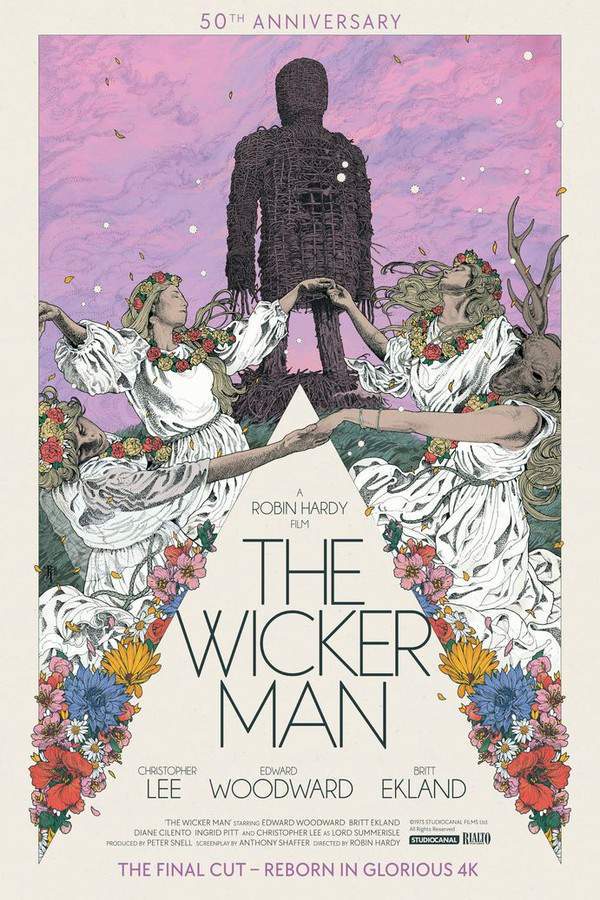
The Wicker Man (1974) movie poster

Plot Summary

The Wicker Man (1974) Plot Summary Explained

Release, runtime and language
1974 · 88 min
JustWatch #260 29
Directed by
Robin Hardy
Starring
Christopher Lee, Aubrey Morris, Edward Woodward, Britt Ekland, Diane Cilento, Ingrid Pitt

Sergeant Neil Howie travels to a remote Scottish island to investigate the disappearance of a young girl. What begins as a routine inquiry quickly spirals into a disturbing ordeal as he encounters a close-knit community with unsettling customs and beliefs. The villagers' strange behavior and cryptic rituals suggest a sinister secret, and Howie finds himself increasingly isolated and vulnerable as he seeks the truth behind the island's eerie atmosphere and the missing girl.

On this page (6)
  1. 1 Where to watch
  2. 2 What happens: full plot
  3. 3 Plot questions answered
  4. 4 Movie threads
  5. 5 Movies like The Wicker Man
  6. 6 Every angle

Where to watch

Where to Watch The Wicker Man (1974)

Where can you watch The Wicker Man? Stream, rent or buy it in the US, including on Amazon Prime Video, Philo and Fawesome: current JustWatch availability with up-to-date prices.

Streaming availability powered by JustWatch

Full plot summary · contains spoilers

What Happens in The Wicker Man: Full Plot Summary

The whole story of The Wicker Man (1974) explained, from the opening scene to the final frame: every key event, every twist and what it all adds up to. Read it as a quick recap before the sequel, to check a scene you missed, or to finally understand what really happened.

On April 29, Sergeant Neil Howie embarks on a journey via seaplane to the secluded and lush island of Summerisle in the Hebrides to look into the mysterious disappearance of a young girl, Rowan Morrison. This investigation is prompted by an anonymous letter that raises concerns. A pious Christian, Howie is unsettled to witness the residents honoring ancient pagan Celtic deities in a place where churches have become relics of the past. The island's inhabitants engage in open sexual practices in the fields, incorporate children in their May Day festivities, educate them about the phallic significance of the maypole, and bizarrely use toads in throat treatments. The islanders are evasive, asserting that Rowan is a figment of his imagination.

During his stay at the Green Man Inn, the landlord's daughter makes a bold pass at him, but Howie, determined to maintain his chastity until marriage, declines her advances. While inspecting a collection of photographs that commemorate the annual harvest, he is puzzled to find the latest image of the May Queen missing; the landlord casually explains it was broken. At the local school, his inquiries about Rowan yield denials from the children, yet his investigation leads him to discover her name in the school register. The schoolteacher eventually points him to her grave.

By April 30, Howie confronts the island's leader, Lord Summerisle, a descendant of a Victorian agronomist, seeking permission to exhume Rowan's grave. Summerisle reveals that his grandfather introduced fruit breeds suited for Scotland and cultivated a belief that reviving ancient gods would bring prosperity, which swayed the islanders away from Christianity. As a result, the population gradually adopted pagan practices, while ministers were driven back to the mainland.

Upon exhumation, Howie finds the coffin surprisingly empty except for a hare's remains. Additionally, he uncovers the missing harvest photograph showing Rowan surrounded by empty boxes, indicating a failed harvest. Through his findings, he realizes that a human sacrifice is performed to appease the gods whenever crops fail, leading him to deduce that Rowan is still alive and is destined for sacrifice to secure a bountiful harvest.

On May Day, desperate for help, Howie attempts to return to the mainland but discovers his seaplane inoperable and its radio damaged, rendering him stranded. During the festivities, Howie overpowers the innkeeper, disguises himself in a Punch costume, and merges into the May Day parade, eventually locating Rowan. After a tense moment where he frees her and they escape into a cave, they are intercepted by the islanders, who joyfully welcome Rowan back.

Lord Summerisle informs Howie that he is the true intended sacrifice, as he fulfills their gods' demands: arriving of his own volition, embodying the authority of a lawman, retaining his virginity, and being duped into their trap. Howie warns Summerisle that the failing crops indicate the villagers will turn against him and offer him as a sacrifice if the ensuing harvest does not prosper, but his warnings fall on deaf ears. In a tragic culmination, the villagers force Howie into a large wicker man alongside various animals, set it ablaze, and sing the ancient folk song "Sumer Is Icumen In." Trapped within, Howie recites Psalm 23, praying fervently as flames engulf him and the animals, ultimately claiming their lives as the wicker man’s structure succumbs to the fire, silhouetting the setting sun.
Last updated: November 08, 2024 at 02:01

Was this helpful?

Plot questions answered

The Wicker Man Plot Explained: Your Questions Answered

The questions people ask most about The Wicker Man (1974): what happens in the confusing scenes, why the characters do what they do, the twists, hidden details and what the ending means. Each answer contains spoilers.

Q1

Why does the innkeeper say Rowan doesn't exist when she's in the school register?

The islanders deliberately lie about Rowan to protect her from Howie. They need him to believe she is dead so he won't search for her before May Day. The school register proves she existed, but the villagers collectively deny her to maintain the deception. Lord Summerisle later explains that Rowan is alive and hidden until the sacrifice.
Foreshadowing: Earlier, Howie notices the most recent May Queen photograph is missing, hinting at a cover-up.

  • rowan morrison
  • summerisle
  • missing girl
  • deception
  • school register
Q2

Why is Sergeant Howie chosen as the sacrifice?

Howie fulfills four specific requirements: he arrived on the island voluntarily, he is a representative of authority as a police sergeant, he has maintained his virginity, and he was deceived into coming there. Lord Summerisle explains that a sacrifice must come of their own free will, possess authority, remain pure, and be lured by trickery. Howie fits all criteria perfectly.

Foreshadowing: The landlord's daughter attempts to seduce Howie at the inn, but he refuses, unknowingly preserving his virginity for the ritual.

  • sacrifice
  • lord summerisle
  • virginity
  • police sergeant
  • wicker man ritual
Q3

What does the empty grave with the hare mean?

The empty grave is a ritual deception. The coffin contains only a hare's remains, which serves as a symbolic placeholder. The hare represents the May Day sacrifice in previous years. By convincing Howie that Rowan is already dead, the islanders prevent him from searching for a living child and allow the planned sacrifice to proceed undisturbed.

Foreshadowing: The schoolteacher directs Howie to the grave, seemingly helpful but actually guiding him toward false evidence.

  • exhumation
  • hare
  • grave
  • ritual
  • deception
  • may day
Q4

Why does Lord Summerisle tell Howie he's the intended sacrifice?

Summerisle reveals the truth as part of the psychological manipulation. He wants Howie to understand his fate and accept it as part of the ritual. Additionally, Summerisle believes the ritual's power comes from the victim's awareness. The revelation also serves as a cruel twist - Howie realizes he has been the target all along, making his helplessness complete.

Foreshadowing: Throughout the film, Summerisle appears welcoming and philosophical, setting up the ironic reveal of his true intentions.

  • lord summerisle
  • revelation
  • psychological torture
  • acceptance
  • ritual
Q5

How does Howie figure out Rowan is still alive?

Howie connects several clues: the empty grave containing only a hare suggests a substitution ritual; the missing May Queen photograph shows Rowan surrounded by empty harvest boxes, indicating a failed crop. He realizes human sacrifices were performed when harvests failed, which means Rowan must be alive to serve as the next offering. The logic clicks when he understands the correlation between failed crops and required sacrifices.

Foreshadowing: The photograph showing empty boxes foreshadows the failed harvest and the need for a human sacrifice.

  • harvest failure
  • may queen
  • sacrifice
  • investigation
  • deduction
  • crops
Q6

Why are the crops failing on Summerisle?

The crops are failing naturally, which is why the islanders desperately need a human sacrifice. The missing harvest photograph showing empty boxes confirms a poor yield. This connects to their belief that appeasing the old gods with human sacrifice ensures prosperity. The failed harvest is the direct reason Rowan was chosen as the May Queen sacrifice.

Foreshadowing: Howie notices the harvest photographs earlier, showing the agricultural importance of the ritual.

  • failed harvest
  • crops
  • prosperity
  • pagan gods
  • sacrifice
  • agriculture
Q7

What was in the anonymous letter that brought Howie to Summerisle?

The anonymous letter raised concerns about a missing child on Summerisle. It prompted Howie, as a police sergeant, to investigate. However, the letter appears to have been a trap - likely orchestrated by Lord Summerisle - designed to lure a suitable sacrifice to the island. The writer knew a devout Christian policeman would feel compelled to investigate a missing child.

Foreshadowing: The entire investigation is revealed as a setup when Summerisle explains Howie came voluntarily, fulfilling the sacrifice requirement.

  • anonymous letter
  • missing girl
  • investigation
  • trap
  • lure
Q8

Why can't Howie leave the island on May Day?

Howie finds his seaplane sabotaged - the aircraft is inoperable and its radio is damaged. This is deliberately done by the islanders to strand him until the May Day ritual concludes. With no communication equipment and no other means of transportation, Howie is trapped on the island, forcing him to attempt rescue through direct action during the festival itself.

Foreshadowing: Earlier, Lord Summerisle shows hospitality but never offers any means of leaving, and the islanders remain evasive about travel.

  • escape attempt
  • seaplane
  • sabotage
  • trapped
  • may day festival
Q9

How did Summerisle's grandfather convert the island to paganism?

Lord Summerisle explains that his grandfather was a Victorian agronomist who introduced fruit breeds suited to Scotland's climate. He convinced the islanders that reviving ancient Celtic gods would bring prosperity. Over time, the population abandoned Christianity - the churches became relics - and returned to pagan practices. This generational shift created a community where human sacrifice for harvests is normalized.

Foreshadowing: The岛的 churches are described as having become relics, showing the complete transformation from Christianity to paganism.

  • lord summerisle
  • grandfather
  • victorian
  • paganism
  • conversion
  • celtic gods
Q10

What was the significance of the maypole and toad remedies shown early in the film?

These scenes establish the island's pagan worldview and sexual openness, contrasting sharply with Howie's Christian values. The children dance around the phallic maypole while being taught its reproductive significance, normalizing what Howie finds disturbing. The toad remedies - used for throat infections - are another ancient practice. Both elements foreshadow the film's theme of primal, pre-Christian traditions that view human sacrifice as natural.

Foreshadowing: The bizarre customs signal that the island operates under entirely different moral and spiritual rules than the mainland.

  • maypole
  • toads
  • pagan customs
  • sexual practices
  • foreshadowing
  • childhood education
Q11

What is the significance of Howie reciting Psalm 23 at the end?

Howie recites Psalm 23 ('The Lord is my shepherd') as he burns inside the wicker man, representing his final, desperate prayer for divine salvation that never arrives. This contrasts the Christian God's absence with the pagan gods' presence - the islanders' ritual works while Howie's faith fails him. The Psalm symbolizes his belief in a protective God who does not intervene, making his death both physically and spiritually harrowing.

Foreshadowing: Howie's unwavering Christian faith is established from the start, making his reliance on Psalm 23 in the final moments a thematic bookend.

  • psalm 23
  • prayer
  • christianity
  • burning
  • faith
  • final moments
  • wicker man
Q12

Why does Howie warn that the villagers will turn on Summerisle if the harvest fails?

Howie understands the villagers' mindset: they sacrificed Rowan (and previously others) expecting prosperity. If the crops still fail after the sacrifice, the logic demands someone must be blamed. Since Summerisle is the spiritual leader who guarantees the gods' favor, he becomes the logical scapegoat. This reveals Howie's awareness of the island's transactional view of sacrifice - it must 'work' or the supplier of failed magic faces consequences.

Foreshadowing: The entire premise of the island revolves around the belief that sacrifices produce results, setting up this logical warning.

  • harvest failure
  • blame
  • summerisle
  • villagers
  • consequence
  • sacrifice logic

Movie threads

More Movies Like The Wicker Man, by Mood & Story

Curated lists built around what makes The Wicker Man tick: the same mood, the same kind of story or the same emotional payoff. Each list explains why these movies belong together.

Movies about investigators uncovering dark secrets like The Wicker Man

An outsider discovers a community's dark secret, becoming trapped in its web. If you enjoyed the chilling investigation in The Wicker Man, you'll find similar tension in these films. This collection features movies where a lone outsider confronts a sinister community, blending mystery, thriller, and horror elements for a deeply unsettling experience.

  • claustrophobic
  • paranoid
  • sinister
  • unsettling
  • suspenseful
  • ritualistic
  • Tone: dark, tense, unsettling
  • Pacing: slow, deliberate build
Why these movies?

The story pattern: The narrative centers on an outsider entering a closed-off group to solve a case. As they dig deeper, cooperation turns to obstruction, and the investigation becomes a fight for survival against a unified, conspiratorial enemy. The plot often involves a ritualistic or ideological motive that the protagonist unknowingly threatens.

Why they belong together: This thread groups films that share the core conflict of an individual versus a hostile collective. They create a potent sense of isolation and paranoia, where the mystery unravels into a personal trap, emphasizing themes of belonging, faith, and the dark side of community.

Slow burn horror movies with ritualistic dread like The Wicker Man

A slow, oppressive build of tension culminating in a horrifying ritualistic conclusion. Fans of The Wicker Man's methodical buildup and pagan horror themes will appreciate these selections. These films prioritize a suffocating atmosphere and psychological tension, often exploring clashes of belief systems and culminating in shocking, ritualistic endings that leave a lasting impact.

  • eerie
  • oppressive
  • dreadful
  • pagan
  • ceremonial
  • bleak
  • Tone: dark, dreadful, bleak
  • Pacing: slow burn
Why these movies?

The story pattern: The narrative is a linear, downward spiral where a character is gradually exposed to increasingly disturbing customs. The audience often understands the horrifying destination before the protagonist does, making their journey a tragic march towards an inevitable, ritualistic sacrifice or ceremony.

Why they belong together: Movies are grouped here for their shared commitment to a slow-burn pace, a deeply oppressive and eerie atmosphere, and a thematic focus on ritual, sacrifice, and the power of belief. The viewing experience is defined by a feeling of inescapable doom.

If you liked this

Movies Like The Wicker Man

Similar movies to The Wicker Man: the same genre, themes or kind of story. Each one comes with its own plot summary, timeline and ending explained.

Browse all movie summaries

Every angle

The Wicker Man (1974) Explained: Plot, Timeline & Characters

Everything about The Wicker Man in one place: what happens in the plot summary, the timeline in chronological order, the characters and meaning and a spoiler-free summary. What's After the Movie adds the cast, box office and post-credit scenes.

Coming soon on iOS and Android

The Plot Explained Movie Summary App

Plot summaries, endings explained and timelines on your phone. Catch up on any movie in minutes, save your favorites and never miss a twist again.

Be the first to know when we launch. Your email stays private, always.

Learn more about the app