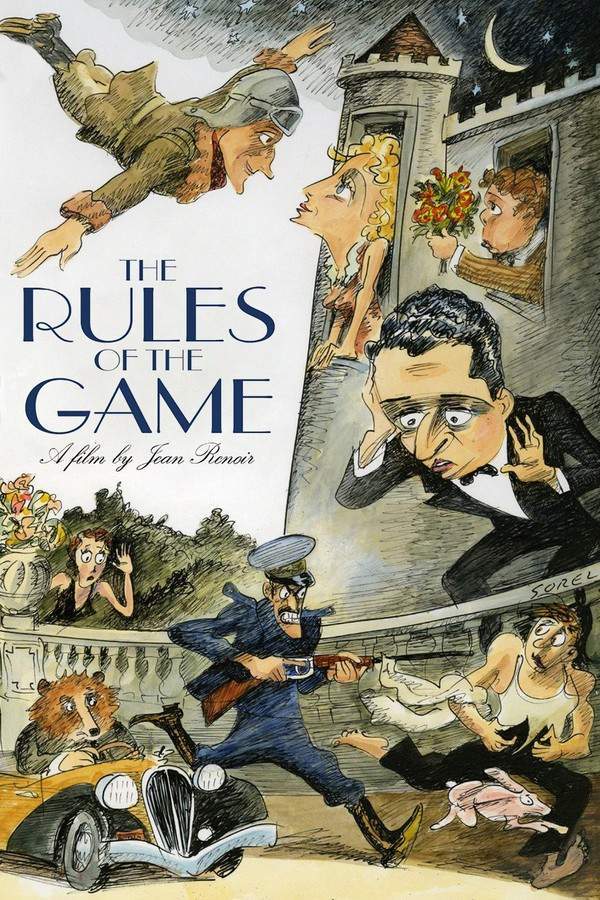
During a weekend hunting party, a group of wealthy Parisians finds their lives and relationships exposed as societal facades begin to fall away. Hidden desires and romantic entanglements surface, threatening to unravel the carefully constructed order of their privileged world. As the lines between the upper class and the servants become increasingly blurred, a web of secrets and deception leads to unexpected and dramatic consequences for everyone involved.
Find where to stream, rent, or buy The Rules of the Game (1950) in the US with current JustWatch availability, up-to-date pricing, and platform listings for subscription, rental, and digital purchase options.
Warning: spoilers below!
Haven’t seen The Rules of the Game yet? This summary contains major spoilers. Bookmark the page, watch the movie, and come back for the full breakdown. If you're ready, scroll on and relive the story!
Trace every key event in The Rules of the Game (1950) with our detailed, chronological timeline. Perfect for unpacking nonlinear stories, spotting hidden connections, and understanding how each scene builds toward the film’s climax. Whether you're revisiting or decoding for the first time, this timeline gives you the full picture.
Last updated: November 22, 2024 at 19:06
Find frequently asked questions about the The Rules of the Game (1950) timeline, including chronological order, nonlinear jumps, cause-and-effect links, and scene sequence clarifications. This timeline FAQ helps explain when key events happen, how moments connect, and why the story unfolds in that specific order.
Octave knows that André is deeply in love with Christine, who is married to Robert. Hoping to bring the former lovers together for a weekend escape, Octave persuades Robert to invite André to the estate. This seemingly generous act is actually a scheme to reunite André and Christine, though Robert is unaware of Octave's true motives.
Earlier scenes establish André's unrequited love for Christine through his emotional radio broadcast.
After discovering Marceau attempting to steal from the estate, Robert surprisingly decides to hire him. Robert recognizes value in Marceau's skills as a poacher and believes he can use the man's abilities to his advantage. This decision creates tension with Schumacher, the gamekeeper, who wanted Marceau punished.
Early tension is established between Schumacher and Marceau over the rabbits on the estate.
Octave lends André his overcoat so André can disguise himself while sneaking to the greenhouse to meet Christine. Lisette had asked Octave not to abandon her for Christine, and Octave, honoring André's concerns, sends André instead while he stays behind. This exchange of clothing becomes crucial to the tragic misunderstanding.
Earlier, Octave confesses his feelings for Christine in the greenhouse, creating jealousy and confusion.
Schumacher sees a man wearing a coat in the dark and, fueled by jealousy over Lisette, believes the figure is a rival pursuing her. The confusion stems from earlier misunderstandings: Schumacher and Marceau had mistakenly identified Christine (wearing Lisette's cloak) as Lisette herself during a compromising moment. When André appears in Octave's coat, Schumacher again misidentifies him, triggering his violent jealousy.
The mistaken identity of Christine wearing Lisette's cloak earlier sets up Schumacher's fatal error.
Robert maintains that the shooting will be described as an unfortunate accident to preserve the social facade of his household. Throughout the film, Robert is obsessed with maintaining order and appearances among the elite guests. Covering up the tragic truth protects the reputation of his circle and prevents scandal, reflecting the film's critique of upper-class hypocrisy.
Robert's preoccupation with maintaining order and his role as host who manages everyone below him is established from the start.
Christine borrows Lisette's cloak during the chaotic events of the masked ball. This seemingly minor detail becomes critical when Schumacher and Marceau mistake Christine for Lisette, sparking the chain of events that leads to tragedy. The cloaked figure they encounter contributes to the fatal misunderstanding.
During the masked ball, Christine and André plan their escape, and the swapping of clothing becomes part of their clandestine meeting.
André is shot by Schumacher, who mistakes him for a rival suitor due to the dark and the borrowed coat. The shooting occurs as André approaches the greenhouse to meet Christine. His death is then covered up by Robert as an accident, maintaining the facade of the weekend's orderly conclusion.
André's desperate attempt to reach Christine, combined with Schumacher's jealousy and the clothing mix-up, creates the fatal collision.
Octave and Marceau slip away into the night following the chaos of the shooting. Octave's departure represents his inability to face the consequences of the weekend's events and his complicity in the tragic chain of events. He had orchestrated the reunion, confessed his love to Christine, and sent André to his fate, all contributing to his decision to flee.
Octave's earlier confession in the greenhouse and his role in sending André to meet Christine directly link to his guilt and departure.
Geneviève, Robert's mistress, remains at the estate even after realizing Robert's interest in her is waning. Christine encourages her to stay, perhaps to maintain the complex social dynamics or prevent Geneviève from leaving Robert entirely. The decision reflects the tangled web of relationships and the characters' willingness to endure emotional discomfort rather than disrupt the social order.
Geneviève's awareness of Robert's waning affection is established early, creating tension in her relationship with him.
Robert is unaware that Octave's invitation scheme is designed to unite André and Christine. Robert believes he is simply being hospitable to a friend. His ignorance about the romantic plot allows the dangerous reunion to proceed, setting in motion the weekend's tragic events. Robert's blindness to the scheme reflects his confidence in his marriage and social position.
Robert's character is established as someone who manages situations and believes he maintains control over his household.
Discover curated groups of movies connected by mood, themes, and story style. Browse collections built around emotion, atmosphere, and narrative focus to easily find films that match what you feel like watching right now.
Witty and melancholic tales dissecting the social rituals of the upper class.If you enjoyed the sharp social critique and intricate character web of The Rules of the Game, explore more movies that delve into the sophisticated, often melancholic world of the elite. These films share a similar focus on societal facades, romantic entanglements, and the satirical unraveling of privileged lives.
These narratives typically unfold in a confined setting, such as a country estate or a weekend gathering, where a large ensemble cast navigates a series of romantic misunderstandings, infidelities, and class tensions. The plot is driven by dialogue and character interaction rather than external action, building steadily towards a climax that exposes the fragility of their social world.
They are grouped together for their shared tone of sophisticated melancholy, their complex, multi-character plots, and their primary focus on satirizing social conventions and the intricate dance of manners within a specific, often insulated, class of society.
Stories where the lives of masters and servants intertwine with dramatic consequences.Fans of The Rules of the Game will appreciate these movies that mirror its exploration of class dynamics. Discover similar stories where the intimate dramas of the upper class are reflected and complicated by the lives of the servants, leading to tension, deception, and poignant cross-class connections.
The narrative structure often cuts between the 'upstairs' world of the owners and the 'downstairs' world of the staff, showing how their lives are mirrored and intertwined. Romantic entanglements frequently cross class boundaries, and secrets known to the servants can dramatically impact the fate of their masters, creating a rich tapestry of interconnected drama.
These films share a central thematic focus on class division and the complex, often hidden relationships between different social strata. They create a specific mood of reflective tension and claustrophobia, set within the microcosm of a single household or estate.
Don't stop at just watching - explore The Rules of the Game in full detail. From the complete plot summary and scene-by-scene timeline to character breakdowns, thematic analysis, and a deep dive into the ending - every page helps you truly understand what The Rules of the Game is all about. Plus, discover what's next after the movie.
Read a complete plot summary of The Rules of the Game, including all key story points, character arcs, and turning points. This in-depth recap is ideal for understanding the narrative structure or reviewing what happened in the movie.
Discover the characters, locations, and core themes that shape The Rules of the Game. Get insights into symbolic elements, setting significance, and deeper narrative meaning - ideal for thematic analysis and movie breakdowns.