Plot Explained Spoilers guaranteed!
Plot Explained

Browse by genre

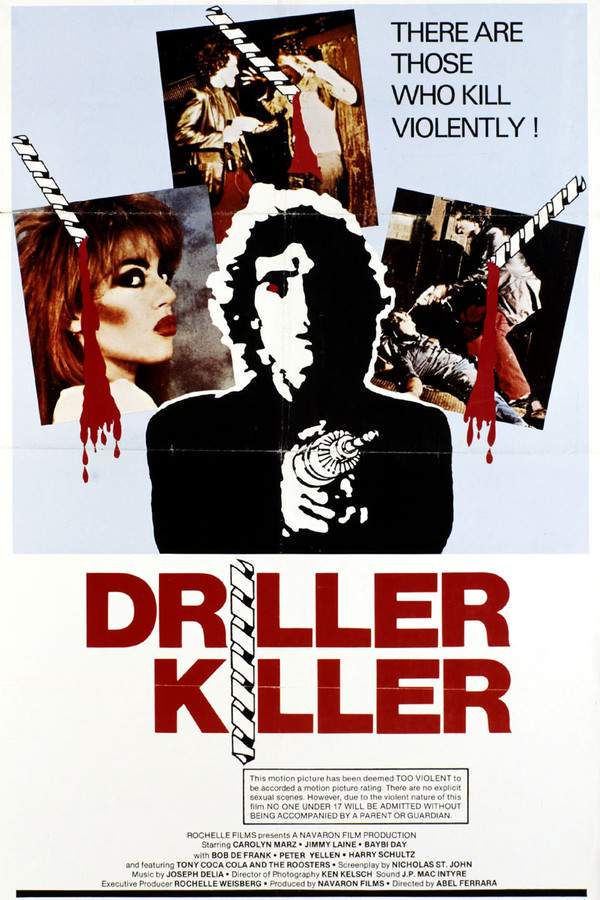
The Driller Killer (1979) movie poster

Timeline

The Driller Killer (1979) Timeline Explained – Every Event in Order

Release, runtime and language
1979 · 96 min · English
Loading streaming availability…
Directed by
Abel Ferrara
Starring
Alan Wynroth, Baybi Day, Carolyn Marz, Harry Schultz, James O'Hara, Louis Mascolo

A struggling artist's mounting frustrations lead him down a dark path, culminating in violent acts against the city's homeless population. Consumed by rage, he uses a power drill as his weapon of choice. The film explores the descent of Jimmy Laine, portraying a cautionary tale of anger and its devastating consequences. His intense performance highlights the fragility of the human psyche when pushed to its breaking point.

On this page (6)
  1. 1 Where to watch
  2. 2 Events in order (15)
  3. 3 Timeline questions answered
  4. 4 Movie threads
  5. 5 Movies like The Driller Killer
  6. 6 Every angle
Loading streaming availability…

15 events in order · contains spoilers

The Driller Killer Timeline: Events in Chronological Order

Every key event of The Driller Killer (1979) in order, scene by scene, with when and where it takes place. Use it to untangle flashbacks, time jumps and parallel storylines, to refresh your memory before the sequel or to find the exact scene you are thinking of.

  1. Reno's Encounter at the Church

    In a small Catholic church located in Spanish Harlem, Reno Miller finds himself face to face with an elderly man who is muttering, 'pity the sinners.' This shocking moment reveals the man to be his long-lost father, now a derelict, triggering a whirlwind of conflicting emotions within Reno.

    Where
    Spanish Harlem
  2. Reno Flees from His Father

    Overwhelmed by the unexpected encounter and the state of his father, Reno flees the church. He confides in his girlfriend Carol, labeling his father as a degenerate and a bum, illustrating his internal struggle and fear of becoming like him.

  3. Picking Up Pamela

    Reno and Carol decide to pick up their roommate Pamela from a local bar. Pamela, deeply engrossed in the punk rock scene, adds another layer of complexity to their turbulent living situation.

    Where
    Union Square
  4. Tensions in the Apartment

    The trio's dynamics become strained as Reno vents his frustrations about their financial struggles. In a moment of anger, he impulsively throws their phone out of the window, symbolizing his overwhelming feelings of helplessness and frustration.

    Where
    Union Square
  5. Dreams Haunting Reno

    Haunted by dreams of his father and the pervasive sound of a power drill, Reno's psychological state deteriorates. The presence of homeless individuals continues to trouble him, serving as a constant reminder of the life he fears.

  6. Seeking Help from Dalton

    Desperate for money, Reno approaches Dalton, the flamboyant art gallery owner, hoping to get a loan. However, Dalton turns him down, citing too many past favors, further pushing Reno into a corner.

  7. Carol's Deceit

    In a bid to manage their worsening situation, Carol concocts a story and writes a check to their landlord. Despite her efforts, the financial strain remains, highlighting the dire circumstances they are facing.

  8. Disruption from Tony's Band

    Reno struggles to focus on his painting of a buffalo as the noise from Tony Coca-Cola's punk band becomes increasingly disruptive. The chaos serves as a metaphor for the turmoil within Reno's mind as he attempts to create art amidst madness.

  9. The Bizarre Encounter

    In a moment of unhinged contemplation, Reno has a strange encounter with a homeless man. This bizarre interaction deepens his resolve not to end up like his father, but it also marks the beginning of his spiraling obsession with his artistic vision.

  10. Carol Receives a Letter

    Carol's receipt of a letter and cash from her ex-husband intensifies the existing tensions between her and Reno. The arrival of this uninvited communication complicates their already fragile relationship, adding to the brewing chaos.

  11. Reno's Descent into Madness

    As Reno's nights blend into chaos, his aspirations spiral into darkness. Consumed by his inner demons, he becomes increasingly obsessed with his work and art, leading to disturbing changes in his psyche.

  12. The Night of Violence

    On a fateful night encapsulated by his mounting obsessions, Reno arms himself with a power drill and goes on a frenzied spree, taking the lives of several homeless individuals. This brutal act signals his complete descent into madness.

  13. Betrayal and Terror

    Reno's relationships begin to collapse due to his increasingly erratic behavior. After inviting Dalton under false pretenses, the culmination of Reno's insanity gives rise to a horrific act of violence, betraying all those he once cared about.

  14. Carol's Uncertain Fate

    Reno's mental unraveling leads to a shocking conclusion with Carol falling into a trap set by Reno. Her fate becomes bleak and uncertain, encapsulating the dire consequences of betrayal and madness in their turbulent lives.

  15. Exploring Urban Life's Dark Themes

    The story delves into the dark underbelly of urban life, portraying the fragility of human relationships amidst despair. It serves as a cautionary tale about the consequences of past decisions and the thin line between sanity and madness.

Last updated: October 25, 2024 at 10:44

Was this helpful?

Timeline questions answered

The Driller Killer Timeline Explained: Your Questions Answered

When does it happen, and why in that order? The questions people ask about the chronology of The Driller Killer (1979): time jumps, flashbacks, cause and effect between scenes and the correct order of events, each answered with spoilers.

Q1

Why does Reno start killing homeless people?

Reno's violence stems from a combination of factors: his traumatic encounter with his derelict father in the church triggers a deep fear of becoming like him, his financial desperation and artistic frustration reach breaking point, and his mounting obsession with his buffalo painting consumes his mental state. The homeless people around him become projections of his worst fear, ending up like his father, which, combined with his psychological deterioration, leads him to attack them as twisted art. The power drill itself represents both his artistic tool and his method of asserting control over what he perceives as a world closing in on him.

Foreshadowing: Earlier scenes show Reno's growing distress at the sight of homeless individuals, and his recurring dreams of the power drill hint at the violent method he will eventually use.

  • Reno Miller
  • homeless killings
  • power drill
  • psychological breakdown
  • art obsession
Q2

What causes Reno Miller's mental breakdown?

Reno's breakdown is triggered by a cumulative series of stressors rather than a single event. The devastating discovery of his father as a derelict shakes his identity, while constant financial pressure from unpaid bills creates desperation. The rejection from Dalton removes his final lifeline, and Tony Coca-Cola's disruptive punk band prevents him from completing his buffalo painting, the one thing he believes could validate his worth as an artist. These pressures compound until his grip on reality slips, and he descends into violent psychosis.

Foreshadowing: Reno's dreams featuring his father and the power drill, along with his increasingly erratic behavior, signal his psychological deterioration before the violence begins.

  • Reno Miller
  • mental breakdown
  • psychological deterioration
  • financial stress
  • artistic frustration
Q3

Why does Reno run away from his father at the church?

Reno flees because he is overwhelmed by the shock of seeing his father reduced to such a deplorable state, a derelict muttering in a Spanish Harlem church. Rather than confronting this painful reality, Reno retreats into denial, dismissing his father as a "degenerate" and a "bum" when telling Carol about the encounter. His flight represents his inability to face the possibility that he too could fall into poverty and insignificance, which later becomes his greatest fear as he fights to maintain his artistic identity.

Foreshadowing: This early rejection of his father sets up the psychological dynamic that drives Reno's violent actions, he is desperately trying to prove he is nothing like his father.

  • Reno father
  • church Spanish Harlem
  • family trauma
  • denial
Q4

Why does Dalton refuse to give Reno a loan?

Dalton refuses Reno's request for a loan because he explains he has already helped Reno too many times in the past. This rejection represents the collapse of Reno's final support system outside his immediate circle, pushing him further into desperation. The refusal also underscores the film's theme of urban alienation, even those in the art world who might understand Reno's struggles ultimately abandon him when his usefulness or reliability runs out.

Foreshadowing: Dalton's earlier patronage of Reno is established, making his refusal more impactful as a turning point in Reno's decline.

  • Dalton
  • art gallery
  • loan rejection
  • financial desperation
Q5

What happens to Carol at the end of the film?

At the film's conclusion, Carol falls into a trap set by Reno, leaving her fate bleak and uncertain. After Reno's relationships have crumbled due to his escalating violence and madness, he lures Carol under false pretenses, similar to how he previously lured Dalton. The ending confirms the complete absence of hope or redemption, with Carol's uncertain fate representing the final devastation wrought by Reno's complete psychological collapse.

Foreshadowing: The deterioration of Reno and Carol's relationship throughout the film, along with Reno's pattern of betraying those close to him, foreshadows this tragic conclusion.

  • Carol
  • ending
  • trap
  • betrayal
  • fate
Q6

What does the power drill represent in the film?

The power drill serves as a dual symbol, both representing Reno's identity as an artist and his descent into violent destruction. Initially, it's his tool for creating art, but as his mind unravels, it becomes his weapon for exerting control and asserting dominance over the homeless people he sees as reminders of his worst fear. The drill also appears in his recurring dreams alongside his father, suggesting it was always linked to his deepest anxieties about becoming like his father. Ultimately, it embodies the corruption of his artistic vision into something violent and destructive.

Foreshadowing: Reno is haunted by dreams of the power drill sound before he ever uses it, indicating it was already symbolically present in his psyche.

  • power drill
  • symbol
  • weapon
  • art tool
  • psychological symbolism
Q7

Why does Reno kill Dalton?

Reno kills Dalton after a failed attempt to have his work validated, which pushes him further into despair and rage. Inviting Dalton under false pretenses, Reno's insanity culminates in a horrific act of violence that betrays the one person from the art world who had previously supported him. This murder represents the complete collapse of Reno's identity as an artist, rather than seeking genuine connection or validation, he destroys the very figure who could have provided it, turning his artistic frustration into final, irreversible violence.

Foreshadowing: Dalton's refusal of Reno's loan request and the failed art validation attempt build toward this violent confrontation.

  • Dalton
  • murder
  • art validation
  • betrayal
  • violence
Q8

Why does Carol get money from her ex-husband?

Carol receives a letter and cash from her ex-husband, which intensifies the tension between her and Reno. This development complicates their already fragile relationship by introducing external financial support from a past romantic entanglement. The money represents both practical survival and emotional complexity, it suggests Carol has other options outside her current life with Reno, which likely makes Reno feel even more inadequate and desperate as he struggles to provide for their household.

Foreshadowing: This event adds another layer of financial and emotional strain that contributes to the growing tension in the apartment.

  • Carol
  • ex-husband
  • money
  • tension
  • relationship
Q9

What is the significance of Reno's buffalo painting?

Reno's buffalo painting represents his last hope for artistic validation and personal identity. He struggles to complete this painting throughout the film while dealing with constant interruptions from Tony Coca-Cola's punk band. The buffalo can be interpreted as a symbol of freedom, wildness, or perhaps his own feeling of being trapped and caged in his urban existence. His inability to finish it, despite it being his anticipated masterpiece, mirrors his broader failure to achieve his artistic dreams and contributes to his psychological collapse.

Foreshadowing: The painting is introduced early as Reno's primary creative focus, making its incompletion increasingly frustrating as the story progresses.

  • buffalo painting
  • art
  • Tony Coca-Cola
  • creative frustration
  • artistic identity
Q10

Why does Reno fixate on homeless people as targets?

Reno fixates on homeless people because they represent his worst fear: ending up like his derelict father who he encountered in the church. The homeless population becomes a physical manifestation of the poverty and degradation he desperately wants to avoid. His bizarre encounter with a homeless man actually strengthens his resolve not to become like his father, but ironically, this same fear transforms into violent action against others in similar situations. Rather than confronting his own vulnerability, he attacks those who embody his greatest fear.

Foreshadowing: Reno's increasing distress at the presence of homeless people around him, combined with his traumatic father discovery, sets up this tragic projection.

  • homeless
  • fear
  • father
  • projection
  • derelict
Q11

What role does the punk rock scene play in the film?

The punk rock scene, represented by Tony Coca-Cola and his band, serves as both a disruptive force and a mirror for Reno's unraveling. The constant noise from their practice sessions prevents Reno from completing his buffalo painting, symbolizing how the chaotic modern world interrupts and destroys artistic creation. The punk scene embodies the same urban chaos and aggression that is consuming Reno. Additionally, Pamela's involvement in the punk rock world adds another layer of counterculture to the apartment's already volatile environment.

Foreshadowing: The band's disruption is established early, making it a consistent source of frustration that contributes to Reno's breakdown.

  • punk rock
  • Tony Coca-Cola
  • noise
  • artistic interruption
  • urban chaos
Q12

What happens to Pamela in the story?

Pamela, the roommates' punk rock-loving friend, becomes part of the escalating chaos in the apartment. While the summary indicates that Reno's relationships crumble and lead to betrayal and bloodshed, Pamela's specific fate is less explicitly detailed than other characters. She represents another element of the turbulent household dynamic and lives in the same state of desperation and instability. Her presence adds to the film's portrayal of young people struggling to survive in the gritty urban environment.

Foreshadowing: Pamela is introduced as part of the troubled trio living in Union Square, establishing her as someone caught in Reno's downward spiral.

  • Pamela
  • roommate
  • punk rock
  • betrayal

Movie threads

More Movies Like The Driller Killer, by Mood & Story

Curated lists built around what makes The Driller Killer tick: the same mood, the same kind of story or the same emotional payoff. Each list explains why these movies belong together.

Urban Descent into Madness stories like The Driller Killer

Stories where the pressures of city life trigger a violent psychological collapse. Find movies like The Driller Killer that explore psychological breakdowns fueled by urban pressure. If you liked the depiction of artistic frustration and city squalor leading to violence, these similar thrillers and horror stories feature characters spiraling into madness.

  • oppressive
  • anxious
  • claustrophobic
  • unsettling
  • urban decay
  • desperate
  • Tone: dark, bleak, tense
  • Pacing: steady, building dread
Why these movies?

The story pattern: The narrative typically follows a protagonist, often an artist or struggling individual, whose mounting frustrations with urban life—financial woes, noise, alienation—erode their sanity. The story is a linear, downward spiral where internal pressure builds steadily until it manifests in external, often brutal, acts.

Why they belong together: These movies are grouped by their shared focus on the city as a catalyst for madness. They share a claustrophobic, anxious mood, a dark and bleak tone, and a steady pacing that methodically builds dread towards an inevitable, violent conclusion.

Slow Burn Psychological Collapse films similar to The Driller Killer

A methodical and unsettling portrayal of a character's irreversible mental fragmentation. Discover movies similar to The Driller Killer that feature a slow burn psychological collapse. If you liked the steady build of dread and the focused study of a mind unraveling, these recommendations offer similar straightforward, heavy narratives with bleak endings.

  • slow burn
  • psychological
  • descent into madness
  • unsettling
  • oppressive
  • desperate
  • Tone: dark, unsettling, nightmarish
  • Pacing: steady, methodical
Why these movies?

The story pattern: These narratives are character studies first and foremost. They follow a straightforward arc that zeroes in on a protagonist's deteriorating mental state. The pacing is deliberate, avoiding complex subplots to maintain an unbroken, claustrophobic focus on the character's growing instability and the factors that push them over the edge.

Why they belong together: They are united by their direct, uncompromising focus on a psychological breakdown. They share a high intensity, a heavy emotional weight, a straightforward narrative complexity, and a steady pacing that creates a relentless, oppressive vibe leading to a bleak conclusion.

If you liked this

Movies Like The Driller Killer

Similar movies to The Driller Killer: the same genre, themes or kind of story. Each one comes with its own plot summary, timeline and ending explained.

Browse all movie summaries

Every angle

The Driller Killer (1979) Explained: Plot, Timeline & Characters

Everything about The Driller Killer in one place: what happens in the plot summary, the timeline in chronological order, the characters and meaning and a spoiler-free summary. What's After the Movie adds the cast, box office and post-credit scenes.

Coming soon on iOS and Android

The Plot Explained Movie Summary App

Plot summaries, endings explained and timelines on your phone. Catch up on any movie in minutes, save your favorites and never miss a twist again.

Be the first to know when we launch. Your email stays private, always.

Learn more about the app