Plot Explained Spoilers guaranteed!
Plot Explained

Browse by genre

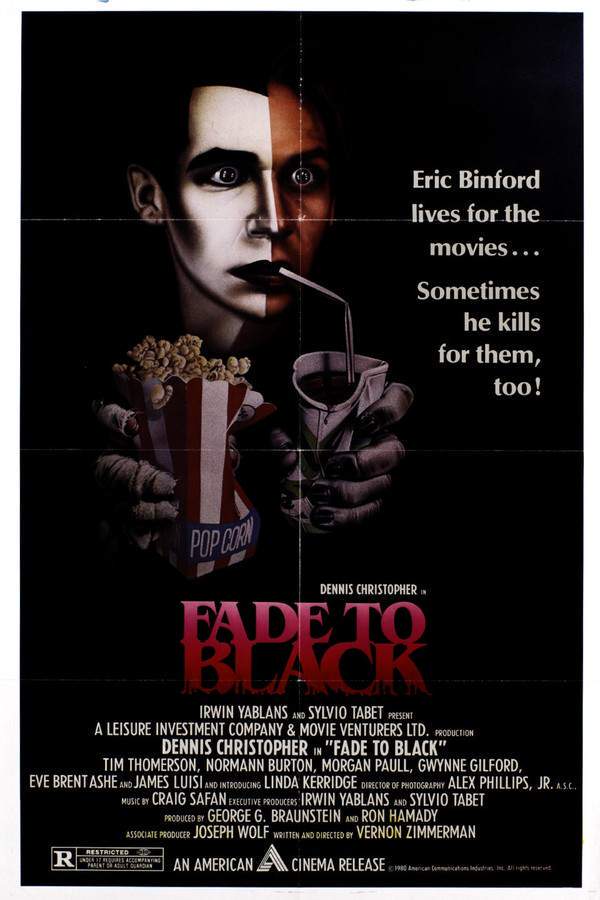
Fade to Black (1980) movie poster

Plot Summary

Fade to Black (1980) Plot Summary Explained

Release, runtime and language
1980 · 102 min · English
JustWatch #16,642 10
Directed by
Vernon Zimmerman
Starring
John Steadman, Tim Thomerson, Norman Burton, Dennis Christopher, Morgan Paull, Eve Brent

A socially awkward film fanatic becomes dangerously fixated on a woman resembling Marilyn Monroe. His obsession spirals into a darkly comedic and violent quest for revenge against those he believes have wronged him. As he enacts his plans, the lines between reality and fantasy blur, leading to a gruesome and unpredictable game of cat and mouse with increasingly dire consequences.

On this page (6)
  1. 1 Where to watch
  2. 2 What happens: full plot
  3. 3 Plot questions answered
  4. 4 Movie threads
  5. 5 Movies like Fade to Black
  6. 6 Every angle

Where to watch

Where to Watch Fade to Black (1980)

Where can you watch Fade to Black? Stream, rent or buy it in the US, including on Night Flight Plus, Philo and Fawesome: current JustWatch availability with up-to-date prices.

Streaming availability powered by JustWatch

Full plot summary · contains spoilers

What Happens in Fade to Black: Full Plot Summary

The whole story of Fade to Black (1980) explained, from the opening scene to the final frame: every key event, every twist and what it all adds up to. Read it as a quick recap before the sequel, to check a scene you missed, or to finally understand what really happened.

Aunt Stella Binford, portrayed by Eve Brent, discovers her late dance partner's son, Eric Binford, played by Dennis Christopher, dozing in his bedroom with a classic film playing on the television. As she awakens him, Stella chastises Eric for wasting his life indulging in movies day and night. She is filled with regrets about how Eric's father dismantled their dance duo and how a car accident, which occurred after she was called away to care for the ailing young Eric, cut short her career, leaving her with paralyzed legs. During breakfast, Stella angrily sweeps Eric's collection of VHS tapes off the table, urging him to pursue knowledge rather than mere entertainment. In a humorous exchange, Eric mimics James Cagney, retorting that Stella talks too much, warning her that one day she would regret her words.

At Continental Film Services, where Eric works, he faces the wrath of his abrasive boss, Norman Burton, who yells at him for his tardiness and orders him to make a delivery. Meanwhile, at a nearby police station, LAPD Captain M.L. Gallagher, played by James Luisi, meets with psychiatrist Tim Thomerson to discuss his role in rehabilitating juvenile offenders—a task Gallagher doubts will succeed. The more amiable Officer Anna Oshenbull, portrayed by Gwynne Gilford, introduces Moriarty to his new office, housed in an old drunk tank in the basement.

Before heading out on his delivery route, Eric wagers his workmates, Richie (played by Mickey Rourke) and Bart (Hennen Chambers), $20 apiece that they won't guess the full name of Rick from Casablanca. After delivering a film to a local studio, Eric finds himself captivated by an aspiring model with an Australian accent, Marilyn O'Connor, portrayed by Linda Kerridge. Enchanted by her beauty, he daydreams about Marilyn channeling Marilyn Monroe, singing 'Happy Birthday.' After impressing her with his extensive movie knowledge, she requests a ride back to work, leaving an indelible mark on Eric’s heart.

Later, Eric arrives home and surprises Stella by tidying his room and dressing smartly for his date with Marilyn. After mimicking Cary Grant, he boldly declares that he is going out with "Marilyn Monroe" and seeks movie money from Stella in exchange for a back rub upon his return. However, the night does not go as planned as Marilyn never shows up.

While dining elsewhere, Marilyn finds herself entangled with a manipulative ex-boyfriend, Joey, played by Peter Horton, who attempts to lure her back into modeling. Wondering about Eric, she rushes to meet him, but by the time he returns home after a long wait, she is already having dinner. In an intense twist of events, Stella confronts Eric about his obsession with films. When he reenacts a scene from Kiss of Death, he accidentally causes her untimely demise. Loss consumes Eric, leading him to disregard Stella’s health books and embrace the chaos brewing inside.

As the days unfold, Eric finds himself attending Stella's funeral dressed as a film character, spiraling deeper into madness. He reinvents himself by embodying characters from classic horror films, engaging in increasingly violent acts, such as confronting Richie at a carnival and taking his life. With pressure mounting from the police—and especially Captain Gallagher's skepticism towards psychiatrist Moriarty's insights—Eric's life descends into a web of violence and madness.

After a series of chilling encounters, Eric’s obsession culminates in a deadly confrontation with the people in his life. Dressed as a movie character, he bonds with Marilyn during a photoshoot, but as their relationship deepens, so does Eric's desperation. In a shocking showdown at Hollywood's Chinese Theater, a cat-and-mouse game ensues with Moriarty and police SWAT teams converging on Eric, leaving chaos in their wake.

Ultimately, as Eric succumbs to the consequences of his twisted dreams and the onslaught of police bullets, he recreates an iconic scene from Cagney’s film, affirming both his identity and tragic fate in the compelling world of cinematic madness. The movie ends on a haunting note, leaving audiences pondering the thin line between reality and fantasy.
Last updated: October 25, 2024 at 09:31

Was this helpful?

Plot questions answered

Fade to Black Plot Explained: Your Questions Answered

The questions people ask most about Fade to Black (1980): what happens in the confusing scenes, why the characters do what they do, the twists, hidden details and what the ending means. Each answer contains spoilers.

Q1

Why does Eric kill his aunt Stella?

Eric accidentally kills Stella during a heated confrontation about his movie obsession. When Stella criticizes his unhealthy fixation on films, Eric reenacts a scene from 'Kiss of Death' to defend himself. In the process, he unintentionally causes her death, either by pushing her or through the physical reenactment that leads to her fatal injury. This tragic accident marks the turning point where Eric's grip on reality begins to unravel completely, sending him into a downward spiral of violence and madness.

Foreshadowing: Earlier at breakfast, Eric mimics James Cagney and warns Stella that she will 'regret' her words, foreshadowing their fatal confrontation.

  • eric kills aunt stella
  • accidental death
  • kiss of death scene
  • confrontation scene
Q2

Why does Eric start killing people?

After accidentally killing Stella, Eric descends into madness and begins killing people. His first victim is his friend Richie at a carnival, whom he kills while fully embodying a horror film persona. Eric's violence stems from his complete inability to separate reality from the films he obsessively watches. He starts seeing everyone through the lens of movie characters and begins enacting the violent scenarios he sees on screen. The deaths of Stella and his growing isolation from reality trigger a psychotic break, leading him to believe he is living out various film characters who commit violence.

Foreshadowing: Eric's obsession with movies and his habit of reenacting scenes warning Stella about her words hints at his potential for violent fantasy.
  • eric violence
  • ricky kill
  • carnival scene
  • movie personas
Q3

Why doesn't Marilyn show up for the date with Eric?

Marilyn doesn't show up for her date with Eric because she gets caught up with her manipulative ex-boyfriend Joey, who tries to lure her back into modeling. While Eric waits eagerly at home, Marilyn is having dinner elsewhere. Although she does think about Eric and tries to meet him later, by the time she arrives at his house, he has already left after a long, disappointed wait. This missed connection is the initial catalyst that sends Eric into deeper obsession and despair, compounding his feelings of rejection and loneliness.

Foreshadowing: During their meeting at the studio, Marilyn mentions her complicated situation with an ex-boyfriend, hinting at the conflict that will prevent her from meeting Eric.

  • marilyn date
  • joey ex-boyfriend
  • missed connection
  • eric rejection
Q4

What causes Eric's mental breakdown?

Eric's mental breakdown is triggered by multiple factors accumulating over time. His social isolation and inability to form real connections leave him dependent on movies for fulfillment. The rejection from Marilyn, her failure to show up for their date, crushes his hope for a real relationship. Most immediately, accidentally killing his aunt Stella during their confrontation fills him with guilt and grief. These combined traumas cause his fragile mental state to collapse, leading him to retreat entirely into movie personas as a coping mechanism. He literally becomes the characters he watches, using them to mask his pain and justify his actions.

Foreshadowing: Stella's constant warnings about Eric wasting his life on movies and her plea for him to pursue 'knowledge rather than mere entertainment' foreshadow the dangers of his escapism.

  • mental breakdown
  • psychosis
  • escapism
  • isolation
  • stella death
Q5

Why does Eric start dressing as movie characters?

After Stella's death, Eric begins dressing as characters from classic horror and crime films as a way to cope with his guilt and expanding delusion. By embodying these personas, like the masked killer from horror films, he transforms himself into someone capable of the violent acts he is about to commit. Dressing as movie characters allows Eric to externalize his crimes, believing he is simply playing a role rather than committing real murder. This transformation represents his complete surrender to fantasy over reality, as he can no longer function as the shy, movie-obsessed man he was before.

Foreshadowing: Eric's habit of constantly mimicking actors and reciting dialogue foreshadows his eventual complete fusion with fictional personas.

  • movie costumes
  • horror personas
  • eric transformation
  • disguise
Q6

How does Eric die at the end of the movie?

Eric dies in a final shootout at Hollywood's Chinese Theater during a tense confrontation with police and psychiatrist Moriarty. Dressed as a film character and fully immersed in his fantasy world, Eric is shot multiple times by police officers. As he lies dying, he recreates an iconic scene from a James Cagney film, affirming his belief that he has become a movie character. His death while performing a film scene cements the tragic merging of his identity with cinematic fantasy, leaving him to die believing he has achieved the immortality he sought through cinema.
Foreshadowing: Eric's earlier warning to Stella about being like Cagney foreshadows his final reenactment at the film's climax.

  • chinese theater
  • dying scene
  • cagney scene
  • police shootout
  • final scene
Q7

Why is Eric so obsessed with movies?

Eric uses movies as an escape from his lonely, socially awkward life. As a film fanatic who works at Continental Film Services, he spends all his time watching classic films, imitating actors, and collecting VHS tapes. His obsession stems from feeling disconnected from reality and unable to form meaningful human relationships. Movies provide him with a fantasy world where he feels powerful and alive, unlike his mundane existence. His aunt Stella criticizes this behavior as wasteful, but Eric has substituted real life with film fantasy to the point where he can no longer distinguish between the two.

Foreshadowing: Stella discovers Eric asleep in his room with a film playing, establishing his pattern of using movies to avoid real life.

  • film obsession
  • movie fanatic
  • escapism
  • social isolation
  • VHS collection
Q8

What happened to Eric's parents?

Eric's mother is deceased, and his father is absent from his life. He lives with his Aunt Stella, who is actually his late dance partner's wife, not his biological aunt. Stella reveals that Eric's father was responsible for dismantling her dance duo with her partner (Eric's father), which ended her career. When young Eric needed care after being sick, Stella was called away, which led to a car accident that paralyzed her legs and ended her dancing career forever. This guilt over ruining Stella's life, combined with his own abandonment issues, contributes to Eric's psychological instability.

Foreshadowing: Stella's regrets about how Eric's father destroyed her dance career and the car accident that left her paralyzed hint at the troubled family history.

  • eric father
  • stella accident
  • dance partner
  • family background
  • abandonment
Q9

Why does Eric kill his friend Richie?

Eric kills Richie at a carnival after fully descending into madness and adopting a violent movie persona. When Richie and Bart (Eric's coworkers) visit the carnival, Eric confronts them while dressed as a horror film character. Using a prop knife or in a delusional state, Eric attacks and kills Richie. This murder represents Eric's complete transformation from a harmless film enthusiast into a dangerous killer who can now commit violence against people he knows. The killing demonstrates how far Eric has gone into his fantasy world, where he sees himself as a movie character entitled to commit the violent acts he watches on screen.

Foreshadowing: Earlier in the film, Eric wagers his coworkers $20 to test their movie knowledge, showing his close but ultimately superficial relationships with them.

  • richie kill
  • carnival murder
  • work friends
  • eric violence escalation
Q10

What is the significance of Eric's final scene?

Eric's final scene at the Chinese Theater is significant because it represents the ultimate fusion of his identity with cinema. Dying while performing a Cagney scene, he achieves what he always wanted, becoming a movie character who lives forever in film. The police shoot him as he reenacts the iconic moment, leaving him to die in a fantasy that the cameras are rolling. This bleak ending serves as a cautionary tale about the dangers of complete escapism and how obsession with fantasy can destroy one's ability to function in reality. It also comments on cinema's power to consume and warp vulnerable minds.

Foreshadowing: Eric's repeated references to Cagney and his early warning to Stella about being like a movie gangster foreshadow this tragic conclusion.

  • final scene
  • chinese theater
  • cagney reenactment
  • dying scene
  • movie immortality
Q11

Who is Marilyn to Eric and why does he fixate on her?

Marilyn O'Connor is an aspiring model who works at a local studio and resembles Marilyn Monroe. Eric becomes fixated on her because she represents the perfect intersection of his two obsessions, beautiful women and classic movies. He imagines her as the real Marilyn Monroe singing 'Happy Birthday,' creating a fantasy where she is both a real woman and a cinematic icon. This idealization allows Eric to project his movie fantasies onto a real person, but when she fails to meet his expectations (by not showing up for the date), she becomes just another source of rejection in his life, fueling his descent into violence.

Foreshadowing: Eric's immediate daydream about Marilyn as Monroe during their first meeting establishes his tendency to transform real people into film fantasies.

  • marilyn o'connor
  • monroe fantasy
  • model
  • infatuation
  • idealization
Q12

Why does the police chase Eric?

The police chase Eric because he becomes an armed and dangerous killer after killing Stella and Richie. Captain Gallagher leads the investigation, initially skeptical of psychiatrist Moriarty's insights into Eric's deteriorating mental state. As Eric's violent rampage escalates, the police track him to Hollywood's Chinese Theater where he has taken some form of action, either holding people hostage or engaging in threatening behavior. The confrontation becomes a full tactical operation with SWAT teams and Moriarty present, as law enforcement attempts to stop Eric before he can harm anyone else. His transformation from a shy film enthusiast to a wanted criminal is complete.

Foreshadowing: Captain Gallagher's skepticism about Moriarty's psychiatric evaluation early in the film hints at the police's initial underestimation of Eric's danger.

  • police chase
  • captain gallagher
  • moriarty psychiatrist
  • swat team
  • chinese theater climax

Movie threads

More Movies Like Fade to Black, by Mood & Story

Curated lists built around what makes Fade to Black tick: the same mood, the same kind of story or the same emotional payoff. Each list explains why these movies belong together.

Movies about obsessive descent like Fade to Black

Unraveling psyches where a single fixation consumes reality. Explore movies like Fade to Black where a character's dangerous obsession leads to psychological collapse. These films share a dark tone, heavy emotional weight, and often a bleak ending, focusing on stories of stalking, delusion, and the blurring line between fantasy and violent reality for fans of disturbing character studies.

  • obsessive
  • unsettling
  • tragic
  • claustrophobic
  • psychological
  • anxious
  • Tone: dark, unsettling
  • Pacing: steady, deliberate
Why these movies?

The story pattern: Narratives in this thread typically follow a linear but psychologically complex arc, where a socially isolated or alienated individual becomes consumed by a singular obsession. Their delusions progressively warp their perception, leading to escalating confrontations with the world they perceive as hostile, and culminating in a destructive, often tragic, conclusion.

Why they belong together: Movies are grouped here for their shared focus on a protagonist's psychological unraveling driven by a powerful obsession. They connect through a dark, unsettling mood, a steady pacing that builds tension towards a violent climax, and a heavy emotional weight stemming from themes of loneliness, alienation, and psychosis.

Movies where reality blends with cinema like Fade to Black

Stories where movie fantasy bleeds violently into a broken reality. If you liked Fade to Black's theme of a film fanatic living out a cinematic fantasy, explore similar movies where characters blur movie fiction with grim reality. These films often combine thriller, horror, and dark comedy elements, creating an unpredictable, nightmarish vibe for viewers who enjoy meta-commentary on cinema itself.

  • unsettling
  • nightmarish
  • meta
  • dark comedy
  • tense
  • obsessive
  • Tone: dark, meta-textual
  • Pacing: steady, builds to chaos
Why these movies?

The story pattern: The narrative pattern involves a protagonist who adopts the roles, aesthetics, and narratives of films as a coping mechanism. As their delusions deepen, they begin to enact scenes from movies in their real life, leading to a collision between their idealized fantasy and the harsh consequences of the real world, structured as a dark and ironic game.

Why they belong together: These movies are linked by their unique blend of cinephilia and psychological thrills, where the love of cinema becomes a catalyst for darkness. They share a specific vibe that mixes unsettling tension with dark comedy, a moderate complexity from layered film references, and a theme of escapism turning deadly.

If you liked this

Movies Like Fade to Black

Similar movies to Fade to Black: the same genre, themes or kind of story. Each one comes with its own plot summary, timeline and ending explained.

Browse all movie summaries

Every angle

Fade to Black (1980) Explained: Plot, Timeline & Characters

Everything about Fade to Black in one place: what happens in the plot summary, the timeline in chronological order, the characters and meaning and a spoiler-free summary. What's After the Movie adds the cast, box office and post-credit scenes.

Coming soon on iOS and Android

The Plot Explained Movie Summary App

Plot summaries, endings explained and timelines on your phone. Catch up on any movie in minutes, save your favorites and never miss a twist again.

Be the first to know when we launch. Your email stays private, always.

Learn more about the app