















Plot Explained Spoilers guaranteed!
Plot Explained

Browse by genre

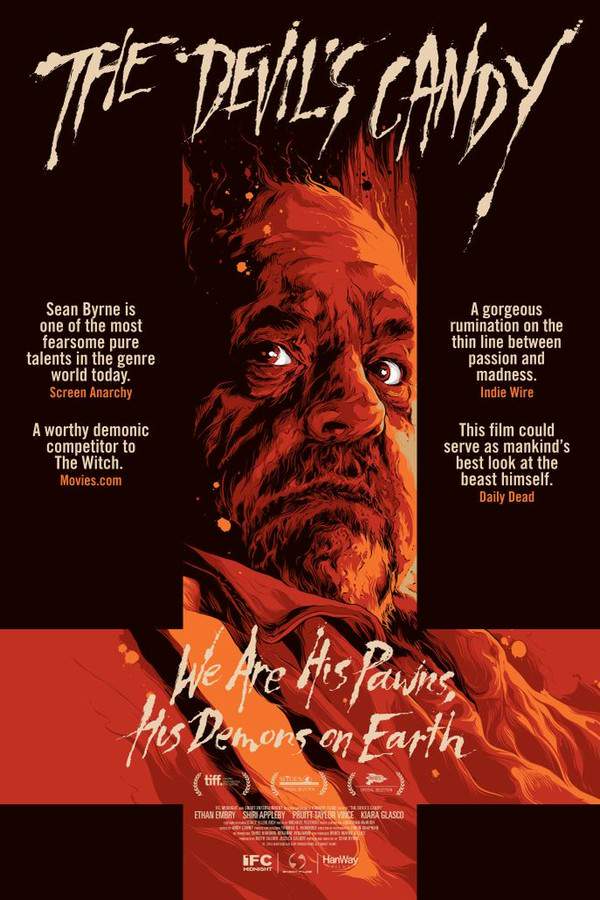
The Devil's Candy (2017) movie poster

Timeline

The Devil's Candy (2017) Timeline Explained – Every Event in Order

Release, runtime and language
2017 · 79 min · English
JustWatch #10,956 18
Directed by
Sean Byrne

A struggling artist named Jesse moves his family to a new home in Texas, unaware of its disturbing history. Their seemingly ordinary townhouse harbors a dark secret, attracting demonic forces. As terrifying events escalate, Jesse discovers the house’s former resident, Ray, has returned, now possessed by a sinister entity and determined to unleash a terrifying power.

On this page (6)
  1. 1 Where to watch
  2. 2 Events in order (15)
  3. 3 Timeline questions answered
  4. 4 Movie threads
  5. 5 Movies like The Devil's Candy
  6. 6 Every angle

Where to watch

Where to Watch The Devil's Candy (2017)

Where can you watch The Devil's Candy? Stream, rent or buy it in the US, including on AMC+, Philo and Shudder: current JustWatch availability with up-to-date prices.

Streaming availability powered by JustWatch

15 events in order · contains spoilers

The Devil's Candy Timeline: Events in Chronological Order

Every key event of The Devil's Candy (2017) in order, scene by scene, with when and where it takes place. Use it to untangle flashbacks, time jumps and parallel storylines, to refresh your memory before the sequel or to find the exact scene you are thinking of.

  1. Raymond Confronts an Unsettling Voice

    As darkness enveloped the rural setting, Raymond Smilie was suddenly faced with a disquieting voice. To push back against the unsettling presence, he picked up his red Flying V guitar and began playing defiantly in front of a sacred crucifix.

  2. Mother Insists on Returning to Institution

    Ray's mother soon entered the room, disturbed by the noise he was making. She unplugged his guitar and insisted that Ray return to the mental institution, which sparked a violent reaction from him.

  3. Ray Commits a Horrific Act

    In a fit of rage, Ray's frustration boiled over, leading to a horrendous act of violence against his mother. This act set in motion the tragic events that would follow, haunting both Ray and his future.

  4. New Owners Move In

    Years later, the property was sold to Jesse Hellman, a struggling painter, his wife Astrid, and their daughter Zooey. They were misled by a real estate agent who spun a tale about the former tenant's tragic end.

  5. Ray Checks Into a Motel

    Meanwhile, Ray had checked into a rundown motel, where he immersed himself in extreme devotional tapes praising the Devil. As he jammed on his guitar, authorities were summoned due to noise complaints.

  6. Eerie Voices Disturb Jesse

    After settling in, Jesse began hearing the same eerie voices that had haunted Ray. This inexplicable experience led to a creative spark, inspiring him to paint a haunting black-and-white piece featuring an inverted cross.

  7. Art Gallery Owner Shows Interest

    Jesse's artwork unexpectedly caught the eye of Belial, an art gallery owner known for his discerning taste. The enthusiastic response from Belial's receptionist fueled Jesse's artistic ambitions.

  8. Ray’s Uninvited Visit

    One ominous night, Ray made an unexpected appearance at the Hellman household. In a cryptic exchange with Zooey, who admired his Flying V guitar, Ray expressed a desire to integrate back into their lives.

  9. An Unsettling Discovery

    The following morning, the Hellmans found Ray's guitar left on their porch, raising alarm bells for Jesse. He adamantly insisted that Zooey shouldn't claim it, sensing a looming threat from Ray.

  10. Ray’s Dark Secret Revealed

    Unbeknownst to the Hellmans, Ray had been abducting and murdering children, committing unspeakable crimes in his deranged state. His past, intertwined with violence, loomed like a dark cloud over their new lives.

  11. Jesse's Artistic Descent

    As Jesse delved into his painting, he transformed a commissioned mural into a grotesque depiction of horror, which horrified Astrid. His obsession deepened, as chilling whispers from within fueled his dark creativity.

  12. Zooey's Terrifying Encounter

    In a terrifying confrontation, Ray stealthily entered Zooey's bedroom and pinned her down. His chilling whispered confessions echoed as he revealed his intentions, prompting her desperate scream for help.

    When
    Night
    Where
    Hellman household
  13. Police Involvement

    The Hellmans rushed to the police for assistance, learning the disturbing reality of Ray's past. Officers arrived to provide protection, placing guards outside their home to ensure their safety.

    Where
    Police Station
  14. Jesse's Desperate Destruction

    Faced with the horrors of Ray's actions, Jesse destroyed his mural, seeking to sever his tie with the darkness threatening to engulf him. It served as a symbolic act of defiance against the evil surrounding them.

  15. Final Confrontation

    Ray brutally eliminated the police guards before invading the Hellman household, causing chaos and terror. In a fierce struggle, Jesse confronted Ray, ultimately leading to Ray's fiery demise via Jesse's guitar.

    When
    Night
    Where
    Hellman household

Last updated: November 22, 2024 at 11:04

Was this helpful?

Timeline questions answered

The Devil's Candy Timeline Explained: Your Questions Answered

When does it happen, and why in that order? The questions people ask about the chronology of The Devil's Candy (2017): time jumps, flashbacks, cause and effect between scenes and the correct order of events, each answered with spoilers.

Q1

Why does Ray kill his mother at the beginning of the movie?

Ray kills his mother because he is already possessed by a demonic entity that has been tormenting him with unsettling voices. When his mother enters the room and demands he return to the mental institution, her disapproval of his guitar playing triggers an explosive rage. The demon influences him to commit violence against her, marking the first act of his murderous path. This establishes Ray as a vessel for evil and explains why he later becomes the primary antagonist targeting the Hellman family.

Foreshadowing: The opening scene establishes Ray's possession and violent tendencies, which later manifest when he returns to target Zooey.

  • ray smilie
  • mother murder
  • demonic possession
  • violence
Q2

How is Jesse connected to Ray through the house?

Jesse begins hearing the same eerie voices that once haunted Ray because the demonic entity that possessed Ray is tied to the house itself. This supernatural presence chooses Jesse as its new vessel, fueling his artistic creativity with dark inspiration. The entity draws Jesse into the same psychological unraveling Ray experienced, making him paint increasingly disturbing imagery. This connection is central to the film's theme of the house acting as a conduit for evil, passing from one occupant to another.

Foreshadowing: Jesse's first supernatural experience occurs immediately upon moving in, mirroring Ray's earlier torment.

  • jesse hellman
  • ray smilie
  • house connection
  • demonic voices
  • supernatural
Q3

Why does Jesse start painting such disturbing demonic imagery?

Jesse's artistic transformation occurs because the demonic presence in the house is channeling its influence through him. The eerie voices he hears ignite a creative fire, but the inspiration is tainted, the entity fuels his paintings with dark visions of suffering children and inverted crosses. This reflects the film's exploration of how evil can corrupt creativity. Jesse becomes aware that his art is being used as a conduit for something sinister when he incorporates real victims, like the boy Ray murdered, into his paintings.

Foreshadowing: His early painting of an inverted cross foreshadows the full demonic descent his art will take.

  • jesse painting
  • demonic art
  • inverted cross
  • artistic obsession
  • creativity
Q4

Why does Ray specifically target Zooey?

Ray targets Zooey because his demonic possession drives him to repeat his pattern of murdering children, which was the source of his dark power. Zooey represents his ideal victim, she is young, vulnerable, and living in the house that connects to his original crimes. Additionally, Ray's interest in reconnecting with the family, demonstrated by his earlier visit and leaving his guitar on the porch, reveals his twisted desire to establish a relationship with Zooey before harming her. His whispered confessions in her bedroom show his possessive intent.

Foreshadowing: Ray's earlier exchange with Zooey about the guitar establishes his interest in her before the direct attack.

  • ray
  • zooey
  • child targeting
  • abduction
  • demonic motive
Q5

How did Ray become possessed by the demon?

Ray became possessed through his intense devotion to dark spiritual forces, evidenced by his extreme devotional tapes praising the Devil that he listens to in the motel. The house itself appears to be a nexus for demonic activity, and Ray's obsessive musical practice and occult interests made him susceptible to possession. The entity feeds on violence and child murder, which became Ray's twisted purpose. His possession represents a corrupting bargain, creative power in exchange for serving evil.

Foreshadowing: The opening scene shows Ray confronting an unsettling voice, indicating possession began before the timeline shown.

  • ray possession
  • demon
  • devil worship
  • entity
  • spiritual corruption
Q6

What happened to the children Ray buried in the yard?

Ray abducted and murdered multiple children, dismembering their bodies and burying the pieces in a hidden hole in the yard alongside the remains of his previous victims. When Jesse discovers the suitcases containing the children's bodies at the end, it confirms the full horror of Ray's crimes. The discovery represents the culmination of the evil Jesse has been battling, the physical evidence of the murders that the demonic presence inspired. This revelation traumatizes Jesse and underscores the film's themes of inherited evil.

Foreshadowing: Jesse's disturbing painting of children's heads being consumed foreshadows the actual buried victims.

  • children
  • buried bodies
  • ray murders
  • yard discovery
  • victims
Q7

Why does the house attract demonic forces?

The house acts as a cursed location that draws demonic entities, likely due to the violent history and dark rituals that occurred there. Ray was possessed while living in this house, and the demonic presence remained after his departure, waiting for new occupants. The property passed to the Hellmans through a deceptive real estate agent who lied about the previous tenant's death. The house functions as a vessel for evil, selecting susceptible individuals like Ray and later Jesse to channel its power.

Foreshadowing: The real estate agent's suspicious story about the previous tenant hints at the house's dark history.

  • cursed house
  • demonic house
  • texas home
  • evil location
  • property
Q8

Why does Jesse destroy his mural?

Jesse destroys his mural to break free from the demonic influence controlling him. He realizes his art has become a conduit for evil, incorporating real victims and even depicting his own daughter in hellish imagery. When Astrid pleads with him to stop, he acknowledges hearing the cries of children within him, a sign the demon is using him. Destroying the mural represents a conscious rejection of the darkness, though the demon's hold proves difficult to fully sever.

Foreshadowing: The progressive corruption of his art, from the inverted cross to depicting Zooey, foreshadows the need for this breaking point.

  • mural destruction
  • jesse breaks free
  • artistic rejection
  • demon influence
  • self-sacrifice
Q9

How does Jesse defeat Ray in the final confrontation?

Jesse defeats Ray by using his own guitar, a reference to Ray's red Flying V, against him during the violent home invasion. When Ray enters the house after killing the police guards, Jesse fights him in a desperate struggle and manages to send Ray into the flames of the fire that has engulfed parts of the house. The guitar becomes a weapon of salvation rather than a tool of darkness, turning the very instrument associated with Ray's evil against him. Jesse then rescues Zooey from the inferno, completing his transformation from artist to protector.

Foreshadowing: Ray's guitar left on the porch earlier, and Jesse's refusal to let Zooey claim it, foreshadow its role in the final confrontation.

  • final battle
  • jesse vs ray
  • fire
  • guitar weapon
  • defeat ray
Q10

What is the significance of the red Flying V guitar in the movie?

The red Flying V guitar symbolizes the conduit of demonic influence that connects Ray to the evil entity. Ray uses it to defy the unsettling presence in the opening scene, playing defiantly in front of the crucifix. After Ray leaves, the guitar appears on the Hellmans' porch, representing the transfer of dark energy to the new occupants. Jesse ultimately uses a guitar, possibly his own or Ray's, to defeat Ray, turning the symbol of darkness into a tool of redemption.

Foreshadowing: Zooey's expression of fondness for the guitar when she meets Ray establishes its symbolic importance.

  • flying v guitar
  • red guitar
  • ray guitar
  • musical symbol
  • demonic tool
Q12

What happens to the police guards outside the house?

The police guards stationed outside the Hellman home are brutally killed by Ray when he returns for his final assault. After eliminating the officers, Ray takes their weapons, arming himself for the home invasion. This moment demonstrates Ray's ruthlessness and the failure of conventional protection against a supernaturally-powered killer. It also removes any external help the Hellmans might have received, forcing Jesse to confront Ray alone.

Foreshadowing: The police station scene establishes that Ray is a known dangerous fugitive with a history of child murder.

  • police guards
  • ray kills
  • home invasion
  • weapons
  • protection failure

Movie threads

More Movies Like The Devil's Candy, by Mood & Story

Curated lists built around what makes The Devil's Candy tick: the same mood, the same kind of story or the same emotional payoff. Each list explains why these movies belong together.

Movies about families fighting demonic forces like The Devil's Candy

Stories where a family's home becomes a battleground against a demonic force. If you liked The Devil's Candy, explore these horror movies where a family's new home turns into a nightmare. These films focus on familial bonds tested by demonic possession and haunted houses, delivering heavy emotional weight and intense survival scenarios similar to this movie.

  • demonic
  • haunting
  • desperate
  • claustrophobic
  • sinister
  • family in peril
  • Tone: dark, desperate, sinister
  • Pacing: steady build, escalating threat
Why these movies?

The story pattern: The narrative typically begins with a family seeking a fresh start, only to discover their new residence is a conduit for malevolent, often demonic, energy. The story escalates from unsettling occurrences to a direct, violent confrontation, with the parents' protective instincts becoming the central force against the encroaching evil. The ending often carries a cost, leaving the family scarred but alive.

Why they belong together: These films are grouped by their core premise of a family besieged within their own home by a supernatural antagonist. They share a high-intensity, dark tone, a steady pacing that builds to a climactic invasion, and a heavy emotional focus on the terror of child endangerment and the primal need to protect one's family.

Movies about artistic obsession and horror like The Devil's Candy

Films where a creator's dark inspiration is fueled by a sinister force. For viewers who liked the theme of artistic frenzy in The Devil's Candy, this list features horror and thriller films where a character's creative work is corrupted by a dark influence. These movies explore the terrifying link between genius and madness, often with a steady, oppressive pacing and a dark tone.

  • obsessive
  • psychological horror
  • sinister
  • unraveling
  • creative madness
  • dark inspiration
  • Tone: dark, obsessive, psychologically intense
  • Pacing: steady, character-focused descent
Why these movies?

The story pattern: The narrative follows a struggling artist who finds a new, potent source of inspiration that is revealed to be parasitic or demonic. Their creative output becomes increasingly disturbing, mirroring their own psychological unraveling or the actions of a malevolent force. The climax often involves the artist using their creation as a weapon or tool to confront the evil, but not without significant personal cost.

Why they belong together: These movies are united by the unique thematic link between artistic expression and supernatural horror. They share a dark, oppressive tone, a steady pacing that allows the madness to fester, and a strong focus on the protagonist's internal transformation. The experience is characterized by a sense of bleak revelation and the high-stakes cost of creation.

If you liked this

Movies Like The Devil's Candy

Similar movies to The Devil's Candy: the same genre, themes or kind of story. Each one comes with its own plot summary, timeline and ending explained.

Browse all movie summaries

Every angle

The Devil's Candy (2017) Explained: Plot, Timeline & Characters

Everything about The Devil's Candy in one place: what happens in the plot summary, the timeline in chronological order, the characters and meaning and a spoiler-free summary. What's After the Movie adds the cast, box office and post-credit scenes.

Coming soon on iOS and Android

The Plot Explained Movie Summary App

Plot summaries, endings explained and timelines on your phone. Catch up on any movie in minutes, save your favorites and never miss a twist again.

Be the first to know when we launch. Your email stays private, always.

Learn more about the app