




Plot Explained Spoilers guaranteed!
Plot Explained

Browse by genre

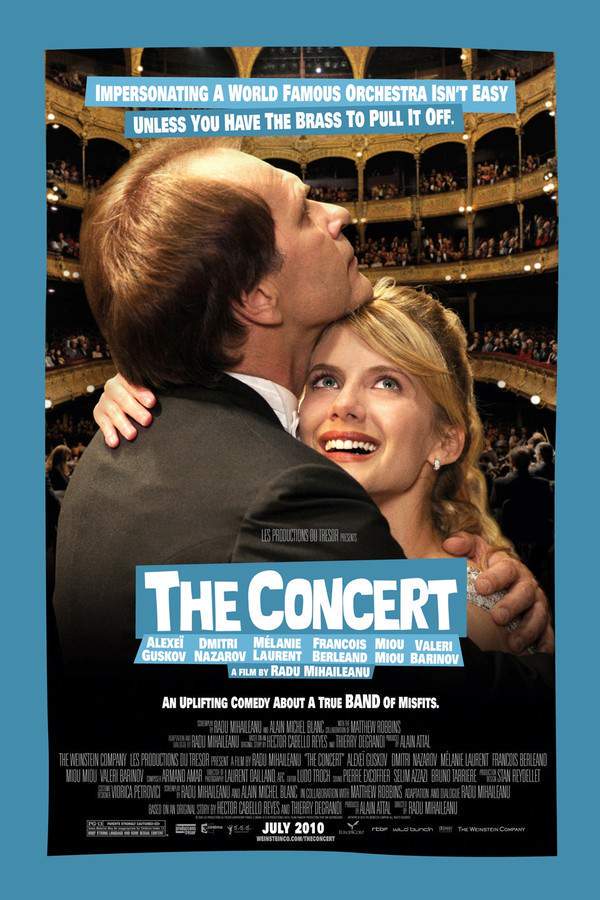
The Concert (2010) movie poster

Timeline

The Concert (2010) Timeline Explained – Every Event in Order

Release, runtime and language
2010 · 119 min · French
Directed by
Radu Mihaileanu
Starring
Mélanie Laurent, Aleksei Guskov, Dmitri Nazarov

After a career impacted by political circumstances, former Bolshoi conductor Andrei Filipov orchestrates a bold artistic endeavor. He assembles his former musicians, including Jewish and Gypsy talents, to celebrate their musical heritage with a concert in Paris. With the exceptional violin skills of Anne-Marie Jacquet, the group faces challenges as they strive to deliver a triumphant performance and confront the shadows of their past.

On this page (6)
  1. 1 Where to watch
  2. 2 Events in order (14)
  3. 3 Timeline questions answered
  4. 4 Movie threads
  5. 5 Movies like The Concert
  6. 6 Every angle

Where to watch

Where to Watch The Concert (2010)

Where can you watch The Concert? Stream, rent or buy it in the US, including on Kanopy, Tubi TV and YouTube Free: current JustWatch availability with up-to-date prices.

Streaming availability powered by JustWatch

14 events in order · contains spoilers

The Concert Timeline: Events in Chronological Order

Every key event of The Concert (2010) in order, scene by scene, with when and where it takes place. Use it to untangle flashbacks, time jumps and parallel storylines, to refresh your memory before the sequel or to find the exact scene you are thinking of.

  1. Fall from grace of The Maestro

    Decades earlier, Andrey Filipov, once a world-famous Bolshoi conductor, was publicly ruined by Brezhnev after defending Jewish musicians. He lost his position and became a janitor, spiraling into alcoholism. His reputation as a maestro persisted in whispers, even as his career stalled.

    When
    Decades earlier
    Where
    Moscow, Bolshoi Theatre
  2. Lea and Yitzhak Strum deportation

    Lea and Yitzhak Strum, close friends of Filipov, were deported to Siberia after speaking out against the regime. Lea’s mind deteriorated, and she imagined the Tchaikovsky concerto daily for her husband. Lea died in 1981, followed by Yitzhak six months later.

    When
    1981 (around)
    Where
    Siberia
  3. Escape with Anne-Marie

    Guylène de La Rivière smuggled baby Anne-Marie out of Russia by hiding her in a cello case during the escape to France. Irina, Filipov, and Sasha arranged the escape to save the child’s life. The infant’s fate becomes tied to a future Paris concert.

    When
    early 1980s
    Where
    Russia to France
  4. Filipov intercepts Paris invitation

    Filipov intercepts an official invitation from Théâtre du Châtelet in Paris to replace a canceled Los Angeles concert. He plans to reunite his old Jewish and Gypsy musicians to perform Tchaikovsky’s Violin Concerto. The mission marks his return to the conductor’s podium.

    When
    present day
    Where
    Moscow/Paris
  5. Gavrilov becomes manager and negotiates terms

    Gavrilov is brought in as the new manager and actively supports Filipov’s plan. He negotiates with the Châtelet on favorable conditions, including unusual demands and sponsorship. His efficiency masks a hidden agenda that unsettles the ensemble.

    When
    present day
    Where
    Paris/Moscow
  6. Anne-Marie chosen as soloist

    The orchestra insists Anne-Marie Jacquet must be the soloist. She has never played Tchaikovsky’s concerto because she fears it, but she longs to perform it with the Bolshoi. Guylène reluctantly accepts the deal to give her a chance at the stage.

    When
    present day
    Where
    Paris
  7. An open mafia sponsorship

    An open Russian mafia boss offers sponsorship, despite being a poor cellist himself. His presence signals the chaotic, morally gray path to the Paris concert. The orchestra’s finances become as dramatic as the music.

    When
    present day
    Where
    Paris
  8. Paris arrival and party nights

    The Bolshoi orchestra arrives in Paris only to disappear from view, taking on taxi-driving, moving, and translating work to survive. The unprofessionalism of the musicians clashes with Filipov’s belief that the concert can heal old wounds. Anne-Marie’s reservations grow as the project spirals.

    When
    present day
    Where
    Paris
  9. Anne-Marie questions participation

    Anne-Marie initially wants to back out after seeing the chaos. The concert is a chance to connect with her missing parents and a past she never knew. Guylène and Filipov press on, framing the performance as a cathartic life choice.

    When
    present day
    Where
    Paris
  10. The past resurfaces: Lea and Anne-Marie's heritage

    La Rivière explains the connection between Lea, the violinist mother, and Filipov’s circle. Lea’s deportation and the daily performance of the imagined concerto shaped Anne-Marie’s identity. The revelation deepens her resolve to join the concert.

    When
    present day
    Where
    Paris
  11. SMS summons the orchestra to honor Lea

    At the last moment, a text summons the entire orchestra to the stage to honor Lea. They arrive without rehearsals, balancing nerves with hope. The atmosphere tightens as the music awaits its chance.

    When
    concert night
    Where
    Theatre du Châtelet, Paris
  12. Bolshoi manager is detained backstage

    The legitimate Bolshoi manager, vacationing in Paris, arrives to derail the performance. Gavrilov intercepts him and locks him in a broom closet to keep the show on track. The improvised night becomes a testament to resilience.

    When
    concert night
    Where
    Theatre du Châtelet, Paris
  13. Concert breakthrough and unity

    Despite a shaky start, Anne-Marie’s performance inspires the orchestra to find spontaneous harmony. Filipov’s leadership resurges as the ensemble reaches a truthfully unified sound. The concert ends in a huge emotional triumph.

    When
    concert night
    Where
    Theatre du Châtelet
  14. A new chapter: career resurgence

    The concert restores Filipov’s career as conductor of a new Andreï Filipov Orchestra. Anne-Marie agrees to join him on a world tour, signaling a reconciliation of past pain and a hopeful future. The film closes on the promise of continued music and healing.

    When
    post-concert
    Where
    World tour

Last updated: October 09, 2025 at 15:43

Was this helpful?

Timeline questions answered

The Concert Timeline Explained: Your Questions Answered

When does it happen, and why in that order? The questions people ask about the chronology of The Concert (2010): time jumps, flashbacks, cause and effect between scenes and the correct order of events, each answered with spoilers.

Q1

Why was Andrey Filipov fired from the Bolshoi?

Andrey Filipov was publicly discredited and lost his position at the Bolshoi Theatre after standing up for Jewish musicians during the Brezhnev era. This act of defiance cost him his career, forcing him to work as a janitor in the same theatre where he once conducted. His reputation as a maestro persisted in whispers, but his professional life collapsed into alcoholism.

Foreshadowing: Earlier scenes establish that Filipov's principled stand was well-known within the theatre community, setting the stage for his later redemption.

  • andrey filipov
  • bolshoi
  • fired
  • Jewish musicians
  • brezhnev
  • conductor
Q2

Why has Anne-Marie Jacquet never played the Tchaikovsky Violin Concerto?

Anne-Marie has never performed the Tchaikovsky Violin Concerto because she fears it. The fear stems from her mother Lea, who was the original soloist for the interrupted Moscow concert. After deportation to Siberia, Lea lost her sanity and spent her days imagining the concerto's cadence until her death in 1981. This traumatic legacy made Anne-Marie afraid to perform the very piece that defined her mother's life.

Foreshadowing: Anne-Marie's initial reluctance to join the project hints at a deeper, unresolved connection to the music.

  • anne-marie jacquet
  • tchaikovsky concerto
  • fear
  • mother
  • lea
  • violinist
Q3

Who is Anne-Marie's mother and what happened to her?

Anne-Marie's mother is Lea Strum, an accomplished violinist who was close friends with Andrey Filipov and his wife Irina. After speaking out against the regime, Lea and her husband Yitzhak were deported to Siberia. Lea developed mental illness and imagined performing the Tchaikovsky concerto daily for her husband until she died in 1981, followed by Yitzhak six months later.

Foreshadowing: The backstory gradually reveals that Lea was the missing piece connecting Filipov's past to Anne-Marie's present.

  • lea strum
  • anne-marie mother
  • deported
  • siberia
  • violinist
  • tchaikovsky
Q4

How did Anne-Marie end up in France?

Anne-Marie was smuggled out of Russia as a baby in the early 1980s. Her agent Guylène de La Rivière hid her in a cello case during the escape to France. The rescue was arranged by Irina and Andrey Filipov along with Sasha Grossman to save the child from the same persecution that destroyed her parents.

Foreshadowing: Guylène's protective behavior toward Anne-Marie suggests a deeper historical bond between them.

  • anne-marie escape
  • cello case
  • france
  • guylène
  • smuggled
  • baby
Q5

Why does Gavrilov lock the Bolshoi manager in a closet?

Gavrilov intercepts the legitimate Bolshoi manager, who happens to be vacationing in Paris and arrives intending to stop the unauthorized concert. Gavrilov locks him in a broom closet to prevent him from derailing the performance, ensuring the show can proceed despite the lack of official authorization.

Foreshadowing: Gavrilov's efficiency and hidden agenda throughout the film suggest he will take extreme measures to protect the mission.

  • gavrilov
  • bolshoi manager
  • closet
  • paris
  • concert
  • stopped
Q6

Why do the musicians disappear after arriving in Paris?

Upon arriving in Paris, the orchestra members abandon their professional obligations and take on menial jobs such as taxi driving, moving, and translation work. This reflects both their desperate financial situation and their loss of discipline after years of marginalization. The chaos represents the contrast between Filipov's artistic vision and the practical realities his musicians face.

Foreshadowing: Anne-Marie's observation that the project feels more about Filipov's catharsis than a true comeback hints at the underlying disorganization.

  • orchestra paris
  • musicians disappear
  • taxi
  • jobs
  • chaos
  • rehearse
Q7

What prompts the orchestra to finally take the stage?

A late SMS summons the entire orchestra to appear at the Théâtre du Châtelet, appealing to their memory of Lea and the promise of honoring her legacy. Despite having no rehearsal, they arrive drawn by this emotional call, ready to perform in tribute to the violinist whose life was destroyed by the regime.

Foreshadowing: The buildup throughout the film establishes that Lea remains a powerful symbolic force for all who knew her.

  • sms summons
  • orchestra
  • lea
  • concert
  • stage
  • honor
Q8

What is Gavrilov's hidden agenda in the Paris project?

Gavrilov, a former KGB agent, presents himself as the orchestra's manager and executes Filipov's plan with cold efficiency. His efficiency masks hidden ambitions that unsettle the principal cellist Sasha Grossman. While the exact nature of his agenda is not fully detailed in the summary, his willingness to lock the Bolshoi manager in a closet suggests he has personal stakes in the concert's success beyond mere employment.

Foreshadowing: Sasha's wariness of Gavrilov early on foreshadows that not everyone involved has honorable intentions.

  • gavrilov
  • kgb
  • hidden agenda
  • manager
  • sasha
  • suspicious
Q9

Why does the orchestra accept sponsorship from a mafia boss?

The orchestra agrees to sponsorship from a Russian mafia boss who wants to join the orchestra, despite his being a poor cellist. This unusual acceptance reflects the desperate financial circumstances and the morally gray path they have taken to reach Paris. The sponsorship represents the chaotic, improvisational nature of their entire enterprise.

Foreshadowing: The film's tone establishes that the characters operate in a world where compromise is necessary for survival.

  • mafia sponsorship
  • russian boss
  • cello
  • orchestra
  • money
  • sponsor
Q10

How does the concert succeed despite no rehearsals?

The concert begins shakily, with even Gavrilov wondering if a higher power might intervene. However, Anne-Marie's luminous interpretation of the solo, inspired by her mother's annotated score, transforms the performance. Her playing inspires the under-rehearsed musicians to find spontaneous harmony, and Filipov's leadership resurges as the ensemble reaches a unified sound.

Foreshadowing: The emotional weight of honoring Lea's memory provides the spiritual rehearsal the musicians lacked.

  • concert success
  • no rehearsal
  • anne-marie
  • spontaneous harmony
  • tchaikovsky
  • orchestra
Q11

What is Anne-Marie's connection to her missing parents?

Anne-Marie was separated from her parents as an infant and never knew them, they were scientists who disappeared in the Alps when she was a child. Guylène de La Rivière frames the Paris concert as a way for Anne-Marie to connect with this missing past. The concert becomes a pathway to understanding her identity and honoring her mother Lea's legacy.

Foreshadowing: Guylène's insistence that the concert holds a key to Anne-Marie's past suggests the revelation is coming.

  • anne-marie parents
  • missing
  • alps
  • concert
  • past
  • identity
  • guylène
Q12

What happens to Andrey Filipov after the concert?

The concert becomes a catalyst for Filipov to reclaim his career. He establishes the Andreï Filipov Orchestra, marking a new chapter in his professional life. Anne-Marie joins him on a widening world tour, signaling a reconciliation of past pain and a hopeful future. The film closes on the promise of continued music and healing.

Foreshadowing: The triumphant ending fulfills Filipov's original goal of restoring his glory through the concert.

  • filipov career
  • new orchestra
  • world tour
  • anne-marie
  • future
  • redemption

Movie threads

More Movies Like The Concert, by Mood & Story

Curated lists built around what makes The Concert tick: the same mood, the same kind of story or the same emotional payoff. Each list explains why these movies belong together.

Artistic redemption stories like The Concert

Past masters reclaim their legacy in a final, triumphant performance. Find more movies like The Concert about talented artists seeking a second chance. If you enjoyed the story of a conductor reclaiming his glory, you'll appreciate these other hopeful dramas of late-in-life comebacks and triumphant creative performances.

  • redemptive
  • triumphant
  • nostalgic
  • cathartic
  • hopeful
  • melancholic
  • Tone: hopeful, nostalgic, cathartic
  • Pacing: steady, character-driven
Why these movies?

The story pattern: The narrative follows a protagonist haunted by a past failure or injustice, often related to their artistic field. A new opportunity arises, forcing them to confront old demons and assemble a team of former colleagues or new talent. The journey is as much about personal healing and reconciliation as it is about preparing for a culminating artistic event that serves as redemption.

Why they belong together: These films are grouped by their shared focus on artistic expression as a path to personal redemption. They balance a melancholic look at the past with a hopeful, forward-moving quest, resulting in a deeply satisfying and emotionally resonant happy ending centered on creative triumph.

Movies about music healing past wounds like The Concert

Characters process a painful past through the collective power of music. Discover movies similar to The Concert where music is a catalyst for redemption and healing. These films feature ensembles overcoming adversity, blending bittersweet nostalgia with the triumphant joy of performance, perfect for fans of heartfelt music dramas.

  • melancholic
  • triumphant
  • cathartic
  • nostalgic
  • hopeful
  • heartfelt
  • Tone: bittersweet, hopeful, triumphant
  • Pacing: steady build
Why these movies?

The story pattern: The plot revolves around assembling a musical ensemble, with each member bringing their own personal history of loss or persecution. The rehearsal process becomes a vehicle for working through these shared and individual traumas. The narrative builds steadily towards a public performance where the music itself delivers emotional closure and a sense of victory over adversity.

Why they belong together: This thread connects movies where the experience of making music is intrinsically linked to emotional recovery. They share a specific mix of moods: the melancholy of remembering a difficult past is balanced and ultimately overcome by the triumphant, communal joy of artistic creation, resulting in a deeply satisfying and hopeful feeling.

If you liked this

Movies Like The Concert

Similar movies to The Concert: the same genre, themes or kind of story. Each one comes with its own plot summary, timeline and ending explained.

Browse all movie summaries

Every angle

The Concert (2010) Explained: Plot, Timeline & Characters

Everything about The Concert in one place: what happens in the plot summary, the timeline in chronological order, the characters and meaning and a spoiler-free summary. What's After the Movie adds the cast, box office and post-credit scenes.

Coming soon on iOS and Android

The Plot Explained Movie Summary App

Plot summaries, endings explained and timelines on your phone. Catch up on any movie in minutes, save your favorites and never miss a twist again.

Be the first to know when we launch. Your email stays private, always.

Learn more about the app