Plot Explained Spoilers guaranteed!
Plot Explained

Browse by genre

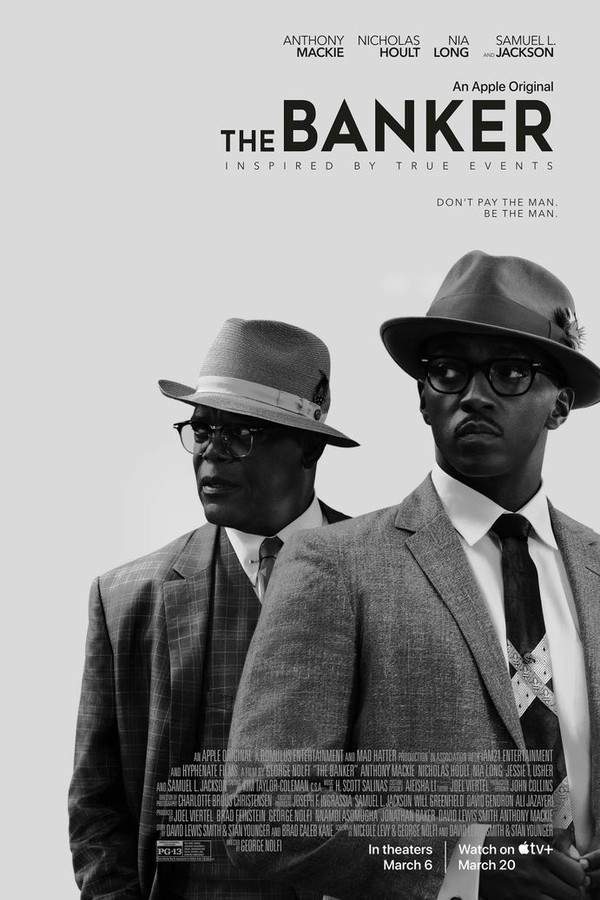
The Banker (2020) movie poster

Plot Summary

The Banker (2020) Plot Summary Explained

Release, runtime and language
2020 · 120 min · English
Echo score 65
JustWatch #395 447
Directed by
George Nolfi
Starring
Samuel L. Jackson, Anthony Mackie, Nicholas Hoult, Michael Harney, Chris Gann, Nia Long

In 1960s America, Bernard Garrett and Joe Morris, two pioneering entrepreneurs, devise a bold plan to overcome racial discrimination and help African Americans realize their aspirations. They create a covert system, with Eunice playing a crucial role, where Garrett poses as a wealthy businessman while Morris manages operations behind the scenes. Their actions challenge the deeply ingrained prejudices of the era and eventually draw the attention of federal investigators, risking everything to create opportunity for their community.

On this page (6)
  1. 1 Where to watch
  2. 2 What happens: full plot
  3. 3 Plot questions answered
  4. 4 Movie threads
  5. 5 Movies like The Banker
  6. 6 Every angle

Where to watch

Where to Watch The Banker (2020)

Where can you watch The Banker? Stream, rent or buy it in the US, including on Apple TV, Amazon Video and Apple TV Store: current JustWatch availability with up-to-date prices.

Streaming availability powered by JustWatch

Full plot summary · contains spoilers

What Happens in The Banker: Full Plot Summary

The whole story of The Banker (2020) explained, from the opening scene to the final frame: every key event, every twist and what it all adds up to. Read it as a quick recap before the sequel, to check a scene you missed, or to finally understand what really happened.

Revolutionary businessmen Bernard Garrett and Joe Morris embark on a daring quest to challenge the deeply ingrained racial barriers of the 1960s. Their aim? To empower fellow African Americans in their pursuit of the American Dream. With the assistance of Bernard's wife, Eunice Garrett, they embark on the unconventional journey of training a poor white man, Matt Steiner, to masquerade as the affluent representative of their blossoming real estate and banking empire. In a clever twist, Bernard and Joe assume the roles of a janitor and a chauffeur. However, their rising success attracts the scrutiny of the federal government, posing a significant threat to the empire they’ve built.

As a young boy, Bernard developed an interest in banking while shining shoes outside a local bank in 1939. Listening to conversations between customers and bankers ignited a passion in him, yet his father reminded him that talent wouldn't matter in the face of the rampant racism permeating Texas. By 1954, after moving to Los Angeles with dreams and aspirations, Bernard aims to utilize his savings from a previous venture in Texas to launch a real estate business.

He discovers a gated community in a predominantly white neighborhood, which lies just two blocks from a community of color. Recognizing the potential demand for rental homes, he is met with a substantial asking price that would leave him without funds for renovations. Enter Joe, a laid-back character who enjoys early drinks, contrasting sharply with Bernard’s serious demeanor. Bernard's reluctance to trust Joe becomes evident as they discuss the opportunity presented by Patrick Barker, who is selling the property for $40,000. In a display of confidence, Bernard proposes $30,000 upfront, promising to renovate the spaces to accommodate well-paid colored doctors and lawyers—improving occupancy rates from a mere 50% to full capacity.

With Joe's assistance, they orchestrate the renovations using Matt as their front. As the predominantly white residents begin to leave, they swiftly fill the apartments with tenants from the African American community. Patrick eventually approaches Bernard with a partnership offer based on the condition that he remains in the shadows while Patrick becomes the public face of their transactions. They enter into a series of joint investments, but tragedy strikes when Patrick passes away, leaving Bernard facing a precarious situation.

As Mrs. Barker expresses her unease in dealing with Bernard, offering him a mere fraction of his investment, he seeks support from the banker who had assisted them. Unfortunately, he is met with refusal. Undeterred, Bernard devises a new strategy centered on a bank's acquisition, leveraging his knowledge of finance to purchase properties in predominantly white areas. He convinces Joe to allow Matt to assume the role of the ‘white’ CEO, training him in both mathematics and golf to refine his appearance as an educated man.

With Donald Silverthorne financing their endeavors, Matt demonstrates remarkable acumen, successfully negotiating a purchase of a property worth $2 million for $1.56 million, catalyzing a flurry of acquisitions that ultimately results in the ownership of 200 buildings.

As Matt marries Susie, a charming diner waitress, they continue expanding their reach. However, Bernard's ambition leads him back to Texas, seeking to acquire a bank in a racially divided region despite Joe's reservations. In this venture, they use Matt as a front once more, creating complications when the new owner secures a position for his son, prompting alarming practices to emerge involving 'color-blind' loan approvals.

As suspicion mounts, Matt proposes to move the questionable loans to another bank to keep up appearances during audits. Despite initial hesitations from Bernard, he is convinced by Joe to proceed with this strategic maneuver. When a treasury official arrives to conduct an audit, discrepancies arise that indicate non-compliance with banking regulations. Faced with grave consequences, Joe and Bernard support the quick sale of problematic loans but incur significant losses in the process.

In a desperate bid to save their enterprise, Matt concocts a scheme to fabricate transactions leveraging the original bank, proposing a plan that ultimately leads to fraudulent activities. Consequently, the banks face closure by the US government, and Joe and Bernard are apprehended by the FBI. Amidst the turmoil, Matt is cornered into a plea deal, ultimately testifying against his partners while choosing self-preservation.

In 1965, both Joe and Bernard are found guilty by an all-white jury, sentenced to three years in prison. With their empire crumbling and most of their assets dissipated, only one building remains under Eunice's name. Meanwhile, Robert Florance, Jr. reclaims the bank at a drastically reduced price, gleefully profiting from Bernard and Joe’s downfall.
Last updated: November 03, 2024 at 21:35

Was this helpful?

Plot questions answered

The Banker Plot Explained: Your Questions Answered

The questions people ask most about The Banker (2020): what happens in the confusing scenes, why the characters do what they do, the twists, hidden details and what the ending means. Each answer contains spoilers.

Q1

Why did Bernard and Joe use Matt as a frontman?

Because of the pervasive racial discrimination in 1960s America, Bernard and Joe knew they could not acquire properties or banks in white neighborhoods if they appeared as Black men. By training Matt Steiner, a poor white man, to pose as the wealthy CEO of their empire, they could bypass racist barriers while remaining the actual decision-makers behind the scenes.

Foreshadowing: Earlier, Bernard's father warned him that talent wouldn't matter in Texas due to racism, setting up the necessity of this workaround.

  • Matt Steiner
  • frontman
  • racial discrimination
  • front company
Q2

How did the white CEO arrangement help their business?

The arrangement allowed them to enter predominantly white neighborhoods and business dealings that would have been impossible otherwise. Matt posed as the educated, wealthy businessman while Bernard and Joe secretly controlled operations, Bernard as a janitor and Joe as a chauffeur. This enabled them to purchase properties in white areas and eventually acquire banks, creating opportunities for Black tenants and community members.

  • real estate
  • acquisition
  • discrimination
  • business strategy
Q3

Why did Bernard and Joe decide to buy a bank in Texas?

After building a successful real estate empire with 200 buildings in Los Angeles, Bernard wanted to expand into banking to have more direct control over loan accessibility for Black communities. Texas represented both opportunity, due to its large Black population, and personal significance, since Bernard had been born there and witnessed racism firsthand.

Foreshadowing: The film opens with Bernard in 1939 Texas, where his father told him racism would block his banking dreams, creating motivation to return and change that system.

  • Texas
  • bank acquisition
  • community empowerment
  • loans
Q4

What went wrong with the bank they acquired in Texas?

The new owner's son secured a position at the bank and began approving questionable loans, creating risky lending practices. When a treasury audit approached, Matt suggested moving these suspicious loans to another bank to hide them, but the situation quickly escalated into full-blown fraud to cover their tracks.

  • audit
  • loans
  • fraud
  • treasury investigation
Q5

Why did Matt testify against Bernard and Joe?

Facing federal charges and potential imprisonment, Matt accepted a plea deal to save himself. He testified against Bernard and Joe in exchange for a reduced sentence, choosing self-preservation over loyalty to the men who had given him his success and education.

  • Matt Steiner
  • plea deal
  • testimony
  • betrayal
Q6

What caused Bernard and Joe to be arrested?

Their scheme collapsed when Matt proposed creating fraudulent transactions through their original bank to cover losses from the problematic Texas loans. These fabrications triggered a federal investigation, leading the FBI to raid their operations and arrest both Bernard and Joe for banking fraud.

  • FBI
  • arrest
  • fraud
  • federal investigation
Q7

Why were they convicted despite their good intentions?

Although their goal was to fight racial discrimination and help Black communities, the jury focused on the technical violations of banking law. Their use of a frontman, fraudulent loan shuffling, and fabricated transactions constituted illegal activity regardless of their motivations, and an all-white jury in 1965 delivered guilty verdicts.

  • trial
  • conviction
  • jury
  • banking law
Q8

What happened to their real estate empire after the trial?

After their 1965 conviction and three-year prison sentences, their empire crumbled. Most of their assets were lost, and only one building remained under Eunice Garrett's name. Meanwhile, Robert Florance, Jr. bought back the bank at a drastically reduced price and profited from their downfall.
  • assets
  • prison
  • losses
  • Robert Florance
Q9

What was the color-blind loan policy and why did it cause trouble?

In Texas, they implemented so-called 'color-blind' loan approvals, meaning they approved loans without considering race. This was meant to fight discrimination, but the bank owner's son exploited this policy to approve risky loans to unqualified borrowers, creating financial problems that later had to be concealed during audits.

  • color-blind loans
  • discrimination policy
  • bank practices
Q10

Why did the government shut down their banks?

The government shut down their banks because of the mounting fraudulent activities they engaged in to cover the bad Texas loans. When the fabricated transactions and illegal loan shuffling were discovered during the treasury audit, federal regulators closed the banks and pursued criminal charges against the perpetrators.

  • bank closure
  • government
  • treasury
  • regulations

Movie threads

More Movies Like The Banker, by Mood & Story

Curated lists built around what makes The Banker tick: the same mood, the same kind of story or the same emotional payoff. Each list explains why these movies belong together.

Strategic undercover justice movies like The Banker

Cunning plans and high-stakes deceptions to fight a corrupt system. If you liked the high-stakes, covert strategy of The Banker, explore more movies where clever protagonists use undercover operations to fight systemic injustice, blending tense drama with thoughtful planning.

  • tense
  • strategic
  • risky
  • ambitious
  • frustrating
  • somber
  • Tone: tense, somber
  • Pacing: steady, strategic
Why these movies?

The story pattern: These stories follow intelligent protagonists who design and execute intricate, often covert, plans to expose or undermine a powerful, unjust system. The narrative typically builds through strategic maneuvers, leading to a climax where their operation is at risk of exposure, often resulting in complex moral and personal consequences.

Why they belong together: They are grouped by their shared focus on a methodical, high-risk plot against a formidable opponent, creating a consistent mood of intellectual tension and moral resolve, where success is measured in systemic impact rather than simple victory.

Bittersweet victory dramas like The Banker

Stories where achieving a greater good comes with profound personal sacrifice. For viewers who appreciated the poignant ending of The Banker, this list features movies with bittersweet triumphs where characters achieve their goals but at a significant personal cost, leaving a lasting emotional impact.

  • bittersweet
  • somber
  • frustrating
  • ambitious
  • heavy
  • reflective
  • Tone: bittersweet, heavy
  • Pacing: steady, deliberate
Why these movies?

The story pattern: The narrative arc follows a determined pursuit of a noble goal, leading to a tangible success or legacy. However, the conclusion is deeply layered, as this success is inextricably linked to a major personal loss, such as freedom, relationships, or fortune, creating a poignant and reflective ending.

Why they belong together: These films share a specific emotional journey that balances achievement with sacrifice, resulting in a powerfully bittersweet tone. They resonate with audiences looking for stories that acknowledge the complicated, often painful, reality of fighting for change.

If you liked this

Movies Like The Banker

Similar movies to The Banker: the same genre, themes or kind of story. Each one comes with its own plot summary, timeline and ending explained.

Browse all movie summaries

Every angle

The Banker (2020) Explained: Plot, Timeline & Characters

Everything about The Banker in one place: what happens in the plot summary, the timeline in chronological order, the characters and meaning and a spoiler-free summary. What's After the Movie adds the cast, box office and post-credit scenes.

Coming soon on iOS and Android

The Plot Explained Movie Summary App

Plot summaries, endings explained and timelines on your phone. Catch up on any movie in minutes, save your favorites and never miss a twist again.

Be the first to know when we launch. Your email stays private, always.

Learn more about the app