Year: 1970
Runtime: 113 mins
Language: Kannada
Director: Pattabhirama Reddy
Narayanappa, a Madhwa Brahmin, passes away in the Agrahara of Durvasapura. Madhwa tradition demands his funeral rites be carried out, yet his transgressions—eating meat, drinking alcohol and marrying a prostitute—spark a dispute among the village Brahmins over who may perform the rites. The dispute stalls the rites until a resolution is reached.
Warning: spoilers below!
Haven’t seen Samskara yet? This summary contains major spoilers. Bookmark the page, watch the movie, and come back for the full breakdown. If you're ready, scroll on and relive the story!
Read the complete plot breakdown of Samskara (1970), including all key story events, major twists, and the ending explained in detail. Discover what really happened—and what it all means.
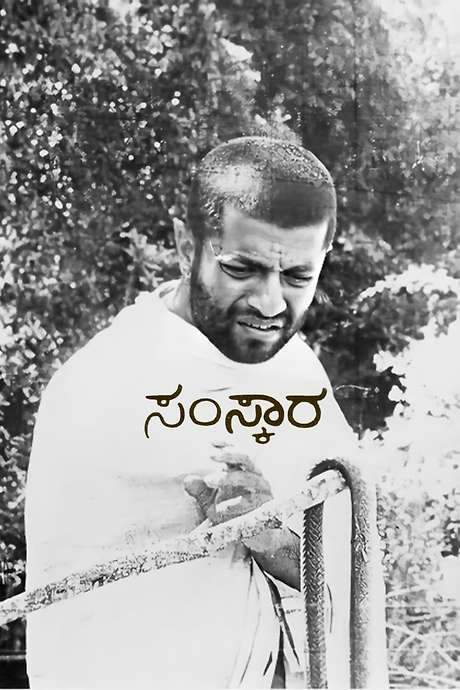
In a narrow street of Durvasapura, a village perched in the Western Ghats of Karnataka, life revolves around a traditional Madhwa Brahmin community that upholds strict ritual rules. At the center of its spiritual life is Praneshacharya, Girish Karnad a devout scholar who has returned from Varanasi with the singular aim of attaining moksha. He is regarded as the village’s moral and spiritual leader, a man who believes that personal sacrifice can clear the path to enlightenment. To preserve his focus and celibacy, he undertakes a calculated act of self-denial: he marries an invalid woman so he can devote himself wholly to spiritual pursuits, a decision that shades the life of the community with quiet tension and complexity.
Opposite him stands Narayanappa, P. Lankesh, a Brahmin by birth who refuses to live by the rigid codes that define his caste. He rejects many Brahminical conventions—eating meat, keeping company with a prostitute named Chandri, and even defying temple rituals that others hold sacred. Narayanappa and his friends venture into the temple tank to fish, then cook and eat the sacred catches, provoking a sharp backlash from the village Brahmins. They appeal to Praneshacharya to expel Narayanappa from Durvasapura, but the leader hesitates, believing there might be a way to persuade Narayanappa to renounce his transgressions rather than exile him.
When Narayanappa travels to Shimoga and returns with a high fever, he dies, throwing the Brahmins into a knot of ritual crisis. The core dilemma crystallizes: in Brahmin practice, cremation must occur quickly to avoid ceremonial pollution, but a non-Brahmin cannot cremate a Brahmin. Praneshacharya must find a solution, yet the ancient scriptures offer no clear answer. He searches the sacred texts, reads aloud with a hopeful heart, and prays at a temple to seek guidance. The day ends with no resolution, leaving him to walk home in a state of unresolved doubt.
On the road, a moment of fascination disrupts Praneshacharya’s rigid detachment. He encounters Chandri, and under her spell he wakes up later to find himself in her arms. Chandri, who has already faced the community’s disapproval, discreetly cremates Narayanappa’s body and leaves Durvasapura for good, hoping to shield the town from further scandal. The village is left with a wound and a question: will Praneshacharya reveal what happened, or remain silent to protect the fragile order of the community? The weight of guilt presses on him as he momentarily contemplates disclosure, but he ultimately leaves the village to live with the consequences of his choices, returning only to confront the truth.
The film’s quiet, ethical tension remains unresolved, inviting viewers to weigh duty, desire, and the price of ascetic ideals. The ensemble performances—[Lakshmi Krishnamurthy], [Dasharathi Dixit], and [B.R. Jayaram]—support the dense moral landscape, while the pivotal figures of Praneshacharya and Narayanappa anchor a story that interrogates tradition from within. The narrative never prescribes an easy answer; instead, it lingers on the consequences of devotion—both to the divine and to the self—leaving the final fate of Praneshacharya in the viewer’s imagination.
Last Updated: October 07, 2025 at 08:39
Discover curated groups of movies connected by mood, themes, and story style. Browse collections built around emotion, atmosphere, and narrative focus to easily find films that match what you feel like watching right now.
Stories where a single decision exposes the cracks in rigid belief systems.If you liked the ethical conflict in Samskara, explore more movies like it that center on a single, heavy moral choice. These films often feature a slow burn pace, tense atmospheres, and explore themes of duty, tradition, and personal hypocrisy, creating a deeply introspective viewing experience.
The narrative typically hinges on a single, pivotal ethical question that disrupts the status quo. Characters, often authority figures or community leaders, are forced into a crisis of conscience, and the plot unfolds as they grapple with the implications of their choice, challenging the very foundations of their world.
These movies are grouped together because they share a focus on a central moral conflict as the primary driver of the plot. They create a similar viewing experience defined by psychological tension, heavy emotional weight, and a slow, deliberate pace that allows the audience to immerse themselves in the complexity of the dilemma.
Films set in insular communities where rigid customs lead to spiritual decay.Discover more films like Samskara that offer a sharp critique of tradition and social hypocrisy. These stories are often set in claustrophobic communities, feature a tense tone, and explore the heavy emotional toll of challenging or upholding rigid belief systems.
The narrative unfolds within a tightly-knit, often isolated community bound by strict conventions. A disruptive event or an individual's transgression exposes the underlying hypocrisy and moral rot of the system, forcing a central character to confront the conflict between outward conformity and inner truth, usually with ambiguous or bleak consequences.
These films are connected by their shared setting of an insular community and their thematic focus on the tension between individual desire and societal expectation. They generate a similar mood of claustrophobia, moral unease, and somber reflection on the cost of upholding tradition.
Don't stop at just watching — explore Samskara in full detail. From the complete plot summary and scene-by-scene timeline to character breakdowns, thematic analysis, and a deep dive into the ending — every page helps you truly understand what Samskara is all about. Plus, discover what's next after the movie.
Track the full timeline of Samskara with every major event arranged chronologically. Perfect for decoding non-linear storytelling, flashbacks, or parallel narratives with a clear scene-by-scene breakdown.
Discover the characters, locations, and core themes that shape Samskara. Get insights into symbolic elements, setting significance, and deeper narrative meaning — ideal for thematic analysis and movie breakdowns.
Get a quick, spoiler-free overview of Samskara that covers the main plot points and key details without revealing any major twists or spoilers. Perfect for those who want to know what to expect before diving in.
Visit What's After the Movie to explore more about Samskara: box office results, cast and crew info, production details, post-credit scenes, and external links — all in one place for movie fans and researchers.
Discover movies like Samskara that share similar genres, themes, and storytelling elements. Whether you’re drawn to the atmosphere, character arcs, or plot structure, these curated recommendations will help you explore more films you’ll love.
Samskara (1970) Scene-by-Scene Movie Timeline
Samskara (1970) Movie Characters, Themes & Settings
Samskara (1970) Spoiler-Free Summary & Key Flow
Movies Like Samskara – Similar Titles You’ll Enjoy
Samsara (2024) Spoiler-Packed Plot Recap
Sadanandante Samayam (2003) Complete Plot Breakdown
Samsara (2001) Full Summary & Key Details
Samuthiram (2001) Plot Summary & Ending Explained
Swarg (1990) Full Summary & Key Details
Sankarabharanam (1980) Movie Recap & Themes
Narsimha (1991) Ending Explained & Film Insights
Sati (1989) Complete Plot Breakdown
Shyama (1986) Plot Summary & Ending Explained
Sanmanassullavarkku Samadhanam (1986) Complete Plot Breakdown
Samsaram Oka Chadarangam (1987) Ending Explained & Film Insights
Shyama (1986) Full Movie Breakdown
Samarasimha Reddy (1999) Film Overview & Timeline
Satyakam (1969) Detailed Story Recap
Swami (1977) Plot Summary & Ending Explained