Plot Explained Spoilers guaranteed!
Plot Explained

Browse by genre

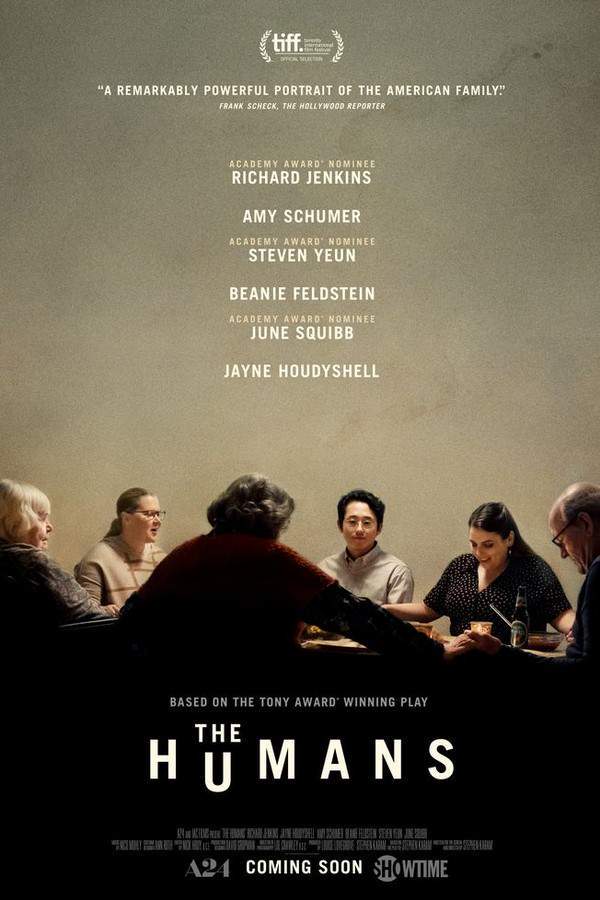
The Humans (2021) movie poster

Plot Summary

The Humans (2021) Plot Summary & Ending Explained

Release, runtime and language
2021 · 108 min · English
Echo score 71
Directed by
Stephen Karam
Starring
Jayne Houdyshell, June Squibb, Steven Yeun, Richard Jenkins, Beanie Feldstein, Amy Schumer

Three generations of a Pennsylvania family convene for Thanksgiving at their daughter's apartment in Lower Manhattan. As the evening progresses, hidden anxieties and long-held fears surface, exposing the complex relationships and underlying tensions within the family. The gathering becomes a haunting exploration of love, secrets, and the darkness that connects them, revealing the fragility of their bonds and the challenges of familial connection.

On this page (8)
  1. 1 Where to watch
  2. 2 What happens: full plot
  3. 3 Plot questions answered
  4. 4 How it ends
  5. 5 The book behind the movie
  6. 6 Movie threads
  7. 7 Movies like The Humans
  8. 8 Every angle

Where to watch

Where to Watch The Humans (2021)

Where can you watch The Humans? Stream, rent or buy it in the US, including on Amazon Video, Apple TV Store and Fandango At Home: current JustWatch availability with up-to-date prices.

Streaming availability powered by JustWatch

Full plot summary · contains spoilers

What Happens in The Humans: Full Plot Summary

The whole story of The Humans (2021) explained, from the opening scene to the final frame: every key event, every twist and what it all adds up to. Read it as a quick recap before the sequel, to check a scene you missed, or to finally understand what really happened.

On Thanksgiving, the Blake family gathers as Erik and Deirdre visit their daughter Aimee alongside Erik's elderly mother, Momo. Their destination is the apartment of their other daughter, Brigid, and her partner Richard, located in Chinatown. Upon arrival, Erik is immediately critical of the dilapidated living conditions, worrying about their proximity to a flood zone and Ground Zero. His past experiences haunt him; on 9/11, he had driven Aimee to a job interview and lingered nearby when tragedy struck, leaving him tormented by a vision of a victim who bore a striking resemblance to his daughter.

As the evening progresses, underlying tensions within the family become increasingly apparent. Brigid expresses her bitterness over their parents' refusal to provide financial help, lamenting the unfulfilled aspirations of her career as a composer—a dream that remains unachieved. Meanwhile, Richard grapples with his own demons, dealing with depression while waiting for a trust fund that won’t mature for another five years. The family dynamics are complicated further by Aimee’s health issues; she not only battles a chronic illness but also faces the emotional toll of losing her job and a long-term relationship, compounded by the need for surgery.

Despair runs deep as Deirdre, struggling with arthritis, becomes a target of ridicule due to her religious delicacies, while Erik, burdened with the melancholy of Momo's decline, scrutinizes Brigid's work ethic and lifestyle choices. There is a fleeting moment of solace when Deirdre reads a heartfelt letter from Momo, crafted during her clearer days. The letter apologizes for her decline and assures her family of her unwavering love, advising them to remain calm amidst life’s turmoil.

As conversations meander through dreams and nightmares, Richard's honesty shines through, yet Erik remains reticent. Finally, he reveals his recurring nightmares of a faceless woman, a symbol of his 9/11 trauma. Light-hearted teasing from the family exacerbates his unease. Urged by Deirdre, Erik divulges a long-hidden secret about an affair with a teacher at his Catholic school—a mistake that cost him his job and pension, leading to the sale of their cherished lake house for Momo’s care. Though Erik insists that he and Deirdre have resolved the issue through counseling, his daughters confront feelings of betrayal and disappointment.

As the Thanksgiving gathering concludes, family members head to a hotel, assisting Momo into a taxi. In a solemn moment, Erik stays behind to address an electrical issue but unexpectedly succumbs to a panic attack in the enveloping darkness, lost and pleading in fear. The situation shifts when Brigid reenters to retrieve him, and together they leave the apartment, carrying the weight of their family's struggles into the uncertain night.

Last updated: November 04, 2024 at 00:03

Was this helpful?

Plot questions answered

The Humans Plot Explained: Your Questions Answered

The questions people ask most about The Humans (2021): what happens in the confusing scenes, why the characters do what they do, the twists, hidden details and what the ending means. Each answer contains spoilers.

Q1

Why is Erik so worried about the apartment's location in Chinatown?

Erik's anxiety stems from his traumatic experience on 9/11, when he drove Aimee to a job interview near the World Trade Center and witnessed the attacks unfold. His concern about flooding and proximity to Ground Zero reflects his lingering fear that history could repeat itself, making him hypervigilant about his family's safety in that location.

Foreshadowing: Erik's critical attitude toward the apartment is established the moment they arrive, setting an uneasy tone for the evening.

  • erik
  • 9/11
  • anxiety
  • chinatown
  • ground zero
  • apartment
Q2

Why did Erik and Deirdre have to sell their lake house?

Erik was forced to sell the lake house to cover the costs of caring for his mother Momo, whose health had declined significantly. The sale provided the necessary funds for her elderly care arrangements.

Foreshadowing: The financial strain is hinted at early when Erik critiques Brigid's lifestyle choices, revealing his preoccupation with money.

  • lake house
  • sale
  • momo
  • care
  • finances
  • erik
Q3

Why did Erik lose his job and pension?

Erik lost his teaching position at a Catholic school and his pension because he had an affair with one of his teachers. The scandal directly resulted in his termination and the loss of his retirement benefits, creating lasting financial consequences for the family.

Foreshadowing: Erik's reluctance to share personal details earlier in the evening hints at his willingness to hide shameful secrets.

  • erik
  • affair
  • teacher
  • job
  • pension
  • catholic school
Q4

What is Richard waiting for financially?

Richard is waiting for a trust fund to mature, which won't be accessible for another five years. This financial limbo contributes to his depression, as he feels trapped waiting for funds he cannot yet access while struggling in the present.

Foreshadowing: Richard's struggle is revealed during the family tensions, showing how financial insecurity affects his mental health.

  • richard
  • trust fund
  • depression
  • finance
  • waiting
Q5

Why is Brigid angry at her parents for not helping financially?

Brigid feels betrayed because her parents refused to help her financially despite having resources. She views this as a sign that they don't believe in her dreams, especially since she struggled to establish herself as a composer. The resentment stems from feeling unsupported during her hardest times.

Foreshadowing: Brigid's bitterness emerges early during dinner when she directly confronts her parents about their refusal to assist her.

  • brigid
  • parents
  • financial help
  • composer
  • dreams
  • resentment
Q6

What does Momo's letter to the family say?

Momo's letter, written during her clearer days, apologizes to her family for her decline and expresses her unwavering love for them. The letter advises the family to remain calm amid life's chaos and turbulence, offering comfort and reassurance despite her weakening state.

Foreshadowing: The letter provides a brief moment of solace before the heavier revelations emerge later in the evening.

  • momo
  • letter
  • love
  • apology
  • family
  • advice
Q7

Why does Erik have nightmares about a faceless woman?

Erik's nightmares of a faceless woman are a manifestation of his unresolved trauma from 9/11. On that day, he witnessed a victim at Ground Zero who bore a striking resemblance to his daughter Aimee, and that image haunts him repeatedly in his sleep.

Foreshadowing: The nightmares are linked to Erik's 9/11 experience, which is introduced early when he expresses fear about the apartment's proximity to Ground Zero.

  • erik
  • nightmares
  • 9/11
  • trauma
  • faceless woman
  • aimee
Q8

What triggers Erik's panic attack at the end of the movie?

Erik's panic attack occurs after the family leaves and he is alone in the dark apartment trying to fix an electrical issue. The darkness, isolation, and accumulated emotional weight of the evening, having revealed his affair and 9/11 trauma, overwhelm him, causing him to panic and plead in fear.

Foreshadowing: The build-up of Erik's suppressed emotions throughout the evening culminates in this vulnerable moment.

  • erik
  • panic attack
  • darkness
  • apartment
  • overwhelm
  • trauma
Q9

Why does the family tease Erik about his nightmares?

The family responds to Erik's disclosure of his nightmares with teasing, which reflects their dysfunctional way of coping with uncomfortable truths. Rather than responding with empathy, they use humor as a defense mechanism, inadvertently making Erik feel more isolated in his pain.

Foreshadowing: This teasing highlights the family's inability to address serious issues constructively, showing why secrets have been kept for so long.

  • family
  • teasing
  • nightmares
  • humor
  • dysfunctional
  • coping
Q10

What is Aimee dealing with besides her chronic illness?

Beyond her chronic illness, Aimee is facing the emotional toll of losing her job and a long-term romantic relationship. She also needs surgery to address her health condition, compounding her struggles during an already difficult time.

Foreshadowing: Aimee's challenges are revealed gradually, showing how multiple losses have affected her emotional state.

  • aimee
  • chronic illness
  • job loss
  • relationship
  • surgery
  • health

Ending explained

What Happens at the End of The Humans?

How The Humans (2021) ends, in short: the final scene, the last twist and what it means for the characters. The full ending explained, with every spoiler, lives on its own page.

Read the full ending explained

The ending of "The Humans" suggests that most of the horror the characters experience is rooted in their own minds and emotional states, rather than actual monsters or supernatural threats. Throughout the film, the characters confront their personal fears, secrets, and anxieties that are symbolized by the strange noises, electrical failures, and the unsettling atmosphere of the cramped apartment. Eric, who is overwhelmed by financial worries and past guilt—especially his affair and the pressure of supporting his family—begins to see horrific visions, including the woman with no facial features. These manifestations, along with the strange noises and distortions in the apartment, appear to reflect his inner turmoil.

When the power goes out and he witnesses shadows and distorted pipes, he initially fears a physical monster is about to emerge. However, these are ultimately revealed to be manifestations of his own fears, with the figure of the old neighbor and the eerie environmental disturbances symbolizing his anxiety and guilt rather than real threats. The film’s climax, where Eric prays in disbelief and then leaves the apartment, underscores the idea that the horror was internal rather than external. The other characters’ reactions—feeling frightened or disturbed by the eerie noises and events—also point to their own unresolved issues and fears.

Continue reading the ending (1 more paragraphs)

In essence, "The Humans" uses its horror elements as a metaphor for the psychological pressures everyone carries—faults, regrets, fears about aging, and financial instability—proving that sometimes, the monsters we fear are merely reflections of ourselves. The film closes with Eric gathering his belongings and stepping out into the outside world, symbolizing the possibility of confronting these inner demons and moving forward, despite the haunting echoes of their personal struggles.

The Humans ending explained in full

Movie threads

More Movies Like The Humans, by Mood & Story

Curated lists built around what makes The Humans tick: the same mood, the same kind of story or the same emotional payoff. Each list explains why these movies belong together.

Claustrophobic family dramas like The Humans

Stories where a family gathering forces long-buried secrets into the open. Explore movies like The Humans where a single location, often a family home or apartment, becomes the stage for an emotionally charged confrontation. These films focus on the complex relationships and secrets that emerge when relatives are forced together, creating a powerful and immersive viewing experience.

  • claustrophobic
  • anxious
  • unsettling
  • melancholic
  • oppressive
  • somber
  • Tone: tense, melancholic, unsettling
  • Pacing: slow burn, deliberate
Why these movies?

The story pattern: The narrative typically unfolds in real-time or over a very short period within a single, confined setting. A family gathering—a holiday, a funeral, a celebration—serves as the catalyst. The primary conflict arises from the forced proximity, which inevitably leads to the eruption of long-suppressed truths, exposing the characters' deepest fears and vulnerabilities.

Why they belong together: Movies are grouped here because they share a powerful sense of claustrophobia and a focus on intense, naturalistic dialogue. They prioritize emotional honesty over plot, creating a feeling of being an uncomfortable witness to a real family's unraveling. The shared mood is one of oppressive anxiety and melancholic revelation.

Slow burn psychological dramas like The Humans

Films where quiet tension builds relentlessly towards a psychological breaking point. Find more movies like The Humans that use a slow, deliberate pace to immerse you in a character's anxieties. If you enjoyed the building tension and focus on psychological fragility, these films offer a similar experience of gradual emotional unraveling and ambiguous, thought-provoking conclusions.

  • slow burn
  • unsettling
  • psychological
  • somber
  • anxious
  • heavy
  • Tone: tense, somber, melancholic
  • Pacing: slow, deliberate, immersive
Why these movies?

The story pattern: The narrative journey is internal and psychological. While the external plot may be simple, the focus is on the gradual accumulation of small pressures, unspoken anxieties, and past traumas that weigh on the characters. The structure is often linear, with tension rising almost imperceptibly until it culminates in a moment of crisis or quiet despair, rather than a tidy resolution.

Why they belong together: These movies are connected by their masterful control of pacing and mood. They share a commitment to a slow, immersive build-up that makes the emotional payoff deeply impactful. The experience is defined by a consistent feeling of unease, a heavy emotional weight, and endings that are often ambiguous or somber, leaving a lasting impression.

If you liked this

Movies Like The Humans

Similar movies to The Humans: the same genre, themes or kind of story. Each one comes with its own plot summary, timeline and ending explained.

Browse all movie summaries

Every angle

The Humans (2021) Explained: Plot, Ending, Timeline & Characters

Everything about The Humans in one place: what happens in the plot summary, the timeline in chronological order, the characters and meaning, the ending explained and a spoiler-free summary. What's After the Movie adds the cast, box office and post-credit scenes.

Coming soon on iOS and Android

The Plot Explained Movie Summary App

Plot summaries, endings explained and timelines on your phone. Catch up on any movie in minutes, save your favorites and never miss a twist again.

Be the first to know when we launch. Your email stays private, always.

Learn more about the app